

Colorado Supreme Court end-of-term stats, federal judges’ backlogs increase | COURT CRAWL
Welcome to Court Crawl, Colorado Politics’ roundup of news from the third branch of government.
The state Supreme Court’s term revealed increased division among the justices in their opinions, plus Colorado’s federal judges have started to accumulate more overdue motions in civil cases.
Colorado Supreme Court 2025-2026 term
• Like its federal counterpart, the state Supreme Court released the final opinions of its term at the end of June. Over the past 12 months, the court issued 76 written opinions, which is roughly in line with the previous two terms. Notably, however, the number of non-unanimous opinions rose from one in five to around one in three.
• Single-justice dissents also rose significantly. And for the first time in seven years, the court deadlocked 3-3, meaning it was unable to issue a majority opinion in the case.
• The reason for the deadlock, readers may recall, was the sudden midterm departure of Justice Melissa Hart, whose prolonged absence at the end of 2025 is something the Supreme Court hasn’t explained to the public to this day. (Hart, ironically, was involved in crafting the judicial branch’s vision statement, a component of which is transparency.)
• Although we won’t see much activity from the Supreme Court until it returns in September, there’s one piece of news to watch out for. Next summer, Chief Justice Monica M. Márquez will rotate out of the judiciary’s top role pursuant to the court’s self-imposed three-year term for the chief justice. The court will likely announce soon who the incoming chief will be, and get the one-year onboarding process started. Going by seniority, Justice William W. Hood III is seemingly next in line.

• Meanwhile, the Supreme Court has intervened in two ongoing criminal prosecutions and a civil dispute that could sow uncertainty for special districts that are sitting on lots of debt.
• The justices also accepted an appeal that questions whether a judge correctly terminated a father’s legal rights over his children and a case that involves the standard for proving a police officer is liable for an unconstitutional search.
Heard on appeal
• The state’s Court of Appeals reversed a man’s convictions for forgery and attempting to influence a public servant because the judge blocked witnesses who could speak to the defendant’s truthful character.
• The Court of Appeals clarified the guardrails around mandatory arbitration agreements in a pair of cases.
• Five years ago, the Court of Appeals ordered a new murder trial because an Arapahoe County prosecutor played a clip of the defendant’s interrogation where an out-of-context statement made it seem like he confessed. During the second trial, the same prosecutor played the same out-of-context clip. The Court of Appeals reversed yet again.
• An unconstitutional search warrant for the defendant’s cell phone prompted the Court of Appeals to reverse his “particularly brutal” rape convictions.
• The Court of Appeals clarified that a victim’s breathing disability must be present on the date a crime was committed against them for them to qualify as “at-risk.”
Backlogged motions
• After multiple periods where the backlog of undecided civil motions was decreasing, Colorado’s federal trial judges saw an increase in the number of motions awaiting a decision as of the reporting period that ended on March 31.
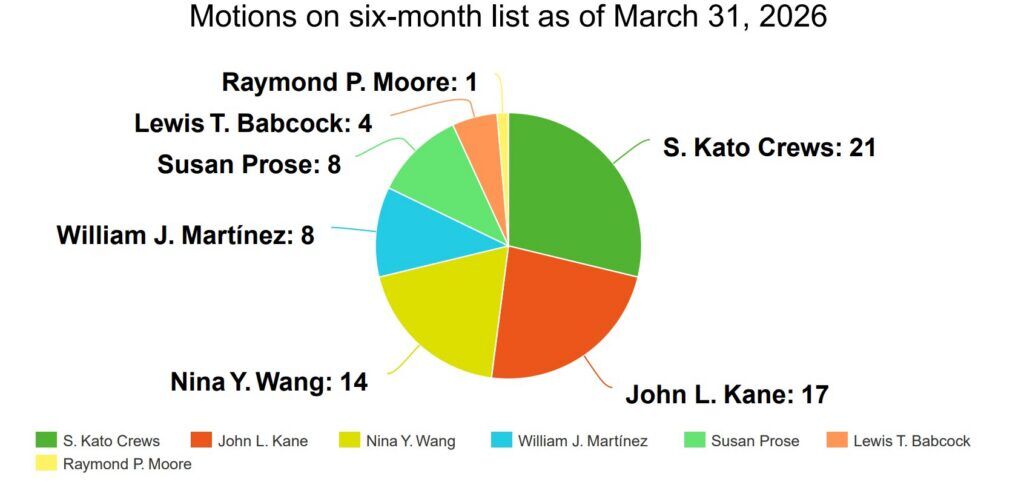
• While judges have the opportunity to explain why they haven’t acted yet on specific motions, this reporting period coincided with a deluge of challenges to immigration custody, which judges have almost uniformly given priority.
• Colorado Politics also identified errors within certain judges’ reports. The court’s clerk took responsibility and said he was working to improve the reporting process.
In federal news
• The U.S. Court of Appeals for the 10th Circuit revived a voter intimidation lawsuit based on an erroneous reading of precedent by the judge before the trial even started.
• A lawyer suing the state’s judiciary over her disability and disbarment proceedings can’t do so anonymously, the 10th Circuit ruled.
• A trial judge correctly found that a former Cherry Creek Schools principal hadn’t proven her allegations of sex or gender discrimination against the district.
• The Army was substantially justified in denying the Purple Heart to a wounded soldier until it saw more concrete evidence during the subsequent lawsuit, the 10th Circuit decided.
• A paramedic cannot be held liable for tackling a man and putting him in a chokehold, leading to his death, the 10th Circuit decided. The court noted that it hadn’t put paramedics on clear notice that those actions would amount to a constitutional violation — and it chose not to draw that line here, either.
• A Teller County fire chief couldn’t prevail on his claims of First Amendment retaliation related to his firing.
• A federal judge returned an ex-Broncos linebacker’s disability discrimination lawsuit to state court after the NFL and the Broncos tried to litigate it federally.
• University of Colorado Regent Wanda James won’t receive a preliminary injunction hearing to challenge the sanctions against her until a judge considers whether her fellow board members are immune from being sued.
• A federal judge concluded that a lawyer hadn’t credibly alleged a disability discrimination claim against an El Paso County judge for denying reasonable accommodations for her long COVID.
• A judge is considering a Denver city employee’s request for an injunction against the mayor’s office in a challenge to her 2025 layoff.
• The defense is renewing its request for a judge to step aside and/or disclose her conversations with the prison warden in Colorado’s only active death penalty prosecution.
In immigration news
• Readers are likely aware that Colorado’s U.S. District Court has been facing a flood of “habeas corpus” petitions from those in immigration detention. The most common allegation is that the government is improperly denying bond hearings to people who are eligible by law. Colorado’s judges have largely agreed with that argument, and the 10th Circuit recently confirmed it as the binding interpretation for all courts in the region to follow.
• But petitions are still being processed, and there are some interesting developments.
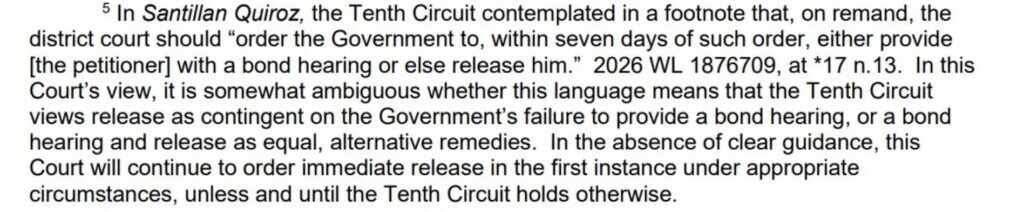
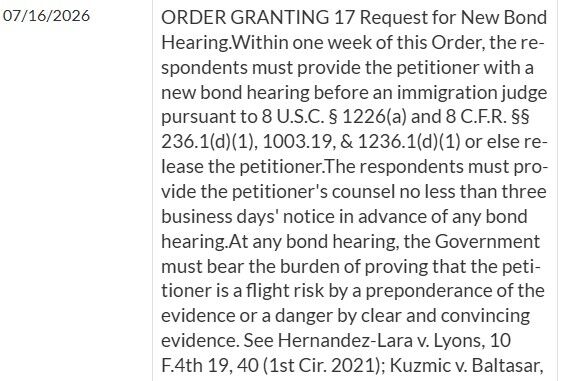
• Senior Judge William J. Martínez is continuing to release people from custody directly, rather than order a bond hearing with an immigration judge, and he says he’ll continue to do it until the 10th Circuit says otherwise:
• Chief Judge Daniel D. Domenico, who was slow to decide habeas petitions and far more likely to deny them than his colleagues, now seems to be resolving cases in favor of petitioners at a faster pace in the wake of the 10th Circuit’s ruling:
Vacancies and appointments
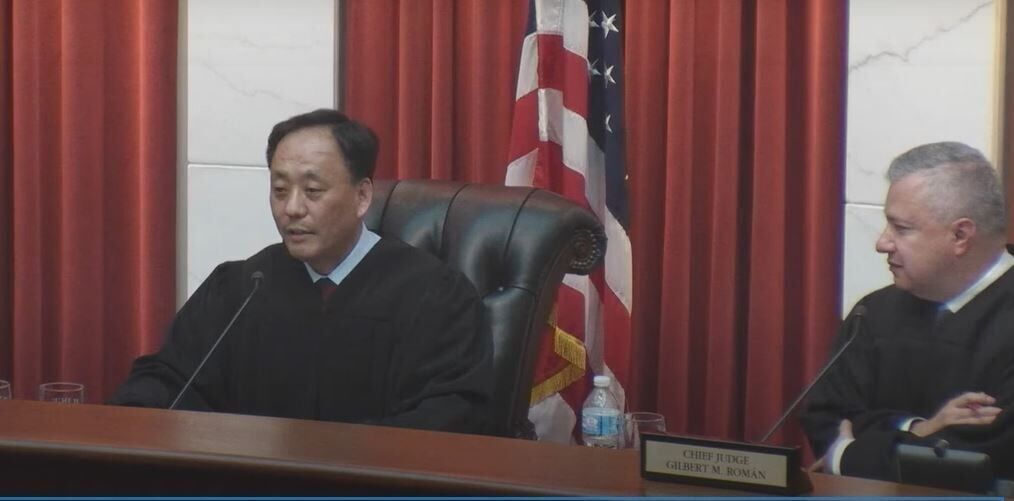
• The governor has appointed Assistant U.S. Attorney Kyle W. Brenton to succeed retiring Chief Judge Gilbert M. Román on the Court of Appeals.
• The governor also selected retired K-12 teacher Stacy L. Noe to succeed now-District Court Judge Deni E. Eiring in her former role as a part-time Cheyenne County Court judge.
• The governor selected Magistrate Andrew D. Herlihy to succeed retiring Judge D. Denise Peacock on the El Paso County Court.
• The governor chose Magistrate Dalia D. Labrador for a seat on the Arapahoe County Court formerly held by now-District Court Judge A. Danielle Touart.
• There are three nominees to succeed retiring Denver District Court Judge Martin F. Egelhoff: Adams County Magistrate Rachel A. Catt, Laura Cramer-Babycz and Victor William “Bill” Scarpato III.
• Applications are due by July 30 to succeed retiring Larimer County Court Judge Kraig S. Ecton.
• Applications are also due on July 30 to succeed retiring Jefferson County Court Judge Keith Goman.
• Finally, applications are due by Aug. 5 to fill vacancies on the Denver County Court triggered by the death of Judge Andre Rudolph and the resignation of Judge Barry Schwartz.
Miscellaneous proceedings
• A judge set a trial date of July 2027 for the renewed murder prosecution of Barry Morphew.
• A Fremont County judge removed the district attorney’s office from a murder case because of a pattern of evidentiary violations that has plagued the office for years.
On break
• Because things will be a bit slower during the summer, Court Crawl will be published every other week during July and August.

Colorado justices to hear appeal in Kendrick Castillo death lawsuit, ‘fugitive’ rule
Michael Karlik
michael.karlik@coloradopolitics.com
Updated 6 hours ago
The Colorado Supreme Court announced on Tuesday that it will decide whether it was proper to dismiss a lawsuit over the 2019 shooting death of Kendrick Castillo after the defendants paid the maximum amount of damages available to Castillo’s parents,...

Arapahoe County judge’s frustration with defense lawyer not grounds for new trial
Michael Karlik
michael.karlik@coloradopolitics.com
Updated 8 hours ago
Colorado’s second-highest court decided last week that an Arapahoe County judge’s repeated rebukes of a defense attorney and orders to “be quiet” did not rise to the level of bias or a violation of the defendant’s due process rights. A...

Divided appeals court upholds vehicle theft conviction despite unclear origin of car’s value
Michael Karlik
michael.karlik@coloradopolitics.com
Updated 4 hours ago
Colorado’s second-highest court upheld a defendant’s conviction for aggravated motor vehicle theft last week, even though it was unclear how the Thornton Police Department estimated the value of the stolen car. Officer Marc Faivre encountered Ashley Shelee Gibbens-Martinez in a...
Disgraced ex-CBI analyst Missy Woods sentenced to prison in DNA scandal
Jenny Deam
jenny.deam@gazette.com
Updated 8 hours ago
A Jefferson County district court judge on Tuesday sentenced a disgraced former Colorado Bureau of Investigation DNA analyst to a decade in prison for altering and deleting data in scores of criminal cases over several years. Jefferson County District Judge...

Parenting from prison: Inmates hope to be present in their children’s lives, while physically absent
Marianne Goodland
marianne.goodland@coloradopolitics.com
Updated 13 hours ago
The room was decorated with balloons, the tables sparking bright with colors as the smell of pizza and cake wafted through the air. As did music. This was, after all, a father-daughter dance. Except this was not a typical father-daughter...
Appeals court confirms Colorado judges can compel electronic records from out of state
Michael Karlik
michael.karlik@coloradopolitics.com
Updated 3 days ago
Colorado’s second-highest court clarified on Thursday that judges are empowered to compel out-of-state companies to produce electronic records under state law. El Paso County jurors convicted Mischa Jargowsky on three counts of money laundering and one violation of Colorado’s organized...

10th Circuit upholds finding of no racial discrimination against family at Denver Chili’s
Michael Karlik
michael.karlik@coloradopolitics.com
Updated 4 days ago
The Denver-based federal appeals court agreed on Wednesday that a Black plaintiff failed to show that a Chili’s manager’s request for her family to provide valid payment at the outset of their meal amounted to racial discrimination. Markesha Futrell-Smith filed...
Appeals court reinstates Mesa County defendant’s request for DNA testing under new Colorado law
Michael Karlik
michael.karlik@coloradopolitics.com
Updated 5 days ago
Colorado’s second-highest court revived a Mesa County defendant’s petition for DNA testing in his three-decade-old attempted murder case on Thursday, concluding that a trial judge wrongly interpreted a recent Colorado law in dismissing the request outright. Jurors convicted Billy Joe...
Appeals court reverses Denver juvenile’s conviction due to improper expert testimony
Michael Karlik
michael.karlik@coloradopolitics.com
Updated 3 days ago
Colorado’s second-highest court reversed a juvenile defendant’s conviction for unlawful sexual contact on Thursday after an expert witness’s testimony improperly suggested the child victim was telling the truth. The defendant, identified as S.H-S., was around 16 years old when he...

Judge orders home confinement for Barry Morphew
Dennis Huspeni
dennis.huspeni@gazette.com
Updated 5 days ago
An Alamosa County district judge has ordered home confinement for Barry Morphew, who is accused of murdering his wife. Barry Morphew, 59, faces a first-degree murder charge in the death of his wife, Suzanne Morphew, who disappeared Mother’s Day weekend...
PREV
PREVIOUS

What to know before Colorado’s new law on semiautomatic firearms goes into effect
A Colorado law passed in 2025 established new requirements for individuals planning to purchase semiautomatic weapons. Here’s what residents should know before Senate Bill 003 goes into effect on Aug. 1. From a ban to a training course For decades, advocates have been pushing for a ban on semiautomatic weapons with detachable magazines, which they […]
Montezuma County judge, discipline officials agree upon suspension for numerous misconduct admissions
A Montezuma County judge and the Colorado Commission on Judicial Discipline both agreed this month that a suspension and public censure are the appropriate consequences for his multiple instances of misconduct, including invoking his title when facing a citation from state officials and exhibiting bias against a criminal defendant. Under constitutional Amendment H, which voters […]