Colorado justices to hear appeal in Kendrick Castillo death lawsuit, ‘fugitive’ rule
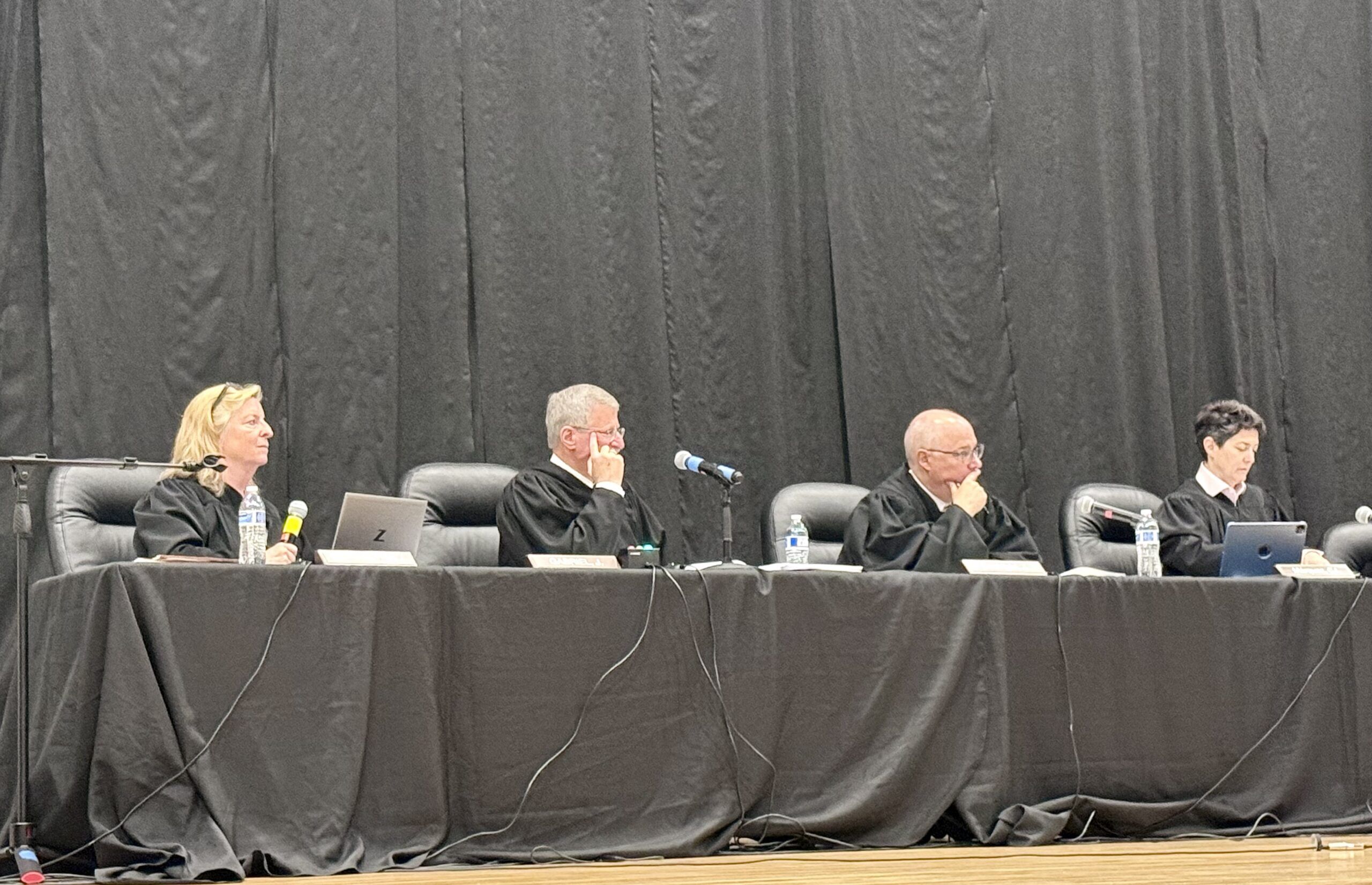
The Colorado Supreme Court announced on Tuesday that it will decide whether it was proper to dismiss a lawsuit over the 2019 shooting death of Kendrick Castillo after the defendants paid the maximum amount of damages available to Castillo’s parents, without admitting liability.
At least three of the court’s seven members must agree to hear a case on appeal.
The justices also will provide guidance for the first time about what appellate judges should do with a case if the government claims that a criminal defendant is a fugitive while his appeal is pending.
In a case originating in Douglas County, John and Maria Castillo, the parents of Kendrick Castillo, sued STEM School Highlands Ranch in 2021, two years after Kendrick died while attempting to stop a pair of armed students from shooting others. The Castillos brought their claims under the Claire Davis School Safety Act, a 2015 law named for an Arapahoe County student murdered years earlier.
The law permitted lawsuits against school districts and charter schools for injuries stemming from “an incident of school violence.” It did so by creating an exception to the broad shield afforded to public entities and employees for the injuries they cause under the Colorado Governmental Immunity Act.
STEM School quickly attempted to dismiss the case as moot because the maximum the Castillos could recover was $387,000, and STEM School intended to deposit that amount with the court without admitting to liability.
Then-District Court Judge Jeffrey K. Holmes recognized there was precedent for doing so in other governmental immunity circumstances, but he rejected the request as premature. He noted the Claire Davis School Safety Act entitled plaintiffs to “vigorous discovery” of evidence about the underlying events.

After the parties engaged in discovery, STEM School once again tried to end the case with the maximum payment. This time, Holmes agreed that, because the only relief the Castillos sought was money damages, and because STEM School was offering just that, the case was moot.
The Castillos appealed, arguing they should not effectively be forced into a settlement where the school did not admit liability. Further, the public deserved answers through a jury trial about “what went wrong.” But a three-judge Court of Appeals panel disagreed that the law provided any further relief to the Castillos after the damages payment.
“The line drawn by the General Assembly reflects a decision to facilitate the completion of discovery but not to compel a trial,” wrote Judge Timothy J. Schutz. “We are not at liberty to disregard this line simply because the issues to be addressed at a potential trial present a matter of public interest.”
The Castillos appealed to the Supreme Court, supported by the Colorado Trial Lawyers Association.
“Lawsuits — especially those arising from catastrophic harm — are about more than money. They’re about truth, accountability, and reform. Juries determine whether the law was broken, whether harms were avoidable, and whether change is required — not just money damages,” wrote attorney Timothy Garvey for the association. “Yet under the decision below, a public defendant may deny all responsibility, hide behind protective orders, and end a lawsuit with money alone. No findings. No testimony. No judgment. No accountability. No change. Only ‘hush money.’”
Under that view, countered the Colorado Defense Lawyers Association, “a defendant who tenders the full statutory maximum the day a lawsuit is filed must still proceed through years of discovery and trial — not because any compensable loss remains unaddressed, but because the plaintiff has a right to a public verdict for its own sake. … (The law) does not guarantee the latter.”
The Supreme Court will review the Court of Appeals’ conclusion.
The case is Castillo et al. v. STEM School Highlands Ranch et al.
Ujine Devin Israel pleaded guilty to assault in Adams County and received a probationary sentence. He appealed a trial judge’s order imposing $3,593 in restitution, challenging the lack of notice he received about the hearing.
The Colorado Attorney General’s Office moved to dismiss the appeal, alleging that Israel failed to report for probation intake and had an active warrant for his arrest.
“A defendant’s fugitive status removes him from the jurisdiction of the appellate court; thus, there is no reason to adjudicate the merits of the fugitive’s claim,” wrote Assistant Attorney General Jaycey DeHoyos. “Thus, under the fugitive disentitlement doctrine, his appeal should be dismissed.”
Israel’s attorney responded that the government had not proven that Israel was actually a fugitive, and the trial judge had made no findings to that effect.
In September 2025, a Court of Appeals panel dismissed Israel’s appeal based on its own review of the docket and its conclusion that Israel was a fugitive.
“A defendant forfeits his right to appellate review of his conviction under the fugitive disentitlement doctrine by fleeing from justice while the appeal is pending,” wrote Judges Jerry N. Jones, Katharine E. Lum, and Grant T. Sullivan in a brief order.
Israel turned to the Supreme Court, noting the justices have never addressed the “fugitive dismissal” or “fugitive disentitlement” rule, as it is known. Moreover, different Court of Appeals panels have approached the question of whether to dismiss an alleged fugitive’s appeal differently.
“Accordingly, there is little to no guidance regarding the rule’s application in Colorado. For example, it is not settled whether the rule even applies, what a court must consider when determining whether dismissal is warranted, who bears the burden of proof, or the procedures for ascertaining an appellant’s fugitive status,” wrote public defender Emma Berry.
The Supreme Court will decide whether the appellate panel properly decided on its own that Israel was a fugitive, or if it should have returned his case to the trial judge for a fugitive determination.
The case is Israel v. People.


Arapahoe County judge’s frustration with defense lawyer not grounds for new trial
Michael Karlik
michael.karlik@coloradopolitics.com
Updated 2 hours ago
Colorado’s second-highest court decided last week that an Arapahoe County judge’s repeated rebukes of a defense attorney and orders to “be quiet” did not rise to the level of bias or a violation of the defendant’s due process rights. A...

Divided appeals court upholds vehicle theft conviction despite unclear origin of car’s value
Michael Karlik
michael.karlik@coloradopolitics.com
Updated 2 hours ago
Colorado’s second-highest court upheld a defendant’s conviction for aggravated motor vehicle theft last week, even though it was unclear how the Thorton Police Department estimated the value of the stolen car. Officer Marc Faivre encountered Ashley Shelee Gibbens-Martinez in a...
Disgraced ex-CBI analyst Missy Woods sentenced to prison in DNA scandal
Jenny Deam
jenny.deam@gazette.com
Updated 2 hours ago
A Jefferson County district court judge on Tuesday sentenced a disgraced former Colorado Bureau of Investigation DNA analyst to a decade in prison for altering and deleting data in scores of criminal cases over several years. Jefferson County District Judge...

Parenting from prison: Inmates hope to be present in their children’s lives, while physically absent
Marianne Goodland
marianne.goodland@coloradopolitics.com
Updated 7 hours ago
The room was decorated with balloons, the tables sparking bright with colors as the smell of pizza and cake wafted through the air. As did music. This was, after all, a father-daughter dance. Except this was not a typical father-daughter...
Appeals court confirms Colorado judges can compel electronic records from out of state
Michael Karlik
michael.karlik@coloradopolitics.com
Updated 2 days ago
Colorado’s second-highest court clarified on Thursday that judges are empowered to compel out-of-state companies to produce electronic records under state law. El Paso County jurors convicted Mischa Jargowsky on three counts of money laundering and one violation of Colorado’s organized...
10th Circuit upholds finding of no racial discrimination against family at Denver Chili’s
Michael Karlik
michael.karlik@coloradopolitics.com
Updated 4 days ago
The Denver-based federal appeals court agreed on Wednesday that a Black plaintiff failed to show that a Chili’s manager’s request for her family to provide valid payment at the outset of their meal amounted to racial discrimination. Markesha Futrell-Smith filed...
Appeals court reinstates Mesa County defendant’s request for DNA testing under new Colorado law
Michael Karlik
michael.karlik@coloradopolitics.com
Updated 5 days ago
Colorado’s second-highest court revived a Mesa County defendant’s petition for DNA testing in his three-decade-old attempted murder case on Thursday, concluding that a trial judge wrongly interpreted a recent Colorado law in dismissing the request outright. Jurors convicted Billy Joe...
Appeals court reverses Denver juvenile’s conviction due to improper expert testimony
Michael Karlik
michael.karlik@coloradopolitics.com
Updated 3 days ago
Colorado’s second-highest court reversed a juvenile defendant’s conviction for unlawful sexual contact on Thursday after an expert witness’s testimony improperly suggested the child victim was telling the truth. The defendant, identified as S.H-S., was around 16 years old when he...

Judge orders home confinement for Barry Morphew
Dennis Huspeni
dennis.huspeni@gazette.com
Updated 5 days ago
An Alamosa County district judge has ordered home confinement for Barry Morphew, who is accused of murdering his wife. Barry Morphew, 59, faces a first-degree murder charge in the death of his wife, Suzanne Morphew, who disappeared Mother’s Day weekend...
Appeals court says jury does not need to view porn to determine if it’s ‘obscene’
Michael Karlik
michael.karlik@coloradopolitics.com
Updated 3 days ago
Colorado’s second-highest court ruled for the first time on Thursday that a jury does not always need to view pornographic material to determine if it meets the criteria for obscenity. Mesa County jurors found Shayla Ann Simpson guilty of child...