

The influencers? Some Colorado appeals judges outpace colleagues in setting legal precedent

A handful of judges on Colorado’s second-highest court are producing substantially more precedent-setting opinions than their colleagues, which create binding interpretations of the law that reach beyond individual cases.
The Court of Appeals issues approximately 1,700 opinions each year. A small number receives state Supreme Court review, but the appellate court is otherwise the final stop for the vast majority of cases.
Most of the court’s opinions are designated as “unpublished,” meaning they resolve the case at hand and do not set a precedent. “Published” opinions, in contrast, create binding interpretations of the law for trial judges that generally stand until the Supreme Court or the legislature says otherwise.
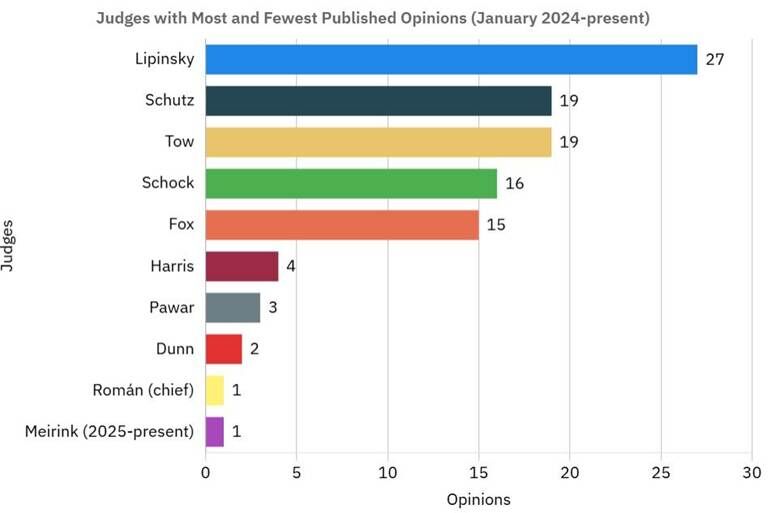
Colorado Politics’ review of published opinions from January 2024 through mid-March 2026 found substantial variation among judges, with the author of the most decisions publishing more than 10 times as frequently as the judge with the fewest.
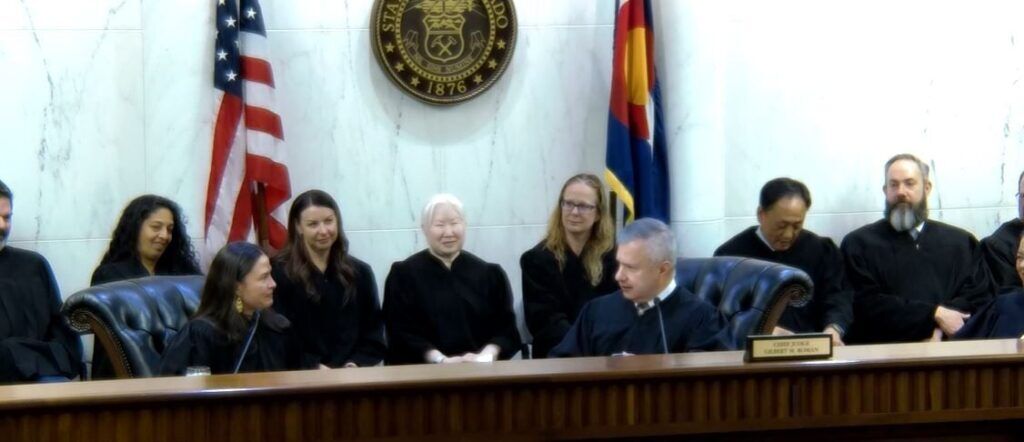
Judge Lino S. Lipinsky de Orlov authored 27 published opinions in that period, while Judge Stephanie Dunn published a total of two. Although Judge Melissa C. Meirink and Chief Judge Gilbert M. Román published one opinion each, special circumstances affected their numbers: Meirink joined the court in January 2025, and Román’s workload as chief includes substantial administrative duties and a smaller caseload.
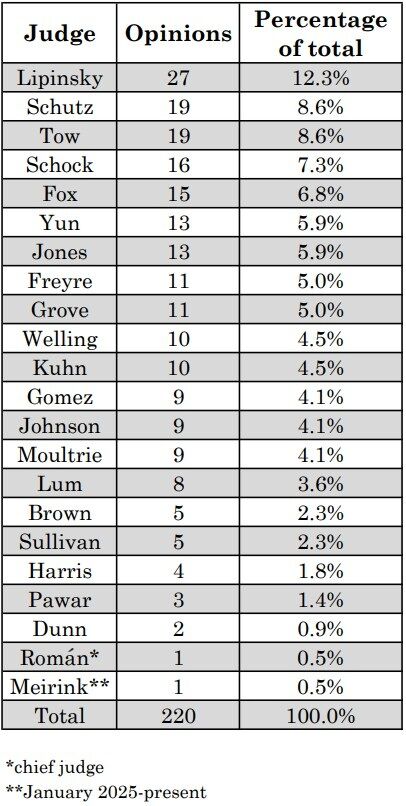
“I am a little surprised by the wide disparity in the numbers of opinions written by each of the appellate judges,” said Bob Borquez, an attorney who litigates in the Court of Appeals. “It’s speculation on my part, but I imagine that the decision to author (a published opinion) is driven by the particular judge and the strength of that judge’s thoughts on the particular issue or issues.”
A judgment call
Between January 2024 and March 2026, there were 238 precedent-setting opinions. Most came from the 22 full-time judges, with a smaller number authored by semi-retired senior judges. With the exception of Meirink, the court’s membership did not change in that period.
Under the court’s rules, opinions are fit for publication if they establish a new rule of law, modify an existing rule, or apply a rule to a new scenario. The case could also involve an issue of public interest, point out deficiencies in current law, or resolve a conflict in legal interpretation.
In recent months, published opinions have addressed, among other things, the constitutionality of the new “reasonable doubt” jury instruction, which is relevant to all criminal trials, and the framework for subcontractors to seek payment on public works projects, which could significantly affect governmental contracting.
Appeals are randomly assigned to three-judge panels, known as “divisions,” and the authoring judge and the division make the initial determination about whether to seek publication. A majority of the full court then votes in favor of or against publication.
Tiffany Mortier, the court’s clerk, said it is possible a judge will be assigned cases repeatedly that do not fit the criteria for publication. Also, even if the issue merits a precedent-setting opinion, the case may not be ideal for laying down a new rule, perhaps because the facts are so unusual that they would be unlikely to repeat.
“And there is the simple fact that different judges will have different perspectives on whether a particular case warrants publication. For example, there is often not a clear answer to whether a decision ‘applies an established rule to a novel fact situation’,” she said. “Ultimately, these cases present judgment calls for the division in determining whether to recommend to the entire court that publication be considered.”
Russell Carparelli, who was a judge on the court between 2003-2013, said there would generally be unanimous support from all judges on publication requests. But there were different schools of thought that could influence the frequency with which an authoring judge sought publication of their opinions.
“It’s kind of like: How do you feel about the value of publication in the system? Maybe some think it’s particularly valuable and it’s good. ‘More published opinions is better generally,'” he said. “And the other one might say, ‘You know, it should be very selective. The decision to publish cases, you should be conservative about that because there’s already so much out there.'”
Consequences of publication
Among the current members of the court, there was general consistency in the total number of opinions each person authors. Counting published and unpublished opinions between January 2024 and March 2026, there was only an 18-decision difference between the judges with the highest and fewest numbers of overall opinions, excluding Meirink and Román. The median was 132 opinions.
In contrast to published opinions, where Lipinsky authored the most and Dunn authored the fewest, their output flipped with respect to unpublished opinions, with Dunn authoring the most and Lipinsky authoring the fewest.
Beyond allowing a judge to potentially influence more areas of the law, increased publication could also increase the chances that the Colorado Supreme Court will choose to review a judge’s work.
“I think it’s fair to say when we see an unpublished opinion,” said Justice William W. Hood III at a 2024 legal event, “we are typically presuming — maybe that’s too strong of a word — but almost a presumption that it’s not grant-worthy because it doesn’t have precedential effect. It’s not binding.”
At that same event, Judge Ted C. Tow III said opinions might merit publication so that the appellate court will not have to re-address the topic in the future, or to signal disagreement with a prior panel’s decision that reached a different interpretation.
“Because we recognize that will catch the attention of the Supreme Court. We want (review) to be granted so they can pick between the two,” Tow said.

One Colorado appellate attorney, speaking on condition of anonymity to avoid affecting clients’ cases by praising or criticizing the judges, said it is surprising how infrequently some judges choose to publish their opinions. They also suggested that some judges may shy away from publication to avoid closer scrutiny from their own court and the Supreme Court.
“They can issue it with no other judicial eyes on it. Three judges can decide it and they don’t have to run it by 19 other colleagues,” the lawyer said. “If you’re averse to reversal by the Supreme Court, it kind of lowers the odds of reversal, lowers the odds of (review).”
Sometimes, the lack of publication creates confusion among lawyers.
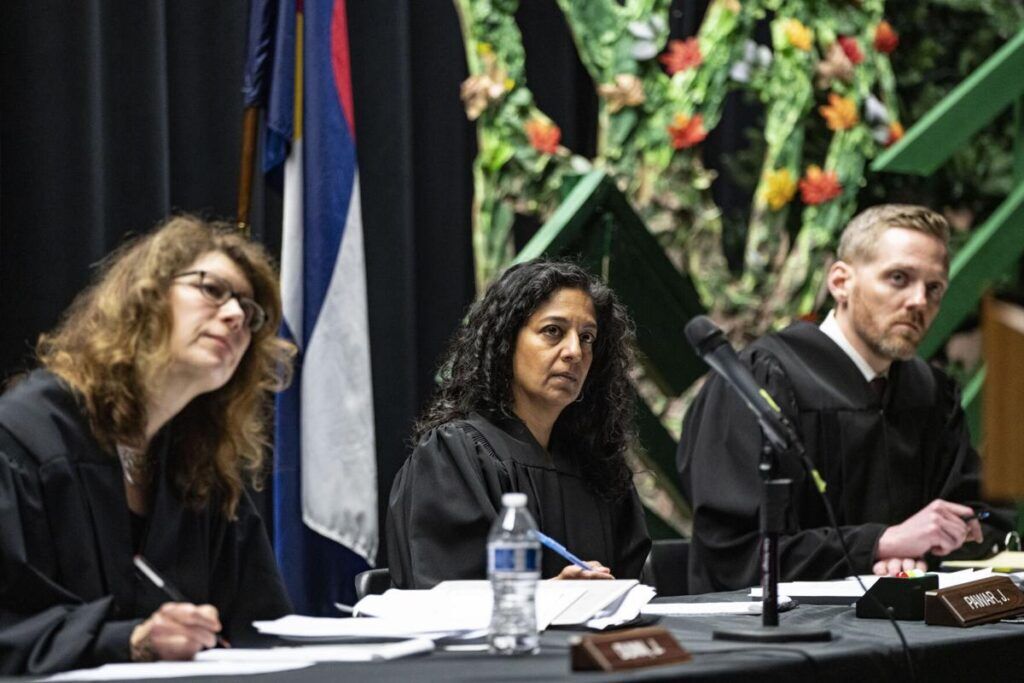
Last week, the Supreme Court heard arguments about an unpublished decision authored by Judge Neeti V. Pawar, who has one of the lowest rates of publication. She wrote that the 49-day appeal deadline in a criminal case was not subject to an extension when the prosecution asked the trial judge to reconsider a ruling. The Denver District Attorney’s Office advocated for the Supreme Court to review that seemingly new legal interpretation contained in the opinion.
“But even if this Court disagrees,” wrote prosecutor and former appellate judge Robert M. Russel, “the new rule should be announced in a published opinion that explains why Colorado is departing from the federal precedent that this Court has previously adopted.”
High publication, not always high impact
The frequency of publication among appellate judges generally does not correlate with seniority. Although Lipinsky, Tow, and Judge Terry Fox have been on the court for several years, newer judges Timothy J. Schutz and Karl L. Schock join them in the list of the most prolific publishers. Likewise, Pawar, Dunn and Judge Elizabeth L. Harris are longer-serving members, yet publish less.
Some part-time senior judges were responsible for more published opinions than their full-time colleagues: Judges Daniel M. Taubman and Michael E. Berger have each authored five since January 2024.
Lipinsky, who has been on the court for seven years, is responsible for more than 12% of all published opinions among the 22 full-time judges. His recent precedents included drawing the line on prosecutions of non-Colorado residents, evaluating the constitutionality of livestreaming a pandemic-era trial, examining the speedy trial deadline in light of judges’ own delays, and clarifying when defendants can cross-examine witnesses about being on probation.
Last week, the state Supreme Court reviewed another of Lipinsky’s opinions pertaining to default judgments in civil trials.
“Let’s assume a judge publishes a lot. Let’s assume that he publishes across the field,” said Carparelli, the retired appellate judge. “He may put out more ideas across the field. What’s the likelihood of those cases actually having a significant impact on trial court cases? Eh, it’s kind of the luck of the draw.”
Carparelli added that some published opinions may pertain to relatively narrow or unique issues, while others may affect the framework of civil and criminal proceedings more broadly.
“Even if, under the rules, it was publishable, that still didn’t mean you should publish it,” he said. “I think it still comes down to a personal judgment about the value of the case as a precedent for future cases.”


Colorado judge explores sanctions against DOJ, ICE for rearresting man 4 days after release on bond
Michael Karlik
michael.karlik@coloradopolitics.com
Updated 9 hours ago
A federal judge in Colorado is considering sanctions against the government after immigration agents rearrested a man four days after an immigration judge found him suitable for release on bond. On July 28, U.S. Magistrate Judge N. Reid Neureiter ordered...

Divided disciplinary panel censures Montezuma County judge after agreement reached
Michael Karlik
michael.karlik@coloradopolitics.com
Updated 16 hours ago
A disciplinary panel formally imposed a public censure, suspension, and further training on Montezuma County Court Judge Ian J. MacLaren on Tuesday by a 2-1 vote. Under constitutional Amendment H, which voters adopted in November 2024, MacLaren was set to...
Colorado’s Western Slope magistrate judges describe unique role in federal judiciary
Michael Karlik
michael.karlik@coloradopolitics.com
Updated 1 day ago
Two of Colorado’s federal judges stationed on the Western Slope spoke to lawyers on Wednesday about their unique roles, the ways their workloads differ, and the need for more criminal defense lawyers to take cases outside the Front Range. “Here...

Denver sues Philip Morris, other tobacco companies over cigarette butt litter
Deborah Grigsby
deborah.smith@denvergazette.com
Updated 7 hours ago
Denver is demanding that some of the biggest tobacco companies in the world pay for the cleanup of discarded cigarette butts on its streets, following a similar campaign that cities in other states have pursued. Denver’s lawsuit, filed this week...

Federal judge rules that request for bond hearing not necessary to challenge immigration detention
Michael Karlik
michael.karlik@coloradopolitics.com
Updated 1 day ago
A federal judge in Colorado ruled last week that it is not mandatory for a person to seek a bond hearing with an immigration judge before they challenge the lawfulness of their detention in federal court. For the past year,...

Boulder Valley School District introduces new policies following antisemitism lawsuit
Marissa Ventrelli
marissa.ventrelli@coloradopolitics.com
Updated 10 hours ago
The chief of Boulder Valley School unveiled new policies for the 2026-2027 school year following a lawsuit filed on behalf of a student alleging antisemitic harassment. In June, the Anti-Defamation League filed a federal civil rights complaint against the school...

Colorado NRA chapter seeks injunction against new gun‑training requirement
Marissa Ventrelli
marissa.ventrelli@coloradopolitics.com
Updated 14 hours ago
The Colorado chapter of the National Rifle Association is seeking an injunction to stop the state from enforcing a new law that took effect earlier this month. The new law requires anyone buying or selling certain firearms to first complete...

Denver moves to dismiss Trump challenge to ‘assault-style’ weapons ban
Deborah Grigsby
deborah.smith@denvergazette.com
Updated 8 hours ago
Denver has filed a motion to dismiss a lawsuit brought by the Trump administration challenging the city’s ban on “assault-style” weapons and magazines exceeding a 15-round capacity. The U.S. Department of Justice filed a suit in federal court in May,...
Federal judge dismisses ex-Colorado judicial discipline director’s conspiracy lawsuit
Michael Karlik
michael.karlik@coloradopolitics.com
Updated 2 days ago
A federal judge dismissed a lawsuit from Colorado’s former judicial discipline director on Tuesday, finding that he failed to adequately state claims for conspiracy or constitutional violations. Christopher S.P. Gregory, who served as the executive director of the Colorado Commission on Judicial...

Federal judge allows retaliation claims to proceed against prison officials
Michael Karlik
michael.karlik@coloradopolitics.com
Updated 1 day ago
A federal judge agreed last week that a man incarcerated at Sterling Correctional Facility had credibly alleged that employees retaliated against him for filing grievances, including by taking away his disability accommodations and turning off his electricity. Louis Peoples Jr.,...
PREV
PREVIOUS

The Turnberry tension: Adams County lawsuit highlights questions around metro districts
Homeowners of a small neighborhood in Commerce City remain confused and irate about the future of their property taxes in the aftermath of a lawsuit between the metropolitan district where they live and a bank. The conflict stems from a 2023 lawsuit in which UMB Bank in its capacity as trustee, alleged the BNC2 Metropolitan […]

3,800 Colorado workers are on strike at JBS, one of the largest meatpacking plants in the US
GREELEY, Colo. (AP) — About 3,800 workers at one of the nation’s largest meatpacking plants went on strike Monday in Colorado in what union representatives said was the first walkout at a U.S. beef slaughterhouse in four decades. Hundreds of strikers picketed in front of the Swift Beef Co. plant in Greeley, owned by JBS […]