

Colorado appeals judges give tutorial on friend-of-the-court briefs | APPELLATE UPDATE
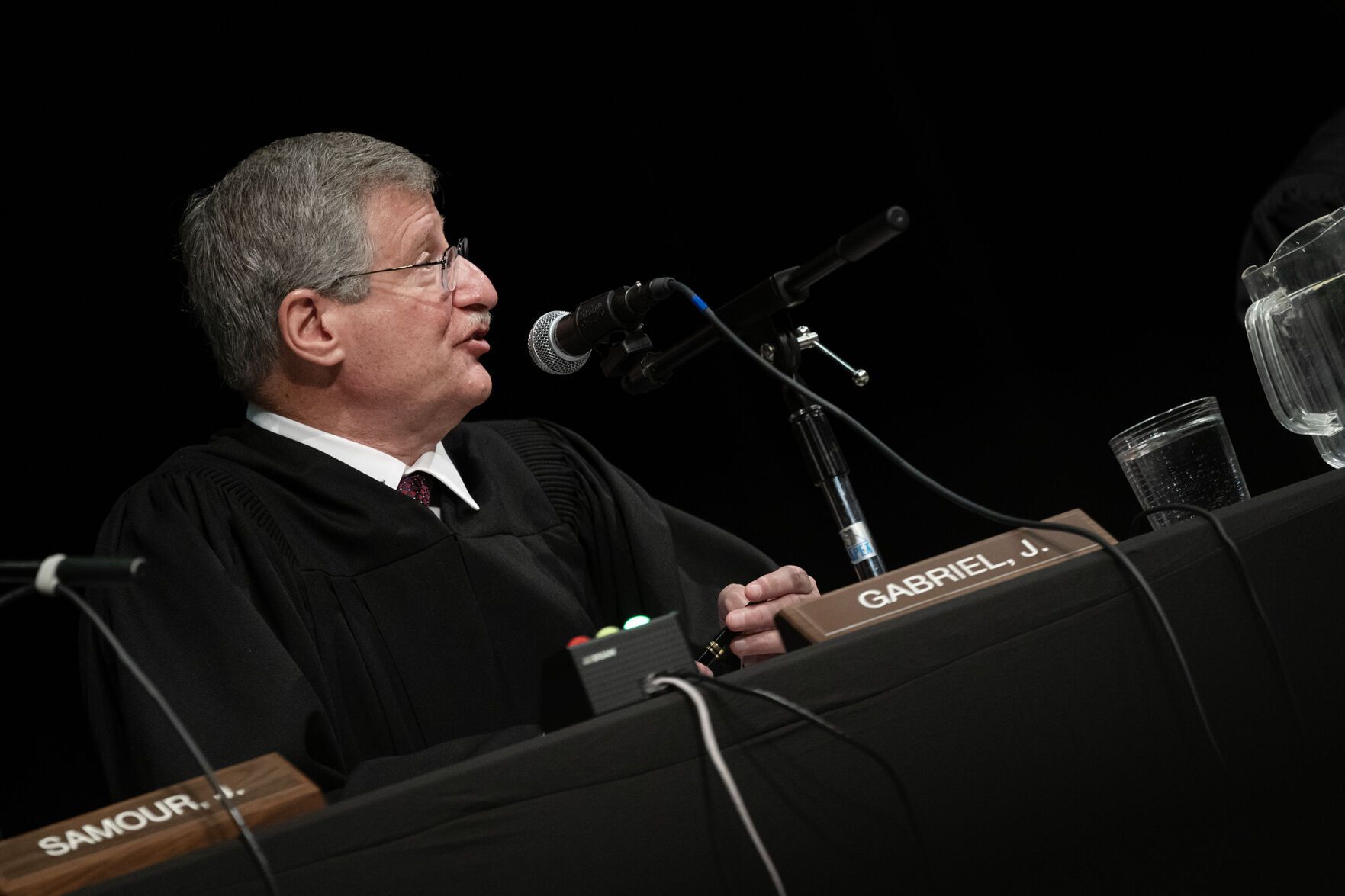
Two members of the Colorado Supreme Court and Court of Appeals described to attorneys on Friday how and when to submit advocacy briefs from outside entities — and the tactics that turn off the judges who read them.
“I get that there are certain advocacy groups on particular sides. I can pick up a particular brief and know what it’s gonna say before I read it. That’s losing an opportunity,” said Justice Richard L. Gabriel. “What’s also not helpful is the ‘parade of horribles.’ … If we decide against you, the entire world is going to collapse tomorrow.”
Non-parties to a case that submit briefs are known as “amicus curiae,” which is Latin for “friend of the court.” Judge Ted C. Tow III said that attorneys often forget the second part of that phrase.
“You’re a friend of the court, not a friend of the party,” he said. “And the more table-pounding there is, it’s obvious that you are not a friend of the court.”
Gabriel and Tow spoke at the annual appellate practice update sponsored by the Colorado Bar Association.
While outside participation is common at the Supreme Court, Tow said amicus briefs are relatively rare at the Court of Appeals, averaging roughly two dozen per year but steadily increasing. He is the lone judge who decides whether to authorize the filing of an amicus brief for his court.
“To use a phrase I tell every law clerk I hire, an amicus’s job, in part, is to keep me from stepping in it,” Tow said.
He added that he finds amicus briefs most helpful if the Court of Appeals is addressing a new law that has never been interpreted and is written unclearly.
“It’s really that this is new ground. This is really new ground. This isn’t just applying established law to new facts. This is a whole different can of beans. Let’s take a look at this from a big picture,” Tow said.

Gabriel cautioned that amicus briefs cannot raise issues that the parties to a case have not raised. However, it is fair game for outside entities to talk about the policy implications of the parties’ arguments.
“What I’m worried about the most as a judge is unintended consequences in something that I write,” he said. “What can an amicus brief do? It can help us with policy ramifications. That would be adding something.”
Gabriel said it is particularly meaningful, although rare, when entities that are normally on opposite sides join together in a single brief. He also encouraged amicus entities to coordinate so that organizations that have a “slightly different spin” can avoid repeating the same message.
However, Tow said there is a danger in coordinating: The appearance that amicus groups are helping a litigant get around the word limit on their own arguments.
Kendra Beckwith, an attorney who frequently litigates in the appellate courts and authors amicus briefs, said she focuses on the narrative that a brief will tell the court. Not all cases will call for amicus participation, and there can be “fatigue” from having the same entities routinely submit briefs.
“What I’m really trying to explain to these two courts: This is the universe in which either this issue arose or it’s going to have an impact,” Beckwith said. “I’m citing to newspaper articles or I’m citing to studies or I’m doing something to explain to the court, ‘This is the universe we’re operating in.’”
For a lot of clients, she continued, “there has been an uptick in, ‘Listen, I want this institution, I want the judicial branch, to hear me. I am still affected by what these courts do and I want my voice to be a part of whatever is going on.'”
She added that, while amicus groups may be friends of the court, they are “a little closer with one side than the other.”
“We get that you’re writing as a friend of the court, but you’re aligned with one side,” responded Gabriel. Yet, he frequently sees briefs that claim to be submitted in support of neither party.
“Then you read it and it’s obviously in support of one party,” he said. “Don’t pretend you’re not when you really are. Don’t put it on the cover. That’s a credibility issue.”
Gabriel also said that amicus briefs can be helpful at the outset, when a litigant is petitioning the Supreme Court to take a case. Outside perspectives can show why the issue is an important one for the justices to hear, he said.
Although the Supreme Court also allows parties to file a brief arguing that the court should not hear a case on appeal, Beckwith said she would discourage amicus groups from filing opposition briefs.
In doing so, she said, “you’ve just raised a whole bunch of hands that attract attention because you’ve said, ‘This is really interesting.'”


Colorado’s Western Slope magistrate judges describe unique role in federal judiciary
Michael Karlik
michael.karlik@coloradopolitics.com
Updated 5 hours ago
Two of Colorado’s federal judges stationed on the Western Slope spoke to lawyers on Wednesday about their unique roles, the ways their workloads differ, and the need for more criminal defense lawyers to take cases outside the Front Range. “Here...

Federal judge rules that request for bond hearing not necessary to challenge immigration detention
Michael Karlik
michael.karlik@coloradopolitics.com
Updated 5 hours ago
A federal judge in Colorado ruled last week that it is not mandatory for a person to seek a bond hearing with an immigration judge before they challenge the lawfulness of their detention in federal court. For the past year,...

Boulder Valley School District introduces new policies following antisemitism lawsuit
Marissa Ventrelli
marissa.ventrelli@coloradopolitics.com
Updated 7 hours ago
The chief of Boulder Valley School unveiled new policies for the 2026-2027 school year following a lawsuit filed on behalf of a student alleging antisemitic harassment. In June, the Anti-Defamation League filed a federal civil rights complaint against the school...

Colorado NRA chapter seeks injunction against new gun‑training requirement
Marissa Ventrelli
marissa.ventrelli@coloradopolitics.com
Updated 6 hours ago
The Colorado chapter of the National Rifle Association is seeking an injunction to stop the state from enforcing a new law that took effect earlier this month. The new law requires anyone buying or selling certain firearms to first complete...

Denver moves to dismiss Trump challenge to ‘assault-style’ weapons ban
Deborah Grigsby
deborah.smith@denvergazette.com
Updated 6 hours ago
Denver has filed a motion to dismiss a lawsuit brought by the Trump administration challenging the city’s ban on “assault-style” weapons and magazines exceeding a 15-round capacity. The U.S. Department of Justice filed a suit in federal court in May,...
Federal judge dismisses ex-Colorado judicial discipline director’s conspiracy lawsuit
Michael Karlik
michael.karlik@coloradopolitics.com
Updated 1 day ago
A federal judge dismissed a lawsuit from Colorado’s former judicial discipline director on Tuesday, finding that he failed to adequately state claims for conspiracy or constitutional violations. Christopher S.P. Gregory, who served as the executive director of the Colorado Commission on Judicial...
Federal judge allows retaliation claims to proceed against prison officials
Michael Karlik
michael.karlik@coloradopolitics.com
Updated 6 hours ago
A federal judge agreed last week that a man incarcerated at Sterling Correctional Facility had credibly alleged that employees retaliated against him for filing grievances, including by taking away his disability accommodations and turning off his electricity. Louis Peoples Jr.,...

U.S. Rep. Lauren Boebert’s son arrested, faces charges of sexual exploitation of minor
Matt Kyle
matt.kyle@denvergazette.com
Updated 2 days ago
U.S. Rep. Lauren Boebert’s son Tyler Jay Boebert has been arrested and accused of recording and sharing a video depicting himself having intercourse with a minor, according to court records. The case originated in Garfield County in Western Colorado and...

Adams County water district may proceed with cost-recovery lawsuit against Denver for contamination
Michael Karlik
michael.karlik@coloradopolitics.com
Updated 2 days ago
A federal judge rejected Denver’s arguments last week for pausing or dismissing a lawsuit brought by an Adams County special district seeking to recover its costs for addressing water contamination as a result of Denver firefighting activities. In January, the...
Federal judge declines to dismiss First Amendment retaliation claim against prison official
Michael Karlik
michael.karlik@coloradopolitics.com
Updated 2 days ago
A federal judge agreed last month that an incarcerated Native American woman may pursue her claim of First Amendment retaliation against a prison official who allegedly interfered with her religious exercise. Yvonne Peterson resided at Buena Vista Correctional Facility for...
PREV
PREVIOUS

Colorado's incoming chief appeals judge lays out agenda | APPELLATE UPDATE
The incoming chief judge of Colorado’s Court of Appeals told lawyers on Friday that his goals for his four-year term include figuring out why criminal cases are taking nearly 1.5 years on average to reach appellate judges’ desks. “Criminal briefing is one of my biggest focuses, to be blunt,” said Judge Ted C. Tow III. […]

Colorado appellate judges, lawyers hold annual conference | APPELLATE UPDATE
Appellate judges and attorneys gathered in Denver on Friday to discuss recent trends, exchange tips and clarify confusing areas of practice. “One of the things I really had to focus on, coming from the trial court, is that my inclination before was to make sure things are raised and people were getting their questions answered. […]