

Colorado Supreme Court rebuffs DA’s office over evidentiary appeal

The Colorado Supreme Court rebuffed a district attorney’s office on Monday for immediately pursuing an appeal of a trial judge’s evidentiary decision that the court had no authority to hear.
State law authorizes prosecutors to file a mid-case, or “interlocutory,” appeal to the Supreme Court when a judge suppresses key evidence from being used in trial. After a February hearing in which a Logan County judge excluded evidence based on the actions of law enforcement, the DA filed an interlocutory appeal.
The defendant, Collin Schneider, stands accused of vehicular eluding and reckless driving. Based on Sterling police officers’ failure to activate their body-worn cameras in accordance with state law, the defense moved to exclude certain testimony by the officers.
Chief Judge Carl S. McGuire III granted the motion. While the prosecution and the defense both appeared to argue on appeal that McGuire relied on the officers’ violation of departmental policy in reaching his decision, the Supreme Court characterized his ruling as based on state law.
Crucially for the appeal, the DA’s office contended that McGuire erred in “suppressing” the evidence. But the Supreme Court concluded that no suppression had occurred.
The unsigned May 4 opinion repeatedly cited a decision the court issued last month, finding El Paso County prosecutors wrongly pursued an interlocutory appeal after a trial judge declined to allow unedited or irrelevant video evidence to be played in its entirety. The judge’s actions did not amount to suppression of evidence, the court found.
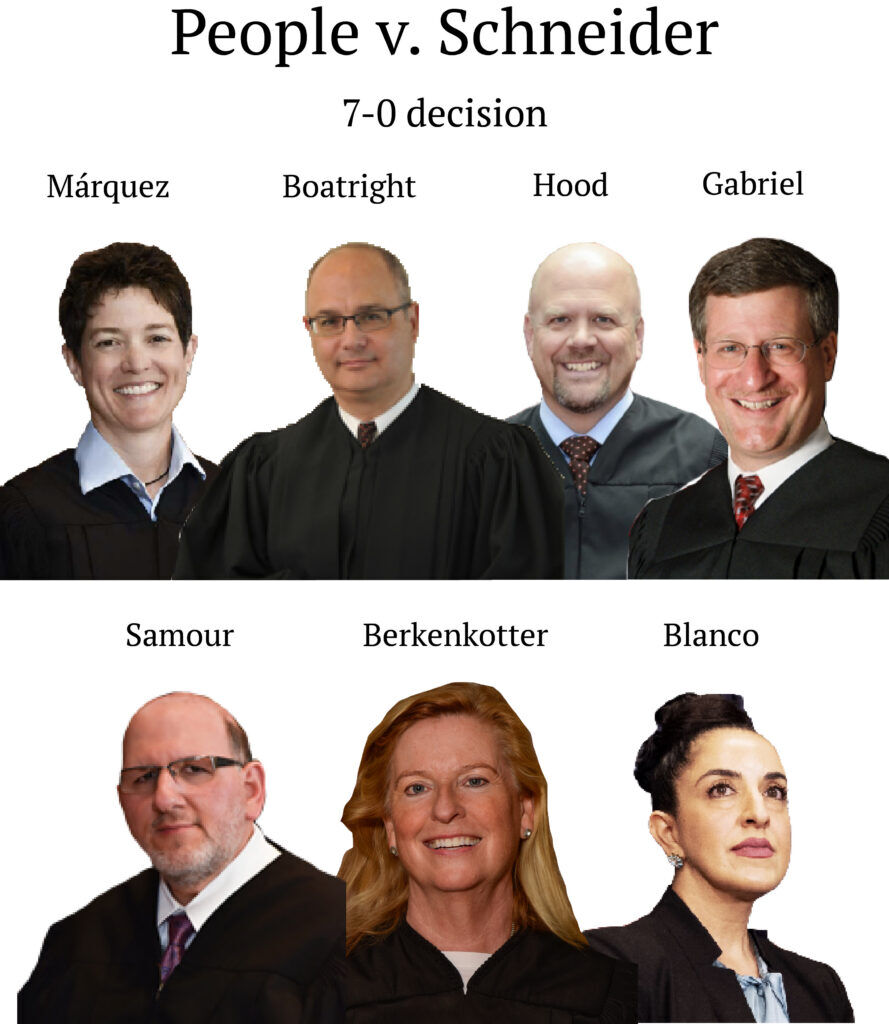
“The word ‘suppress’ in criminal motions practice is a specialized term denoting the exclusion from trial of any evidence procured illegally, typically in violation of the defendant’s constitutional rights or protections,” wrote Justice Carlos A. Samour Jr. “The county court judge did not preclude any evidence that was illegally obtained, let alone evidence allegedly collected in violation of (the defendant’s) constitutional rights or protections.”
Samour added that the court would be green-lighting many immediate appeals of routine evidentiary decisions were it to expand the meaning of “suppressing” evidence.
Consequently, the justices agreed in Schneider’s case that McGuire’s order excluding the evidence did not fall within any of the scenarios that would allow the Supreme Court to address a suppression decision.
“Each of these grounds for suppression is premised on a violation of a defendant’s Fourth, Fifth, Sixth, or Fourteenth Amendment rights,” the court wrote. “By contrast, the motion and order excluding evidence here were grounded entirely in (Colorado law).”
Travis Sides, the elected district attorney, did not immediately know if McGuire’s decision could otherwise be appealed to the Court of Appeals.
“Based on the ruling, I don’t see a legal path forward for the prosecution,” said Levi Price, an attorney for Schneider. “We were surprised they litigated the original motion rather than just using it as a teachable moment for the police, and really surprised when they appealed.”
The case is People v. Schneider.

10th Circuit says landowner cannot sue ex-Routt County judge for statements in decision
Michael Karlik
michael.karlik@coloradopolitics.com
Updated 13 hours ago
A Routt County landowner cannot sue a former judge for his allegedly inaccurate statements in a case where the landowner was not a party, the Denver-based federal appeals court decided on Wednesday. Anne Fitzsimmons, who lives in Germany, owns a...
Parole, appeals deadlines and restitution: Colorado justices accept cases
Michael Karlik
michael.karlik@coloradopolitics.com
Updated 1 day ago
The Colorado Supreme Court announced on Monday that it will determine how a defendant’s parole-eligibility date should be calculated in instances where a new trial results in a sentence being imposed retroactively to the date of the original, since-overturned sentence....

Federal judge rejects DOJ bid to force Colorado to hand over voter information
Marissa Ventrelli
marissa.ventrelli@coloradopolitics.com
Updated 11 hours ago
A U.S. district court judge has dismissed a lawsuit filed by the U.S. Department of Justice against Colorado Secretary of State Jena Griswold for refusing to provide the agency with personal voter information. Last December, the DOJ’s Civil Rights Division asked...
3 Colorado judges receive unfavorable retention recommendation as one performance commission violates rules
Michael Karlik
michael.karlik@coloradopolitics.com
Updated 2 days ago
Of the 123 Colorado judges standing for retention on the November ballot, citizen-led performance commissions found that three did not meet the required performance standards. However, in an unprecedented move, the commission charged with evaluating Supreme Court and Court of...

10th Circuit weighs Gross Reservoir expansion, judge’s ‘punishment’ of Denver Water
Michael Karlik
michael.karlik@coloradopolitics.com
Updated 14 hours ago
Members of the Denver-based federal appeals court considered on Friday whether they could intervene in an ongoing infrastructure project to enlarge a Boulder County dam after a trial judge deemed the underlying permit unlawful nearly two years ago. Denver Water...

10th Circuit upholds federal prohibition on juvenile handgun possession
Michael Karlik
michael.karlik@coloradopolitics.com
Updated 2 days ago
The Denver-based federal appeals court concluded on Monday that Congress acted within its constitutional powers to make it a crime for juveniles to possess handguns in most instances. The decision from the U.S. Court of Appeals for the 10th Circuit...

Senate advances judicial nominee, Montezuma County judge agrees to discipline | COURT CRAWL
Michael Karlik
michael.karlik@coloradopolitics.com
Updated 3 days ago
Welcome to Court Crawl, Colorado Politics’ roundup of news from the third branch of government. A U.S. Senate committee advanced a judicial nominee from Colorado, plus a Montezuma County judge agreed to receive discipline for his misconduct that stops short...
Judge denies Calderon injunction case against Denver, Johnston
Deborah Grigsby
deborah.smith@denvergazette.com
Updated 3 days ago
A U.S. District Court judge has denied a preliminary injunction in the case of Jessica Calderon, the Denver city employee who won a temporary restraining order preventing the City and County of Denver from terminating her amid the 2025 citywide...

10th Circuit partially revives lawsuit over 2020 Denver protest injuries
Michael Karlik
michael.karlik@coloradopolitics.com
Updated 4 days ago
The Colorado-based federal appeals court revived a man’s claims against Denver on Friday after concluding a trial judge resolved the case in the city’s favor without analyzing two of the three instances of alleged excessive force and other constitutional violations....
Federal judges find Colorado immigration judge violated several orders
Michael Karlik
michael.karlik@coloradopolitics.com
Updated 5 days ago
Multiple federal judges in Colorado have freed people from immigration custody after determining that one immigration judge violated their directives for properly conducting bond hearings. For nearly a year, Colorado’s U.S. District Court has faced a flood of habeas corpus petitions...
PREV
PREVIOUS

Crank challenger Jessica Killin named to House Democrats’ ‘Red to Blue’ program in Colorado’s 5th CD
The House Democrats’ campaign arm on Monday added Jessica Killin to its nationwide “Red to Blue” program in Colorado’s Republican-leaning 5th Congressional District, calling the first-time candidate a “top-tier” challenger in a seat the party is aiming to flip in this year’s midterm elections. Killin, an Army veteran and former chief of staff to second […]

Democrat Jena Griswold holds wide lead in Colorado attorney general primary, her internal poll shows
Democratic attorney general candidate Jena Griswold, Colorado’s term-limited secretary of state, holds a wide lead over her three primary opponents just weeks before ballots are set to go out to voters, a new internal poll released by her campaign on Monday shows. Griswold counts more than twice as much support among likely primary voters as […]