

Denver law students create AI-powered tools in federal judge’s ‘design sprint’
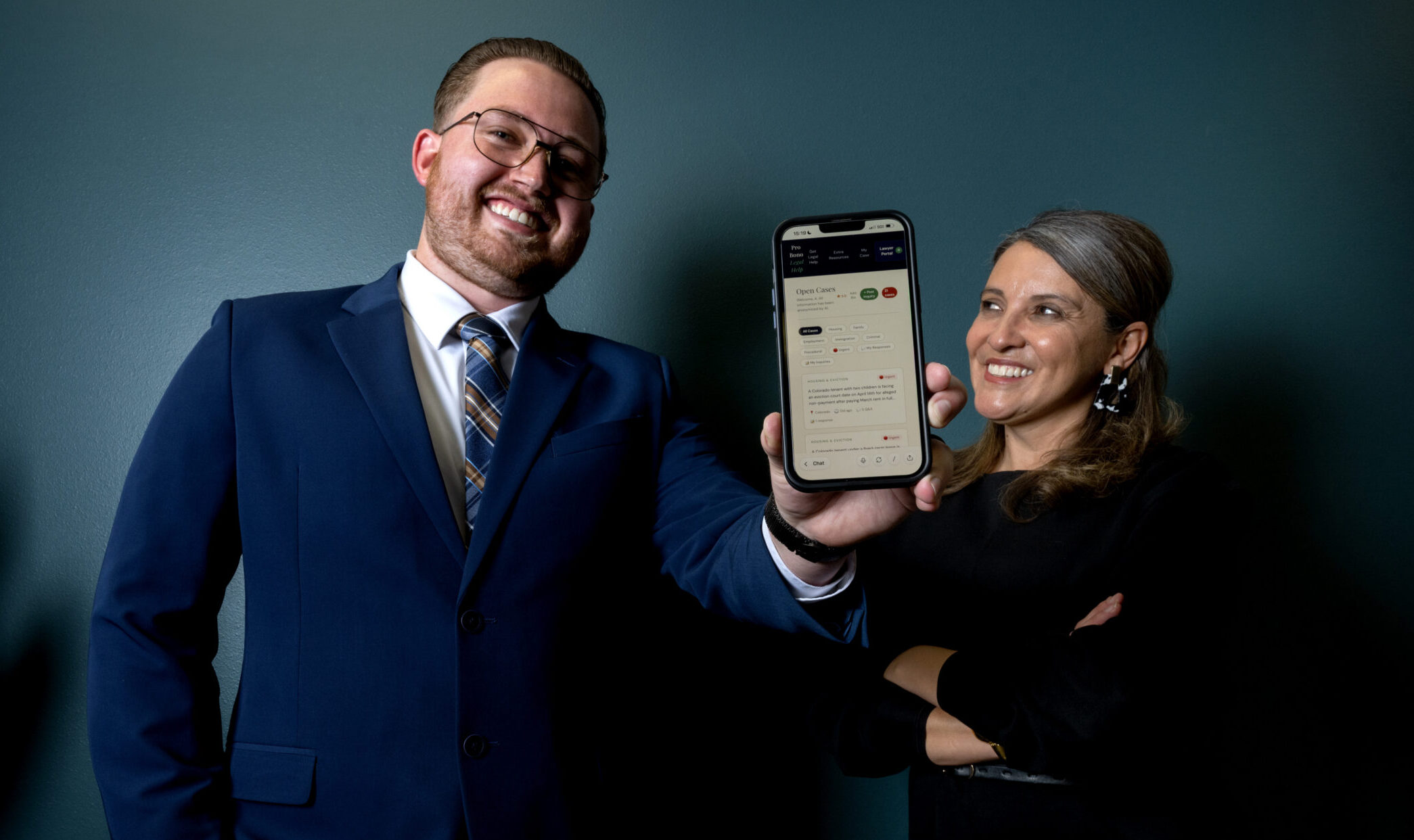
A tenant discovered a handwritten note on his door stating he had 48 hours to move out. The landlord changed the locks without notice or court proceedings. The tenant paid rent on time and had never received any complaints about a lease violation. As a result of the landlord’s actions, he could not get inside to access his medication, work clothes, or the lease itself.
The tenant then sought legal advice.
“To help our volunteer attorneys understand the timeline, have you received any written warnings or communications from your landlord regarding your lease prior to the locks being changed?”
“Regarding the note she left, does it list a specific reason for the lock change or any reference to a court case number?”
“Has any law enforcement officer or court official been involved in this situation or served you with any formal documents?”
Those questions and the tenant’s detailed responses helped frame the case for a lawyer to review and decide if they wanted to take it on.
The only snag? The tenant is not real. Nor were the questions coming from a real person.
Instead, the exchange occurred through a website designed by second- and third-year law students at the University of Denver this spring. The artificial intelligence-powered prototype is intended to demonstrate how a chatbot can perform intake functions for lawyers, who then have the opportunity to discuss and potentially intervene.
The class, called “Reimagining Justice,” was taught by U.S. Magistrate Judge Maritza Dominguez Braswell, who has carved out a high-profile role in the federal judiciary as an expert on emerging AI tools for the legal profession.
The focus of the course was “the AI piece, and trying to get them to think about AI as a tool in the context of a justice system that doesn’t always function the way it was intended to,” she said. “Most people can’t access our system in the way that it was designed to be accessed with a lawyer. So, thinking about how AI could potentially provide a solution to that, and then giving them the tools along the way to actually make that work.”
The design sprint
Recently, judges in Colorado have grappled with how to regulate the use of AI in the law. The Colorado Supreme Court adopted a rule this year cautioning attorneys to use artificial intelligence tools in a manner consistent with their professional obligations or else face possible discipline. Some federal judges have also implemented protocols requiring parties to attest to their use or non-use of generative AI in legal filings.
Braswell, who is the lone federal judge stationed in Colorado Springs, has become heavily involved with educating lawyers and judges about the pitfalls and possibilities of AI tools. She regularly speaks alongside other AI-interested judges, and she launched the Judicial AI Consortium earlier this year as a national project.
Then came the DU “design sprint.”
Braswell’s class divided into two teams to rapidly create a tool to address an access-to-justice issue.
“The first step is the ’empathy-building’ phase. So, students were required to identify a particular area in the access-to-justice space,” said Braswell, “and then identify who their potential targets would be in terms of users of their service or of their product. And then go and talk to them and observe them and understand what their pain points are.”
One team focused on immigration law, and ultimately created a clearinghouse where users can receive push alerts for executive orders, legislation, and agency policy changes in the fast-evolving area. Each update comes with an AI summary, a “plain language” description, and a bullet-pointed list of how clients might be affected.
The tool also includes a case simulator, in which users can select a variety of conditions common to immigration cases and indicate the current stage of their case. The tool then suggests actions for the client to take, as well as which specialists to consult.

The other team created the intake tool, in which users describe their legal issue to the chatbot or call a phone number with an AI receptionist. After providing information in response to the chatbot’s prompts for relevant details, the client’s messages are displayed to lawyers who have signed up to use the tool. They can discuss the case among themselves, respond to the client, and “concur” or “dissent” on each other’s replies — the equivalent of upvoting or downvoting an online post.
Conor Burns, a third-year law student on the team that designed the intake tool, said members of the class visited with a self-represented litigant coordinator in the state court system, attended a clinic on tenant rights and evictions, and watched a divorce hearing where neither party spoke English or had an attorney.
“We tried to get a wide array of information before trying to come up with a way to solve any issues,” Burns said.
Anthony Kennedy, a second-year law student who interned for Braswell prior to taking her class, said the intake tool was intended to flag urgent legal issues, as well as those that might require expertise in more than one area of law — for example, an eviction that also overlaps with a family law problem.
“If you ever frequently go on Reddit, you’ll see the lawyer Reddit pages … a public defender might be asking, ‘Hey, I’m having a case with these types of situations. Is there anything that I should be aware of?'” he said. “Our hope in kind of adding something like that was to ideally provide a more secure environment than Reddit for attorneys to be able to share information.”
Slightly less skeptical
Braswell said the teams used “vibe coding” to create the tools, which allows users to describe what they want to an AI program and refine the product through additional commands, rather than traditional, manual coding.
On April 16, Braswell brought in multiple legal professionals to judge the final products.
U.S. Magistrate Judge Kathryn A. Starnella said she walked in with significant skepticism of artificial intelligence, as she has been a late-adopter of technology in general. She also harbors concerns about AI displacing the critical-thinking skills that lawyers must develop.
“I forbid my staff from using AI in their writing of draft orders,” said Starnella. “While I do see the potential for increasing access to justice, I’ve seen issues with pro se (self-represented) litigants using AI to draft briefs or to do their legal research. And then they file things with hallucinated citations. So, I’ve had to issue sanctions on a few occasions. I’ve had to warn pro se litigants. I’ve had to redirect them to other sources that may provide more reliable research results.”

However, Starnella was curious to see what the students created and she understood that there would inevitably be useful applications of legal AI in the future. She said she left the classroom with a bit more of an open mind about artificial intelligence.
“What was refreshing to me about these two student presentations is that neither proposal is replacing lawyers or replacing the analytical thinking that lawyers do,” Starnella said. “Rather, it’s an aid to make lawyers more effective and to assist pro se litigants and give the pro se litigants tools to either advocate on their behalf or, ultimately, if they get pro bono counsel or otherwise are able to hire their own counsel, it provides them tools where they can understand or better understand what’s going on with the law and how it impacts them.”
Another project judge, Brittany Kauffman, who is the CEO of the Institute for the Advancement of the American Legal System at DU, said she found the exercise an essential part of the law school experience.
“They weren’t just building an AI tool, but they were learning along the way about design thinking, about user design, about empathy, and viewing the use of AI from the perspective of the user,” Kauffman said. “Also, learning about the users of our justice system more generally.”
Kennedy, the second-year student, said he is aware that some states have helped create environments in which AI legal tools are available for self-represented litigants, and large law firms are not the ones who exclusively benefit from the latest innovations.
“One of the things I admire the most about Judge Braswell is how simple she makes really big things look,” he said. “The way that we go through society, as young people and students, almost requires us to assume that everything is so complicated. That every process, every ability to make change is just going to be an insurmountable hurdle. But in reality, it just takes a couple of people that really care about making change.”
Braswell said each of the prototypes would need professional work before they could be used commercially, but she is interested in handing the baton to those who might be interested in the students’ vision.
“Part of the feedback was, ‘Can we use something like this? Can you actually make this happen for us? Because it would be helpful. We could use this. We need something like this,'” she said.

Colorado Springs mother Deborah Nicholls’ murder conviction overturned
Nick Smith
nick-smith@coloradopolitics.com
Updated 2 hours ago
A Colorado Springs mother convicted in 2008 of murdering her three children in a house fire might get a new trial after a judge ruled that prosecutors withheld key evidence that could have impacted the jury’s verdict. Deborah Nicholls, whose...
Colorado court overturns illegal $7,000 restitution order
Michael Karlik
michael.karlik@coloradopolitics.com
Updated 2 hours ago
Colorado’s second-highest court overturned a Weld County defendant’s obligation to pay more than $7,000 in crime victim restitution on Thursday because a trial judge failed to issue a legally compliant restitution order at the time of sentencing. In Colorado, as...
Appeals court orders second look at Denver Water’s immunity for cyclist’s injury
Michael Karlik
michael.karlik@coloradopolitics.com
Updated 2 hours ago
Colorado’s second-highest court ordered another look at a bicyclist’s negligence lawsuit against Denver Water on Thursday, concluding that a trial judge needed to evaluate the utility’s potential immunity using the state Supreme Court’s new guidance. Joseph A. “Joey” Scott alleged...
Labels, duration not definitive proof of ‘intimate relationship,’ Colorado court rules in domestic violence case
Michael Karlik
michael.karlik@coloradopolitics.com
Updated 2 hours ago
Colorado’s second-highest court clarified on Thursday that the length of a couple’s relationship and the labels they attach to it are not conclusive evidence of whether it is an “intimate relationship” that can give rise to a domestic violence prosecution....

Colorado AG urges Supreme Court to let Boulder climate lawsuit proceed
Marissa Ventrelli
marissa.ventrelli@coloradopolitics.com
Updated 5 hours ago
Colorado Attorney General Phil Weiser has filed a court brief with the U.S. Supreme Court in a lawsuit brought by Boulder city officials seeking to hold oil companies liable for their environmental impact. The case began in 2018, when the...
10th Circuit says landowner cannot sue ex-Routt County judge for statements in decision
Michael Karlik
michael.karlik@coloradopolitics.com
Updated 1 day ago
A Routt County landowner cannot sue a former judge for his allegedly inaccurate statements in a case where the landowner was not a party, the Denver-based federal appeals court decided on Wednesday. Anne Fitzsimmons, who lives in Germany, owns a...
Defendant’s competency in question in El Paso County case involving slain Army police officer
Nick Smith
nick-smith@coloradopolitics.com
Updated 13 hours ago
It will be another 60 days before a 4th Judicial District court determines if a man charged in the shooting death of an Army police officer is competent to proceed in his case. Judge Erin Sokol granted a request Wednesday...
Parole, appeals deadlines and restitution: Colorado justices accept cases
Michael Karlik
michael.karlik@coloradopolitics.com
Updated 2 days ago
The Colorado Supreme Court announced on Monday that it will determine how a defendant’s parole-eligibility date should be calculated in instances where a new trial results in a sentence being imposed retroactively to the date of the original, since-overturned sentence....
Federal judge rejects DOJ bid to force Colorado to hand over voter information
Marissa Ventrelli
marissa.ventrelli@coloradopolitics.com
Updated 1 day ago
A U.S. district court judge has dismissed a lawsuit filed by the U.S. Department of Justice against Colorado Secretary of State Jena Griswold for refusing to provide the agency with personal voter information. Last December, the DOJ’s Civil Rights Division asked...
3 Colorado judges receive unfavorable retention recommendation as one performance commission violates rules
Michael Karlik
michael.karlik@coloradopolitics.com
Updated 2 days ago
Of the 123 Colorado judges standing for retention on the November ballot, citizen-led performance commissions found that three did not meet the required performance standards. However, in an unprecedented move, the commission charged with evaluating Supreme Court and Court of...
PREV
PREVIOUS

Colorado space startup secures $650 million for expansion
The window to deliver space superiority for the U.S. is open but shrinking rapidly, according to defense startup True Anomaly. The Centennial-based company hit a milestone in its pursuit to help deliver that, announcing Tuesday that it raised $650 million in late-stage investment money, bringing its total valuation to $2.2 billion. Since its inception in […]

Aurora mental health nonprofit cuts 100-plus jobs after Colorado agency reduces reimbursement rate
A nonprofit that provides services through 11 mental health centers in Aurora announced Thursday that it is eliminating 111 jobs effective June 30, the result of federal and state budget reductions. Aurora Mental Health & Recovery said the positions being eliminated are mostly administrative and support service jobs. That includes 91 jobs currently held by […]