

SCOTUS arguments, varied workload: 6 Colorado solicitors general talk about job

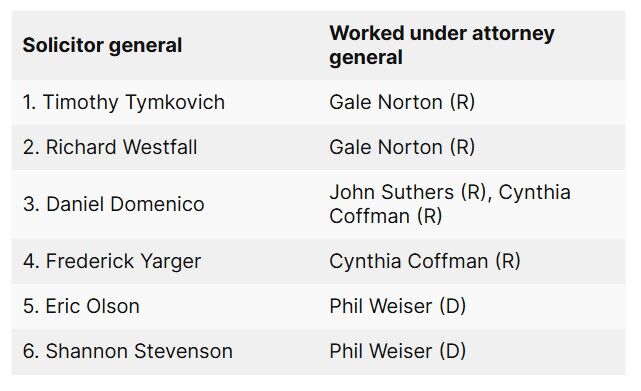
Six current and former solicitors general of Colorado, including two who have since become members of the bench, spoke to attorneys on Wednesday about how the role has changed over time, what the workload entails, and their experiences arguing at the U.S. Supreme Court.
“It is an incredible amount of time that you put in preparing for a Supreme Court argument, which I used to think was a huge waste because I’d be hard-pressed to find a single case where they don’t know what the result’s gonna be when they walk into the argument,” said U.S. District Court Chief Judge Daniel D. Domenico. “That’s not true, at least, for my cases where I have oral argument and I’m really trying to figure some things out.”
“At SCOTUS, part of the art is you know you’re gonna have a ‘no’ vote, and making sure you deal with their questions quickly and efficiently so you can go talk to the people whose minds you can persuade,” added Eric R. Olson.
Colorado law requires the attorney general to appoint a solicitor general to represent the state in court. The virtual discussion, sponsored by the Colorado Bar Association, brought together people who had served in the position across 35 years.
In the early 1990s, “the role was to represent the cabinet officers, basically, in legal matters. There was no legal policy. There was no association with other states. There was no legal policy advancement. It was very much a dry and desiccated position,” said Judge Timothy M. Tymkovich of the U.S. Court of Appeals for the 10th Circuit. “And (Attorney General) Gale Norton’s vision of it, and one that I subscribed to, was to open it up as an innovative actor within the state of Colorado and a player in the national scene in a capacity that hadn’t been thought of before this era.”
Shannon Stevenson, the current solicitor general, said there are a handful of areas that she focuses on beyond appellate work on constitutional issues. She was involved in the criminal prosecutions of Aurora first responders over the death of Elijah McClain, multi-state litigation against the federal government and other entities, and water litigation between states.
The Colorado River dispute is “just a fascinating, complicated, thorny legal problem that is a pleasure and honor to work on,” Stevenson said.
“And I worked on Colorado River litigation, so some things haven’t changed much,” said Tymkovich.
“I feel like every SG here has dealt with that issue,” added Frederick R. Yarger.
Of the six participants, all but Richard A. Westfall had argued cases in front of the Supreme Court. Westfall said he had a couple of “very close misses,” including one case in which Norton decided a few months beforehand that she would argue for the state.
“AG (Phil) Weiser did that to me twice,” added Olson.
“How do you prepare when you expect the court to be hostile, which I’m sure sometimes happened,” asked the moderator, Colorado Supreme Court Justice Richard L. Gabriel.
The participants said there is a massive amount of preparation, from working with the outside groups that want to submit supportive briefs to planning how to respond to points raised by those organizations, and participating in “moot courts” that simulate how the oral arguments might go.
“There could be research projects that would take weeks that end up being one sentence in your brief. But you have to do that work to put the sentence in,” said Stevenson.
Domenico said the two cases he argued at the U.S. Supreme Court involved the “least sexy” topics, but he believes the oral arguments are still an “important civic enterprise” for exploring key issues publicly.
“You have to be prepared or you’re gonna just embarrass yourself. But I still don’t think you’re gonna change the result in any case, no matter how badly you do,” Domenico said.
More broadly, Domenico recalled that part of the solicitor general’s role involved being someone for the attorney general “to kick things around with, who was sort of someone he brought in specifically as a sounding board.”
During Domenico’s time in the position, the Colorado Attorney General’s Office formed a group of assistant solicitors general, which had the effect of increasing communication and information-sharing across the office.
“The actual reason I first started that was because I wanted to spend more time working with Monica Márquez, who was in the office at the time,” said Domenico, referring to Colorado’s now-chief justice. “That was the way I dragged her more into my orbit, by calling her an assistant solicitor general.”
In response to a question about the political aspects of the job, Olson said solicitors general have to “honor the system” and not refuse cases that they personally disagree with.
“In my experience, the truly political stuff was really the exception,” he said. “Overwhelmingly, all of us are committed to doing what’s best for Colorado, and most of the time, there’s general agreement on what that looks like.”
Tymkovich said that during his time in the role, the attorney general was a Republican, but Gov. Roy Romer was a Democrat. At the Supreme Court, Tymkovich argued on behalf of Romer, who was a named defendant in a challenge to a voter-approved constitutional amendment that the justices later overturned.
Norton “really asked me to play it straight on the legal issues with the governor’s office,” he said.
Finally, Gabriel asked whether the solicitors general are spending less time arguing in the state Supreme Court than in the past.
“Anecdotally, it feels like the solicitor general’s time is being devoted more on the federal side of things,” he said.
Domenico said he likely argued more often to the Colorado Supreme Court than the federal courts, but part of the job entails “figuring out, sometimes, when to let someone else argue a case.”
“It was important to me to not just steal all the Supreme Court cases from people who lived with the case for years,” he said.

10th Circuit says landowner cannot sue ex-Routt County judge for statements in decision
Michael Karlik
michael.karlik@coloradopolitics.com
Updated 7 hours ago
A Routt County landowner cannot sue a former judge for his allegedly inaccurate statements in a case where the landowner was not a party, the Denver-based federal appeals court decided on Wednesday. Anne Fitzsimmons, who lives in Germany, owns a...
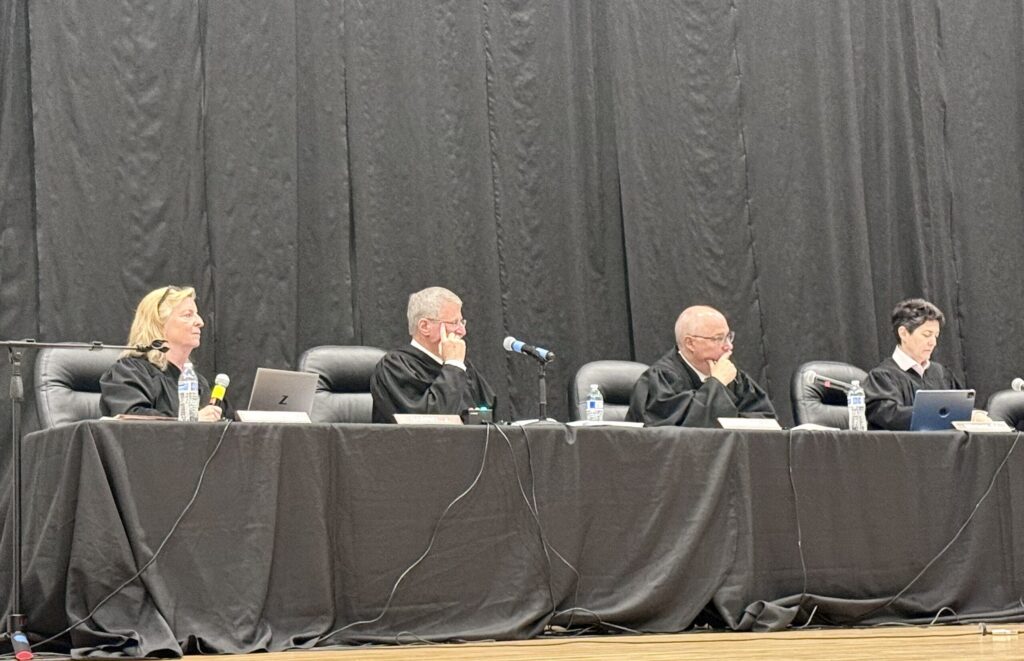
Parole, appeals deadlines and restitution: Colorado justices accept cases
Michael Karlik
michael.karlik@coloradopolitics.com
Updated 1 day ago
The Colorado Supreme Court announced on Monday that it will determine how a defendant’s parole-eligibility date should be calculated in instances where a new trial results in a sentence being imposed retroactively to the date of the original, since-overturned sentence....
Federal judge rejects DOJ bid to force Colorado to hand over voter information
Marissa Ventrelli
marissa.ventrelli@coloradopolitics.com
Updated 5 hours ago
A U.S. district court judge has dismissed a lawsuit filed by the U.S. Department of Justice against Colorado Secretary of State Jena Griswold for refusing to provide the agency with personal voter information. Last December, the DOJ’s Civil Rights Division asked...
3 Colorado judges receive unfavorable retention recommendation as one performance commission violates rules
Michael Karlik
michael.karlik@coloradopolitics.com
Updated 2 days ago
Of the 123 Colorado judges standing for retention on the November ballot, citizen-led performance commissions found that three did not meet the required performance standards. However, in an unprecedented move, the commission charged with evaluating Supreme Court and Court of...
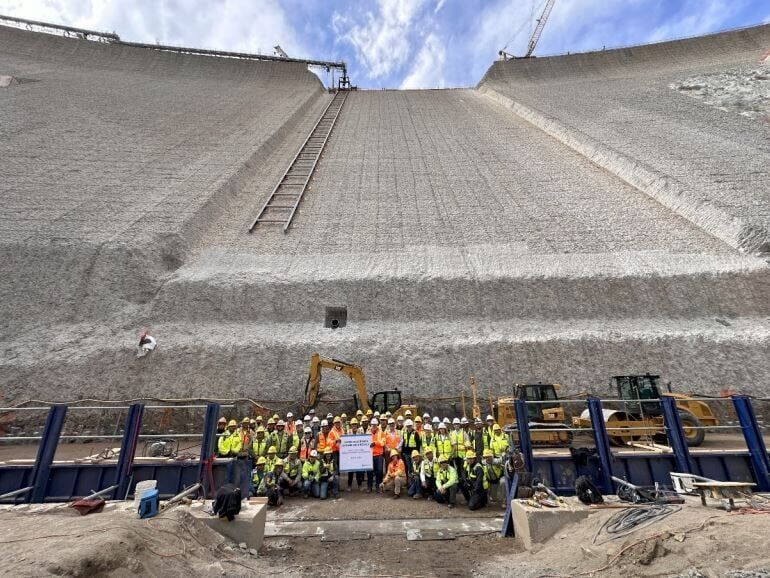
10th Circuit weighs Gross Reservoir expansion, judge’s ‘punishment’ of Denver Water
Michael Karlik
michael.karlik@coloradopolitics.com
Updated 8 hours ago
Members of the Denver-based federal appeals court considered on Friday whether they could intervene in an ongoing infrastructure project to enlarge a Boulder County dam after a trial judge deemed the underlying permit unlawful nearly two years ago. Denver Water...
10th Circuit upholds federal prohibition on juvenile handgun possession
Michael Karlik
michael.karlik@coloradopolitics.com
Updated 1 day ago
The Denver-based federal appeals court concluded on Monday that Congress acted within its constitutional powers to make it a crime for juveniles to possess handguns in most instances. The decision from the U.S. Court of Appeals for the 10th Circuit...

Senate advances judicial nominee, Montezuma County judge agrees to discipline | COURT CRAWL
Michael Karlik
michael.karlik@coloradopolitics.com
Updated 3 days ago
Welcome to Court Crawl, Colorado Politics’ roundup of news from the third branch of government. A U.S. Senate committee advanced a judicial nominee from Colorado, plus a Montezuma County judge agreed to receive discipline for his misconduct that stops short...
Judge denies Calderon injunction case against Denver, Johnston
Deborah Grigsby
deborah.smith@denvergazette.com
Updated 3 days ago
A U.S. District Court judge has denied a preliminary injunction in the case of Jessica Calderon, the Denver city employee who won a temporary restraining order preventing the City and County of Denver from terminating her amid the 2025 citywide...

10th Circuit partially revives lawsuit over 2020 Denver protest injuries
Michael Karlik
michael.karlik@coloradopolitics.com
Updated 3 days ago
The Colorado-based federal appeals court revived a man’s claims against Denver on Friday after concluding a trial judge resolved the case in the city’s favor without analyzing two of the three instances of alleged excessive force and other constitutional violations....

Federal judges find Colorado immigration judge violated several orders
Michael Karlik
michael.karlik@coloradopolitics.com
Updated 4 days ago
Multiple federal judges in Colorado have freed people from immigration custody after determining that one immigration judge violated their directives for properly conducting bond hearings. For nearly a year, Colorado’s U.S. District Court has faced a flood of habeas corpus petitions...
PREV
PREVIOUS

Sheridan school board approves teachers’ contract, ending historic strike
The Sheridan teachers strike that languished through much of the month is officially over. The Sheridan School District Board of Education unanimously voted Tuesday to accept the union contract. “It has been a long road to get to today,” Sheridan Educators Association President Kate Biester said in a statement to The Denver Gazette after this […]

Appeals court recognizes weekend, holiday rule applies to judicial review deadline
Colorado’s second-highest court clarified for the first time last week that the rule extending deadlines in civil cases when the final day falls on a weekend or holiday also applies to litigants seeking review of governmental decisions. Nicholas A. Rigato was incarcerated at Fremont Correctional Facility when prison officials found him guilty of three conduct […]