

Lifetime sex offender registration not ‘punishment,’ Colorado justices say

The Colorado Supreme Court concluded on Monday that lifetime sex offender registration is not cruel and unusual punishment because it is not “punishment.”
At the same time, two members urged lawmakers to heed the advice of the Sex Offender Management Board and adopt a new, more accurate system of measuring a person’s risk of recidivism.
Under Colorado law, “sexually violent predators” are subject to lifetime sex offender registration. To qualify, they must be 18 years or older, convicted of certain offenses, commit the offense against certain types of people and, finally, be “likely to subsequently commit one or more” sexual offenses.
Although the legislature has not deemed lifetime registration to be “punishment,” Colorado’s justices were confronted with the question of whether lifetime registration still exhibits clear hallmarks of punishment.
No, they concluded.
The legal requirement to notify the community about sexually violent predators and the difficulty finding employment or housing, wrote Justice Brian D. Boatright, do not transform lifetime registration into punishment.
“Public shaming is typically understood to involve confrontation that is both ‘direct’ and ‘face-to-face,’ yet nothing in the community notification statute mandates such face-to-face confrontation,” he wrote in the April 27 opinion. “Additionally, any shaming that occurs via ‘vitriol and threats’ in the comment sections of social media posts is not government sponsored.”
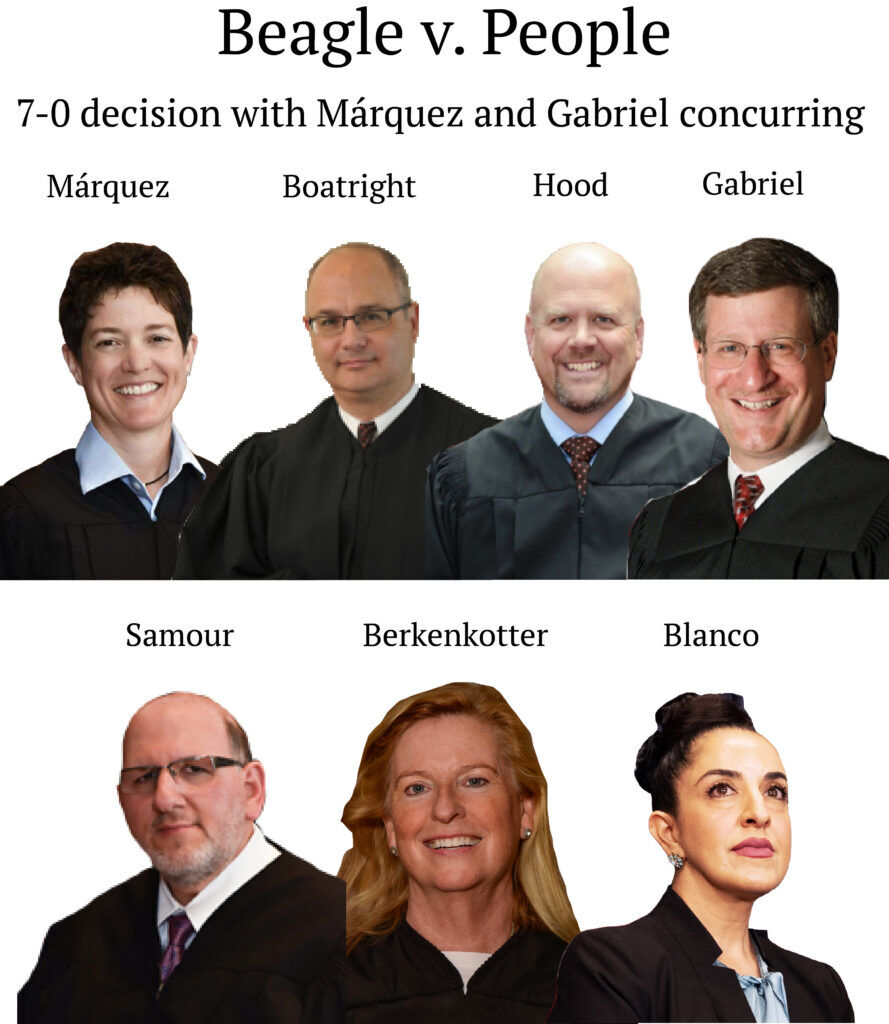
Timothy Paul Beagle pleaded guilty in Jefferson County to attempted sexual assault and distributing drugs to a minor. He did not have any prior sex crimes on his record, but a trial judge imposed lifetime registration on him.
Beagle argued the label amounted to cruel and unusual punishment in violation of the Eighth Amendment. Although the state Supreme Court in 2021 deemed mandatory lifetime registration for juveniles to be cruel and unusual, it had not reached that conclusion for adults. Moreover, the U.S. Supreme Court concluded in 2003 that Alaska’s sex offender registration law was not punishment because its goal was to advance “public safety.”
The Court of Appeals upheld Beagle’s designation, but acknowledged there was potential merit to his argument.
On appeal, the ACLU of Colorado weighed in to support Beagle, arguing that lawmakers established the sexually violent predator designation in 1997 out of a belief that sex offenders posed a lifetime risk. However, scholarship suggests the risk of recidivism declines over time, with data from Colorado showing very few lifetime registrants committing new felonies.
“Something lasting for life is excessive when the current state of the science and the data shows the risk of recidivism doesn’t stay static for life,” public defender Kevin M. Whitfield told the state’s justices during oral arguments.
Justice Richard L. Gabriel wondered if Beagle’s challenge actually implicated the accuracy of the existing tools to designate someone a sexually violent predator due to their risk, more so than the designation itself.
“I have some concerns about the tools,” he said.

Assistant Attorney General Jaycey DeHoyos acknowledged the label of sexually violent predator “can be misleading. It can cause that sort of panic.” But she maintained that any public backlash “goes against the spirit of what I think this law is trying to accomplish.”
Boatright, in the majority opinion, noted that vitriolic commentary toward a defendant “does not transform community notification into ‘public shaming'” in a way that would suggest punishment. He also wrote that difficulties in finding housing or employment are “consequences stemming from the very nature of the underlying conviction,” not from the lifetime obligation to register.
Moreover, there is “a comparatively well-developed individualized risk assessment tool” that estimates a defendant’s risk of recidivism, Boatright continued.
Taken together, the requirements are a “civil regulatory means principally designed to keep a community safe by ensuring that community members can take the steps needed to keep themselves safe,” Boatright concluded.
Chief Justice Monica M. Márquez wrote separately for herself and Gabriel, observing the Sex Offender Management Board has warned the legislature that the tool used to designate someone a sexually violent predator does not do “a good job of accurate assessment of risk to reoffend.” The board also cautioned that mislabeling someone as high-risk can lead to unnecessary marginalization.
“I respectfully urge the legislature to review the relevant research and consider whether the SVP designation continues to serve its intended purpose,” she wrote.
The case is Beagle v. People.

10th Circuit says landowner cannot sue ex-Routt County judge for statements in decision
Michael Karlik
michael.karlik@coloradopolitics.com
Updated 2 hours ago
A Routt County landowner cannot sue a former judge for his allegedly inaccurate statements in a case where the landowner was not a party, the Denver-based federal appeals court decided on Wednesday. Anne Fitzsimmons, who lives in Germany, owns a...
Parole, appeals deadlines and restitution: Colorado justices accept cases
Michael Karlik
michael.karlik@coloradopolitics.com
Updated 1 day ago
The Colorado Supreme Court announced on Monday that it will determine how a defendant’s parole-eligibility date should be calculated in instances where a new trial results in a sentence being imposed retroactively to the date of the original, since-overturned sentence....

Federal judge rejects DOJ bid to force Colorado to hand over voter information
Marissa Ventrelli
marissa.ventrelli@coloradopolitics.com
Updated 1 hour ago
A U.S. district court judge has dismissed a lawsuit filed by the U.S. Department of Justice against Colorado Secretary of State Jena Griswold for refusing to provide the agency with personal voter information. Last December, the DOJ’s Civil Rights Division asked...
3 Colorado judges receive unfavorable retention recommendation as one performance commission violates rules
Michael Karlik
michael.karlik@coloradopolitics.com
Updated 1 day ago
Of the 123 Colorado judges standing for retention on the November ballot, citizen-led performance commissions found that three did not meet the required performance standards. However, in an unprecedented move, the commission charged with evaluating Supreme Court and Court of...

10th Circuit weighs Gross Reservoir expansion, judge’s ‘punishment’ of Denver Water
Michael Karlik
michael.karlik@coloradopolitics.com
Updated 3 hours ago
Members of the Denver-based federal appeals court considered on Friday whether they could intervene in an ongoing infrastructure project to enlarge a Boulder County dam after a trial judge deemed the underlying permit unlawful nearly two years ago. Denver Water...

10th Circuit upholds federal prohibition on juvenile handgun possession
Michael Karlik
michael.karlik@coloradopolitics.com
Updated 1 day ago
The Denver-based federal appeals court concluded on Monday that Congress acted within its constitutional powers to make it a crime for juveniles to possess handguns in most instances. The decision from the U.S. Court of Appeals for the 10th Circuit...

Senate advances judicial nominee, Montezuma County judge agrees to discipline | COURT CRAWL
Michael Karlik
michael.karlik@coloradopolitics.com
Updated 2 days ago
Welcome to Court Crawl, Colorado Politics’ roundup of news from the third branch of government. A U.S. Senate committee advanced a judicial nominee from Colorado, plus a Montezuma County judge agreed to receive discipline for his misconduct that stops short...
Judge denies Calderon injunction case against Denver, Johnston
Deborah Grigsby
deborah.smith@denvergazette.com
Updated 2 days ago
A U.S. District Court judge has denied a preliminary injunction in the case of Jessica Calderon, the Denver city employee who won a temporary restraining order preventing the City and County of Denver from terminating her amid the 2025 citywide...

10th Circuit partially revives lawsuit over 2020 Denver protest injuries
Michael Karlik
michael.karlik@coloradopolitics.com
Updated 3 days ago
The Colorado-based federal appeals court revived a man’s claims against Denver on Friday after concluding a trial judge resolved the case in the city’s favor without analyzing two of the three instances of alleged excessive force and other constitutional violations....

Federal judges find Colorado immigration judge violated several orders
Michael Karlik
michael.karlik@coloradopolitics.com
Updated 4 days ago
Multiple federal judges in Colorado have freed people from immigration custody after determining that one immigration judge violated their directives for properly conducting bond hearings. For nearly a year, Colorado’s U.S. District Court has faced a flood of habeas corpus petitions...
PREV
PREVIOUS

Colorado declares April 27 'Denver Summit FC Day'
Gov. Jared Polis signed a proclamation declaring April 27 Denver Summit FC Day in Colorado in celebration of the state’s first professional women’s sports team. “Colorado is a sports state and Denver Summit has hit the field running, breaking NWSL attendance records at the Empower Field home opener,” Polis said. “I am thrilled the Summit […]

Colorado regulators could force Xcel customers to pay for troubled plant for decades
Colorado regulators would gain expanded power to order Xcel Energy to finance major costs for its chronically troubled Comanche 3 coal plant through bonds backed by a decades-long charge on every customer’s monthly electric bill. House Bill 26-1326, the Colorado Public Utilities Commission “sunset bill” that cleared its first committee on April 23, would let […]