

Colorado Democratic bill would allow lawsuits against federal officials, drawing warnings from local critics

Colorado Democrats are considering a bill that would let people sue federal, state, and local officials for alleged constitutional violations — a change supporters say would check government power but critics warn could trigger a surge of lawsuits against public employees.
Senate Bill 176 would allow individuals who have been subjected to a “deprivation of any rights, privileges, or immunities” afforded in the U.S. Constitution to sue for civil damages within two years of the alleged violation.
The bill still permits federal officials to claim absolute or qualified immunity, but both forms of immunity come with exceptions.
A wide range of groups — from the District Attorneys Council to victims’ rights and child welfare advocates — oppose the bill not because of what it would mean for federal officials, but because of its impact on local officials.
According to Jessica Dotter of the Colorado District Attorneys Council, the bill would also allow individuals to file civil suits against state and local officials, including lawmakers, judges, certain medical professionals, and even school librarians.
Allowing those officials to assert a defense of qualified or absolute immunity isn’t a sufficient protection, Dotter argued, because the decision whether or not to grant that immunity is up to the judge.
She added, “It would create a brand new vehicle, if you will, for plaintiff’s attorneys to take any aggrieved person — one who doesn’t agree with what the librarian did, or the judge did, or the DA did, or the governor did — and be able to sue them in state court.”
While case law exists protecting state officials from being sued in federal court, Colorado district attorneys believe there is insufficient precedent at the state court level to provide the same immunity.
“We would have to start at the starting line and develop that, which will take years and years,” Dotter said. “And in the meantime, it will cost counties a bunch of money to indemnify and insure all of their employees against any potential lawsuit.”
Supporters of the bill — dubbed the “No Kings Act” and sponsored by Sens. Mike Weissman, D-Aurora, and Julie Gonzales, D-Denver, and Reps. Javier Mabrey, D-Denver, and Yara Zokaie, D-Fort Collins — argue it’s needed to guard against government overreach, pointing to recent federal actions they say illustrate the risks.
“What we’ve seen as recently as yesterday are examples of abuses of constitutional rights, or at least threats to them, that go well outside the immigration context,” said Weissman, referring to a federal investigation into the Southern Poverty Law Center for allegedly engaging in wire fraud and conspiracy to commit money laundering.
Weissman called the investigation and ensuing indictment a “paradigm example of the federal regime weaponizing the apparatus of government against disfavored organizations or viewpoints.”
He added, “It’s exactly the kind of thing that deserves a remedy.”
Senate Bill 176 has not yet been assigned to a committee.
The sponsors of SB 176 are also sponsoring Senate Bill 005, which would allow an individual to sue a federal immigration agent for violating their constitutional rights. That bill passed the Senate on a 20-11 vote and will now be heard by the House Judiciary Committee.


Group submits signatures for proposed Colorado graduated income tax
Marianne Goodland
marianne.goodland@coloradopolitics.com
Updated 2 hours ago
The measure, which eliminates Colorado’s flat tax, is expected to raise $2 billion in new revenue The proposal to amend the Colorado constitution to change the state’s flat rate into a graduated income tax came in under the wire Monday,...

Democratic group maps out path to Colorado House and Senate supermajorities
Marissa Ventrelli
marissa.ventrelli@coloradopolitics.com
Updated 4 hours ago
A national organization that works to elect Democrats to state legislatures has its sights on Colorado, unveiling a road map to establish a supermajority in both the House and Senate. Democrats have held a majority in the House since 2013...
Courageous Colorado bucks Trump’s federal stupidity | Miller Hudson
Miller Hudson
miller-hudson@coloradopolitics.com
Updated 8 hours ago
There are several theories regarding the rhythm of American politics. The most frequently cited is the pendulum hypothesis — positing that episodes of liberal dominance are then interrupted by spans of conservative control. Since Ronald Reagan’s presidential election in 1980,...

A historic moment during another major drought | Rachel Gabel
Rachel Gabel
rachel-gabel@coloradopolitics.com
Updated 3 days ago
Gustav Sumnick emigrated from Germany, traveled to Oklahoma and decided rather than be a Sooner, he wanted to be a farmer. He moved north to Nebraska and married an Irish immigrant farmer’s daughter. They farmed near Fremont, Nebraska, where the...

Colorado can’t forget the lessons of COVID | Jon Caldara
Jon Caldara
jon-caldara@coloradopolitics.com
Updated 10 hours ago
We are finally getting a clearer picture of what happened during COVID. Not because the people who locked us up, masked our faces and forced unproven chemicals into our bodies have suddenly become transparent, but because Anthony Fauci’s COVID-era diary...

Historic preservation supporters organize to oppose Trump changes | Bob Loevy
Tom Cronin
tom-cronin@coloradopolitics.com
Updated 3 days ago
Historic preservation organizations in Colorado Springs, the remainder of Colorado and across the nation are organizing to resist a recent effort to relax and weaken historic preservation laws in the United States. In Washington, D.C., the Advisory Council on Historic...

At conservative summit, Colorado Republican leaders concede Democrats’ election edge
Marissa Ventrelli
marissa.ventrelli@coloradopolitics.com
Updated 2 days ago
Four Republican state lawmakers told attendees at a gathering of conservative leaders on Friday they doubt their party can win statewide races, noting that Colorado’s electorate has been shifting toward Democrats but adding they see an opening in several pockets....
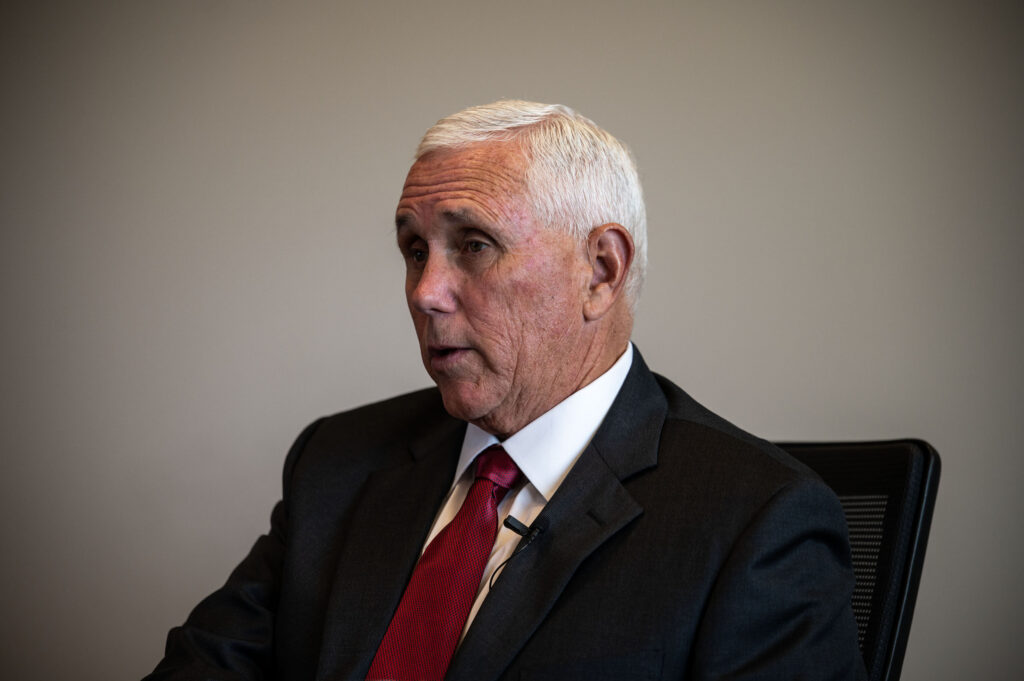
Q&A with Mike Pence | Former vice president says GOP’s populist turn from conservatism isn’t permanent
Ernest Luning
ernest.luning@coloradopolitics.com
Updated 2 days ago
Former Vice President Mike Pence says he’s concerned that the Republican Party has taken a populist turn away from bedrock conservative principles during President Donald Trump’s second term, but he believes the party will return to its roots when Trump...

Republican Victor Marx taps George Markert as his lieutenant governor pick in Colorado’s gubernatorial race
Ernest Luning
ernest.luning@coloradopolitics.com
Updated 3 days ago
Colorado Republican gubernatorial nominee Victor Marx named George Markert, a retired Marine colonel, as his running mate for lieutenant governor Friday morning, saying the former U.S. Senate candidate will bring “exceptional character, proven leadership and a lifetime of serving others”...
Pueblo mayor, council concoct Trumpian Texas Two-Step | Dennis Maes
Dennis Maes
dennis-maes@coloradopolitics.com
Updated 4 days ago
Several weeks ago, an article was published positing Pueblo Mayor Heather Graham is a disciple of the calamitous Donald Trump school of governance — specifically as it related to questionable ethical practices and the misuse of public funds. Recently, Graham...
PREV
PREVIOUS

10th Circuit agrees Frontier must pay TSA for security fees
Frontier Airlines must pay nearly $5.4 million to the Transportation Security Administration after it improperly held onto security-related fees paid by certain customers, the federal appeals court in Denver ruled on Monday. The TSA argued that federal law and regulations permit refunds of a ticket-based security fee to be paid to only two recipients: the […]

Colorado Aeronautical Board greenlights millions in airport funding
Many of Colorado’s public-use airports can now begin or complete key projects that enhance aviation safety and support the state’s transition to cleaner aviation fuels. Last week, the Colorado Aeronautical Board approved $7.3 million in grants from the Colorado Aviation Discretionary Grant Program. This state-funded program funnels aviation fuel tax revenue back to Colorado airports […]