

10th Circuit agrees Frontier must pay TSA for security fees

Frontier Airlines must pay nearly $5.4 million to the Transportation Security Administration after it improperly held onto security-related fees paid by certain customers, the federal appeals court in Denver ruled on Monday.
The TSA argued that federal law and regulations permit refunds of a ticket-based security fee to be paid to only two recipients: the TSA or the passenger who bought the ticket. By retaining the fee when a passenger cancels their ticket and never uses their travel credit, Frontier was giving itself a financial windfall.
By 2-1, a three-judge panel of the U.S. Court of Appeals for the 10th Circuit agreed with the government.
“Congress tasked Frontier with collecting the fee under the auspices of the federal government for a purpose designated by it (civil aviation security services) and provided various safeguards to ensure that the fees are not subverted,” wrote Senior Judge Paul J. Kelly Jr. in the April 20 opinion. Even if a passenger does not end up traveling, “Frontier cannot keep the fees for itself.”
Judge Timothy M. Tymkovich dissented, believing the TSA is only entitled to collect the fee when a passenger uses the agency’s services by traveling.
“Because Congress did not authorize this collection, TSA has no legal right to the fees disputed here,” he wrote.
Through the Aviation and Transportation Security Act of 2001, Congress established the “September 11th security fee.” The amount is $5.60 for a one-way trip and no more than $11.20 for a round-trip. The fee is imposed “on passengers” and supports TSA salaries, benefits, capital improvements, training, and other costs.
The law requires airlines to collect the fee and send the amount to the government each month.
In 2020, the TSA notified Frontier that an audit found the Denver-based airline owed nearly $5.4 million, stemming from how it handled cancellations. When a passenger cancels their ticket, Frontier either refunds the amount or issues a credit to the customer and then applies a cancellation fee. After 90 days, the “credit shell” expires.
Instead of refunding the security fee to the passenger or to the TSA once the credit shell expired, Frontier kept it. Frontier disputed that it owed the government any money, arguing that TSA could not impose a fee on anyone who did not ultimately fly. Further, Frontier contended that it refunded the fee to customers as a credit shell.
“Frontier’s contrary interpretation of the statutory and regulatory language is artificial, as it emphasizes one consideration (i.e., whether the passenger has actually traveled) over unambiguous and consistent textual indications that air carriers must collect all Fees based on air transportation when it is purchased,” responded Assistant Administrator and Chief Financial Officer Holly C. Mehringer in upholding the TSA’s financial assessment. “Frontier’s creation of an expiring credit shell is not a refund of the Fee to the passenger.”
During oral arguments to the 10th Circuit panel in January, Frontier maintained that it need not transmit a fee from passengers who never use the TSA’s security services due to a ticket cancellation.
“What is the rationale for Frontier not to refund the entire ticket price when the flight is canceled?” asked Judge Harris L Hartz. “You don’t take the trip. Why doesn’t Frontier, as a matter of course, refund the entire amount?”
“It’s just a business decision,” responded attorney Adam P. Feinberg.
Case: Frontier Airlines, Inc. v. Department of Homeland Security
Decided: April 20, 2026
Jurisdiction: Department of Homeland Security
Ruling: 2-1
Judges: Paul J. Kelly Jr. (author)
Harris L Hartz (concurrence)
Timothy M. Tymkovich (dissent)
Ultimately, the panel rejected Frontier’s view that only traveling passengers are subject to the fee. Kelly noted that the law’s structure means airlines will inevitably pass on fees to the TSA after a ticket purchase, but before some passengers’ scheduled travel dates.
“The sort of services funded by the fee include personnel costs, such as salaries, training costs, costs of background investigations of TSA employees and other personnel, and the costs of deploying federal law enforcement to airports,” wrote Kelly for himself and Hartz. “These are not the sort of costs that are specific to any one traveler.”
Tymkovich acknowledged in dissent that the law was unclear whether it intended the fee to cover security services for individual passengers or for the traveling population as a whole. But he believed it was logical for the fee to offset the costs associated with an individual passenger, meaning the TSA was not entitled to collect the fee from someone who did not end up flying.
“The plain meaning of ‘passengers,'” he wrote, “shows that TSA is authorized to impose the fee only on persons who physically travel in airplanes.”
Hartz wrote separately to say that the law “could have been clearer.” Although he believed cancellations mean the security fee is no longer justified, nothing “permits an airline to give itself credit for a fee collected from a customer in that circumstance.”
The case is Frontier Airlines, Inc. v. Department of Homeland Security.

Labels, duration not definitive proof of ‘intimate relationship,’ Colorado court rules in domestic violence case
Michael Karlik
michael.karlik@coloradopolitics.com
Updated 1 hour ago
Colorado’s second-highest court clarified on Thursday that the length of a couple’s relationship and the labels they attach to it are not conclusive evidence of whether it is an “intimate relationship” that can give rise to a domestic violence prosecution....

Colorado Springs mother Deborah Nicholls’ murder conviction overturned, case vacated
Nick Smith
nick-smith@coloradopolitics.com
Updated 2 hours ago
A Colorado Springs mother convicted of murdering her three children in a house fire in 2008 had her verdict overturned and her case vacated. According to a judge’s order, 59-year-old Deborah Nicholls’ conviction was overturned Saturday, Aug. 1 by District...

Colorado AG urges Supreme Court to let Boulder climate lawsuit proceed
Marissa Ventrelli
marissa.ventrelli@coloradopolitics.com
Updated 6 hours ago
Colorado Attorney General Phil Weiser has filed a court brief with the U.S. Supreme Court in a lawsuit brought by Boulder city officials seeking to hold oil companies liable for their environmental impact. The case began in 2018, when the...
10th Circuit says landowner cannot sue ex-Routt County judge for statements in decision
Michael Karlik
michael.karlik@coloradopolitics.com
Updated 20 hours ago
A Routt County landowner cannot sue a former judge for his allegedly inaccurate statements in a case where the landowner was not a party, the Denver-based federal appeals court decided on Wednesday. Anne Fitzsimmons, who lives in Germany, owns a...

Defendant’s competency in question in El Paso County case involving slain Army police officer
Nick Smith
nick-smith@coloradopolitics.com
Updated 5 hours ago
It will be another 60 days before a 4th Judicial District court determines if a man charged in the shooting death of an Army police officer is competent to proceed in his case. Judge Erin Sokol granted a request Wednesday...
Parole, appeals deadlines and restitution: Colorado justices accept cases
Michael Karlik
michael.karlik@coloradopolitics.com
Updated 2 days ago
The Colorado Supreme Court announced on Monday that it will determine how a defendant’s parole-eligibility date should be calculated in instances where a new trial results in a sentence being imposed retroactively to the date of the original, since-overturned sentence....

Federal judge rejects DOJ bid to force Colorado to hand over voter information
Marissa Ventrelli
marissa.ventrelli@coloradopolitics.com
Updated 18 hours ago
A U.S. district court judge has dismissed a lawsuit filed by the U.S. Department of Justice against Colorado Secretary of State Jena Griswold for refusing to provide the agency with personal voter information. Last December, the DOJ’s Civil Rights Division asked...
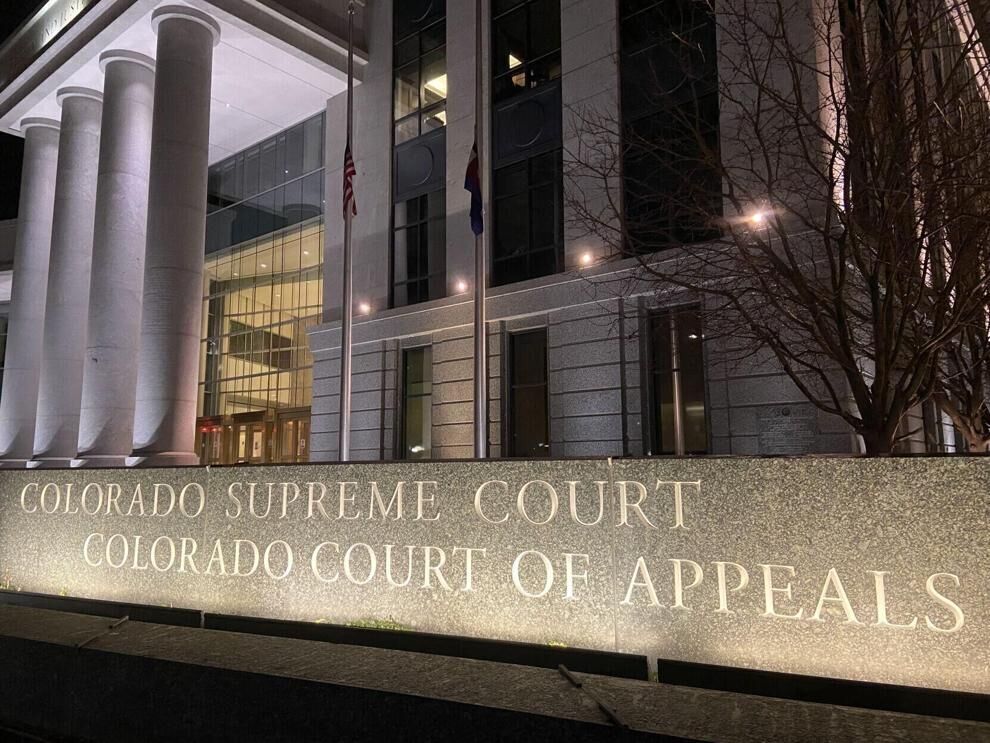
3 Colorado judges receive unfavorable retention recommendation as one performance commission violates rules
Michael Karlik
michael.karlik@coloradopolitics.com
Updated 2 days ago
Of the 123 Colorado judges standing for retention on the November ballot, citizen-led performance commissions found that three did not meet the required performance standards. However, in an unprecedented move, the commission charged with evaluating Supreme Court and Court of...

10th Circuit weighs Gross Reservoir expansion, judge’s ‘punishment’ of Denver Water
Michael Karlik
michael.karlik@coloradopolitics.com
Updated 21 hours ago
Members of the Denver-based federal appeals court considered on Friday whether they could intervene in an ongoing infrastructure project to enlarge a Boulder County dam after a trial judge deemed the underlying permit unlawful nearly two years ago. Denver Water...

10th Circuit upholds federal prohibition on juvenile handgun possession
Michael Karlik
michael.karlik@coloradopolitics.com
Updated 2 days ago
The Denver-based federal appeals court concluded on Monday that Congress acted within its constitutional powers to make it a crime for juveniles to possess handguns in most instances. The decision from the U.S. Court of Appeals for the 10th Circuit...
PREV
PREVIOUS

Colorado House ethics panel reviews complaint alleging misuse of Democratic caucus money
Colorado’s House Ethics Committee has begun reviewing a complaint accusing Rep. Mandy Lindsay of improperly handling Democratic caucus money, setting in motion a weeks‑long inquiry into her role and responsibilities as caucus co‑chair. The complaint was filed in January by Rep. Bob Marshall, D-Highlands Ranch. Lindsay has until April 30 to respond to the complaint. […]

Colorado Democratic bill would allow lawsuits against federal officials, drawing warnings from local critics
Colorado Democrats are considering a bill that would let people sue federal, state, and local officials for alleged constitutional violations — a change supporters say would check government power but critics warn could trigger a surge of lawsuits against public employees. Senate Bill 176 would allow individuals who have been subjected to a “deprivation of […]