

10th Circuit upholds verdict against Denver, officer for protest-related violations
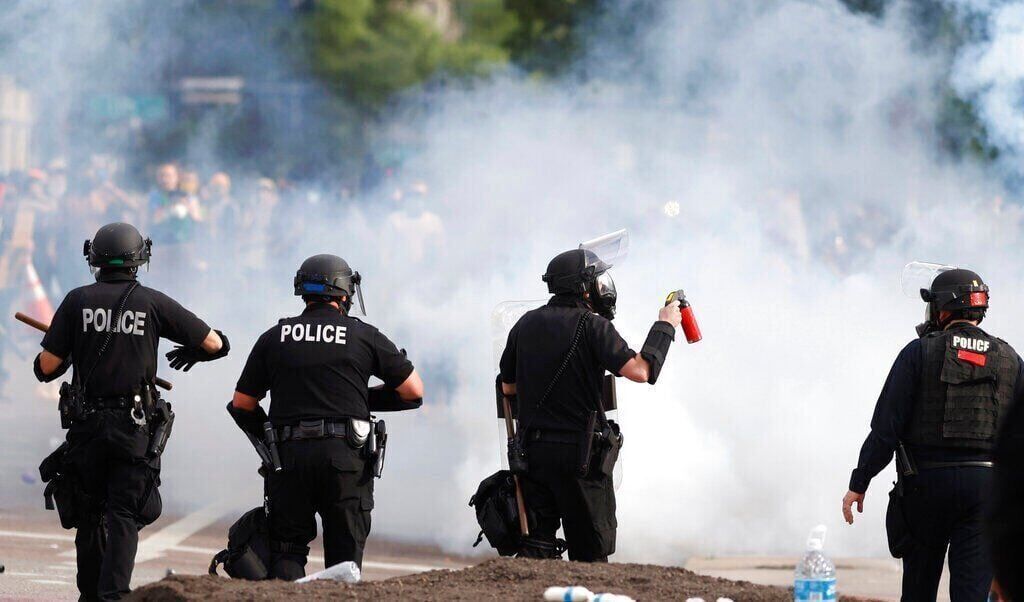
The Colorado-based federal appeals court on Tuesday turned aside multiple challenges to a 2022 jury verdict that found Denver and one of its officers violated the constitutional rights of protesters and were liable for $14 million.
In the first of many lawsuits culminating in a jury trial, 12 plaintiffs largely succeeded in arguing that Denver’s own actions violated their First Amendment rights, Fourth Amendment rights, or both during the demonstrations that began in May 2020. At the time, protesters in Denver and across the world took to the streets in response to the police killing of George Floyd in Minneapolis. Law enforcement used chemicals, projectiles and other force against them.
In a pair of decisions, a three-judge panel of the U.S. Court of Appeals for the 10th Circuit found that evidence supported the jury’s verdict and that the trial judge did not commit any errors warranting reversal.
“There was sufficient evidence, including from Plaintiffs’ two experts, that Denver policymakers knew its officers would have to confront a civil rights protest,” wrote Senior Judge David M. Ebel in the April 21 opinion. “Plaintiffs presented sufficient evidence for a reasonable jury to find that the City was deliberately indifferent in not training its officers adequately on crowd control and the use of less-lethal munitions during protests.”
Among other things, Denver argued that U.S. District Court Senior Judge R. Brooke Jackson erred by allowing testimony from the city’s former independent police monitor, Nicholas Mitchell, about his investigation. Mitchell’s statements were uniquely damaging, argued attorney Frederick R. Yarger to the appellate panel, because “he is the only witness they could use to tell the jury he was the Denver official tasked with assessing the department’s response to the protests.”
Jackson had ruled that Mitchell could testify about his investigation because it was “paid for by the taxpayers, and it seems to me that these taxpayers sitting in the jury box are entitled to hear about it.”
“Denver doesn’t want to admit that it made even a single mistake,” said Jackson. “There were excessive applications of force. I think the videos demonstrate that.”
After the verdict, the city asked for a new trial, in part, on the grounds that Mitchell had no personal knowledge of what occurred at the protests and was not qualified as an expert witness. Jackson denied the request, finding that even if Mitchell’s testimony was improper, there “was substantial evidence supporting the verdict.”
“Judge Jackson limited Nick Mitchell to testifying about what he did, his personal observations and his personal conclusions,” plaintiffs’ attorney R. Reeves Anderson told the 10th Circuit panel. “And his notices that he previously gave to Denver about the inadequacy of its policies and training.”
The 10th Circuit took no issue with Mitchell’s testimony.
“Mitchell testified to matters that were rationally based on his perception as a fact gatherer, even though his perceptions were not first-hand observations of the protests themselves,” wrote Ebel. “In this respect, Mitchell’s testimony is analogous to testimony from law enforcement officers who, although they did not witness the criminal activity at issue in a given case, are permitted … to testify as to their investigation of that criminal activity.”
Case: Packard v. City and County of Denver
Decided: April 21, 2026
Jurisdiction: U.S. District Court for Colorado
Ruling: 3-0
Judges: David M. Ebel (author)
Joel M. Carson III
Richard E.N. Federico
The panel separately decided the appeal of Officer Jonathan Christian, who shot a pepper ball at plaintiff Elisabeth Epps while she was crossing the street to the Capitol. Jurors saw a bruise documented on Epps’ leg. They found Christian liable for excessive force.
Christian argued that Jackson should have granted him qualified immunity, a judicial doctrine that shields government employees from civil lawsuits unless they violate a person’s clearly established rights.
“Had he given her a direct command to stop before he fired the shot?” asked Ebel during oral arguments.
“The evidence does not suggest that,” conceded Christian’s attorney, Andrew D. Ringel.
Epps, who subsequently served one term in the state House of Representatives, pointed to a 10th Circuit decision from the same case in 2023 that found “it had been clearly established for (at least) twelve years” that officers commit a constitutional violation by using less-lethal force on non-threatening protesters.
“There was no justified reason for Officer Christian to shoot her,” attorney Brian M. Williams told the panel.
The judges agreed with Epps.
“There was sufficient evidence to support the jury’s finding, including Epps’ testimony and video evidence that Officer Christian shot Epps, without warning, with a pepperball as she walked by herself (and not in a group), unarmed and non-threatening, across the street toward the capitol,” wrote Ebel. “Any crime she may have been committing, including jaywalking, was minor.”
Lawyers for the defendants did not immediately respond to a request for comment.
“This outcome is monumental and should be a lesson to law enforcement across the country. No police officer or municipality can escape accountability for their violence against people exercising their sacred right to peacefully protest,” said Tim Macdonald, the ACLU of Colorado’s legal director, who represented some of the plaintiffs.
“Our clients bravely stood up in the streets against police brutality in 2020, and they’ve been doing it ever since in the courts,” added Elizabeth Wang, who represented the other plaintiffs.
The case is Packard et al. v. City and County of Denver et al.
Editor’s note: This article has been updated to clarify the description of Christian’s excessive force violation.


Parenting from prison: Inmates hope to be present in their children’s lives, while physically absent
Marianne Goodland
marianne.goodland@coloradopolitics.com
Updated 1 day ago
The room was decorated with balloons, the tables sparking bright with colors as the smell of pizza and cake wafted through the air. As did music. This was, after all, a father-daughter dance. Except this was not a typical father-daughter...
Appeals court confirms Colorado judges can compel electronic records from out of state
Michael Karlik
michael.karlik@coloradopolitics.com
Updated 14 hours ago
Colorado’s second-highest court clarified on Thursday that judges are empowered to compel out-of-state companies to produce electronic records under state law. El Paso County jurors convicted Mischa Jargowsky on three counts of money laundering and one violation of Colorado’s organized...
10th Circuit upholds finding of no racial discrimination against family at Denver Chili’s
Michael Karlik
michael.karlik@coloradopolitics.com
Updated 10 hours ago
The Denver-based federal appeals court agreed on Wednesday that a Black plaintiff failed to show that a Chili’s manager’s request for her family to provide valid payment at the outset of their meal amounted to racial discrimination. Markesha Futrell-Smith filed...
Appeals court reinstates Mesa County defendant’s request for DNA testing under new Colorado law
Michael Karlik
michael.karlik@coloradopolitics.com
Updated 1 day ago
Colorado’s second-highest court revived a Mesa County defendant’s petition for DNA testing in his three-decade-old attempted murder case on Thursday, concluding that a trial judge wrongly interpreted a recent Colorado law in dismissing the request outright. Jurors convicted Billy Joe...
Appeals court reverses Denver juvenile’s conviction due to improper expert testimony
Michael Karlik
michael.karlik@coloradopolitics.com
Updated 1 day ago
Colorado’s second-highest court reversed a juvenile defendant’s conviction for unlawful sexual contact on Thursday after an expert witness’s testimony improperly suggested the child victim was telling the truth. The defendant, identified as S.H-S., was around 16 years old when he...

Judge orders home confinement for Barry Morphew
Dennis Huspeni
dennis.huspeni@gazette.com
Updated 2 days ago
An Alamosa County district judge has ordered home confinement for Barry Morphew, who is accused of murdering his wife. Barry Morphew, 59, faces a first-degree murder charge in the death of his wife, Suzanne Morphew, who disappeared Mother’s Day weekend...
Appeals court says jury does not need to view porn to determine if it’s ‘obscene’
Michael Karlik
michael.karlik@coloradopolitics.com
Updated 14 hours ago
Colorado’s second-highest court ruled for the first time on Thursday that a jury does not always need to view pornographic material to determine if it meets the criteria for obscenity. Mesa County jurors found Shayla Ann Simpson guilty of child...
10th Circuit disagrees Sterling officer had no basis to arrest motorist who lacked insurance details
Michael Karlik
michael.karlik@coloradopolitics.com
Updated 2 days ago
The Denver-based federal appeals court disagreed on Tuesday with a trial judge’s decision to bar evidence from a pat-down search from being used against a defendant. Federal prosecutors obtained an indictment of Jorge Sigala-Baray for being a felon in possession of a...
Colorado Springs officers’ tasing, threats prompt federal judge to block use of suspect’s statements
Michael Karlik
michael.karlik@coloradopolitics.com
Updated 2 days ago
A federal judge blocked the government last month from using some of a defendant’s statements as evidence, reasoning that the defendant made them involuntarily as Colorado Springs officers tased him five times and one officer threatened to kill him. Officers...

Appeals court rejects CDOT employee’s discrimination, retaliation claims
Michael Karlik
michael.karlik@coloradopolitics.com
Updated 11 hours ago
Colorado’s second-highest court agreed last week that a Colorado Department of Transportation employee had not shown that his employer discriminated and retaliated against him due to his religion and national origin. Ayman Salloum, who described himself as a 70-year-old Muslim...
PREV
PREVIOUS

DPS committee backs bell-to-bell cellphone ban
Students might have to ditch their cell phones if the Denver Public Schools Board of Education follows a recommendation to adopt a bell-to-bell cellphone ban. A Communication Devices Advisory Committee was formed earlier this year to comply with a new state law that requires school districts to adopt a cellphone policy by July 1. The […]

Colorado lawmakers push limits on data-driven pricing as critics push back
Colorado lawmakers are weighing a proposal to restrict the use of algorithms in setting prices and wages, as advocates warn the technology enables hidden discrimination while business groups argue the bill overreaches and interferes with legitimate data‑driven practices. House Bill 1210 would prohibit using a “price or wage setting algorithm” to determine the amount charged […]