

Divided appeals court finds no prosecutorial misconduct in prison assault case

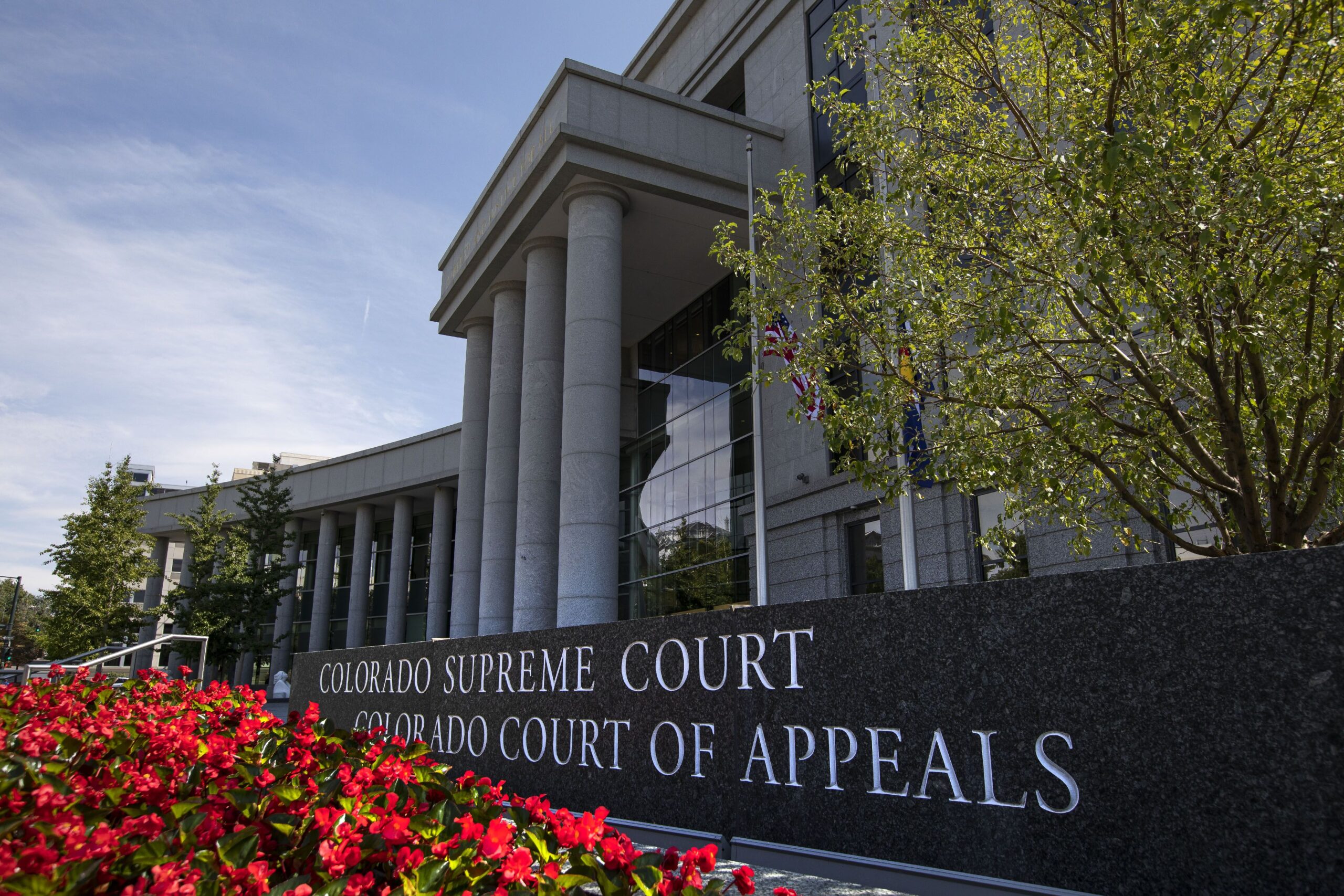
Colorado’s second-highest court concluded last week that a Lincoln County prosecutor did not misstate the law to a degree that undermined a jury’s assault verdict against the defendant.
During closing arguments in Phillip Archuleta’s 2023 trial, the prosecutor suggested to jurors that Archuleta did not have to make contact with a corrections officer during a scuffle to be found guilty of assault, even though Colorado law requires Archuleta to have “applied physical force.” Archuleta contended on appeal that the mischaracterization amounted to prosecutorial misconduct.
By 2-1, a three-judge Court of Appeals panel decided that any misstep by the prosecutor did not cast serious doubt on the outcome of the trial.
The panel’s “review of the record reveals overwhelming evidence that Archuleta did apply physical force to (the victim),” wrote Judge Matthew D. Grove in the April 30 opinion. Video footage “plainly shows Archuleta applying physical force to (the victim) when he shoved him into the trash can.”
Judge Daniel M. Taubman disagreed. He believed the surveillance footage did not clearly show an application of force. Further, Taubman concluded the prosecutor’s misstatement of the law rose to the level of misconduct.
“Rather than applying the evidence to the statute, the prosecutor sought to make the statute fit the evidence. This was a ‘foul’ blow that undermined the fundamental fairness of the trial,” wrote Taubman. “In my view, this error was plainly improper and casts doubt on the reliability of the conviction.”
Although the Court of Appeals did not name the prosecutor, the 23rd Judicial District Attorney’s Office identified him as Rick Rabner.
Case: People v. Archuleta
Decided: April 30, 2026
Jurisdiction: Lincoln County
Ruling: 2-1
Judges: Matthew D. Grove (author)
David H. Yun
Daniel M. Taubman (dissent)
Prosecutors charged Archuleta with assaulting an employee at Limon Correctional Facility. There was a physical interaction in which officers pepper sprayed Archuleta, and Archuleta swung his fists. The victim fell onto a nearby trash can. Video footage did not definitively show Archuleta making contact with the victim, and the only person present who testified at trial acknowledged that he did not see Archuleta land a punch.
To convict Archuleta, jurors had to find that he “knowingly and violently” applied physical force to the victim.
In closing arguments, Rabner told jurors that “swinging closed fists — landing or not — that’s violent.” After Archuleta’s attorney rhetorically asked jurors where they saw Archuleta make contact with the victim on the video, Rabner suggested contact was unnecessary.
“Did he knowingly and violently act towards a member of staff? That’s it. Didn’t have to punch, didn’t have to kick, didn’t have to stab, didn’t have to shoot. He had to knowingly and violently act towards a member of staff,” said Rabner. “Did he knowingly and violently — while in custody, confined to the detention facility — do what he shouldn’t have done against a staff member?”
The Court of Appeals panel determined the evidence was sufficient for the jury to find Archuleta guilty. The majority further concluded that, while Rabner’s statements “may have been improper,” the broader context did not warrant reversal of Archuleta’s conviction.
Grove, writing for himself and Judge David H. Yun, noted the prosecutor and District Court Judge H. Clay Hurst both told jurors at various points about the requirements of Colorado law. Consequently, jurors would have understood that physical contact between Archuleta and the victim was required.
“Thus, even if the jury were to conclude that Archuleta’s punches earlier in the confrontation did not make contact, and even if it were to also find that Archuleta was not applying physical force when he and (the victim) began tussling,” wrote Grove, “the shove that propelled (the victim) into the trash can and then onto the floor provides overwhelming evidence that Archuleta applied physical force.”
Taubman, in dissent, took issue with that analysis. He argued that Rabner relied on Archuleta’s punch, and not the shove into the trash can, as the act of assault. The grainy video, which jurors were not allowed to slow down or pause, was also unclear, Taubman continued.
“‘Didn’t have to punch, didn’t have to kick, didn’t have to stab, didn’t have to shoot.’ With this refrain, the prosecution repeatedly argued in closing that defendant, Phillip Archuleta, could be convicted of second degree assault without the actual application of physical force,” wrote Taubman. “The error here was obvious. The prosecutor’s comments ‘eviscerated a key legal element’ of second degree assault by suggesting that the application of physical force was unnecessary.”
Despite the ambiguity of the video, Taubman believed there was “barely sufficient evidence” to support the jury’s verdict. Therefore, he would have reversed Archuleta’s conviction and permitted prosecutors to retry him.
The case is People v. Archuleta.


A new day? Colorado’s troubled guardianship office pursues ‘cultural reset’
Marianne Goodland
marianne.goodland@coloradopolitics.com
Updated 4 days ago
Colorado’s guardianship program, long criticized for mismanagement and high staff attrition, is undergoing a “cultural reset,” as its new director works to repair partnerships and prepare for a major expansion under recent legislation. Created by lawmakers in 2017, the Office...

Local party leaders, incoming judge among members of judicial performance commission that violated law
Michael Karlik
michael.karlik@coloradopolitics.com
Updated 2 days ago
A local Democratic leader and 2024 presidential elector. A legislative aide and leader in the Young Republicans. An incoming county court judge freshly appointed by the governor. They are among the eight members of the northeastern Colorado judicial performance commission...

Judge dismisses lawsuit seeking records from Colorado Democratic group
Marianne Goodland
marianne.goodland@coloradopolitics.com
Updated 3 days ago
A lawsuit seeking to obtain records from Democratic lawmakers affiliated with a caucus has been thrown out by a Denver District Court judge. On July 17, Judge Ericka Englert dismissed the April lawsuit filed by progressive activist Derrick Blanton, who...
Colorado Springs mother Deborah Nicholls’ murder conviction overturned
Nick Smith
nick-smith@coloradopolitics.com
Updated 4 days ago
A Colorado Springs mother convicted in 2008 of murdering her three children in a house fire might get a new trial after a judge ruled that prosecutors withheld key evidence that could have impacted the jury’s verdict. Deborah Nicholls, whose...
Colorado court overturns illegal $7,000 restitution order
Michael Karlik
michael.karlik@coloradopolitics.com
Updated 2 days ago
Colorado’s second-highest court overturned a Weld County defendant’s obligation to pay more than $7,000 in crime victim restitution on Thursday because a trial judge failed to issue a legally compliant restitution order at the time of sentencing. In Colorado, as...

Appeals court rejects former DougCo commissioner’s legal fee claim
Nicholas Fogleman
nicholas.fogleman@denvergazette.com
Updated 3 days ago
The Colorado Court of Appeals rejected a former Douglas County commissioner’s bid for reimbursement of attorney fees she incurred while responding to multiple investigations into her conduct. The dispute stemmed from a 2019 anonymous letter sent to county officials alleging...
Appeals court orders second look at Denver Water’s immunity for cyclist’s injury
Michael Karlik
michael.karlik@coloradopolitics.com
Updated 4 days ago
Colorado’s second-highest court ordered another look at a bicyclist’s negligence lawsuit against Denver Water on Thursday, concluding that a trial judge needed to evaluate the utility’s potential immunity using the state Supreme Court’s new guidance. Joseph A. “Joey” Scott alleged...
Labels, duration not definitive proof of ‘intimate relationship,’ Colorado court rules in domestic violence case
Michael Karlik
michael.karlik@coloradopolitics.com
Updated 3 days ago
Colorado’s second-highest court clarified on Thursday that the length of a couple’s relationship and the labels they attach to it are not conclusive evidence of whether it is an “intimate relationship” that can give rise to a domestic violence prosecution....

Colorado AG urges Supreme Court to let Boulder climate lawsuit proceed
Marissa Ventrelli
marissa.ventrelli@coloradopolitics.com
Updated 4 days ago
Colorado Attorney General Phil Weiser has filed a court brief with the U.S. Supreme Court in a lawsuit brought by Boulder city officials seeking to hold oil companies liable for their environmental impact. The case began in 2018, when the...
10th Circuit says landowner cannot sue ex-Routt County judge for statements in decision
Michael Karlik
michael.karlik@coloradopolitics.com
Updated 5 days ago
A Routt County landowner cannot sue a former judge for his allegedly inaccurate statements in a case where the landowner was not a party, the Denver-based federal appeals court decided on Wednesday. Anne Fitzsimmons, who lives in Germany, owns a...
PREV
PREVIOUS

Colorado legislators reject 'No Kings' bill allowing residents to sue federal officers
A panel of Colorado legislators on Tuesday rejected legislation that would have allowed residents to sue federal and local officials in state court for alleged constitutional violations. Senate Bill 176 would have allowed individuals who have been subjected to a “deprivation of any rights, privileges, or immunities” afforded in the U.S. Constitution to sue for civil […]

Hickenlooper hears stories on Medicaid, health costs at Denver Health
U.S. Sen. John Hickenlooper went to Denver Health on Tuesday to hear how rising health care costs and federal policy changes are affecting patients. He got an earful. Hospital staff shared stories about Medicaid patients who lost eligibility — and then a limb or their life. Dr. Stephanie Augustine, a family medicine physician, told of […]