

SCOTUS decision on ‘3 strikes’ sentences does not benefit defendants with older convictions, appeals court says
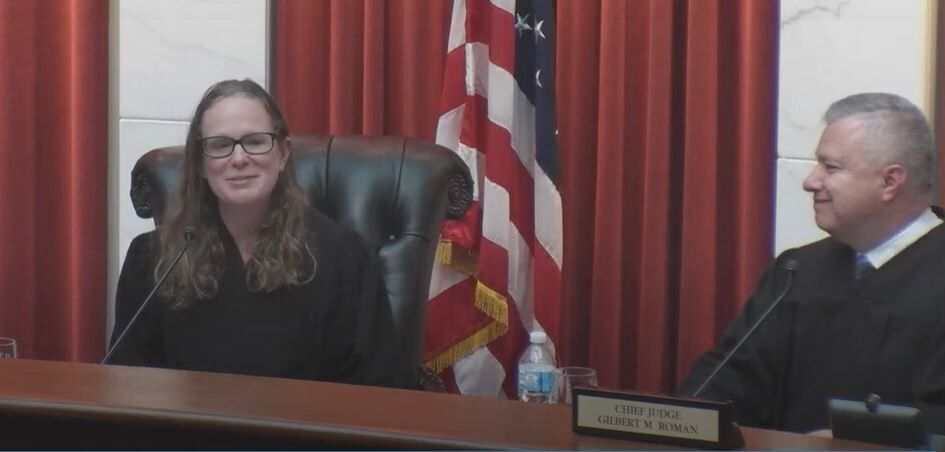
A recent U.S. Supreme Court decision affecting how defendants are sentenced under Colorado’s “three strikes” law does not benefit people whose convictions have long been final, the state’s second-highest court ruled on Thursday.
For many years, Colorado’s Habitual Criminal Act required judges to impose three or four times the maximum sentence if a defendant was convicted of a felony and had multiple prior felonies. Those prior convictions must arise “out of separate and distinct criminal episodes.” Before 1995, juries made that determination, but legislators changed the law that year to entrust judges with the task.
Then, in 2024, the Supreme Court called into question Colorado’s method of enhancing defendants’ sentences under the three-strikes law. By 6-3, the justices ruled in Erlinger v. United States that the U.S. Constitution requires juries to decide beyond a reasonable doubt whether a defendant committed prior felonies on separate occasions.
The legislature has since revised the three strikes law to clarify that juries must be involved.
But what did the Erlinger decision mean for people whose convictions became final before the Supreme Court’s ruling?
A Jefferson County jury convicted Delano Marco Medina in 2015 of assault-related offenses. A judge imposed a 44-year sentence under the habitual criminal law.
After the Erlinger decision, Medina, representing himself, moved to dismiss the habitual criminal components of his case because he had not received a jury’s consideration of his prior convictions.
In a November 2024 order, District Court Judge Chantel Contiguglia concluded that Medina’s three-strikes sentence would be unconstitutional if Erlinger applied retroactively.
She noted that the Supreme Court had recognized a new constitutional rule. But, to be retroactive, it would need to alter the scope of conduct that the state has the power to punish. Contiguglia determined the Erlinger decision did not do that.
Alternatively, retroactivity would apply to a “watershed” rule, meaning the likelihood of accurately convicting someone would be jeopardized in the rule’s absence. Contiguglia believed that letting a judge analyze the existence of prior “separate and distinct criminal episodes” did not seriously affect the accuracy of Medina’s convictions.
“What is considered to be ‘separate occasions’ is ultimately subjective, and without guidance from the common law or legislature on precisely what ‘separate occasions’ means, juries will diverge on their interpretation of the meaning of ‘separate occasions’,” she wrote, “just as judges will.”
Case: People v. Medina
Decided: May 7, 2026
Jurisdiction: Jefferson County
Ruling: 3-0
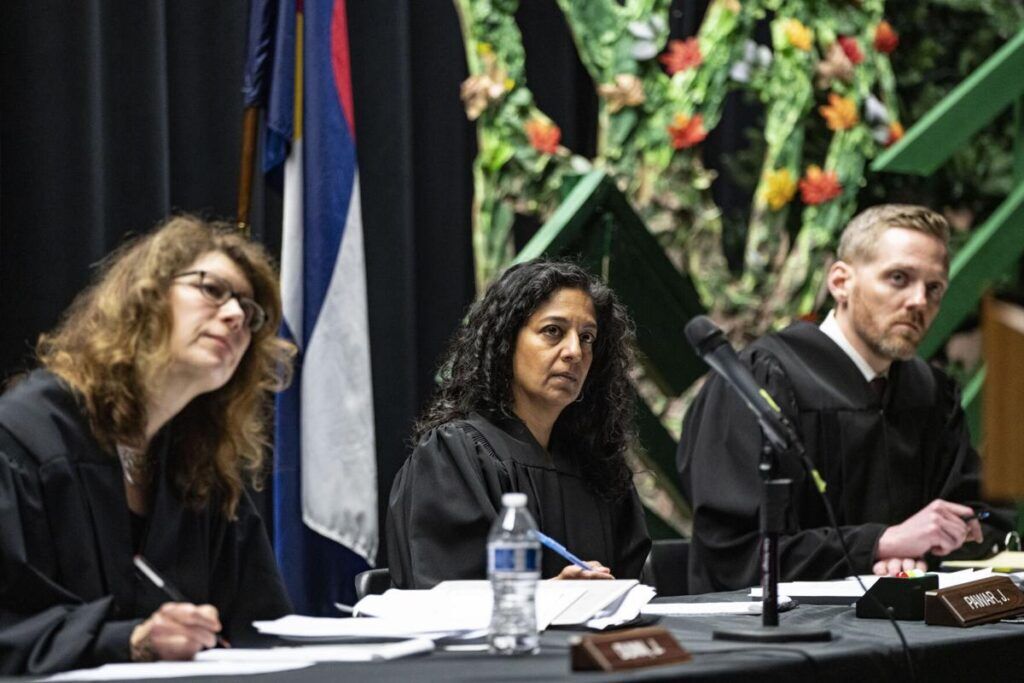
Judges: Christina F. Gomez (author)
Neeti V. Pawar
Sueanna P. Johnson
A three-judge Court of Appeals panel agreed that the new constitutional rule from the Supreme Court did not apply retroactively to defendants like Medina.
“The rule announced in Erlinger is procedural, not substantive. It doesn’t alter the range of conduct or the class of persons the law punishes,” wrote Judge Christina F. Gomez in the May 7 opinion. “Rather, it solely affects the manner of determining a defendant’s punishment by allocating decision-making authority between a judge and a jury on an issue affecting habitual sentencing.”
She added that the prior system also did not create a risk of injustice to defendants.
The case is People v. Medina.


A new day? Colorado’s troubled guardianship office pursues ‘cultural reset’
Marianne Goodland
marianne.goodland@coloradopolitics.com
Updated 3 days ago
Colorado’s guardianship program, long criticized for mismanagement and high staff attrition, is undergoing a “cultural reset,” as its new director works to repair partnerships and prepare for a major expansion under recent legislation. Created by lawmakers in 2017, the Office...
Local party leaders, incoming judge among members of judicial performance commission that violated law
Michael Karlik
michael.karlik@coloradopolitics.com
Updated 1 day ago
A local Democratic leader and 2024 presidential elector. A legislative aide and leader in the Young Republicans. An incoming county court judge freshly appointed by the governor. They are among the eight members of the northeastern Colorado judicial performance commission...
Judge dismisses lawsuit seeking records from Colorado Democratic group
Marianne Goodland
marianne.goodland@coloradopolitics.com
Updated 2 days ago
A lawsuit seeking to obtain records from Democratic lawmakers affiliated with a caucus has been thrown out by a Denver District Court judge. On July 17, Judge Ericka Englert dismissed the April lawsuit filed by progressive activist Derrick Blanton, who...
Colorado Springs mother Deborah Nicholls’ murder conviction overturned
Nick Smith
nick-smith@coloradopolitics.com
Updated 3 days ago
A Colorado Springs mother convicted in 2008 of murdering her three children in a house fire might get a new trial after a judge ruled that prosecutors withheld key evidence that could have impacted the jury’s verdict. Deborah Nicholls, whose...
Colorado court overturns illegal $7,000 restitution order
Michael Karlik
michael.karlik@coloradopolitics.com
Updated 2 days ago
Colorado’s second-highest court overturned a Weld County defendant’s obligation to pay more than $7,000 in crime victim restitution on Thursday because a trial judge failed to issue a legally compliant restitution order at the time of sentencing. In Colorado, as...

Appeals court rejects former DougCo commissioner’s legal fee claim
Nicholas Fogleman
nicholas.fogleman@denvergazette.com
Updated 2 days ago
The Colorado Court of Appeals rejected a former Douglas County commissioner’s bid for reimbursement of attorney fees she incurred while responding to multiple investigations into her conduct. The dispute stemmed from a 2019 anonymous letter sent to county officials alleging...
Appeals court orders second look at Denver Water’s immunity for cyclist’s injury
Michael Karlik
michael.karlik@coloradopolitics.com
Updated 3 days ago
Colorado’s second-highest court ordered another look at a bicyclist’s negligence lawsuit against Denver Water on Thursday, concluding that a trial judge needed to evaluate the utility’s potential immunity using the state Supreme Court’s new guidance. Joseph A. “Joey” Scott alleged...
Labels, duration not definitive proof of ‘intimate relationship,’ Colorado court rules in domestic violence case
Michael Karlik
michael.karlik@coloradopolitics.com
Updated 2 days ago
Colorado’s second-highest court clarified on Thursday that the length of a couple’s relationship and the labels they attach to it are not conclusive evidence of whether it is an “intimate relationship” that can give rise to a domestic violence prosecution....

Colorado AG urges Supreme Court to let Boulder climate lawsuit proceed
Marissa Ventrelli
marissa.ventrelli@coloradopolitics.com
Updated 3 days ago
Colorado Attorney General Phil Weiser has filed a court brief with the U.S. Supreme Court in a lawsuit brought by Boulder city officials seeking to hold oil companies liable for their environmental impact. The case began in 2018, when the...
10th Circuit says landowner cannot sue ex-Routt County judge for statements in decision
Michael Karlik
michael.karlik@coloradopolitics.com
Updated 4 days ago
A Routt County landowner cannot sue a former judge for his allegedly inaccurate statements in a case where the landowner was not a party, the Denver-based federal appeals court decided on Wednesday. Anne Fitzsimmons, who lives in Germany, owns a...
PREV
PREVIOUS

Colorado Senate committee rejects transparency bill that would have applied to legislative caucuses
A panel of senators voted down a proposed measure requiring legislative caucuses to disclose certain financial records. Sponsored by Sen. Mike Weissman, D-Aurora, Senate Bill 168 would also require legislative caucuses to provide the Legislative Council with caucus members’ contact information. The bill specifically addresses legislative caucuses based on interest, ideology, issue, or identity, not […]

Colorado Senate honors journalism icon Fred Brown
The Colorado Senate on Thursday honored longtime Denver Post bureau chief Fred Brown with a ceremony as distinctive as the journalist himself, donning masks bearing his likeness and celebrating his five decades of shaping political reporting and ethical standards in the state. The tribute, offered by Sen. Mark Baisley, R-Woodland Park, noted Brown’s 50 years […]