

Colorado Gov. Polis faces intense lobbying blitz from DC-based groups over credit card ‘swipe-fee’ bill

Colorado’s long‑running fight over credit‑card swipe fees entered its final round Tuesday, when lawmakers sent a proposal to Gov. Jared Polis and rival industry coalitions immediately launched competing campaigns to sway his decision.
The clash pits groups urging Polis to sign the bill — restaurants, hotels, breweries, liquor stores, small businesses, and big‑box retailers — against the financial industry players pushing for a veto. The latter include banks, credit unions, credit‑card companies, and airlines, which argue the measure would wipe out credit‑card rewards programs that consumers use to earn and redeem points for everyday purchases and travel.
The focus has shifted from the legislature to persuading the governor one way or the other. And while community groups and small businesses weighed in throughout the session, the loudest voices are now coming from Washington, D.C.
Also known as interchange fees, swipe fees refer to the 2% to 3% that credit card companies charge retailers every time a customer swipes a credit card to make a purchase.
Senate Bill 26-134 would prohibit credit card companies from charging businesses a transaction fee based on the amount of sales tax. That is, they may not include the sales tax portion of a transaction when calculating the percentage-based “swipe” fee.
In a statement Wednesday, the Colorado Restaurant Association, which is among the bill’s biggest supporters, called the bill’s passage a “huge victory for restaurants across the state.”
“And we now eagerly anticipate Governor Jared Polis signing the bill into law,” the group said.
The Senate amended the bill to require businesses that save on credit card swipe fees to pass those savings along to consumers or use them for employee pay and benefits.
The bill scraped through the Senate on May 1 by a single vote, 18–17, after sitting untouched for nearly two months following its March 4 introduction. Its path through the House was far smoother, helped along by heavyweight sponsorship from the House speaker and majority leader.
SB 134 had its first hearing on Monday and was on its way to the governor’s desk by Wednesday.
The 2026 effort is a slimmed-down version of a 2025 bill that failed in the state Senate.
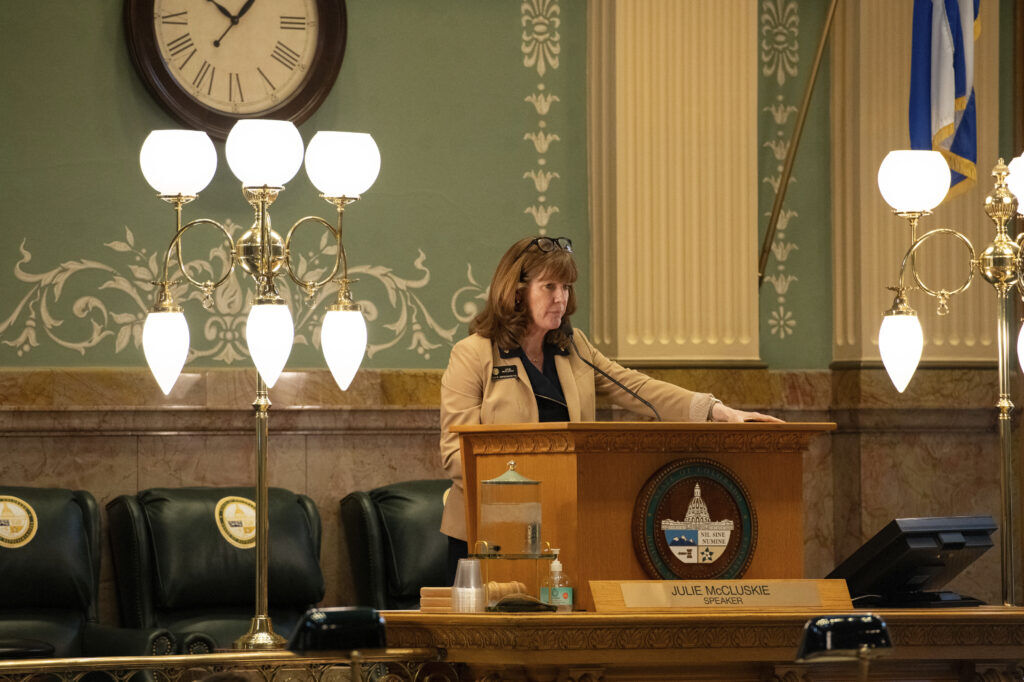
That narrower scope was intentional, House Speaker Julie McCluskie, D-Dillon, told the House Finance Committee. It’s a matter of fairness, she said, adding retailers are being charged a swipe fee on sales taxes that they don’t get to keep.
She also pointed out that the bill would exempt every Colorado-chartered bank and credit union holding assets of less than $60 billion as of Feb. 1, 2026.
Colorado credit unions, despite the exemption, remained opposed to SB 134, citing worries that the exemption wouldn’t work.
Payment systems are not designed to carve out specific taxes or data layers from transactions. Creating that carve-out would result in costly changes to the point-of-sale systems, according to Katie March, representing the state’s credit unions.
No other state has implemented this kind of legislation, she said, adding an asset-cap exemption has never worked to hold small institutions harmless.
Credit union representatives also pointed to the Office of the Comptroller of the Currency, which issued rules on April 24 stating that all federally chartered banks would be preempted from complying with state-level interchange laws.
The ruling could subject Colorado to litigation from the federal government, they said.
A legal opinion from the National Restaurant Association argued that the interim final rules apply only to national banks in connection with the Illinois law that prompted them, and they do not extend to other parts of the payments system, such as payment card networks. Because those networks are not banks, the group’s opinion stated, the federal agency “has no authority to preempt non‑bank entities from state law.”
In the final weeks before the vote on the Colorado legislation, nearly 200 lobbying firms and individual lobbyists were brought in to work on the issue. With lawmakers giving the bill final approval on May 6, Polis now has 30 days to sign it, veto it or allow it to take effect without his signature. Until he decides, lobbying on both sides is expected to intensify.
Among the loudest voices is Airlines for America President and CEO Chris Sununu, who sent Polis a letter on Wednesday urging a veto. Sununu cited polling showing that 80% of Colorado consumers consider credit‑card bonus rewards an important benefit.
He warned that airline‑branded credit cards generated more than $1.2 billion in economic impact and supported nearly 10,000 Colorado jobs in 2024, arguing SB 134 would inject “unnecessary uncertainty” into the rewards system and threaten revenue and investment.
The Electronic Payments Coalition, which represents credit unions, community banks, and payment card networks, also called for a veto. EPC Executive Chairman Richard Hunt said lawmakers ignored warnings from tourism groups, community leaders, legal experts, and small businesses about the “credit card chaos” the bill could create, adding that only a veto would prevent confusion at checkout, costly legal battles, and harm to workers and businesses.
“The only way to prevent confusion at checkout, years of costly legal battles, and harm to Colorado workers and businesses is for Governor Polis to veto this legislation,” Hunt added.
Meanwhile, the Merchants Payment Coalition, a Washington, D.C.-based organization that represents the National Retail Federation, National Association of Convenience Stores, National Grocers Association, the Food Marketing Institute, and other merchant groups, is advocating for Polis to sign the bill.
“This is landmark legislation that will save Colorado small businesses and their customers millions of dollars each year and keep that money in the local economy rather than sending it off to out-of-state megabanks and global card networks,” the coalition’s Doug Kantor said.


Healthcare Freefall: Longer drives, fewer options for maternity care in Colorado
Thelma Grimes
thelma.grimes@coloradopolitics.com
Updated 1 day ago
Editor’s Note: Colorado’s healthcare system is entering a period of accelerating instability — a “tsunami,” as multiple leaders describe it — driven by collapsing hospital finances, shrinking Medicaid reimbursements, disappearing services and a political fight over who is responsible for...

‘All in Good Taste:’ A delicious way to raise money for a good cause | NONPROFIT REGISTER
Joanne Davidson Special to Colorado Politics
joanne-davidson-special-to-colorado-politics@coloradopolitics.com
Updated 4 days ago
JUNIOR ACHIEVEMENT-ROCKY MOUNTAIN Greenwood Village News: Fundraising dinners abound in these parts, and the one that’s hard to beat is All in Good Taste. This benefit for Junior Achievement-Rocky Mountain is presented by Huntington Bank and held at the Orchard...

Trump reaches deal to halt tariffs on beef for 90 days in bid to lower prices
Rena Rowe
rena.rowe@washingtonexaminer.com
Updated 4 days ago
President Donald Trump announced Friday that he had reached a deal to temporarily ease tariffs on beef imports, saying the move would help lower prices for families as the United States faces a severe cattle shortage and record-high beef prices....
Budget red ink threatens to spike inflation and unemployment
Zach Halaschak
zach-halaschak@coloradopolitics.com
Updated 4 days ago
The ticking time bomb that is the national debt just crossed the $40 trillion mark and could spark a fiscal crisis that could throw the economy into disarray, spiking unemployment and exploding inflation. Republicans and some centrist Democrats have long...

Aurora grapples with affordable housing needs, deficits
Kyla Pearce
kyla.pearce@gazette.com
Updated 6 days ago
Aurora is grappling with affordable housing needs as demand for project funding increases and the state cuts grant money. Currently, the city needs about 12,000 affordable housing units, Martin Petrov at Aurora Housing Authority told members of the Housing, Neighborhood...
Douglas County unveils plan to cut red tape, speed business approvals
Nicholas Fogleman
nicholas.fogleman@denvergazette.com
Updated 6 days ago
Douglas County officials on Monday unveiled a Red Tape Reduction Action Plan aimed at streamlining permitting and development reviews to position the county as “the best place in America to invest.” The plan, developed through a partnership between the Douglas...

Celebratory spirit isn’t dampened as rain forces a garden party to move indoors | NONPROFIT REGISTER
Joanne Davidson Special to Colorado Politics
joanne-davidson-special-to-colorado-politics@coloradopolitics.com
Updated 4 days ago
WARREN VILLAGE Denver News: The popularity of the Warren Village Summer Garden Party can without a doubt be credited to this: The chance to enjoy delicious food and refreshing beverages in the splendor of Dr. Jody Mathie’s exquisitely landscaped backyard. ...

Second affordable housing project on church land opens in Colorado Springs
DEBBIE KELLEY
debbie-kelley@coloradopolitics.com
Updated 7 days ago
Greccio Housing doesn’t just do business deals. The nonprofit residential developer and property manager aligns its projects with a mission of providing stable, safe and affordable housing that helps struggling residents achieve stability, according to Executive Director Lee Patke. The...

‘Art of Hope’ celebration will mark TGP’s 40th anniversary | NONPROFIT REGISTER
Joanne Davidson
joanne-davidson@coloradopolitics.com
Updated 1 week ago
THE GATHERING PLACE Denver News: Forty years ago, two University of Denver social work students saw a need that couldn’t be ignored: Women and children experiencing homelessness had to exit overnight shelters seemingly at the crack of dawn, leaving them with nowhere safe to go during...

French court blocks Macron’s social media ban for children under 15
Emily Hallas
emily-hallas@coloradopolitics.com
Updated 2 weeks ago
France’s top court struck down on Friday a law championed by President Emmanuel Macron that would have made it illegal for children to have social media accounts. The law, approved by lawmakers in July, was set to take effect at...
PREV
PREVIOUS

Arapahoe County defendant serving life could receive new trial after lawyer withheld key details
An Arapahoe County defendant who is serving a life sentence for a 20-year-old murder could receive a new trial because his lawyer withheld key details that affected his decision to decline a plea deal, Colorado’s second-highest court ruled last week. There was no dispute that Michael Evans did not shoot the victim during an October […]

Federal judge hears request to halt 'stewardship' transfer of NCAR supercomputer
A federal judge sought to understand last week how the government possesses the authority to transfer “stewardship” of a research and forecasting supercomputer from the Boulder-based operator of the National Center for Atmospheric Research. In the process, U.S. District Court Senior Judge R. Brooke Jackson raised questions about whether the decision is final, what “stewardship” […]