

Overtime for farms, school safety, public office rules: What’s new in Colorado law
Gov. Jared Polis signed 25 bills into law Monday, bringing changes that will affect workers, families, schools, and local governments across Colorado.
The new laws deal with a range of issues – from overtime rules for farmworkers to limits on lawmakers holding multiple offices, along with school safety upgrades and new standards for dementia care facilities.
These measures — some technical, others sweeping — reflect the wide array of issues lawmakers tackled during a session defined by tight budgets and competing priorities.
No double-dipping
As introduced, Senate Bill 59 would have prohibited state lawmakers — including newly elected members of the Colorado General Assembly — from holding a second elected office at the same time.
The issue has surfaced repeatedly over the past decade, as several legislators have simultaneously served on city councils, town councils or school boards.
In the 2026 General Assembly, Rep. Lori Goldstein, D‑Westminster, serves both as chair of the Adams 12 school board and as the representative for House District 29. Rep. Max Brooks, R‑Castle Rock, who represents House District 45, also sits on the Castle Rock Town Council.
Both Brooks and Goldstein voted “no” on the bill.
However, the original bill was amended to remove the language referring to members-elect.
Under the version signed by the governor, the bill requires any lawmaker who holds another elected office to resign from that position upon being sworn into the Colorado General Assembly.
The law includes a few exceptions: lawmakers may finish out the other term if less than a year remains, if they serve on a special district board, or — if they are senators — when they are in the middle of their legislative term.
Not all legislators holding another government kept those positions upon joining the legislature.
Rep. Kenny Nguyen, D-Broomfield, a member of the Broomfield City Council when he was chosen earlier this year by a vacancy committee to replace Rep. William Lindstedt, resigned his city council seat shortly before being sworn in at the Capitol.
Overtime pay on farms
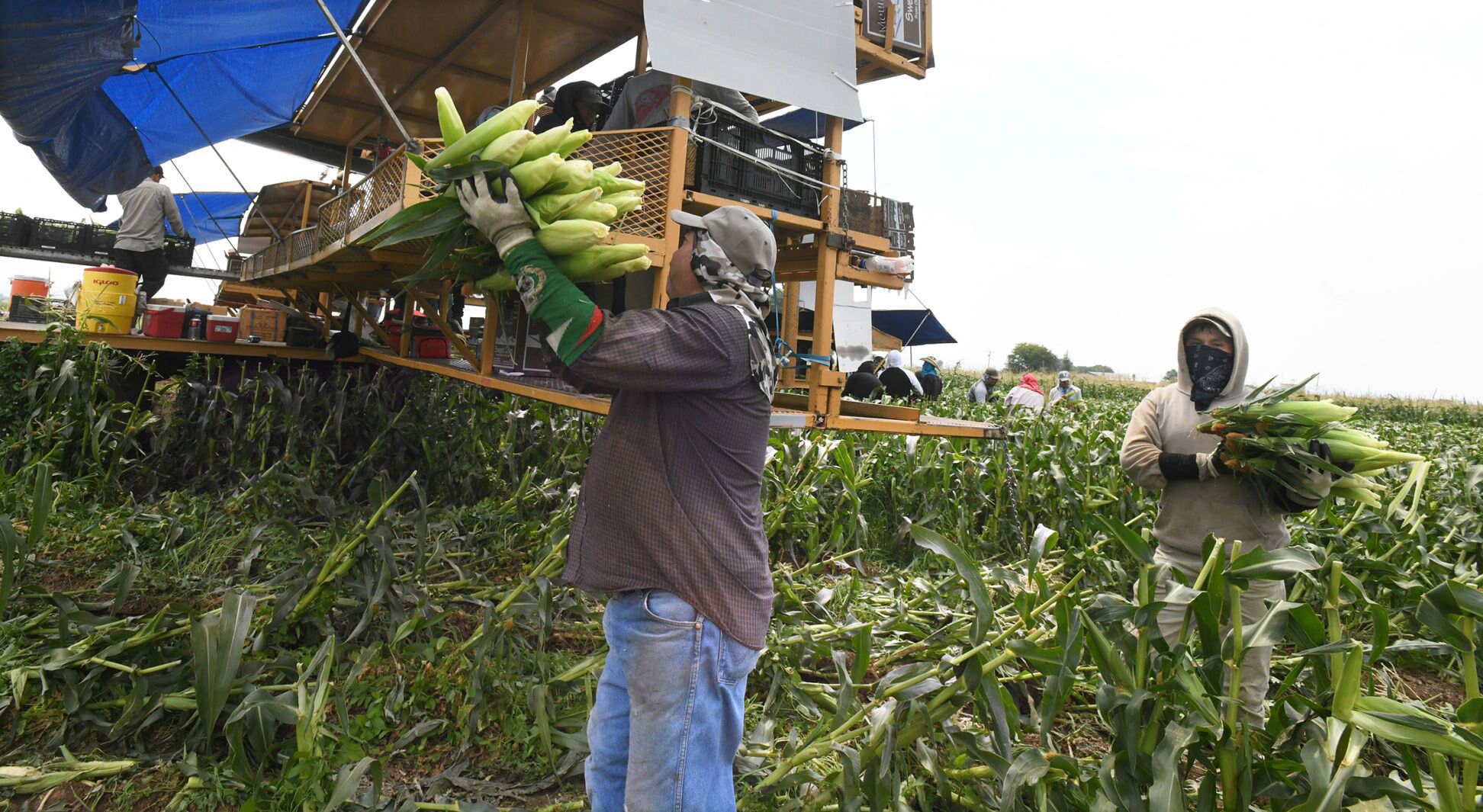
Senate Bill 121 raises the overtime threshold for agricultural workers from 48 hours to 56 hours per week.
Supporters argued that many employers currently cap workers at 48 hours to avoid paying overtime, citing studies showing the policy reduces overall earnings and forces some workers to take second jobs.
Opponents of the measure countered that agricultural workers should be subject to the same overtime rules as other workers, rather than having a separate standard.
The bill overturns a portion of a 2021 law that has been modified twice. Last year, Polis signed into law a bill that repealed the provision allowing anyone, including union organizers, to enter the private property of farmers and ranchers without permission.
Similar language from a California law was declared unconstitutional by the U.S. Supreme Court three days before Polis signed the 2021 bill.
School safety measures
Polis also signed into law Senate Bill 104, which requires schools to install exterior key boxes accessible to law enforcement in each building and room on the school grounds.
While no one testified against SB 104 at its two committee hearings, it imposes an unfunded mandate on schools, with an estimated cost of $500 to $1,000 per school.
Schools, however, can seek funding from a state school security disbursement program.
Dementia care
The governor also signed House Bill 1107 into law, approving new requirements for dementia care facilities and updating the standards for how they disclose information to residents and families.
The bill became notable during the 2026 session after Rep. Lisa Feret, D‑Arvada, made an unusual offer — she said she would personally pay the costs of implementing the new regulations if necessary.
The proposal originally included updated disclosure requirements, as well as new education and training standards for LPNs and CNAs seeking authorization to administer intramuscular injections.
However, the bill carried an $88,000 price tag at a time when lawmakers were grappling with more than a $1 billion in general fund shortfall. Even after removing the injection‑training provisions and scaling back parts of the disclosure requirements, the cost remained at $36,000.
In the House Health & Human Services Committee, Feret introduced an amendment directing the state to rely on gifts, grants, and donations to cover the expense.
The bill’s final fiscal note later stated that the Colorado Department of Public Health and Environment could create the required disclosure form using existing appropriations.


Colorado farmers, ranchers wrestle with hurdles amid extreme drought conditions
Shen Wu Tan (Special to The Denver Gazette)
shen-wu-tan@gazette.com
Updated 4 days ago
Some producers take drastic steps to adapt to dry climate, record-low snowpack This is the first time that Jim Magnuson, who operates a family farm in the rural town of Eaton, can ever recall planting only 75% of his acreage. ...

Colorado produce not tied to nationwide cyclospora outbreak, agriculture officials say
Marissa Ventrelli
marissa.ventrelli@coloradopolitics.com
Updated 2 weeks ago
There is no indication that the recent outbreak of cyclospora, a fecal parasite that has contaminated food and water across nearly every state, can be linked to produce grown in Colorado, according to the state’s Department of Agriculture. “Colorado growers...

With no 7-state deal, federal agency turns to 10-year Colorado River strategy
Marianne Goodland
marianne.goodland@coloradopolitics.com
Updated 2 months ago
The U.S. Department of the Interior is moving forward with a 10-year framework for managing the Colorado River after 2026, outlining a plan to issue new operating guidelines every two years as the seven basin states remain unable to reach...
Colorado on the hook for $1 million in costs to pay for wolves’ livestock kills
Marianne Goodland
marianne.goodland@coloradopolitics.com
Updated 3 months ago
After paying more than $700,000 in March to ranchers for livestock lost to wolves, the Colorado Parks and Wildlife Commission is poised to approve two additional claims totaling $262,000 at its meeting this week. Those approvals would bring total payouts...
While growth slows statewide, small-town populations in Colorado boom
Savannah Eller
savannah-eller@coloradopolitics.com
Updated 3 months ago
A proposed housing project could more than double the population of Calhan, a town of just 760 on the Eastern Plains outside Colorado Springs. For some small towns on the Front Range, it’s a familiar situation. Colorado’s overall population growth...
Governor’s wildlife commission picks face pushback ahead of Colorado Senate hearing
Marianne Goodland
marianne.goodland@coloradopolitics.com
Updated 4 months ago
Colorado’s largest coalition of hunters, anglers, and wildlife conservation groups is urging state lawmakers to reject two of Gov. Jared Polis’ latest nominees to the Colorado Parks and Wildlife Commission, setting up a contentious confirmation hearing before the Senate Agriculture...
Cannabis overhaul introduced in Colorado Senate
Chris Osher
chris-osher@gazette.com
Updated 4 months ago
Colorado lawmakers on Wednesday introduced a measure that, if approved, would place a ballot proposal before voters this fall that contains changes backers say would improve consumer safety and overhauls how the marijuana industry is taxed. The proposed ballot initiative would fund a testing...

Colorado House passed a bill raising threshold for agriculture overtime by one vote
Marianne Goodland
marianne.goodland@coloradopolitics.com
Updated 4 months ago
The bill that would raise the overtime threshold for overtime pay for certain agricultural workers won the narrowest of votes Thursday in the Colorado House. Senate Bill 121 won a 33-32 vote, a dramatic difference from votes cast Wednesday on...

Colorado marijuana regulators pledge crackdown on intoxicating hemp
Christopher Osher
chris.osher@gazette.com
Updated 4 months ago
Citing potential tax avoidance, ‘serious risk to public safety,’ Marijuana Enforcement Division warns companies about swapping illegal chemically converted hemp for marijuana This article was produced for ProPublica’s Local Reporting Network in partnership with The Denver Gazette. Colorado regulators announced...
Senate-passed farmworkers overtime bill easily clears Colorado House committee
Marianne Goodland
marianne.goodland@coloradopolitics.com
Updated 4 months ago
A proposal to ease Colorado’s overtime requirements for agricultural employers cleared a key House committee Monday, setting up a broader fight over whether the state should scale back a labor policy adopted just five years ago. The House Agriculture, Water...
PREV
PREVIOUS

From social media trusts to 3D-gun restrictions: How Colorado's latest laws affect residents
Gov. Jared Polis on Monday signed two new laws — one requiring parents to set up trusts for children who appear on social media and another banning the production of firearms using 3D‑printing technology. Under House Bill 1058, parents must create a trust for their child if the family earns at least $40,000 a year from […]

Appeals court upholds discipline for Denver officers' inadequate domestic violence investigation
Colorado’s second-highest court last week upheld Denver’s discipline of two officers whose investigation of a domestic violence report was brief, failed to separate the victim from her abuser, and overlooked the victim’s severe injuries. Officers Cory Stuper and Brian Finneran argued that pervasive procedural violations in the adjudicative process and their own desire to respect […]