

Jeffco prosecutors did not have enough evidence to convict man, appeals court rules

Colorado’s second-highest court overturned a man’s conviction for sex crimes against a child, determining last week that prosecutors did not have enough evidence to prove his guilt.
James C. Johnson disputed at trial and on appeal that he was even the person who pulled a pickup truck alongside a 10-year-old girl in Lakewood and made inappropriate comments to her. He pointed out that the victim, A.W., never positively identified him, and in fact selected someone else out of a photo lineup.
A three-judge panel of the Court of Appeals assumed, as did the jury, that the driver of the truck was Johnson. Even so, the panel could not say the government proved Johnson committed the felony offense of enticement of a child.
According to the allegations, A.W. was walking her dog near her Lakewood home on April 1, 2019, when a white man driving a black pickup truck pulled up beside her. The man rolled down his window and spoke to her for one to two minutes. He asked A.W. for her name, where she lived and how old she was. Upon hearing that she was 10, the man said that was a “perfect age for a boyfriend.”
Then the man asked, “Have you ever touched it?” It was unclear what “it” was, but the man said he was “just curious.” A.W. walked away and the man drove off in the other direction.
Based on A.W.’s description of the truck and a neighbor’s surveillance video, A.W.’s mother believed she saw the pickup truck at a gas station. She reported it to police, who in turn traced the truck to Johnson. Police showed A.W. a photo lineup and she confidently identified one man by his “head shape,” but the man was not Johnson.
Under Colorado law, enticing a child requires someone to invite or persuade – or attempt to invite or persuade – a child to enter “any vehicle, building, room, or secluded place” with an intent to commit sexual assault or contact.
Besides the facts of A.W.’s encounter, the prosecution also sought to tell the jury about a previous incident involving Johnson in Louisiana. He was charged with kidnapping after he allegedly invited a 5-year-old girl to enter his vehicle, kissed her on the mouth and then asked her to get out. It was unclear whether the charge resulted in a conviction.
Although evidence of a defendant’s other misconduct is not admissible if the purpose is to illustrate the defendant has bad character, District Court Judge Lily W. Oeffler allowed jurors to hear about the Louisiana incident. The jury then convicted Johnson of enticement.
On appeal, Johnson argued it was a mistake to admit the Louisiana evidence because it invited jurors to believe he was guilty of enticing A.W. because it was in line with his character. He also argued the facts of the A.W. encounter – a man making inappropriate comments to a child – did not fulfill the components of the offense.
“What prevents any man who pulls up to ask a young child questions to not be guilty of enticement?” asked defense attorney Nicole M. Mooney during oral arguments to the appellate panel.
The prosecution countered that the Louisiana evidence was “logically relevant” because the circumstances were similar to A.W.’s encounter. Further, jurors could believe Johnson wanted A.W. to get into his truck for sexual reasons, but A.W. “thwarted his plan by walking away.”
The appellate panel was skeptical of that interpretation of events.
“Where’s the evidence that he intended to get her into the truck?” asked Judge Lino S. Lipinsky de Orlov. “He didn’t ask her to approach the truck. He didn’t gesture for her to approach the truck. He didn’t get out of the truck. He didn’t open the door.”
“We know by his actions, by common sense, that what he intended to do was eventually to persuade A.W. to get into his truck,” responded Assistant Attorney General Alejandro Sorg.
“Where’s the evidence?” demanded Lipinsky again. “It’s your argument that every time someone drives up to a child, uses sexualized language with the child, may talk about ‘touching it’ – that person has committed the crime of enticement?”
The panel’s opinion consequently found there was insufficient evidence to establish, beyond a reasonable doubt, the man inside the pickup truck had attempted to persuade A.W. to get into the vehicle with an intent to sexually assault her.
“Although Johnson’s statements to A.W. were highly inappropriate, making inappropriate statements to a child or asking an underaged stranger personal questions, without more, does not satisfy the ‘attempted to invite or persuade to enter a vehicle’ element of the offense,” Lipinsky wrote in the panel’s Dec. 8 opinion.
Lipinsky added that the evidence of the Louisiana encounter did not prove Johnson’s culpability either. Even if Johnson had kissed the 5-year-old girl on the lips, that does not constitute unlawful sexual contact under Colorado law.
The panel reversed Johnson’s conviction. Because the prosecution failed to present sufficient evidence, the government will not be permitted to try Johnson again for the alleged offense.
The case is People v. Johnson.


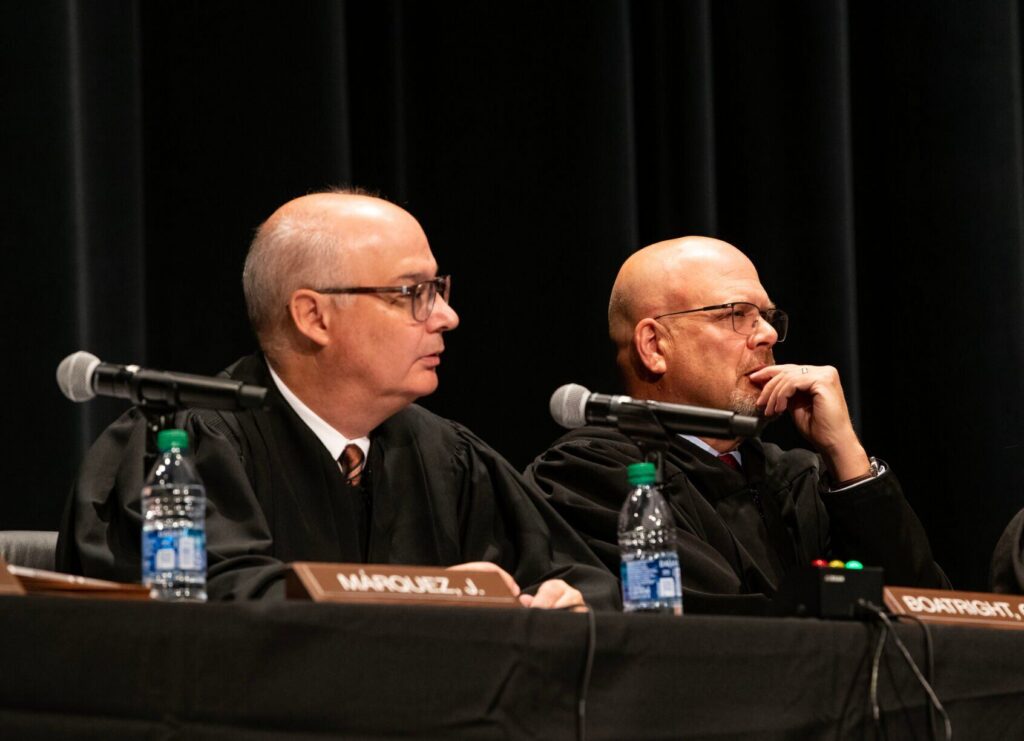
Colorado justices suggest father entitled to appeal of custody decision
Michael Karlik
michael.karlik@coloradopolitics.com
Updated 18 hours ago
Members of the Colorado Supreme Court signaled strongly on Tuesday that a father deserved some avenue for challenging a temporary child custody order that no lower court believed it could review due to the unusual circumstances of the case. Because...
Colorado justices agree fraud claims belong in corporate dispute
Michael Karlik
michael.karlik@coloradopolitics.com
Updated 20 hours ago
The Colorado Supreme Court decided on Tuesday that a corporate plaintiff validly pursued fraud claims over conduct that was not covered by a contract or by a set of interrelated business agreements leading up to the contract. Previously, the Court...
Colorado Supreme Court says intimate messages irrelevant to assault case
Michael Karlik
michael.karlik@coloradopolitics.com
Updated 22 hours ago
The Colorado Supreme Court decided on Tuesday that a Douglas County judge acted reasonably by blocking evidence of a defendant’s BDSM-related conversations with the victim in his trial for assault and false imprisonment. While the Court of Appeals believed that...
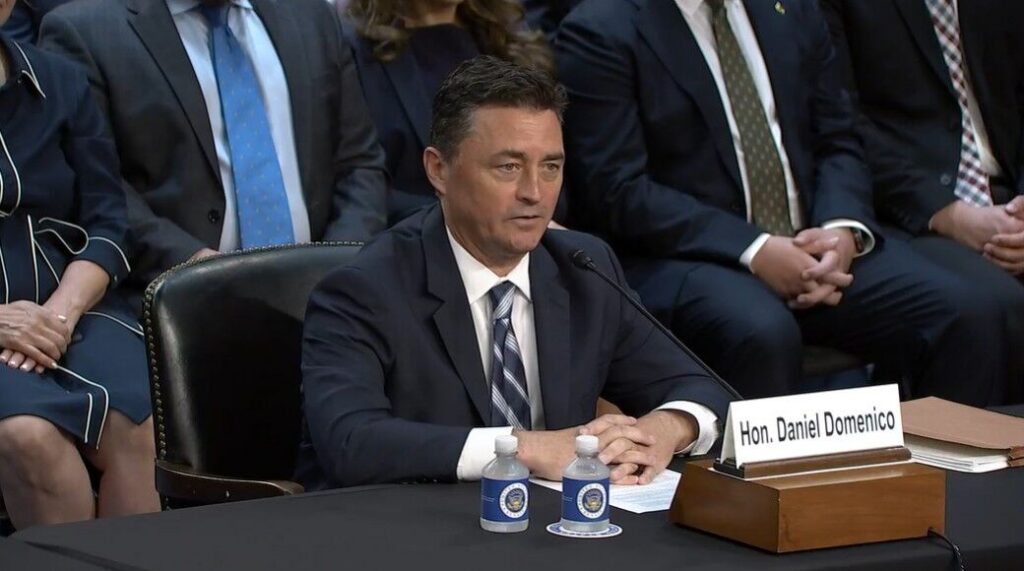
Trump’s 10th Circuit nominee declines to name 2020 election winner, defends immigration decisions
Michael Karlik
michael.karlik@coloradopolitics.com
Updated 23 hours ago
President Donald Trump’s nominee to the Denver-based federal appeals court declined to say who won the 2020 presidential election during his appearance before the U.S. Senate Judiciary Committee on Wednesday, and defended his recent rulings in immigration detention cases. U.S....

Colorado law allowing lawsuits against ‘conversion therapy’ providers takes effect July 1
Marissa Ventrelli
marissa.ventrelli@coloradopolitics.com
Updated 15 hours ago
With a new law taking effect July 1, Colorado is creating a legal pathway for people to sue licensed providers of “conversion therapy,” even as debate over the practice’s constitutionality continues in the wake of a recent U.S. Supreme Court...
Colorado justices expand ability for civil defendants to avoid participating, win after trial
Michael Karlik
michael.karlik@coloradopolitics.com
Updated 1 day ago
The Colorado Supreme Court decided on Tuesday that a civil defendant, whose non-participation in the case meant that he legally admitted to the sexual assault allegations against him, could nonetheless prevail after he showed up to testify at trial. A...
Colorado justices find ability to extend appeal deadline applies equally to prosecutors, defendants
Michael Karlik
michael.karlik@coloradopolitics.com
Updated 2 days ago
The Colorado Supreme Court decided on Tuesday that prosecutors have the same ability as criminal defendants to freeze their deadline to appeal a trial judge’s ruling when they ask for reconsideration, even though the rules do not explicitly say so....
Colorado justices confirm leaving-the-scene prosecutions require no proof of driver’s knowledge
Michael Karlik
michael.karlik@coloradopolitics.com
Updated 14 hours ago
The Colorado Supreme Court confirmed on Tuesday that its 20-year-old decision involving drivers who leave the scene of an accident remains good law and prosecutors do not have to prove that such defendants knew they were involved in an accident....

Judge blocks Colorado’s proposed ban on using SNAP benefits for soda
Marissa Ventrelli
marissa.ventrelli@coloradopolitics.com
Updated 20 hours ago
A federal judge has temporarily blocked Colorado and several other states from enforcing a proposed “Healthy Choice Waiver” that would have barred Supplemental Nutrition Assistance Program (SNAP) recipients from using their benefits to buy soda and other sugary drinks. Under...
Boulder police overreached in interrogating suspect, Colorado Supreme Court finds
Michael Karlik
michael.karlik@coloradopolitics.com
Updated 3 days ago
Two Boulder detectives violated a man’s constitutional rights by interrogating him at his home using a court order that solely authorized the collection of his DNA evidence, the Colorado Supreme Court concluded on Tuesday. The ruling curtailed the ability of...
PREV
PREVIOUS

Rep. Chris deGruy Kennedy appointed as speaker pro tempore
State Rep. Chris deGruy Kennedy has been appointed to serve as speaker pro tempore for the Colorado House of Representatives during the upcoming legislative session. Incoming House Speaker Julie McCluskie picked deGruy Kennedy, D-Lakewood, and announced the appointment on Monday. “deGruy Kennedy’s institutional knowledge, proven leadership and dedication to making Colorado a better place for everyone […]

Xcel's natural gas line upgrade in Denver Highlands area can proceed despite objections
The Colorado Public Utilities Commission dismissed objections to a proposed $27 million project to install larger natural gas main lines in Denver’s Highlands neighborhood, giving Xcel Energy permission to install some 8,000 feet of new, 12-inch gas pipe there. Xcel officials proposed the project to address problematic areas of the city where the existing pipelines […]