

Denver residents are wary of bus rapid transit and Waymo, voter survey says
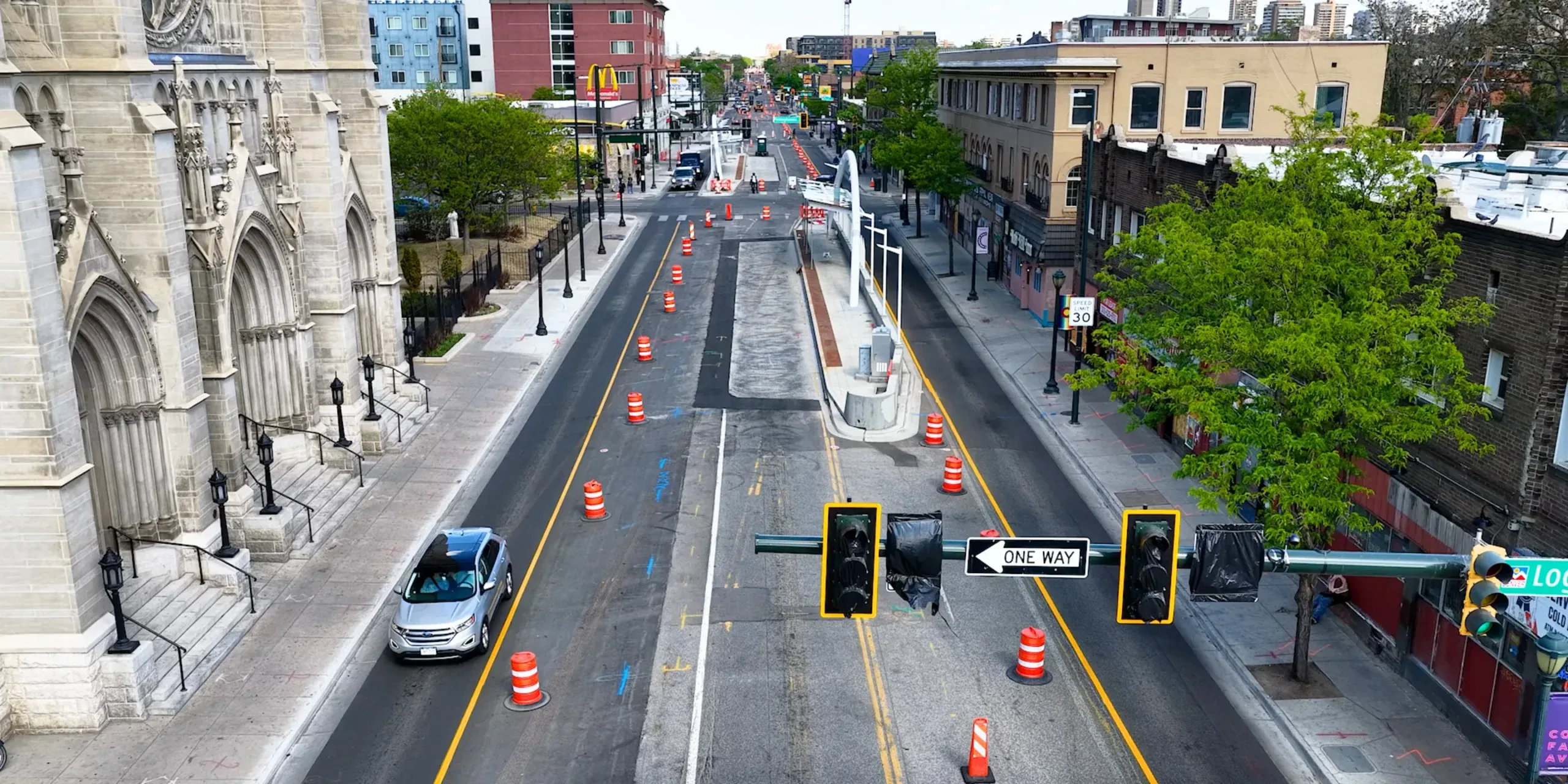
As Denver residents and commuters get their first look at how the Regional Transportation District’s Bus Rapid Transit project has narrowed East Colfax Avenue east of downtown, they seem to be flashing a caution light about any further expansion of BRT to other city arterials.
That’s according to a newly released study by the Colorado Polling Institute, which found that almost half of Denver voters are now wary of how BRT will work out in the city.
In 2025, the polling group’s survey showed that a slim plurality of voters, 39%, were optimistic about the BRT project and its potential benefits, as opposed to 38%, who expressed worries.
Today, 47% of voters view BRT more negatively, while the percentage of those enthused by its prospects fell to 36%.
The RTD and Denver Department of Transportation and Infrastructure BRT project on East Colfax created a dedicated bus lane in each direction down the middle of the heavily used east-west corridor.
City officials said the project will provide “more reliable and frequent bus service, arriving every 4.3 minutes during the day, reduce transit travel time by 15 to 30 minutes.”
The nonpartisan study is based on telephone interviews with 400 likely voters, conducted in early August. The sample group was chosen with respect to representative demographics, including age and gender, the institute said in releasing the data. The survey had a margin of error of plus-or-minus 4.9 percentage points.
Meanwhile, the driverless robotaxis deployed by Waymo, which launched service within a 60-square-mile area of Denver on Tuesday, faces an uphill task ahead in gaining the favor of potential customers.
A majority of those surveyed said they would wait-and-see before hailing the autonomous vehicles. Just 32% of voters considered themselves likely to use Waymo in the future.
Those included 10% who reported already having tried a robotaxi elsewhere and another 11% who said they are “very likely” to hail one soon.
In contrast, some 58% of voters said they are “not likely” to use the new human-less driving service, including 36% who described themselves as “not at all likely” to ride a Waymo car.
East Colfax narrowed
The BRT project, which is being carried out in partnership with DOTI, is already highly visible along East Colfax between downtown and Colorado Boulevard.
In that stretch, drivers can see the narrowed-down traffic patterns that resulted in single lanes of traffic east and westbound. The other lanes that had long served East Colfax are being repurposed to create bus-only lanes and center station platforms for riders.
Those are just part of planners’ intentions for BRT along the arterial. The broader plan calls for a $280 million, 10-mile BRT corridor extending between downtown’s Union Station and I-225 in Aurora. Officials hope to complete that broader plan in 2028.
“Once completed, BRT is expected to save customers up to 30 minutes in travel time,” an RTD promotional statement said.
BRT is also being promoted to transform two other major Denver arterials.
Plans currently call for a 9-mile BRT stretch along Colorado Boulevard, from I-70 all the way south to East Hampden Avenue and along Federal Boulevard for an 18-mile span from West 120th Avenue in Westminster, south to West Dartmouth Avenue in Denver.
A Denver neighborhood association has already issued its opposition to the project in its current form, and the city council in Glendale, which adjoins the project to the east of a key portion of South Colorado Boulevard, has called for a complete stop to the project.
More residents see advantages of scooters and e-bikes
Another transportation option is receiving a warmer reception from voters, the poll said.
Some two-thirds of voters see advantages to Denver’s shared electric bike and scooter program, which is providing short-term rentals in partnership with the provider Veo. The program is more broadly favored by surveyed voters in Southwest Denver and in Central Denver, close to downtown, the survey said.
Support for the rental program was lowest in Southeast Denver, where just 55% of those surveyed saw more benefits than downsides to the rentals. Some 45% of Southeast voters surveyed saw more problems than advantages.
Among those generally supportive of the scooter and bike rentals, voters saw convenience and less reliance on car transportation as advantages of the program.
Those surveyed who tended to oppose the rentals mentioned reckless drivers and other dangers to pedestrians, as well as improper parking of bikes and scooters, as the chief negatives.
A few weeks ago, Denver City Councilmember Chris Hinds said he has received more than 100 complaints to his office regarding Veo and that he has even forwarded complaints directly to the company.
Hinds, who sponsored city legislation requiring “micromobility” vendors to include sidewalk detection technology, said he believes Veo may be in violation of its agreement with the city and has asked the city attorney to review the contract.
The proposal shifts responsibility for preventing sidewalk riding from the city to the vendor and requires the use of technology to do so, Hinds said.
Rebekah Hernandez, a Veo official, said the company is working to identify “which sidewalks we can safely label as ‘no ride zones’ around the city.”
“Right now, riders on sidewalks hear a loud warning notification and can eventually be fined for chronic sidewalk violations. While I know it’s frustrating to see scooters zooming down sidewalks, Veo allows this behavior in the scenario that a scooter needs to jump on a sidewalk to avoid being hit by a car,” Hernandez wrote in a July 20 email.
Veo officials said that most of its Denver fleet already has GPS technology on board to prevent sidewalk riding.
Meanwhile, hospitals are warning that serious injuries involving e-bikes, e-scooters and children have risen significantly in Colorado over the past year and a half. A spokesperson for Children’s Hospital Colorado’s Anschutz campus said in an email that there were 100 total cases in 2024 and 2025 relating to traumatic e-mobility device injuries, while in 2026 alone, there have already been 60 cases.
Deborah Grigsby contributed to this article.


Denver plans to spend $50M on improvements to Sloan’s Lake
Nicole C. Brambila
nicole-c-brambila@coloradopolitics.com
Updated 1 day ago
Denver plans to spend $50 million for Sloan’s Lake improvements. Mayor Mike Johnston and Councilmembers Amanda P. Sandoval and Jamie Torres announced the project’s launch steps from the lake’s shore near the jetty in the park on Wednesday morning. “After...
Wildlife commissioner pushes for tougher penalties after hunter accidentally kills Colorado wolf
Marianne Goodland
marianne.goodland@coloradopolitics.com
Updated 1 day ago
Colorado wildlife officials on Wednesday revisited the agency’s handling of violations involving protected species, prompting renewed debate over whether current penalties are sufficient. Colorado Parks and Wildlife Commissioner Rebecca Niemiec on Wednesday urged the agency to impose stronger penalties —...
Petitions seek to place noise restrictions, surveillance cameras and water limits on Colorado Springs ballot
Brennen Kauffman
brennen-kauffman@coloradopolitics.com
Updated 8 hours ago
Petitioners in Colorado Springs are preparing to gather signatures to place restrictions on noise levels, developments that use a large volume of water and surveillance cameras that use automatic tracking technology. The City Clerk’s office on Monday gave final approval...

Colorado’s Parks and Wildlife chair’s decision to limit public comments sparks backlash from fellow commissioners
Marianne Goodland
marianne.goodland@coloradopolitics.com
Updated 1 day ago
Last week, the chairman of Colorado’s wildlife commission unilaterally decided to limit public comments, complaining, in particular, that elected officials often “grandstand” at meetings and noting that the election season is well underway. This week, the commission overturned its chair’s...
Capped or graduated income tax rate? Colorado voters to decide
Marianne Goodland
marianne.goodland@coloradopolitics.com
Updated 1 day ago
The proposal to create income tax tiers — which would replace Colorado’s flat rate — has been certified for the November general election ballot, setting the stage for a major showdown between two competing forces seeking to define the parameters of...

Some charges against Colorado Democrat arrested for intoxication dropped, Texas police say
Deborah Grigsby
deborah.smith@denvergazette.com
Updated 2 days ago
The charges of resisting arrest against a Lone Tree Democrat who is running for the Colorado state House have been dropped, according to authorities from Texas. Christian Schilder, who is running to represent Colorado’s House District 39, was apprehended on...

A silver lining: Low water conditions at Green Mountain Reservoir open door for major repairs
Marianne Goodland
marianne.goodland@coloradopolitics.com
Updated 8 hours ago
One of the most striking signs of the low snowpack and drought that has plagued Colorado this year can be found by driving by Green Mountain Reservoir in Grand County. The reservoir, first filled in the 1940s, sits at its...
DougCo commissioners refer competing election measure on board expansion
Nicholas Fogleman
nicholas.fogleman@denvergazette.com
Updated 1 day ago
Douglas County commissioners formally waded into the debate over a voter-led ballot initiative Monday by unanimously referring a separate measure that would give voters an additional option if they choose to expand the board from three members to five. The...

More Denver voters identify as socialists as support reaches 3-year high
Nico Brambila
nico.brambila@denvergazette.com
Updated 13 hours ago
More Denver voters identify as socialists than Republicans, continuing a three-year rise that comes on the heels of Democratic Socialist Melat Kiros’ upset primary victory over longtime U.S. Rep. Diana DeGette. Seventeen percent of Denver voters now identify as socialists,...

Colorado redistricting limits measure heads to November ballot
Marissa Ventrelli
marissa.ventrelli@coloradopolitics.com
Updated 3 days ago
A proposed constitutional amendment that would prohibit Colorado’s congressional maps from being redrawn outside of election cycles has qualified for the November ballot, according to the Secretary of State’s Office. Under Initiative No. 256, redistricting changes for the 2028 election...
PREV
PREVIOUS

Aurora seeks public input on gas station spacing, other requirements
Aurora officials are asking for public input on a series of regulations for gas stations, including spacing and charging station requirements. Members of the public have until Oct. 31 to take the city’s survey, which is available on the Engage Aurora website. Currently, the city’s Unified Development Ordinance sets the following regulations for gas stations: […]

10th Circuit orders new unlawful arrest trial against Colorado Springs officers
The Denver-based federal appeals court concluded on Friday that a trial judge inappropriately allowed jurors to see several unflattering video clips of a plaintiff being belligerent toward police officers during a trial to determine whether police violated her constitutional rights. Sasha Cronick pursued claims of unlawful search and arrest against Colorado Springs officers who handcuffed […]