10th Circuit orders new unlawful arrest trial against Colorado Springs officers
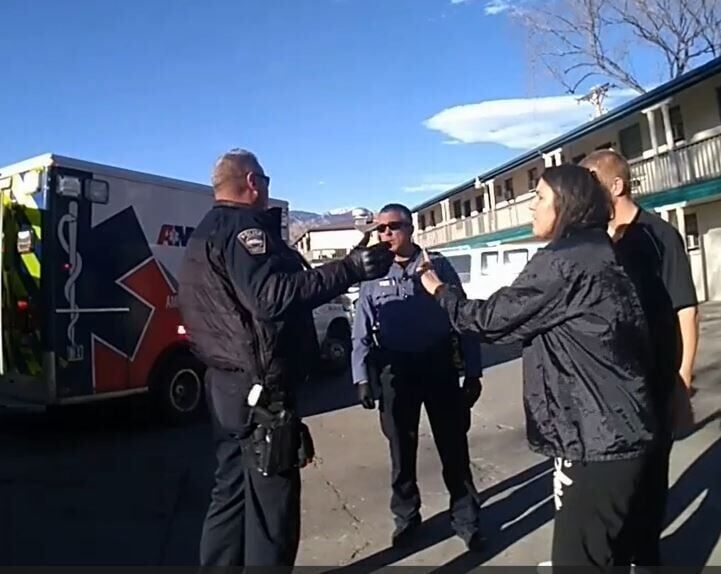
The Denver-based federal appeals court concluded on Friday that a trial judge inappropriately allowed jurors to see several unflattering video clips of a plaintiff being belligerent toward police officers during a trial to determine whether police violated her constitutional rights.
Sasha Cronick pursued claims of unlawful search and arrest against Colorado Springs officers who handcuffed her minutes after she helped resuscitate a man who had stopped breathing from a drug overdose in 2018. After a trial last year, jurors sided with the defendants.
On appeal to the U.S. Court of Appeals for the 10th Circuit, Cronick argued that then-U. S. District Court Senior Judge Christine M. Arguello allowed jurors to see harmful, irrelevant evidence of Cronick berating police officers in interactions subsequent to the events at hand. A three-judge panel agreed with her.
“On this point, consider what a jury might think while watching Cronick berate police officers and security guards, call them rude names, and threaten to sue them,” wrote Judge Gregory A. Phillips in the Aug. 28 opinion. Jurors might think, “she’s harassed so many people so many other times, why should it matter that she was unjustifiably arrested this time? The clips prompt these provocative questions, which is why they’re unfairly prejudicial. They distract from the jury’s actual assignment: whether the officers violated Cronick’s rights by unlawfully arresting and searching her at the Sun Springs Motel.”
At the same time, the 10th Circuit panel upheld Arguello’s imposition of $18,680 against Cronick and her lawyers for deleting electronic evidence.
Case: Cronick v. Pryor
Decided: August 28, 2026
Jurisdiction: U.S. District Court for Colorado
Ruling: 3-0
Judges: Gregory A. Phillips (author)
Carolyn B. McHugh
Veronica S. Rossman
On Dec. 12, 2018, Cronick was staying at the motel when she heard shouts for help. A man was lying unconscious outside of a guest room, apparently due to a drug overdose.
Cronick called 911 and talked with a dispatcher while simultaneously recording video. The footage showed Cronick instructing another woman how to perform chest compressions and mouth-to-mouth resuscitation. Their efforts resulted in the man beginning to breathe again moments before first responders arrived.
“Sasha, you did a great job today. Thank you,” the dispatcher told her.
Cronick remained nearby, recording on her phone and intermittently answering questions about what happened. Officer Christopher Pryor walked up and learned Cronick was the one who called 911. He asked for her name and room number, but she responded she was “not answering questions like that,” then mentioned “police harassment.”
“Why don’t you leave the immediate area,” Pryor said, touching her out of view of his body-worn camera.
“Get your f—–g hands off me. Don’t f—–g touch me,” Cronick screamed while walking away.
“Lighten up, lady,” Pryor said while following her. “I asked you to leave the area.”
Other officers gathered around Pryor. Cronick began demanding their names and, in response, Pryor and Officer Robert McCafferty placed her in handcuffs and patted her down.
Cronick later went to trial in municipal court for the charge of failure to disperse. A judge agreed she came “dangerously close” to being convicted, but it was unclear whether Pryor had ever actually given her an order to leave, resulting in her acquittal.
Cronick then sued the officers. Arguello determined a jury could find Cronick did not pose a threat or otherwise breach the peace, except for her yelling in response to being touched. A jury could also find that Pryor had not given an “order” to Cronick, such that she disobeyed it by declining to leave the scene. The officers immediately appealed to the 10th Circuit, which upheld Arguello’s order in 2024 and put the case on track for trial.
However, before trial, Arguello considered what should happen after the revelation that Cronick deleted YouTube videos and certain online communications relevant to the case. She decided monetary sanctions were appropriate for Cronick and the plaintiff’s attorneys for “enabling and facilitating Ms. Cronick’s ongoing disobedience” of an evidentiary order.
Arguello also instructed the jury, as a consequence for the missing video evidence, to note that Cronick “regularly records police officers, and those recordings demonstrate Ms. Cronick engages in behavior that is disruptive to police business.”
Finally, over objections that the footage would “smear Ms. Cronick’s character,” Arguello allowed the defendants to play video clips of Cronick’s encounters with police after the Sun Springs Motel incident. The videos depicted Cronick calling police offensive names, accusing an officer of “beat(ing) your f—–g wife,” and asking viewers for money.
The defense attorney characterized Cronick as being “on the hunt for content,” including at the Sun Springs Motel.
“The case that we were dealing with, there were no factual disputes. It was on video from 10 different angles,” Cronick’s attorney, David Lane, told the 10th Circuit panel during oral arguments. “The only issue for the jury was, were Sasha Cronick’s (rights) violated given these videos? All this other stuff does nothing but dump on her character. ‘She’s a crazy woman who screams at cops’.”
The defendants maintained that the videos showed a pattern of conduct by Cronick.
“Ms. Cronick was asked to leave the scene. She did not leave the scene. She did not leave the scene because her pattern was to record, get a response, and then make money off it,” said Ryan D. Doherty with the Colorado Springs City Attorney’s Office.
“These videos seem highly prejudicial to me,” countered Judge Carolyn B. McHugh. “Can I come away saying these other videos had no impact on the jury’s decision here because the evidence with respect to the case at issue was so overwhelmingly against the plaintiff that this doesn’t matter? I can’t say that.”
Ultimately, the panel agreed with Cronick that the videos invited jurors to view her as a “bad person” who habitually disrupts police officers.
“We see the pattern the officers wanted the jury to accept: She did this in the videos, so she did it here too,” wrote Phillips. “Cronick’s trial was supposed to concern her arrest at the Sun Springs Motel, not her later police encounters.”
The panel ordered a new trial. It also upheld Arguello’s monetary sanctions for the deletion of evidence. Phillips noted that if Cronick’s lawyers wanted to avoid liability for their client’s actions, they could have withdrawn from the case or provided Arguello with enough information to understand what happened.
“In a time when a reversal of a civil jury verdict after trial is beyond a rarity,” said Lane, “we are extremely gratified that the 10th Circuit recognized that Sasha Cronick’s trial was so grossly unfair that the only just resolution was to grant her a new trial.”
Colorado Springs declined to comment on behalf of the defendants.
The case is Cronick v. Pryor et al.

Federal judge to await SCOTUS decision before addressing Boulder County firearm ordinances
Michael Karlik
michael.karlik@coloradopolitics.com
Updated 3 hours ago
A federal judge agreed on Friday that she would await the U.S. Supreme Court’s decision in an upcoming Second Amendment case before she addresses the constitutionality of similar gun ordinances in multiple Boulder County jurisdictions. Rocky Mountain Gun Owners, the...

State Supreme Court names next chief justice, 10th Circuit releases full-court decision | COURT CRAWL
Michael Karlik
michael.karlik@coloradopolitics.com
Updated 4 hours ago
Welcome to Court Crawl, Colorado Politics’ roundup of news from the third branch of government. The Colorado Supreme Court has named its next chief justice, and the Denver-based federal appeals court released a decision that overwhelmingly rejected one of its...
10th Circuit overturns framework for sentencing probation violators by 11-1
Michael Karlik
michael.karlik@coloradopolitics.com
Updated 2 days ago
In a rare decision by all 12 of its full-time judges, the Denver-based federal appeals court ruled in a lopsided vote on Friday that one of its members created a sentencing process for probation violators that was out of step...
Federal judge dismisses excessive force lawsuit against Colorado Springs, officer
Michael Karlik
michael.karlik@coloradopolitics.com
Updated 2 days ago
A federal judge concluded last week that a Colorado Springs police officer could not be held liable for shooting a suspect three times after the man menaced two victims with a gun and fled the scene. Al’morion Germany was involved...
Weld County man sentenced to 236 years for sexually assaulting 9-year-old girl
Kyla Pearce
kyla.pearce@gazette.com
Updated 3 days ago
A Weld County man was sentenced to 236 years in prison for repeatedly sexually assaulting a 9-year-old girl. Joshua Andrews, 41, was charged in June with 12 counts of sexual assault on a child by a person in a position...
Wrongfully deported man to be returned to U.S., Colorado federal judge orders
Michael Karlik
michael.karlik@coloradopolitics.com
Updated 4 days ago
Colorado’s chief federal judge took the extraordinary step of directing the government on Tuesday to do everything it can to return a man it deported in violation of his order. At the same time, Colorado’s chief magistrate judge has set...
Denver murder, assault convictions reversed due to faulty jury instructions
Michael Karlik
michael.karlik@coloradopolitics.com
Updated 3 days ago
Colorado’s second-highest court reversed a defendant’s convictions for murder and assault last week after concluding a Denver judge incorrectly omitted key jury instructions that could have affected the verdict and sentencing. Stephen C. Swainson fatally stabbed Israel Casillas in downtown...
‘Understand people for who they are’: 2 federal judges talk about compassion in courtroom
Michael Karlik
michael.karlik@coloradopolitics.com
Updated 3 days ago
Before taking the bench in 2022, U.S. District Court Judge Charlotte N. Sweeney was an employment discrimination attorney. While the cases could be emotionally charged, they were different from the criminal proceedings she is now handling. “It wasn’t necessarily affecting...
Denver murder conviction reversed for incomplete self-defense instruction
Michael Karlik
michael.karlik@coloradopolitics.com
Updated 22 hours ago
Colorado’s second-highest court reversed a defendant’s murder conviction last week because a Denver judge gave an incomplete instruction to the jury about the man’s right to self-defense. Donald R. Gonzales and Gary McLaughlin met up in a Capitol Hill parking...
Colorado lawmaker, House leaders named in workplace-retaliation lawsuit
Marianne Goodland
marianne.goodland@coloradopolitics.com
Updated 6 days ago
A former legislative aide has filed a lawsuit alleging she was mistreated, illegally directed to perform campaign work and harmed by a House leadership structure she charged was fragmented, politicized and ineffective at protecting employees. The lawsuit, filed by Jennifer...