

Misconduct complaints from ex-Colorado judicial discipline director dismissed against federal judges

The administrative body for the Denver-based federal appeals court upheld a finding last week that misconduct complaints against Colorado’s chief federal trial judge and the chief appeals judge warranted dismissal and appeared to be a “litigation tactic” by the complaining party.
The Judicial Council of the U.S. Court of Appeals for the 10th Circuit concluded in a brief July 22 order that Judge Harris L Hartz was correct to find attorney Christopher S.P. Gregory’s allegations fell short of establishing judicial misconduct.
“Complainant disregards one very important factor — namely that allegations are not true simply because he says they are,” Hartz wrote in a March 30 order that the 10th Circuit posted to its website this week. “Complainant must support his allegations with sufficient evidence to raise an inference that misconduct has occurred.”
Gregory, the former director of the Colorado Commission on Judicial Discipline, is suing the state Supreme Court, the discipline commission, the disciplinary rulemaking committee and others. Generally, he alleges a conspiracy related to the 2019 decision to award a multimillion-dollar contract to a Colorado judicial employee who was herself facing misconduct allegations.
Later reporting revealed that the employee, Mindy Masias, had cataloged alleged instances of judicial misconduct that she was prepared to disclose.
Ordinarily, misconduct proceedings against federal judges provide anonymity to the complaining party and the subject judge. However, Gregory publicly disclosed his complaint against U.S. District Court Chief Judge Daniel D. Domenico in his court filings.
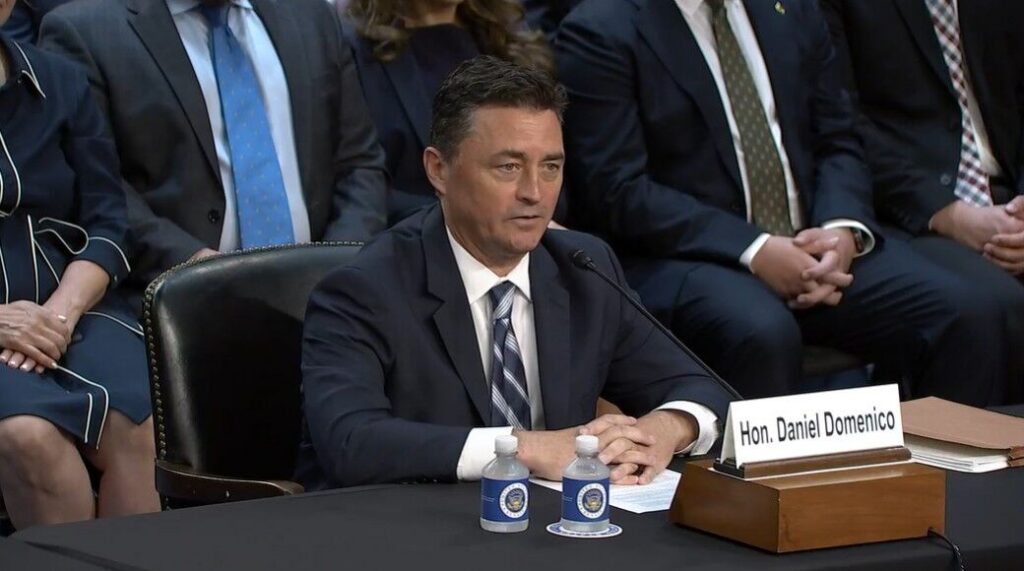
Domenico briefly handled Gregory’s lawsuit, but recused himself in February out of “an abundance of caution,” reasoning that some of Gregory’s allegations could implicate Domenico’s own state employment before he took the bench in 2019.
Prior to his recusal, Domenico had dismissed a similar case of Gregory’s that was sealed from public view, which prompted Gregory to file a misconduct complaint against Domenico with Chief Judge Jerome A. Holmes of the 10th Circuit.
“Judge Domenico intentionally inserted himself into the underlying case to achieve an overtly biased outcome favorable to his self-identified friends,” Gregory wrote.
On Sept. 22, Holmes issued an order dismissing Gregory’s complaint. He indicated he had undertaken a “limited inquiry” and asked Domenico to respond to the allegations of bias related to his connections with the judges or lawyers Gregory was suing.
“In his response, the judge notes that the ‘personal friendships’ Complainant alleges exist are, instead, professional friendships, such that if he saw one of the parties at a professional event or on the street, he would certainly greet that person, but he does not socialize on a personal level with the individuals,” wrote Holmes.
“A judge’s recusal is not necessarily required merely because a judge previously knew or worked with parties to a case. And, even if a recusal was required here,” Holmes continued, “this Complainant did not support the allegation that the subject judge failed to recuse for illicit purposes with any evidence.”
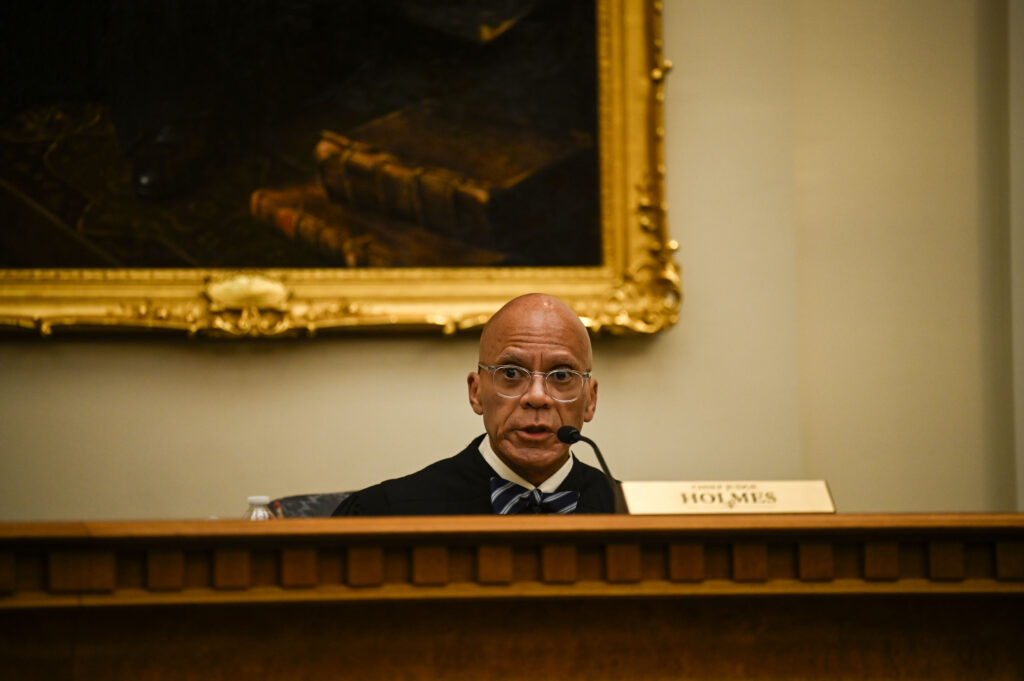
Gregory then filed more complaints against Domenico and Holmes. He also provided Colorado Politics with two dozen complaints he filed against various judges within the six-state region covered by the 10th Circuit. Broadly, he alleged that Holmes’ presentation of an award to one of Colorado’s Supreme Court justices during a 2024 conference and the judiciary’s unwillingness to assign his litigation to a judge outside of the 10th Circuit gave rise to misconduct.
Hartz, the next-most senior judge after Holmes, handled Gregory’s new complaints against Domenico and Holmes. He noted that Gregory’s allegations once again revolved around Domenico’s allegedly improper failures to immediately recuse from Gregory’s cases, as well as Holmes’ allegedly improper failure to recuse from handling the initial Domenico complaint.
Hartz concluded Gregory’s allegations either did not demonstrate impropriety or amounted to disagreements with rulings, which are not ordinarily grounds for misconduct.
“To the extent Complainant believes filing numerous and repetitive, misconduct complaints will force the recusal of judges he does not prefer in favor of those he hopes will be more sympathetic to his case,” Hartz added, “the filing of a misconduct complaint that has not been deemed meritorious is not, in itself, cause for recusal.”
He also warned Gregory that he would hold off on resolving any future complaints from Gregory related to his civil cases until they conclude, “as Complainant appears intent on filing numerous and largely similar complaints against judges who are addressing his civil matters in the very early stages of litigation, in what appears to be a litigation tactic,” Hartz wrote.
Gregory sought review of Hartz’s decision from the 10th Circuit Judicial Council, which consists of circuit and trial judges. He argued Hartz had mischaracterized his complaints as “simply my disagreeing with Judge Domenico and Judge Holmes’s non-disqualification decisions.” Instead, both judges allegedly “used their respective assignments to achieve outcomes based upon personal bias or prejudice,” and Hartz was “enabling the misconduct of other judges and attorneys.”
The Judicial Council upheld Hartz’s order.


10th Circuit partially revives lawsuit over 2020 Denver protest injuries
Michael Karlik
michael.karlik@coloradopolitics.com
Updated 2 hours ago
The Colorado-based federal appeals court revived a man’s claims against Denver on Friday after concluding a trial judge resolved the case in the city’s favor without analyzing two of the three instances of alleged excessive force and other constitutional violations....
Federal judges find Colorado immigration judge violated several orders
Michael Karlik
michael.karlik@coloradopolitics.com
Updated 3 hours ago
Multiple federal judges in Colorado have freed people from immigration custody after determining that one immigration judge violated their directives for properly conducting bond hearings. For nearly a year, Colorado’s U.S. District Court has faced a flood of “habeas corpus” petitions...

First-ever Red Rocks naturalization ceremony draws most diverse group of new citizens
Michael Karlik
michael.karlik@coloradopolitics.com
Updated 4 hours ago
Colorado’s federal trial court held its first-ever naturalization ceremony for nearly 300 new citizens on Thursday at Red Rocks Park and Amphitheatre. “We’re doing it to commemorate the 250th anniversary of the Declaration of Independence and the United States. Red...

Jeffco taxpayers could be on the hook for a possible child sex assault settlement
Matt Kyle
matt.kyle@denvergazette.com
Updated 8 hours ago
Taxpayers may end up on the hook for a child sexual assault settlement, possibly worth up to $15 million, after Jeffco Public Schools failed to notify its insurance company in a timely manner about the case. The incident stems from...
10th Circuit finds no fair housing violation by Littleton landlord for worker’s alleged rape of tenant
Michael Karlik
michael.karlik@coloradopolitics.com
Updated 1 hour ago
The Denver-based federal appeals court concluded on Monday that Littleton’s housing authority could not be held liable for a maintenance worker’s alleged rape of a tenant, as the worker’s employment did not provide any special access to the victim. A...

Jeffco Public Schools sues Trump administration to protect funding after alleged transgender policies violation
Matt Kyle
matt.kyle@denvergazette.com
Updated 1 day ago
In the wake of several threats by the Trump administration to revoke federal funding, Jeffco Public Schools filed a lawsuit against the Department of Education seeking to protect that badly needed money. Jeffco has been under investigation by the DOE’s...
Denver detox center did not violate man’s rights with 10-hour hold, 10th Circuit says
Michael Karlik
michael.karlik@coloradopolitics.com
Updated 3 days ago
The Colorado-based federal appeals court concluded on Tuesday that Denver’s detoxification facility did not violate a man’s rights by holding him against his will for 10 hours until his blood alcohol content was projected to reach zero. Unusually, Brian Garrett’s...

Federal judge clarifies ex-GOP treasurer candidate’s burden to prove defamation claims
Michael Karlik
michael.karlik@coloradopolitics.com
Updated 3 days ago
A federal judge clarified last week that businessman and former Republican statewide candidate Brian Watson will need to surmount a higher hurdle in proving his claim that a party guest’s alleged description of him as a “criminal” amounted to defamation....
Colorado board permits state to appeal injunction against arthritis drug price cap
Marissa Ventrelli
marissa.ventrelli@coloradopolitics.com
Updated 3 days ago
A Colorado board voted Friday to allow the Attorney General’s Office to fight an injunction against a price cap on a drug that treats arthritis. A U.S. district court judge had granted the company Amgen a preliminary injunction, temporarily blocking...

Federal judge rejects constitutional claims, ‘expressions of hatred’ by Club Q defendant
Michael Karlik
michael.karlik@coloradopolitics.com
Updated 4 days ago
A federal judge rejected a defendant’s claims that he received constitutionally ineffective assistance of counsel while facing federal hate crime and firearms charges for murdering five people at a Colorado Springs LGBTQ nightclub in 2022. Anderson Lee Aldrich is serving...
PREV
PREVIOUS

Boulder County coroner IDs body found over 50 years ago
After nearly 55 years, a body found in Boulder County has been identified. The Boulder County Coroner’s office on Thursday announced it has identified a set of remains found in Bluebell Canyon in August 1971 as Douglas Sumner, 22. The identification concluded decades of investigative and forensic work, the coroner’s office said and now allows […]

Republican Victor Marx taps George Markert as his lieutenant governor pick in Colorado’s gubernatorial race
Colorado Republican gubernatorial nominee Victor Marx named George Markert, a retired Marine colonel, as his running mate for lieutenant governor Friday morning, saying the former U.S. Senate candidate will bring “exceptional character, proven leadership and a lifetime of serving others” to the ticket. Marx is facing Democratic nominee Phil Weiser, the state’s attorney general, and […]