

Trump’s 10th Circuit nominee recuses from cases against federal government without explanation
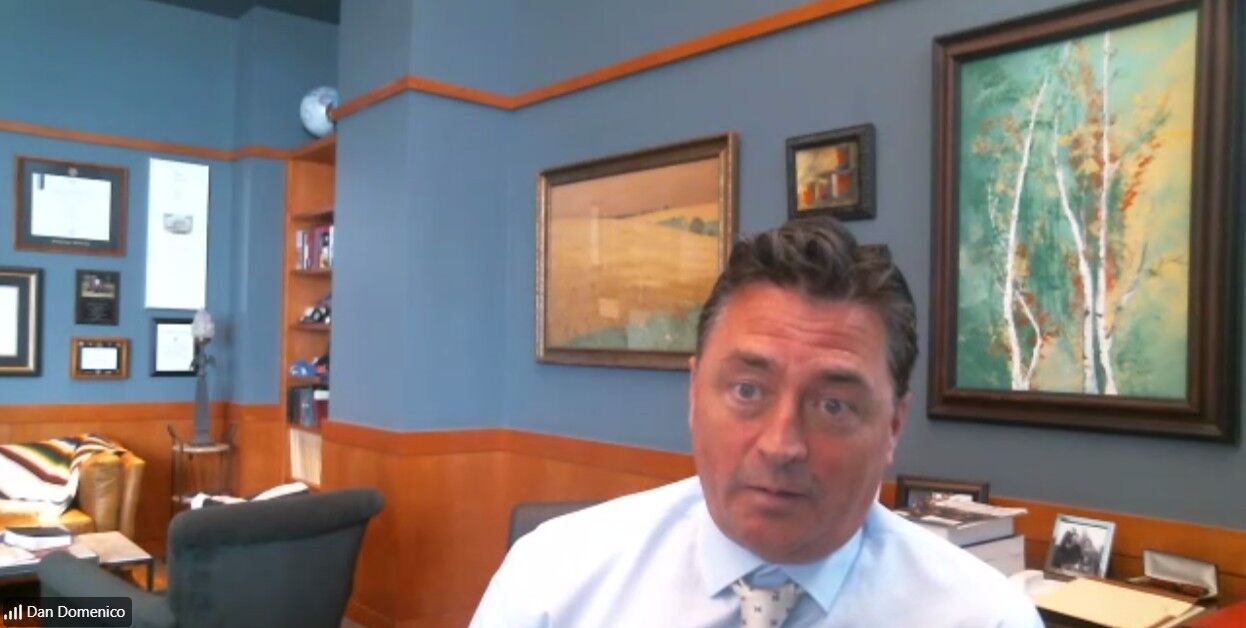
President Donald Trump’s nominee to fill a vacancy on the Denver-based federal appeals court recused himself without a clear explanation from nine cases against the executive branch while he was undergoing vetting by the White House this spring.
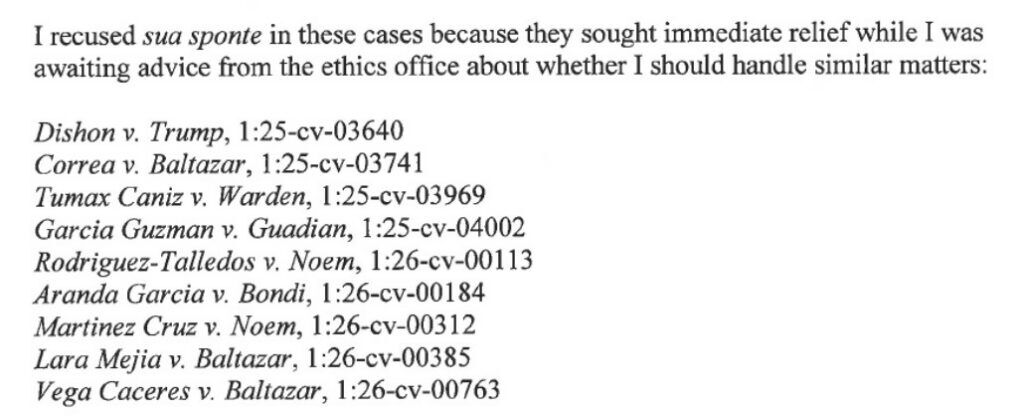
U.S. District Court Chief Judge Daniel D. Domenico disclosed the recusals in his responses to the U.S. Senate Judiciary Committee’s questionnaire. He issued identical orders on just two days — March 13 and March 17 — stepping aside in the nine cases.
“On review of the pleadings, parties and entries of appearance in this case, I conclude that I must recuse myself,” Domenico wrote without elaboration in each case.
Of the cases Domenico listed, most are “habeas corpus” cases brought by individuals in immigration custody challenging the lawfulness of their detention. The ninth case is a lawsuit from a self-represented Littleton man who is suing the U.S. Department of Justice and Google for First Amendment violations related to multiple executive branch directives.
Colorado Politics reviewed the filings in each case up to the point of Domenico’s recusals, examining the lawyers involved, the government officials referenced and the factual allegations. There appears to be no common link between the cases other than the federal executive branch being named as a defendant in each.
Domenico explained in his questionnaire that he recused in the nine cases “because they sought immediate relief while I was awaiting advice from the ethics office about whether I should handle similar matters.”
However, Domenico continues to preside over other habeas cases and nonimmigration cases with federal defendants, such as the National Science Foundation and U.S. Secretary of State Marco Rubio.
While many of the cases on Domenico’s recusal list featured motions for a temporary restraining order or for expedited resolution, some did not. Moreover, some requests for immediate action came only after the cases had sat on Domenico’s desk for months without action.
For example, one petitioner filed his habeas case on Dec. 13. The court assigned Domenico to preside two days later. On Jan. 20, the petitioner asked Domenico to order the government to respond, a process for other judges that happens within hours or days after a petition’s filing. After no word from Domenico, the petitioner sought a temporary restraining order one week later. Domenico then directed the government to respond.
The government filed its response on Feb. 5. There was no further action in the case until Domenico recused on March 17.
“We were very curious about the recusal at the time and could not identify a reason at the time, and we still don’t know,” said Jess Dawgert, who represented the petitioner. She was further confused when, weeks later, Domenico released an order in a different case “on the sole issue” she presented.
Through the district court’s clerk, Domenico declined to answer Colorado Politics’ questions about his potential ethical conflict.
Colorado Politics previously reported that Domenico has only adjudicated a trickle of habeas petitions and has sided against petitioners far more often than his colleagues. He is also the only federal judge in Colorado who has agreed with the government’s broad view of its mandatory detention authority, in a decision issued after the White House’s vetting began.
Domenico, who was appointed by Trump during his first term, has long been interested in serving on the powerful U.S. Court of Appeals for the 10th Circuit, which issues binding interpretations of law for federal courts in Colorado and five neighboring states.
According to the questionnaire submitted for his district court nomination, Domenico said he spoke with Colorado’s then-Republican senator, Cory Gardner, about a possible nomination to the 10th Circuit early in Trump’s first term. U.S. Supreme Court Justice Antonin Scalia had died the prior year, and the Republican majority in the Senate blocked President Barack Obama from appointing a successor before the end of his term. Neil M. Gorsuch, a 10th Circuit judge from Colorado, wound up as Trump’s appointee.
“After Judge Gorsuch was nominated for the U.S. Supreme Court, I reiterated my interest in the circuit court opening to Senator Gardner’s office and the U.S. Department of Justice,” Domenico wrote to the judiciary committee.
During a reception to celebrate Gorsuch’s swearing-in, Domenico spoke with officials from the White House Counsel’s Office. While he did not elaborate on the substance of the conversation, Domenico wrote that Gardner called him three days later to say the White House wanted to nominate Domenico for the district court, not the 10th Circuit.
After Judge Timothy M. Tymkovich of Colorado announced in February that he would step aside and create a vacancy in his 10th Circuit seat, Trump announced on May 11 that he was selecting Domenico, a former law clerk for Tymkovich.
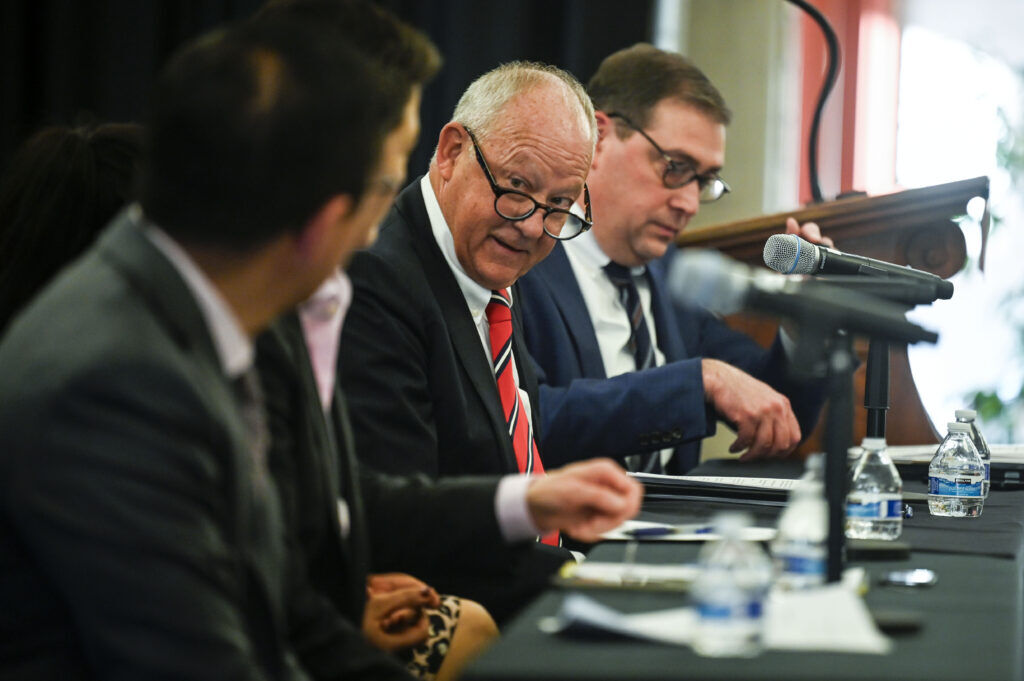
In his most recent questionnaire, Domenico said that the White House Counsel’s Office contacted him in early March to arrange an interview for the vacancy, shortly before his batch of recusals.
“I then had limited email and phone correspondence with officials in that office to arrange the logistics and timing of the interview, and I emailed them a resume and list of significant cases,” he wrote. “I interviewed with a number of people from the Counsel’s Office on March 23, 2026.”
Colorado Politics contacted lawyers, retired judicial colleagues of Domenico’s and former law clerks to inquire whether they knew of or could discern Domenico’s reason for recusing in the nine cases. Of those who responded, none had a concrete explanation.
Jeremy Fogel, a retired judge from the Northern District of California who is now the executive director of the Berkeley Judicial Institute, said the judicial code of conduct does not explicitly require judges to state their reasons for recusing.
However, “in most cases doing so provides insight about ethical standards and thus can contribute to greater public confidence in the judiciary,” he said. “And at times, a lack of transparency can have the opposite effect.”

Adams County murder conviction reversed due to faulty jury instruction
Michael Karlik
michael.karlik@coloradopolitics.com
Updated 6 hours ago
Colorado’s second-highest court overturned an Adams County defendant’s murder conviction last month because the instruction provided to the jury about a trespasser’s right to use self-defense did not accurately reflect Colorado law. A person is justified in using force to...
Colorado court upholds murder conviction despite jury disobeying instructions
Michael Karlik
michael.karlik@coloradopolitics.com
Updated 23 hours ago
Colorado’s second-highest court upheld an Arapahoe County defendant’s murder conviction last month, even though jurors found he was not the one who shot the victim and the evidence suggested he was not present for the shooting. A three-judge Court of...
Divided appeals court reverses conviction after judge declined to define ‘bludgeon’
Michael Karlik
michael.karlik@coloradopolitics.com
Updated 1 day ago
Colorado’s second-highest court reversed a Jefferson County defendant’s felony menacing conviction on Thursday, concluding that the trial judge’s failure to define “bludgeon” for jurors may have affected the outcome. A three-judge Court of Appeals panel divided in unusual ways in...
10th Circuit dismisses Tina Peters’ challenge to confinement as moot
Michael Karlik
michael.karlik@coloradopolitics.com
Updated 19 hours ago
The Denver-based federal appeals court granted the state’s unopposed request on Wednesday to dismiss former Mesa County clerk Tina Peters’ challenge to her confinement as moot. Although Peters received a commutation of her prison sentence last month from Gov. Jared...
Federal judge declines to recuse from death penalty case after Supermax visit
Michael Karlik
michael.karlik@coloradopolitics.com
Updated 21 hours ago
A federal judge declined to recuse herself last month from a death penalty case arising out of Colorado’s “Supermax” prison, finding that her tour of the facility earlier this year did not bias her decision-making. U.S. District Court Judge Charlotte...
Appeals court clarifies offense of impersonating a peace officer
Michael Karlik
michael.karlik@coloradopolitics.com
Updated 2 days ago
Colorado’s second-highest court clarified this month that a person commits the offense of impersonating a peace officer if they engage in “any conduct” while pretending to be law enforcement. In a case out of El Paso County, Richard James Coulier...
Colorado Supreme Court reverses 2 Chaffee County judges for imposing fee on habeas petitioner
Michael Karlik
michael.karlik@coloradopolitics.com
Updated 3 days ago
The Colorado Supreme Court rejected two separate appeals earlier this month from an incarcerated defendant seeking immediate release from prison, but concluded that two Chaffee County judges incorrectly required him to prepay filing fees for his cases. David J. Gottorff...
Weld County judge wrongly denied bail to murder defendant in gap between law change
Michael Karlik
michael.karlik@coloradopolitics.com
Updated 3 days ago
Colorado’s second-highest court ruled this month that a Weld County judge was wrong to deny bail to a murder defendant in the window between the state Supreme Court’s recognition of the right to bail and the voters’ subsequent overruling of...
Defendants acquitted by insanity are eligible for records-sealing, appeals court says
Michael Karlik
michael.karlik@coloradopolitics.com
Updated 2 days ago
Colorado’s second-highest court clarified last month that defendants who are found not guilty by reason of insanity are eligible to have their criminal records sealed from public view. Judges must seal criminal records if, among other things, a defendant is...
Colorado Supreme Court shuts down ‘new form of representation’ in postconviction cases
Michael Karlik
michael.karlik@coloradopolitics.com
Updated 4 days ago
While unrepresented defendants in postconviction proceedings are permitted to have a court-appointed attorney investigate and augment their claims, that is not the case when a private lawyer authors the original petition, the Colorado Supreme Court decided on Monday. In contrast...
PREV
PREVIOUS

Colorado Iranians express disappointment with U.S.-Iran deal
Iranians in Colorado worry agreement solidifies the Islamic regime’s power A group of Colorado Iranians expressed disappointment in the agreement reached between the U.S. and the Islamic Republic of Iran, arguing it preserves the government’s hold on power and any hope of a regime change there has dissipated. “Very sad and demoralized, that’s where I’m […]

Bernie Sanders endorses DeGette challenger Melat Kiros in Colorado’s 1st CD Democratic primary
U.S. Sen. Bernie Sanders on Friday endorsed congressional candidate Melat Kiros, one of two Democrats challenging 15-term U.S. Rep. Diana DeGette in Colorado’s June primary. Sanders, a Vermont independent who caucuses with the Democrats, called the 29-year-old Kiros “exactly the kind of bold leader we need in Congress” and said he is “excited” to endorse […]