

Colorado Supreme Court shuts down ‘new form of representation’ in postconviction cases
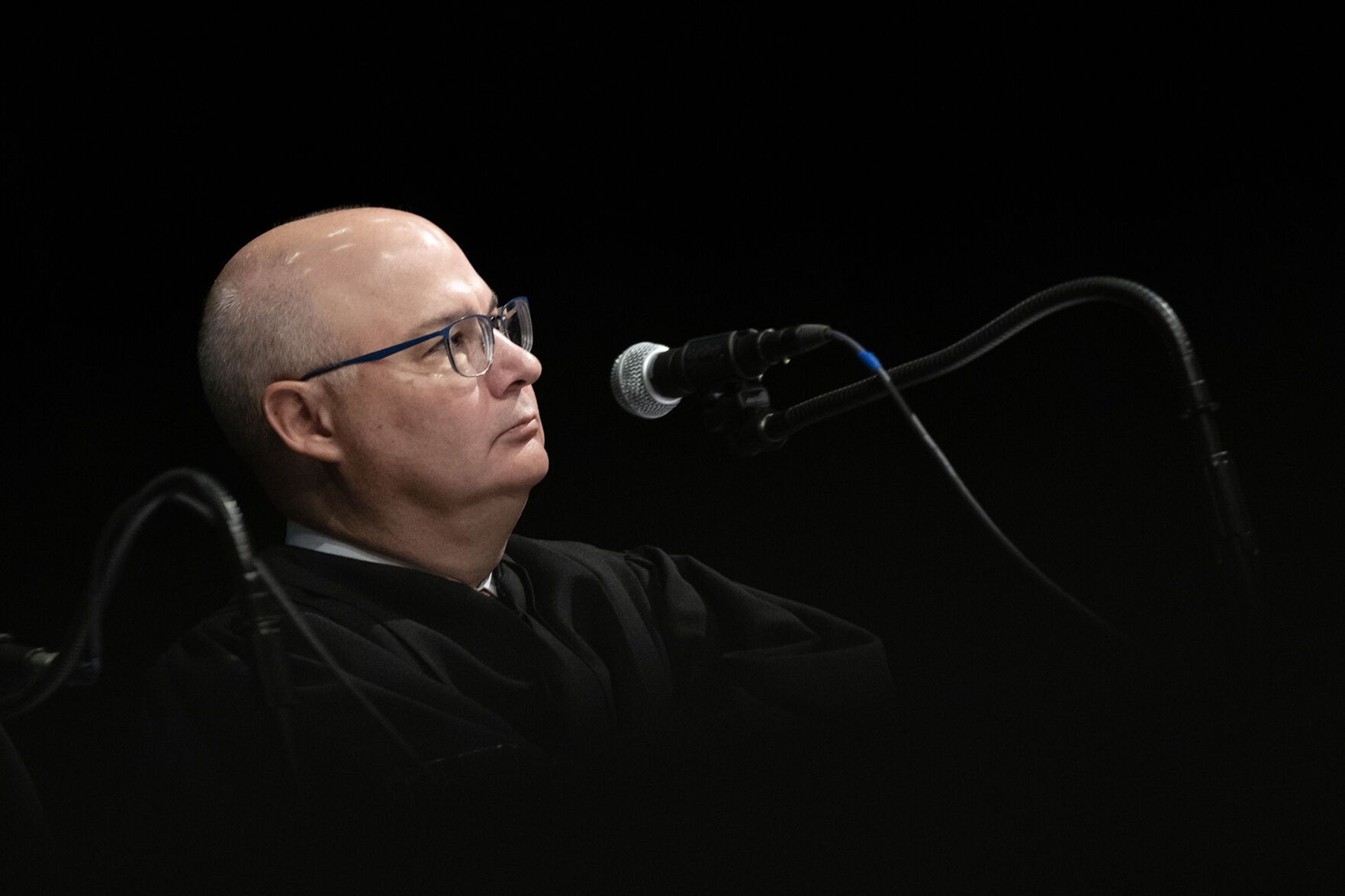
While unrepresented defendants in postconviction proceedings are permitted to have a court-appointed attorney investigate and augment their claims, that is not the case when a private lawyer authors the original petition, the Colorado Supreme Court decided on Monday.
In contrast to direct appeals of criminal convictions, which usually allege trial- or sentencing-related errors, postconviction relief is available only on specific grounds, such as ineffective assistance of counsel or newly discovered evidence. Under the rules, a trial judge can deny a postconviction petition outright if the defendant is clearly not entitled to relief.
However, if a judge does not deny the motion, they “shall cause a complete copy of said motion” to be sent to the prosecution and, if the defendant has requested counsel, also send a copy to the public defender’s office. The appointed attorney may then investigate or supplement claims that have “arguable merit,” and the judge may then hold a hearing.
In the case of Clemente Roberts, who alleges he received constitutionally ineffective assistance of counsel for his Denver murder prosecution, Roberts’ family hired lawyers to submit his postconviction motion. However, the attorneys simultaneously moved to withdraw, noting their agreement with Roberts was limited to filing the petition. They requested that a public defender be appointed to represent Roberts going forward.
On Dec. 1, District Court Judge Alex C. Myers determined Roberts’ petition potentially had merit. He forwarded the petition to the public defender’s office to “investigate, and add any claims the Public Defender finds to have arguable merit.”
The prosecution asked him to reconsider. Although the district attorney’s office had no objection to a public defender representing Roberts in future filings or at hearings, it did not believe an appointed attorney should be permitted to add claims to those his private attorneys had already identified.
“The logic of the rule is plainly to give pro se (self-represented) defendants who have filed a meritorious petition the opportunity for professional supplementation. To hold otherwise would permit Roberts — and any postconviction petitioner with resources to hire counsel for the initial petition — to file a second set of claims at state expense,” wrote Senior Deputy District Attorney Johanna G. Coats.
Myers stood by his decision. He noted Roberts’ private attorneys had since withdrawn from the case, and he “no longer has counsel.” Moreover, he found it problematic if a public defender, after performing their own investigation, could only stick to the claims Roberts’ private counsel originally advanced.
“As with every appointment of new counsel, they will be required to exercise their own independent judgment,” Myers wrote, “determine which issues they wish to pursue from those already raised, and to supplement the petition as they deem appropriate.”
The district attorney’s office immediately turned to the Supreme Court, arguing that the rules did not contemplate allowing criminal defendants to have two different sets of lawyers file postconviction claims.
“Further, if allowed to stand, the court’s order will create a new form of representation,” wrote Coats. “Defense counsel would like to create a practice in which she can represent defendants a little bit — just enough to get past summary denial — so the defendant is then entitled to file a second set of postconviction claims.”
Because the public defender identified a conflict of interest, Roberts received court-appointed representation through the Office of the Alternate Defense Counsel. The lawyers are, coincidentally, the same attorneys who filed his original petition. They informed the Supreme Court that they had no intention of adding claims to his petition.
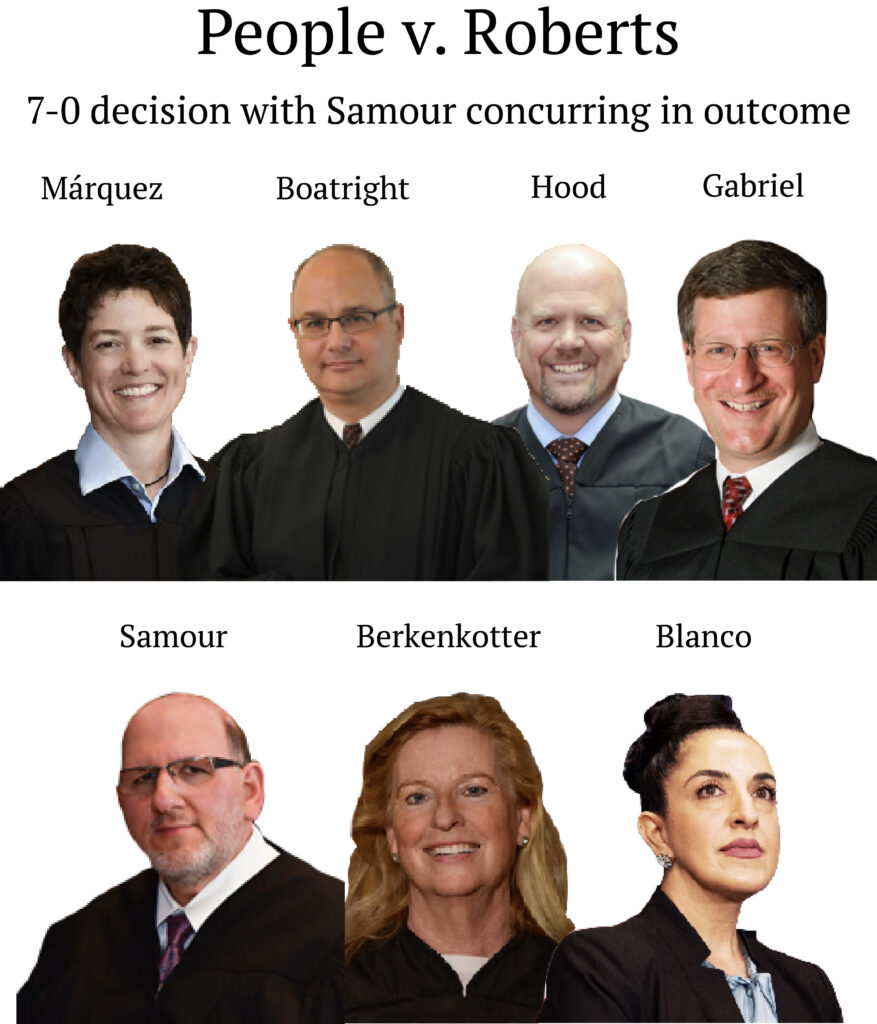
Justice Brian D. Boatright, in the June 15 opinion, noted the existence of other cases raising the same procedural question, and it was important for the Supreme Court to provide an answer.
The court’s majority found the rules to be ambiguous, with both the defense and prosecution interpretations seeming reasonable. But by looking to the “purpose and context underlying the rule,” wrote Boatright, the prosecution’s view was correct.
It is “of no moment whether a represented defendant had counsel for a limited purpose or more comprehensive representation. Either way, Roberts had counsel file the (postconviction) motion,” wrote Boatright. “Accordingly, we hold that because Roberts’s private attorney filed the (postconviction) motion on his behalf … he was not entitled to have the public defender or other court-appointed counsel supplement the motion.”
Justice Carlos A. Samour Jr. wrote separately to say that he did not find the rule ambiguous, and the language clearly supported the prosecution’s view. He was mystified by Boatright’s assertion that the majority needed to look beyond the rule’s wording to determine its meaning. He did not see where that analysis occurred in the opinion.
“Nowhere does the majority discuss the rule’s history or explain how the rule’s purpose removes the perceived ambiguity — nor can it, because there is no ambiguity,” Samour wrote. “Indeed, neither party argued ambiguity in this case; the majority ventured down that path all on its own.”
The case is People v. Roberts.


Local party leaders, incoming judge among members of judicial performance commission that violated law
Michael Karlik
michael.karlik@coloradopolitics.com
Updated 10 hours ago
A local Democratic leader and 2024 presidential elector. A legislative aide and leader in the Young Republicans. An incoming county court judge freshly appointed by the governor. They are among the eight members of the northeastern Colorado judicial performance commission...

Judge dismisses lawsuit seeking records from Colorado Democratic group
Marianne Goodland
marianne.goodland@coloradopolitics.com
Updated 1 day ago
A lawsuit seeking to obtain records from Democratic lawmakers affiliated with a caucus has been thrown out by a Denver District Court judge. On July 17, Judge Ericka Englert dismissed the April lawsuit filed by progressive activist Derrick Blanton, who...

Colorado Springs mother Deborah Nicholls’ murder conviction overturned
Nick Smith
nick-smith@coloradopolitics.com
Updated 2 days ago
A Colorado Springs mother convicted in 2008 of murdering her three children in a house fire might get a new trial after a judge ruled that prosecutors withheld key evidence that could have impacted the jury’s verdict. Deborah Nicholls, whose...
Colorado court overturns illegal $7,000 restitution order
Michael Karlik
michael.karlik@coloradopolitics.com
Updated 1 day ago
Colorado’s second-highest court overturned a Weld County defendant’s obligation to pay more than $7,000 in crime victim restitution on Thursday because a trial judge failed to issue a legally compliant restitution order at the time of sentencing. In Colorado, as...

Appeals court rejects former DougCo commissioner’s legal fee claim
Nicholas Fogleman
nicholas.fogleman@denvergazette.com
Updated 2 days ago
The Colorado Court of Appeals rejected a former Douglas County commissioner’s bid for reimbursement of attorney fees she incurred while responding to multiple investigations into her conduct. The dispute stemmed from a 2019 anonymous letter sent to county officials alleging...
Appeals court orders second look at Denver Water’s immunity for cyclist’s injury
Michael Karlik
michael.karlik@coloradopolitics.com
Updated 2 days ago
Colorado’s second-highest court ordered another look at a bicyclist’s negligence lawsuit against Denver Water on Thursday, concluding that a trial judge needed to evaluate the utility’s potential immunity using the state Supreme Court’s new guidance. Joseph A. “Joey” Scott alleged...
Labels, duration not definitive proof of ‘intimate relationship,’ Colorado court rules in domestic violence case
Michael Karlik
michael.karlik@coloradopolitics.com
Updated 1 day ago
Colorado’s second-highest court clarified on Thursday that the length of a couple’s relationship and the labels they attach to it are not conclusive evidence of whether it is an “intimate relationship” that can give rise to a domestic violence prosecution....

Colorado AG urges Supreme Court to let Boulder climate lawsuit proceed
Marissa Ventrelli
marissa.ventrelli@coloradopolitics.com
Updated 2 days ago
Colorado Attorney General Phil Weiser has filed a court brief with the U.S. Supreme Court in a lawsuit brought by Boulder city officials seeking to hold oil companies liable for their environmental impact. The case began in 2018, when the...
10th Circuit says landowner cannot sue ex-Routt County judge for statements in decision
Michael Karlik
michael.karlik@coloradopolitics.com
Updated 3 days ago
A Routt County landowner cannot sue a former judge for his allegedly inaccurate statements in a case where the landowner was not a party, the Denver-based federal appeals court decided on Wednesday. Anne Fitzsimmons, who lives in Germany, owns a...
Defendant’s competency in question in El Paso County case involving slain Army police officer
Nick Smith
nick-smith@coloradopolitics.com
Updated 3 days ago
It will be another 60 days before a 4th Judicial District court determines if a man charged in the shooting death of an Army police officer is competent to proceed in his case. Judge Erin Sokol granted a request Wednesday...
PREV
PREVIOUS

Colorado State Shooting Association files constitutional challenge to firearms dealer law
A firearms group has filed a lawsuit challenging a recently signed law expanding regulations for firearms dealers in Colorado. House Bill 26-1126 clarifies that firearms dealers must hold both a federal and state license to operate. The bill also allows the Department of Revenue to fine dealers up to $100,000 for second or subsequent violations of […]

Denver Public Schools superintendent confirms interest in Miami-Dade job
After repeatedly denying rumors he was pursuing jobs in other districts, Denver Public Schools (DPS) Superintendent Alex Marrero confirmed that he has been “recruited” in the Miami-Dade County Public Schools search. In a June 9 email to the Board of Education obtained by The Denver Gazette, Marrero said he was “recruited regarding the Superintendent vacancy […]