

10th Circuit dismisses Tina Peters’ challenge to confinement as moot
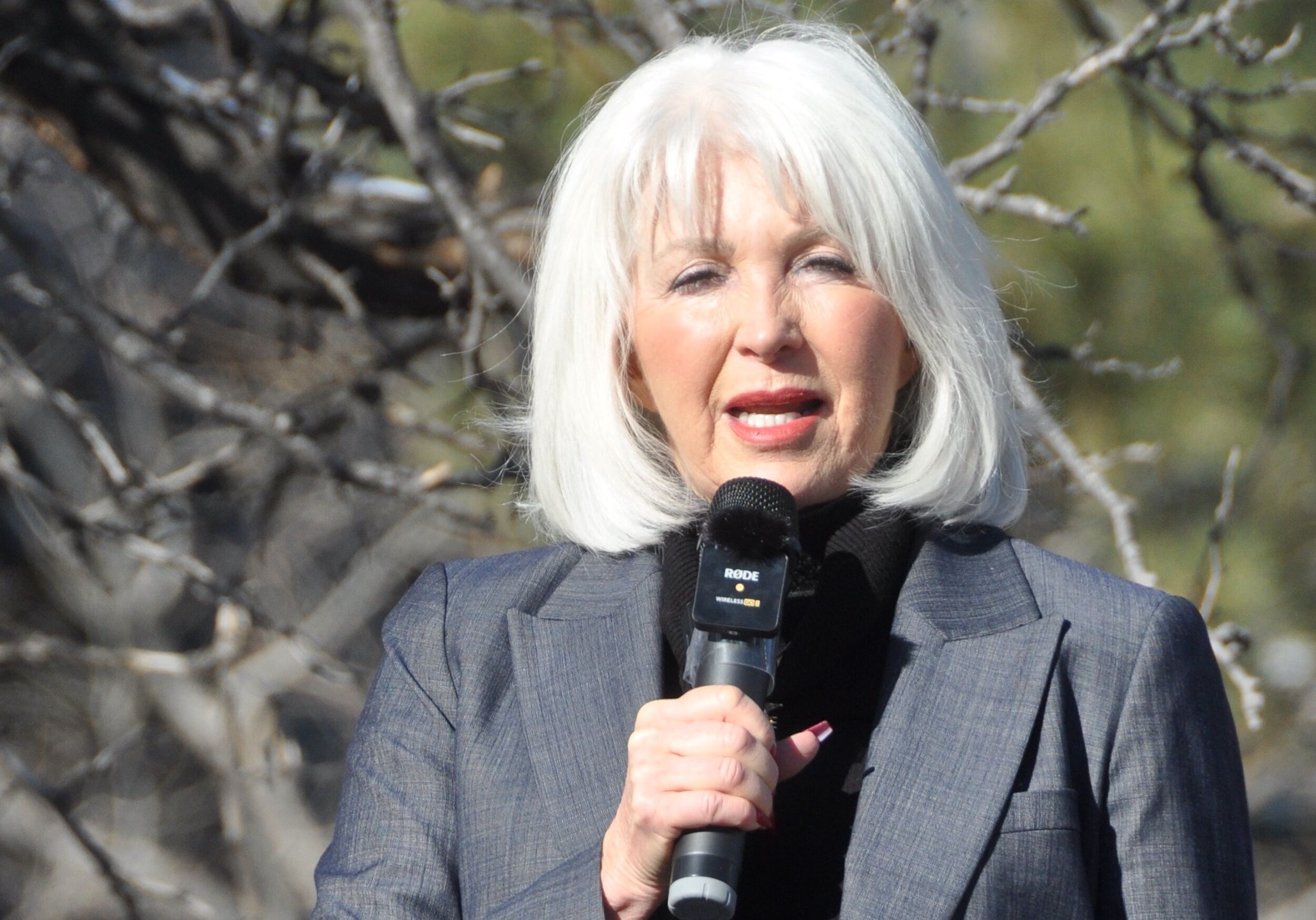
The Denver-based federal appeals court granted the state’s unopposed request on Wednesday to dismiss former Mesa County clerk Tina Peters’ challenge to her confinement as moot.
Although Peters received a commutation of her prison sentence last month from Gov. Jared Polis and has since left prison, her federal proceedings addressed whether Peters could be freed on bond while she appealed the lawfulness of her state convictions and sentence.
Mesa County jurors convicted Peters in 2024 for her role in a security breach of her office’s voting equipment when she was the elected GOP clerk. She received a nine-year prison sentence.
From there, Peters’ state criminal case spun off into several distinct, but related, developments.
While she pursued a routine appeal through the state’s Court of Appeals, Peters also filed a seemingly unprecedented federal petition for “habeas corpus,” a legal tool used to challenge one’s confinement. Specifically, Peters sought to be released on bond while her appeal moved forward, a request that state courts previously denied.
Chief U.S. Magistrate Judge Scott T. Varholak ruled at the end of 2025 that Peters satisfied none of the criteria that would permit him to intervene in ongoing state proceedings and grant her release on bond. Peters’ lawyers appealed his decision to the U.S. Court of Appeals for the 10th Circuit.
Meanwhile, Colorado’s Court of Appeals decided Peters’ direct appeal of her criminal convictions. A three-judge panel rejected her arguments, including her contention that a purported pardon by President Donald Trump applied to her state convictions and her claim that she was entitled to immunity under federal law.
However, the panel agreed that District Court Judge Matthew D. Barrett appeared to base Peters’ sentence on improper considerations about her beliefs in election fraud. It returned the case to Barrett to impose a new sentence.
Weeks after the appellate decision, Barrett addressed Peters’ motion to once again release her on bond while her appeal and her resentencing remained pending. On April 29, Barrett issued a new order denying Peters’ bond anew. He reasoned that she was unlikely to prevail in reversing her convictions and she remained a potential flight risk.
“Now that she is post-conviction and serving a prison term, the risk of flight, and incentive to flee, should she be released, increases dramatically,” Barrett wrote. “Of course, Defendant is free to contest her convictions, but the light continues to dim on the likelihood of success.”
Two weeks later, Polis announced that Peters would be eligible for parole as of June 1, despite heavy opposition from Democrats and some Republicans. She left prison on the scheduled day.
Finally, Peters agreed to end her federal habeas appeal around that same time. The development was not a product of Polis’ clemency, but rather Barrett’s April order denying bond again.
The state, in arguing for dismissal of the federal case, noted Peters’ habeas petition revolved around the original decision not to release her pending appeal.
“Here, this habeas matter no longer presents a live case or controversy because the state court order Appellant challenges has been superseded and is now void,” wrote Senior Assistant Attorney General Lisa K. Michaels on May 7.
Peters’ attorneys agreed with the state’s position, prompting a three-judge 10th Circuit panel to dismiss the appeal on June 17.
“Upon consideration, we agree with the parties that this case has become moot,” wrote Judges Harris L Hartz, Carolyn B. McHugh, and Senior Judge Paul J. Kelly Jr. in an unsigned order.
The case is Peters v. Stancil et al.


10th Circuit partially revives lawsuit over 2020 Denver protest injuries
Michael Karlik
michael.karlik@coloradopolitics.com
Updated 11 hours ago
The Colorado-based federal appeals court revived a man’s claims against Denver on Friday after concluding a trial judge resolved the case in the city’s favor without analyzing two of the three instances of alleged excessive force and other constitutional violations....
Federal judges find Colorado immigration judge violated several orders
Michael Karlik
michael.karlik@coloradopolitics.com
Updated 1 day ago
Multiple federal judges in Colorado have freed people from immigration custody after determining that one immigration judge violated their directives for properly conducting bond hearings. For nearly a year, Colorado’s U.S. District Court has faced a flood of habeas corpus petitions...

Misconduct complaints from ex-Colorado judicial discipline director dismissed against federal judges
Michael Karlik
michael.karlik@coloradopolitics.com
Updated 3 days ago
The administrative body for the Denver-based federal appeals court upheld a finding last week that misconduct complaints against Colorado’s chief federal trial judge and the chief appeals judge warranted dismissal and appeared to be a “litigation tactic” by the complaining...

First-ever Red Rocks naturalization ceremony draws most diverse group of new citizens
Michael Karlik
michael.karlik@coloradopolitics.com
Updated 1 day ago
Colorado’s federal trial court held its first-ever naturalization ceremony for nearly 300 new citizens on Thursday at Red Rocks Park and Amphitheatre. “We’re doing it to commemorate the 250th anniversary of the Declaration of Independence and the United States. Red...
Jeffco taxpayers could be on the hook for a possible child sex assault settlement
Matt Kyle
matt.kyle@denvergazette.com
Updated 3 days ago
Taxpayers may end up on the hook for a child sexual assault settlement, possibly worth up to $15 million, after Jeffco Public Schools failed to notify its insurance company in a timely manner about the case. The incident stems from...
10th Circuit finds no fair housing violation by Littleton landlord for worker’s alleged rape of tenant
Michael Karlik
michael.karlik@coloradopolitics.com
Updated 1 day ago
The Denver-based federal appeals court concluded on Monday that Littleton’s housing authority could not be held liable for a maintenance worker’s alleged rape of a tenant, as the worker’s employment did not provide any special access to the victim. A...

Jeffco Public Schools sues Trump administration to protect funding after alleged transgender policies violation
Matt Kyle
matt.kyle@denvergazette.com
Updated 4 days ago
In the wake of several threats by the Trump administration to revoke federal funding, Jeffco Public Schools filed a lawsuit against the Department of Education seeking to protect that badly needed money. Jeffco has been under investigation by the DOE’s...
Denver detox center did not violate man’s rights with 10-hour hold, 10th Circuit says
Michael Karlik
michael.karlik@coloradopolitics.com
Updated 5 days ago
The Colorado-based federal appeals court concluded on Tuesday that Denver’s detoxification facility did not violate a man’s rights by holding him against his will for 10 hours until his blood alcohol content was projected to reach zero. Unusually, Brian Garrett’s...

Federal judge clarifies ex-GOP treasurer candidate’s burden to prove defamation claims
Michael Karlik
michael.karlik@coloradopolitics.com
Updated 5 days ago
A federal judge clarified last week that businessman and former Republican statewide candidate Brian Watson will need to surmount a higher hurdle in proving his claim that a party guest’s alleged description of him as a “criminal” amounted to defamation....
Colorado board permits state to appeal injunction against arthritis drug price cap
Marissa Ventrelli
marissa.ventrelli@coloradopolitics.com
Updated 6 days ago
A Colorado board voted Friday to allow the Attorney General’s Office to fight an injunction against a price cap on a drug that treats arthritis. A U.S. district court judge had granted the company Amgen a preliminary injunction, temporarily blocking...
PREV
PREVIOUS

Federal judge declines to recuse from death penalty case after Supermax visit
A federal judge declined to recuse herself last month from a death penalty case arising out of Colorado’s “Supermax” prison, finding that her tour of the facility earlier this year did not bias her decision-making. U.S. District Court Judge Charlotte N. Sweeney is presiding over the federal murder prosecution of Ishmael Petty, who is accused […]

Divided appeals court reverses conviction after judge declined to define 'bludgeon'
Colorado’s second-highest court reversed a Jefferson County defendant’s felony menacing conviction on Thursday, concluding that the trial judge’s failure to define “bludgeon” for jurors may have affected the outcome. A three-judge Court of Appeals panel divided in unusual ways in the case of Michael Casey Simms. Two judges believed the definition of “reasonable doubt” that […]