

Colorado justices rule county courts may jail defendants during misdemeanor appeals
The Colorado Supreme Court clarified on Monday that county court judges may order defendants into custody while they appeal their misdemeanor convictions.
The justices pointed out the Colorado Constitution explicitly forbids judges from setting bail pending appeal if they find the defendant is a danger to the community, as was the case with Richard Lewis.
In November 2023, a jury in Denver County Court found Lewis guilty of multiple misdemeanors for sexual assault. He received 12 months in the county jail plus five years of sex offender probation as a sentence.
Before trial, Lewis had been out on a personal recognizance bond. At sentencing, Lewis indicated he would appeal his convictions and asked to remain free on bond until a district court judge could review the case.
In response, Presiding Judge Kerri Lombardi cited Colorado’s law governing bail pending appeal. In instances where bail is allowed, a judge must decline to let defendants remain free if they are likely to flee, pose a danger to the community or the appeal would be frivolous.
Lombardi said she had “significant concerns about the safety of the community,” and also believed any appeal of Lewis’ sentence would be frivolous. She refused to allow Lewis to remain free until the conclusion of his appeal.
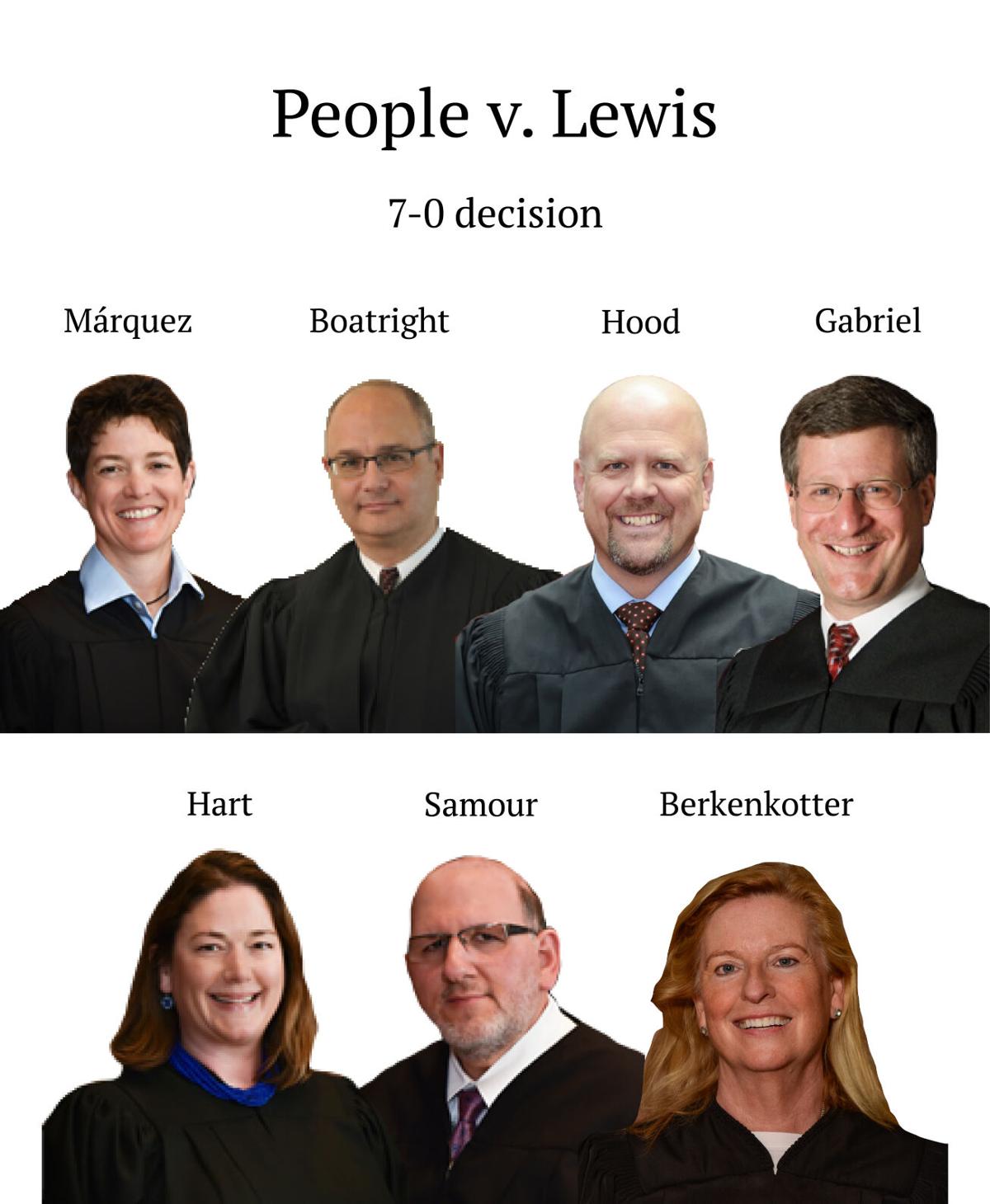

Lewis turned directly to the Supreme Court to challenge Lombardi’s decision, noting the justices had never addressed the issue before.
Among other things, he argued Lombardi violated the Supreme Court’s own precedent. In a 2014 decision, People v. Steen, the court responded to a Boulder County District Court judge — now-Justice Maria E. Berkenkotter — who declined to pause the defendant’s probationary sentence while she reviewed the appeal of his county court conviction.
The Supreme Court’s majority at the time noted criminal defendants have the right to appeal, but appealing a misdemeanor conviction from a county court would be meaningless if defendants had to start serving their brief sentences right away — and potentially complete their entire punishment before a district judge could rule on the appeal.
But in a Sept. 9 opinion, Chief Justice Monica M. Márquez, who also authored the decision in Steen, explained that pausing a defendant’s sentence pending appeal and denying the defendant bail pending appeal are two different concepts, with the latter expressly governed by the state constitution.
Therefore, a county court judge has the authority to stay a defendant’s jail sentence while simultaneously ordering him into custody.
“Accordingly, having found that Lewis presented a danger to the community, the county court properly denied bail,” Márquez wrote.
The case is People v. Lewis.

Misconduct complaints from ex-Colorado judicial discipline director dismissed against federal judges
Michael Karlik
michael.karlik@coloradopolitics.com
Updated 6 hours ago
The administrative body for the Denver-based federal appeals court upheld a finding last week that misconduct complaints against Colorado’s chief federal trial judge and the chief appeals judge warranted dismissal and appeared to be a “litigation tactic” by the complaining...

First-ever Red Rocks naturalization ceremony draws most diverse group of new citizens
Michael Karlik
michael.karlik@coloradopolitics.com
Updated 9 hours ago
Colorado’s federal trial court held its first-ever naturalization ceremony for nearly 300 new citizens on Thursday at Red Rocks Park and Amphitheater. “We’re doing it to commemorate the 250th anniversary of the Declaration of Independence and the United States. Red...
10th Circuit finds no fair housing violation by Littleton landlord for worker’s alleged rape of tenant
Michael Karlik
michael.karlik@coloradopolitics.com
Updated 1 day ago
The Denver-based federal appeals court concluded on Monday that Littleton’s housing authority could not be held liable for a maintenance worker’s alleged rape of a tenant, as the worker’s employment did not provide any special access to the victim. A...

Jeffco Public Schools sues Trump administration to protect funding after alleged transgender policies violation
Matt Kyle
matt.kyle@denvergazette.com
Updated 17 hours ago
In the wake of several threats by the Trump administration to revoke federal funding, Jeffco Public Schools filed a lawsuit against the Department of Education seeking to protect that badly needed money. Jeffco has been under investigation by the DOE’s...
Denver detox center did not violate man’s rights with 10-hour hold, 10th Circuit says
Michael Karlik
michael.karlik@coloradopolitics.com
Updated 2 days ago
The Colorado-based federal appeals court concluded on Tuesday that Denver’s detoxification facility did not violate a man’s rights by holding him against his will for 10 hours until his blood alcohol content was projected to reach zero. Unusually, Brian Garrett’s...

Federal judge clarifies ex-GOP treasurer candidate’s burden to prove defamation claims
Michael Karlik
michael.karlik@coloradopolitics.com
Updated 2 days ago
A federal judge clarified last week that businessman and former Republican statewide candidate Brian Watson will need to surmount a higher hurdle in proving his claim that a party guest’s alleged description of him as a “criminal” amounted to defamation....
Colorado board permits state to appeal injunction against arthritis drug price cap
Marissa Ventrelli
marissa.ventrelli@coloradopolitics.com
Updated 3 days ago
A Colorado board voted Friday to allow the Attorney General’s Office to fight an injunction against a price cap on a drug that treats arthritis. A U.S. district court judge had granted the company Amgen a preliminary injunction, temporarily blocking...

Federal judge rejects constitutional claims, ‘expressions of hatred’ by Club Q defendant
Michael Karlik
michael.karlik@coloradopolitics.com
Updated 3 days ago
A federal judge rejected a defendant’s claims that he received constitutionally ineffective assistance of counsel while facing federal hate crime and firearms charges for murdering five people at a Colorado Springs LGBTQ nightclub in 2022. Anderson Lee Aldrich is serving...

Divided 10th Circuit upholds Colorado congestion fee on car rentals
Michael Karlik
michael.karlik@coloradopolitics.com
Updated 3 days ago
The Denver-based federal appeals court concluded on Monday that a 2024 “congestion impact fee” that lawmakers imposed on short-term vehicle rentals did not conflict with a federal prohibition on certain airport-related charges. Beginning in the 1970s, Congress began limiting the...
10th Circuit dismisses woman’s lawsuit following 10-year attempt to undo restraining order
Michael Karlik
michael.karlik@coloradopolitics.com
Updated 6 days ago
The Denver-based federal appeals court rejected a woman’s challenge on Friday to a restraining order imposed on her more than a decade ago, finding that she cannot credibly claim she will be prosecuted for violating the restraining order through her...