

10th Circuit tosses Pueblo County sheriff defendants’ appeal in fatal shooting lawsuit
The Denver-based federal appeals court rejected an attempt from Pueblo County sheriff’s employees on Wednesday to rely on their own version of the facts to escape liability for fatally shooting an unarmed man outside a middle school.
A trial judge ruled last year that the defendants were not entitled to qualified immunity, a judicially created doctrine shielding government employees from civil lawsuits unless they violate a person’s clearly established legal rights. Although judges’ pretrial decisions are normally not appealable immediately, there is an exception for orders denying qualified immunity — so long as the appeal focuses on legal questions or if the evidence “blatantly” contradicts the trial judge’s factual narrative.
A three-judge panel of the U.S. Court of Appeals for the 10th Circuit concluded that the Pueblo County defendants’ appeal improperly relied on their own assertions of what happened.
“Almost all the ‘facts’ marshaled by the Officers were neither found nor assumed by the district court,” wrote Judge Veronica S. Rossman in the June 10 opinion. “We lack jurisdiction to resolve an argument that tries to smuggle in factual disputes under the guise of an abstract legal issue.”
Case: Estate of Ward v. Lucero
Decided: June 10, 2026
Jurisdiction: U.S. District Court for Colorado
Ruling: 3-0
Judges: Veronica S. Rossman (author)
Gregory A. Phillips
Carolyn B. McHugh
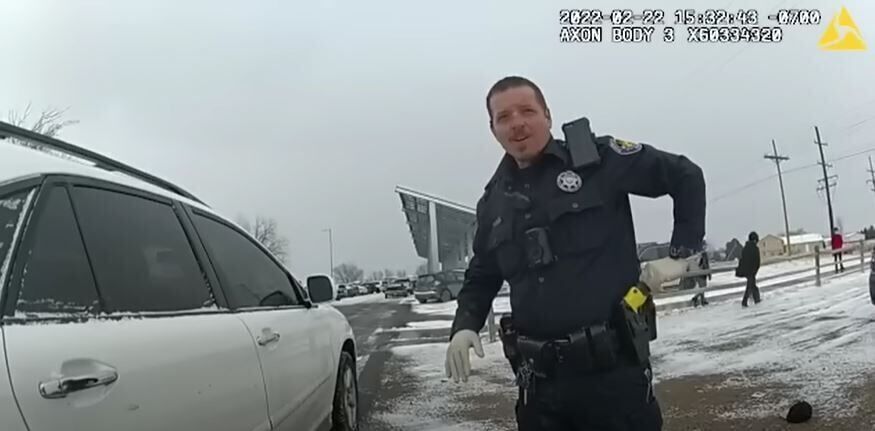
On Feb. 22, 2022, Richard Ward rode with his mother and her boyfriend to Liberty Point International School to pick up Ward’s younger brother. At one point, Ward left their white SUV and, upon returning, briefly mistook another white SUV for the one they had arrived in.
Deputies Charles McWhorter and Cassandra Gonzales responded to a call about Ward’s behavior. Their body-worn cameras captured the moments leading up to Ward’s death.
“Just looking for my little brother,” Ward explained to McWhorter, opening the SUV door as the deputy approached. Ward had one hand in his jacket pocket, which McWhorter appeared to pull. Ward asked why McWhorter was touching him.
McWhorter said he understood Ward was “going around trying to mess with doors.” Ward insisted he believed the other white SUV was his and apologized to the woman inside. McWhorter asked if Ward was under the influence or had weapons.
While Ward was going through his pockets, he ingested what the lawsuit described as an anti-anxiety tablet.
“What did you just stick in your mouth?” McWhorter demanded and immediately pulled Ward out of the SUV.
“It was a pill. Let me go!” Ward screamed.
Within 20 seconds of wrestling on the ground, McWhorter shot Ward three times. McWhorter stood above Ward’s body and did not render aid, nor did Gonzales. Instead, McWhorter shut the SUV door and said he “bloodied (his) nose.”
Ward died from his injuries.
Sheriff’s personnel handcuffed his mother, Kristy Ward Stamp. They placed her in a vehicle, patted her down, and took her to the sheriff’s office. They then interviewed her and — after nearly three hours — let her go. Law enforcement held onto her personal items for days, and her car for months.
In a May 2025 order, U.S. District Court Judge Charlotte N. Sweeney green-lit the claims of excessive force and unlawful seizure for a jury trial, based on the defendants’ actions toward Ward and Ward Stamp. She denied the defendants qualified immunity, finding that a jury could consider the disputed evidence and believe the defendants committed clear constitutional violations.

A “reasonable jury could conclude Mr. Ward’s conduct did not rise to the level of severity to justify the use of deadly force against Mr. Ward,” Sweeney wrote. Further, “Plaintiffs have put forth sufficient evidence showing Defendants lacked probable cause to detain Ms. Ward Stamp.”
The defendants immediately appealed to the 10th Circuit. They argued that Sweeney used “the incorrect method of factual analysis” and that her view of the encounter was “blatantly contradicted” by the evidence. Defense attorneys raised new alleged facts, including that Ward “headbutted” McWhorter and was “under the influence of drugs and/or alcohol.”
Lawyers for Ward Stamp warned that the defendants were trying to “relitigate the facts,” which was improper for an immediate appeal.
Before oral arguments, the 10th Circuit asked the defendants for the second time to explain why the court could even hear the case. Although the defendants responded that they were “willing to concede” the facts as Sweeney viewed them, the 10th Circuit judges were still perplexed.
“You simply say, ‘These are the facts the district court should have found and we win.’ And then in your reply,” said Judge Carolyn B. McHugh during oral arguments, “you say, ‘Well, if we are stuck with the facts as found by the district court, we still win.’ I’m not sure you can do that.”

“Tell me what the district court found that the district court could not find,” said Judge Gregory A. Phillips.
“As to which facts?” asked defense attorney Alex M. Pass.
“The district court said, ‘Based on everything that I’ve seen and has been presented to me, I would sustain a jury verdict against your clients because the jury could find facts X, Y, Z.’ So, I assume you’re here today challenging facts X, Y, Z,” said Phillips. “What are they?”
The panel sided with the defendants, concluding that Sweeney used the correct method to determine whether the claims could proceed to trial. Otherwise, there was no blatant contradiction between the evidence and her narrative, meaning the defendants’ reliance on other facts doomed their challenge.
“Sometimes, a litigant decides to ‘fight the district court’s facts,'” wrote Rossman. “Other times, a party does not facially attack the district court’s factfinding so much as marshal ‘additional facts’ the district court never found. But our limited jurisdiction does not abide such tactics.”
The case is Estate of Ward et al. v. Lucero et al.

Federal judge green-lights civil trial against ex-Fort Collins DUI officer
Michael Karlik
michael.karlik@coloradopolitics.com
Updated 2 days ago
A federal judge ruled on Thursday that Fort Collins’ former “DUI officer” will face a civil trial for allegedly investigating a motorist for impaired driving without any reasonable suspicion to do so. In recent years, several people arrested by Officer...

Colorado Supreme Court suspends Mesa County judge pending misconduct investigation
Michael Karlik
michael.karlik@coloradopolitics.com
Updated 21 hours ago
The Colorado Supreme Court suspended Mesa County Court Judge Michael J. Grattan on Thursday amid a misconduct investigation. The court’s Sept. 10 order gave Grattan 21 days to explain why his paid suspension should not continue through the end of...
Colorado Supreme Court changes course, dismisses case about special district bonds
Michael Karlik
michael.karlik@coloradopolitics.com
Updated 21 hours ago
The Colorado Supreme Court declined on Friday to decide a dispute between a large-scale Commerce City development and the various districts financing it, after initially showing interest in the ongoing case. Colorado has roughly 2,800 special districts, which are local...
10th Circuit tosses GEO Group’s pretrial appeal in human trafficking lawsuit
Michael Karlik
michael.karlik@coloradopolitics.com
Updated 3 days ago
The Denver-based federal appeals court dismissed an attempt by The GEO Group on Wednesday to appeal a trial judge’s non-existent decision two months before the company is scheduled to face a civil trial over alleged trafficking violations at the Aurora...
Denver sues Trump to block armed ICE agents from polling sites
Deborah Grigsby
deborah.smith@denvergazette.com
Updated 3 days ago
The city of Denver, along with several groups, sued the Trump administration Thursday, seeking to block U.S. Immigration and Customs Enforcement officers who are armed from polling sites during the upcoming midterm elections. In fact, there are no official orders...

Federal judge takes no action against ICE in Colorado after hearing about mistakes, not ‘blatant violations’
Michael Karlik
michael.karlik@coloradopolitics.com
Updated 19 hours ago
A federal judge declined to take action against U.S. Immigration and Customs Enforcement on Thursday after hearing that a pattern of alleged lawbreaking amounted to mistakes and a misunderstanding of the government’s position in court. For nearly a year, Colorado’s...
Colorado doctors, dentists challenge state law on gender‑transition services in new federal lawsuit
Marissa Ventrelli
marissa.ventrelli@coloradopolitics.com
Updated 16 hours ago
A group of Christian doctors and dentists has filed a federal lawsuit challenging a Colorado law they say requires them to provide gender‑transition services that conflict with their religious and ethical beliefs. The lawsuit, filed by the Christian Medical and...
Federal judge directs plaintiff to revise complaint alleging Denver officers’ constitutional violations
Michael Karlik
michael.karlik@coloradopolitics.com
Updated 19 hours ago
A federal judge directed a plaintiff to revise his allegations on Wednesday to more precisely state what two Denver officers and the city itself allegedly did to violate his constitutional rights by facilitating his prosecution for murder until prosecutors dropped...

Lawsuit challenges Douglas County commissioners’ ballot actions
Nicholas Fogleman
nicholas.fogleman@denvergazette.com
Updated 3 days ago
A new lawsuit against Douglas County commissioners seeks to invalidate the board’s intervention in efforts to expand the commission from three members to five and restore the original ballot language approved by more than 20,000 petition signers. The suit marks...
Federal judge explores new sanctions against ex-Colorado judicial discipline director
Michael Karlik
michael.karlik@coloradopolitics.com
Updated 21 hours ago
A federal judge on Wednesday directed Colorado’s former judicial discipline director, for the third time this year, to explain why she should not sanction him for his latest conduct in his litigation against the state’s judiciary. Christopher S.P. Gregory, who served...
PREV
PREVIOUS

Backers of Colorado road-funding initiative reject withdrawal deadline
The standoff over a road‑funding initiative in Colorado persisted after supporters declined state lawmakers’ request to withdraw the measure, while both sides signaled they are willing to pursue a broader agreement ahead of the fall deadline. Initiative No. 175, backed by the coalition Restore Our Roads, would require that all transportation-related revenue be used exclusively […]

Primary preview: Regina English, Chauncy Johnson face off in House District 17
State Rep. Regina English is facing a young, ambitious Democratic activist in the primary election for House District 17. The choice between English and Chauncy Johnson in District 17, representing the southern portion of Colorado Springs from the east side of downtown to the Colorado Springs Airport, is the only competitive Democratic legislative primary in […]