

Colorado Supreme Court upholds man’s child enticement conviction
The Colorado Supreme Court on Tuesday concluded the state’s second-highest court wrongly overturned a man’s Jefferson County conviction for a child sex offense, determining the evidence was sufficient after all to find him guilty.
James Clayton Johnson is serving six years to life in prison after jurors convicted him of enticement. The offense requires someone to attempt to persuade a child to enter a vehicle or “secluded place” with an intent to commit unlawful sexual contact. Previously, the Court of Appeals found prosecutors failed to prove either portion of the offense.
But the Supreme Court believed Johnson’s lewd comments toward a 10-year-old girl and his behavior during the brief interaction did support a guilty verdict if the Court of Appeals had correctly viewed the evidence most favorably to the prosecution’s narrative.
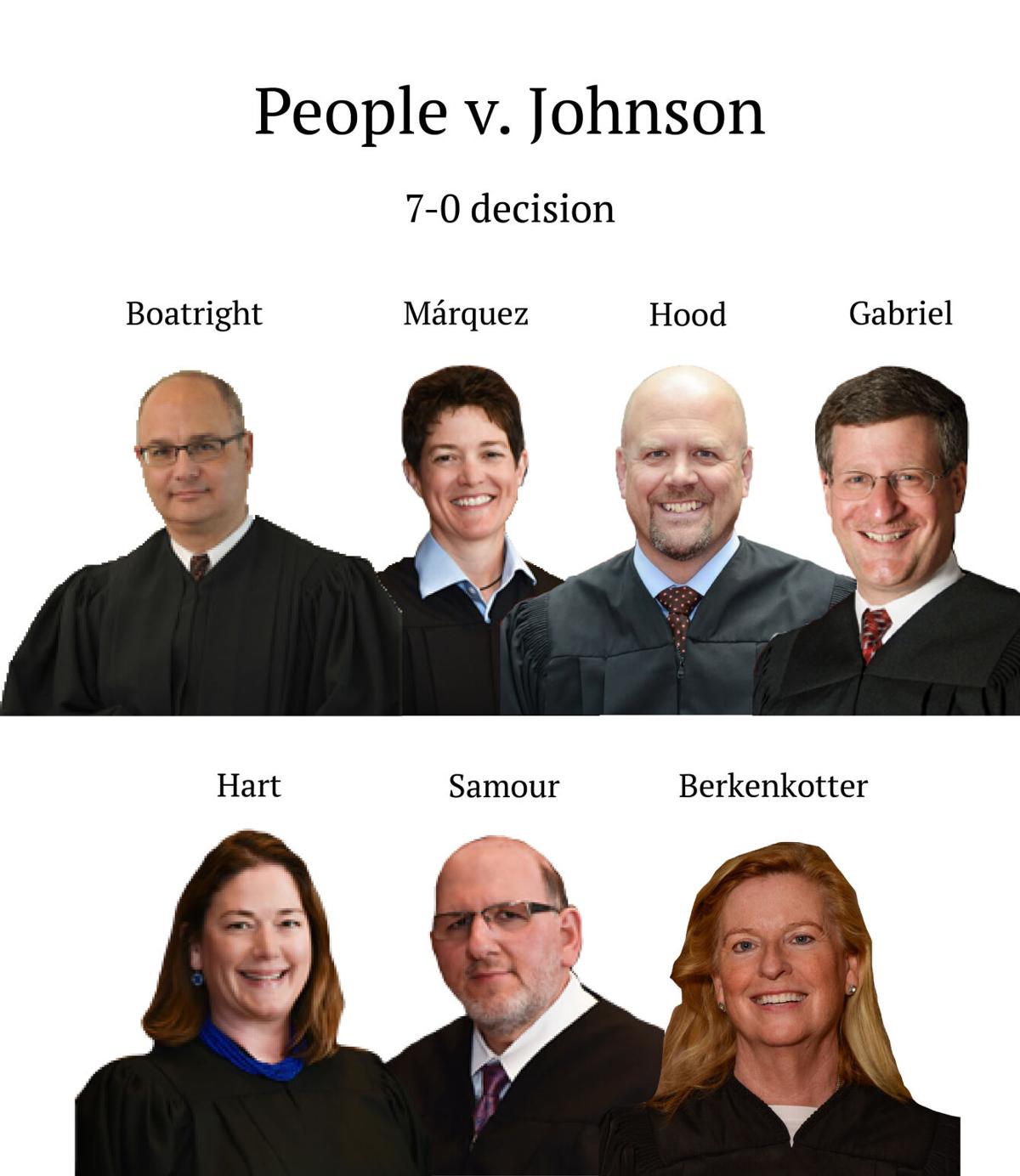

“Even absent descriptions of specific sexual acts, courts have relied, at least in part, on defendants’ explicit sexual conversations with child victims to find the requisite intent to support a conviction under enticement and enticement-like statutes,” wrote Justice Monica M. Márquez in the May 28 opinion.
Jurors at Johnson’s trial heard that:
• A man driving Johnson’s truck pulled beside the victim, A.W., in a Lakewood neighborhood while she was walking her dog.
• He inquired about A.W.’s name, age and address.
• The man said the girl was “the perfect age for a boyfriend.”
• He asked whether she had “ever touched it,” potentially referring to male genitalia.
The interaction lasted approximately one minute before the man and A.W. departed in opposite directions.
In response, prosecutors charged Johnson with enticing a child. He disputed he was the driver of the truck, as the victim identified another man in a photo lineup. A three-judge panel for the Court of Appeals ultimately decided that even if Johnson was the driver, the “highly inappropriate” statements did not prove enticement.
As for Johnson’s alleged attempt to persuade A.W. to enter the truck, Judge Lino S. Lipinsky de Orlov noted what the evidence did not show — specifically, any words or gestures to get A.W. into the truck or an attempt to stop her when she walked away. Similarly, it was unclear that Johnson’s intent was to commit unlawful sexual contact.
“We acknowledge that Johnson’s comment that A.W. was the ‘perfect age for a boyfriend’ and his question whether she had ‘ever touched it’ could indicate to a reasonable mind that Johnson had sexual thoughts about A.W,” wrote Lipinsky. “However, there is too large an inferential leap between those thoughts and a formed intent to act upon them by committing sexual assault.”

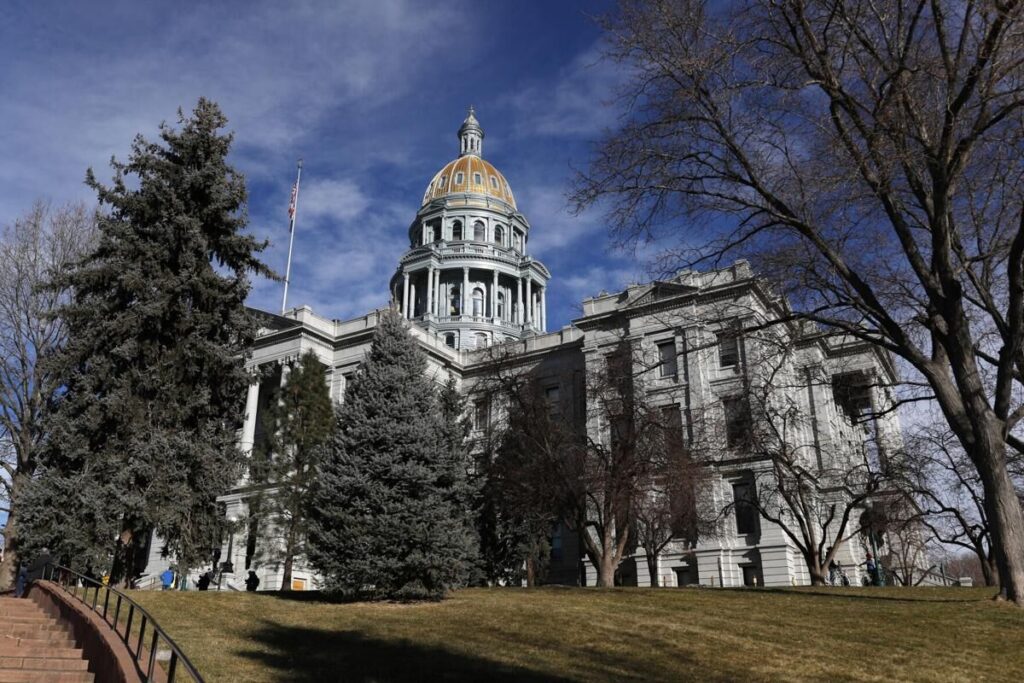
The Ralph L. Carr Colorado Judicial Center, on Tuesday, Sept. 13, 2022, in Denver, Colo. (Timothy Hurst/The Denver Gazette)
Timothy Hurst

The Ralph L. Carr Colorado Judicial Center, on Tuesday, Sept. 13, 2022, in Denver, Colo. (Timothy Hurst/The Denver Gazette)
The government appealed to the Supreme Court, arguing the entire context — pulling alongside a stranger and making inappropriate comments — suggested there was no “innocent explanation.” It also slammed the Court of Appeals’ list of actions Johnson did not take, arguing it “effectively shows abusers how far they can go” without committing a crime.
“He’s immediately going to talking about a penis three questions in,” Senior Assistant Attorney General Grant R. Fevurly told the justices at oral arguments, referring to Johnson. “‘Have you ever touched it?’ That can, frankly, hardly be clearer evidence of what exactly is on his mind.”
Márquez, in the court’s opinion, did not address the dispute over the driver’s identity. Instead, she agreed the Court of Appeals failed to appreciate that Johnson’s actions could amount to “steering the conversation toward asking A.W. to enter Johnson’s truck — likely so she could ‘touch it.'”
“Johnson’s question about whether A.W. had ever ‘touched it’ can reasonably be viewed as the beginning of an invitation to do precisely that. And because that would constitute unlawful sexual contact, we conclude that the evidence was sufficient to prove that Johnson acted with the intent,” Márquez added.
The Supreme Court returned the case to the Court of Appeals to address Johnson’s other grounds for appeal, including his claim that the jury improperly heard how he allegedly persuaded a 5-year-old girl in Louisiana to enter his car and kissed her. Márquez noted the Supreme Court believed the evidence was sufficient to convict Johnson even without considering the Louisiana encounter.
The case is People v. Johnson.


10th Circuit partially revives lawsuit over 2020 Denver protest injuries
Michael Karlik
michael.karlik@coloradopolitics.com
Updated 1 day ago
The Colorado-based federal appeals court revived a man’s claims against Denver on Friday after concluding a trial judge resolved the case in the city’s favor without analyzing two of the three instances of alleged excessive force and other constitutional violations....
Federal judges find Colorado immigration judge violated several orders
Michael Karlik
michael.karlik@coloradopolitics.com
Updated 9 hours ago
Multiple federal judges in Colorado have freed people from immigration custody after determining that one immigration judge violated their directives for properly conducting bond hearings. For nearly a year, Colorado’s U.S. District Court has faced a flood of habeas corpus petitions...

Misconduct complaints from ex-Colorado judicial discipline director dismissed against federal judges
Michael Karlik
michael.karlik@coloradopolitics.com
Updated 2 days ago
The administrative body for the Denver-based federal appeals court upheld a finding last week that misconduct complaints against Colorado’s chief federal trial judge and the chief appeals judge warranted dismissal and appeared to be a “litigation tactic” by the complaining...

First-ever Red Rocks naturalization ceremony draws most diverse group of new citizens
Michael Karlik
michael.karlik@coloradopolitics.com
Updated 7 hours ago
Colorado’s federal trial court held its first-ever naturalization ceremony for nearly 300 new citizens on Thursday at Red Rocks Park and Amphitheatre. “We’re doing it to commemorate the 250th anniversary of the Declaration of Independence and the United States. Red...
Jeffco taxpayers could be on the hook for a possible child sex assault settlement
Matt Kyle
matt.kyle@denvergazette.com
Updated 2 days ago
Taxpayers may end up on the hook for a child sexual assault settlement, possibly worth up to $15 million, after Jeffco Public Schools failed to notify its insurance company in a timely manner about the case. The incident stems from...
10th Circuit finds no fair housing violation by Littleton landlord for worker’s alleged rape of tenant
Michael Karlik
michael.karlik@coloradopolitics.com
Updated 10 hours ago
The Denver-based federal appeals court concluded on Monday that Littleton’s housing authority could not be held liable for a maintenance worker’s alleged rape of a tenant, as the worker’s employment did not provide any special access to the victim. A...

Jeffco Public Schools sues Trump administration to protect funding after alleged transgender policies violation
Matt Kyle
matt.kyle@denvergazette.com
Updated 3 days ago
In the wake of several threats by the Trump administration to revoke federal funding, Jeffco Public Schools filed a lawsuit against the Department of Education seeking to protect that badly needed money. Jeffco has been under investigation by the DOE’s...

Denver detox center did not violate man’s rights with 10-hour hold, 10th Circuit says
Michael Karlik
michael.karlik@coloradopolitics.com
Updated 4 days ago
The Colorado-based federal appeals court concluded on Tuesday that Denver’s detoxification facility did not violate a man’s rights by holding him against his will for 10 hours until his blood alcohol content was projected to reach zero. Unusually, Brian Garrett’s...

Federal judge clarifies ex-GOP treasurer candidate’s burden to prove defamation claims
Michael Karlik
michael.karlik@coloradopolitics.com
Updated 4 days ago
A federal judge clarified last week that businessman and former Republican statewide candidate Brian Watson will need to surmount a higher hurdle in proving his claim that a party guest’s alleged description of him as a “criminal” amounted to defamation....
Colorado board permits state to appeal injunction against arthritis drug price cap
Marissa Ventrelli
marissa.ventrelli@coloradopolitics.com
Updated 5 days ago
A Colorado board voted Friday to allow the Attorney General’s Office to fight an injunction against a price cap on a drug that treats arthritis. A U.S. district court judge had granted the company Amgen a preliminary injunction, temporarily blocking...