

Federal judge dismisses Douglas County’s challenge to collective bargaining law
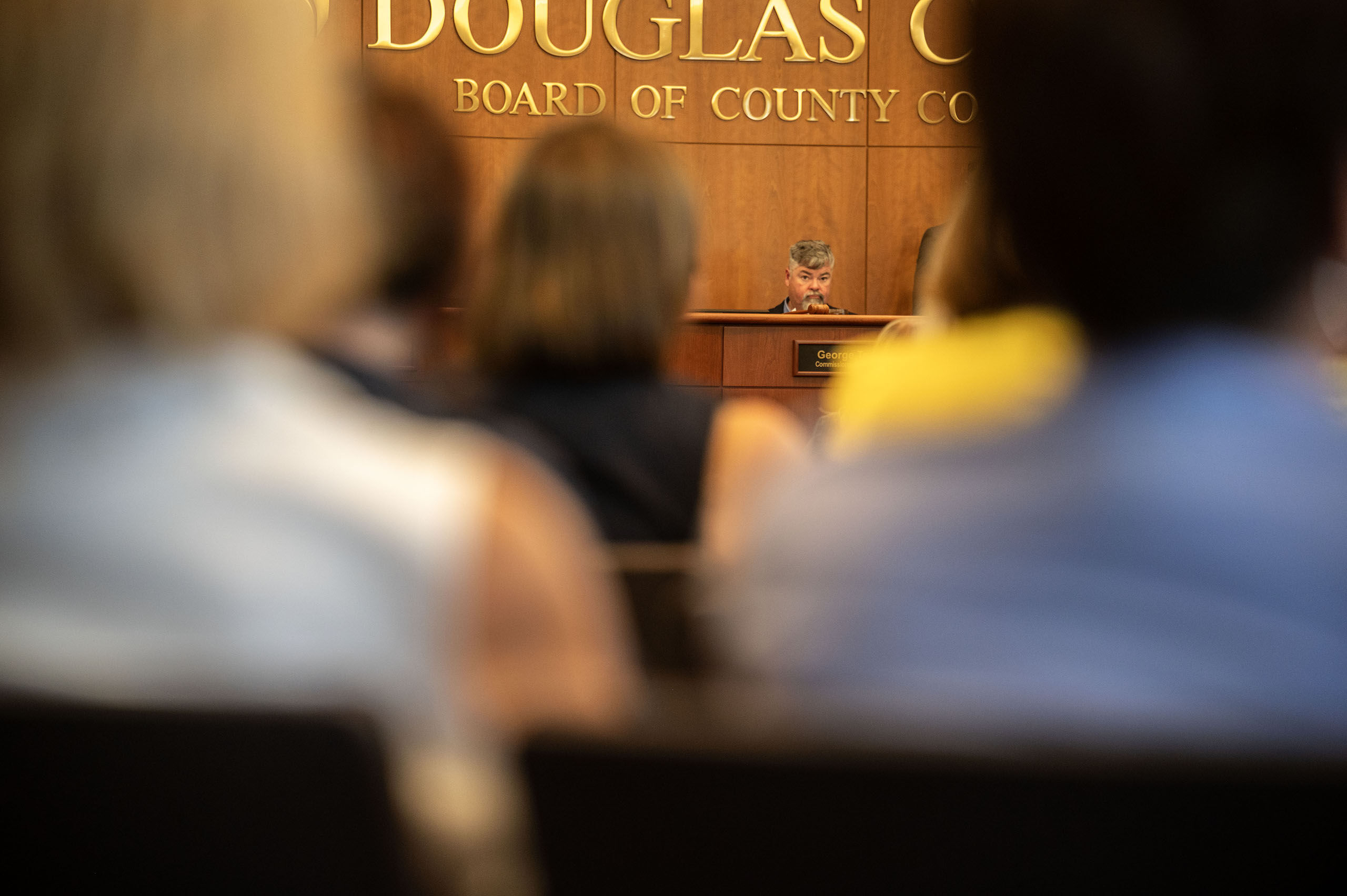
A federal judge dismissed claims brought by the Douglas County Board of Commissioners alleging that a state law granting county employees the right to organize and join labor unions violates free speech protections and conflicts with federal labor law.
Douglas County officials have consistently challenged the provisions and authority of Colorado’s Collective Bargaining by County Employees Act, or COBCA, filing multiple lawsuits in state and federal court seeking to overturn the law’s application and reverse a state labor ruling against the Douglas County Sheriff’s Office.
A judge dismissed the case on Aug. 20, finding that the county lacked legal standing to sue. The court did not rule on the merits of the challenge to the state law.
In the federal lawsuit filed in October 2025 against Gov. Jared Polis and Colorado Department of Labor and Employment Director Joe Barela, Douglas County commissioners sought a declaration resolving what they described as legal uncertainties surrounding COBCA and an injunction preventing future enforcement of the law.
Among other provisions, COBCA “prohibits counties from expressing views that deter or discourage unionizing and governs aspects of how a county must interact and bargain with unionized employees,” according to court documents.
County officials argued that this prohibition conflicts with federal labor law that promotes “open and robust dialogue between employers and employees on labor relations issues” and that COBCA violates state and federal free-speech protections.
Rather than address the merits of those claims, the state moved to dismiss the case for lack of standing.
To establish standing in federal court, plaintiffs must show they have suffered or are likely to suffer an injury due to the defendant’s conduct, and it can be corrected by the court.
The court found that the county alleged only a “speculative future harm,” rather than a “credible threat of future harm.” The court concluded that merely asserting a potential conflict between federal and state law is insufficient to establish standing.
“An injury in fact does not automatically occur by the mere presence on the statute books of an unconstitutional statute,” Judge Philip Brimmer wrote in the decision.
The ruling neither upheld nor struck down COBCA. Instead, the court determined that Douglas County failed to demonstrate an injury or a sufficient threat of future injury to challenge the law in federal court.
In response to the defendants’ motion to dismiss, county officials argued that they had already suffered harm through a prior COBCA violation finding, that the law creates a chilling effect on free speech, and that complying with federal law could cause them to “risk being charged with violating conflicting and preempted state law.”
Judge Brimmer found the county had not provided sufficient support for those claims.
The court acknowledged the prior violation but concluded that “past exposure to illegal conduct does not in itself show a present case or controversy regarding injunctive relief.” The judge further found that the county failed to allege any intent to engage in conduct that would violate COBCA, arguing only that it might suffer injury if it were to do so.
The judge also found that the plaintiffs provided no affidavits or testimony showing they wished to engage in protected speech but refrained from doing so because of fears of enforcement.
The decision marks another setback in Douglas County’s efforts to challenge COBCA.
Douglas County filed a similar lawsuit against Polis in state court. That case was dismissed for lack of subject-matter jurisdiction, and the county is awaiting a decision on its appeal.
The county is also awaiting a decision in its attempt to overturn a state ruling against Sheriff Darren Weekly, which found that county officials unlawfully interfered with a 2024 unionization effort by sheriff’s deputies.
The county has also filed multiple lawsuits alleging that COBCA does not apply to sheriff’s deputies and that the law is unconstitutional and void.

10th Circuit orders second look at immunity for Kiowa County deputy over fatal vehicle crash
Michael Karlik
michael.karlik@coloradopolitics.com
Updated 3 hours ago
The Denver-based federal appeals court directed a trial judge on Tuesday to further analyze whether a Kiowa County deputy and the sheriff’s office may be sued for a fatal vehicle collision. The Colorado Governmental Immunity Act generally shields government entities and public...
Colorado justices to hear appeal in Kendrick Castillo death lawsuit, ‘fugitive’ rule
Michael Karlik
michael.karlik@coloradopolitics.com
Updated 21 hours ago
The Colorado Supreme Court announced on Tuesday that it will decide whether it was proper to dismiss a lawsuit over the 2019 shooting death of Kendrick Castillo after the defendants paid the maximum amount of damages available to Castillo’s parents,...

Arapahoe County judge’s frustration with defense lawyer not grounds for new trial
Michael Karlik
michael.karlik@coloradopolitics.com
Updated 22 hours ago
Colorado’s second-highest court decided last week that an Arapahoe County judge’s repeated rebukes of a defense attorney and orders to “be quiet” did not rise to the level of bias or a violation of the defendant’s due process rights. A...

Divided appeals court upholds vehicle theft conviction despite unclear origin of car’s value
Michael Karlik
michael.karlik@coloradopolitics.com
Updated 19 hours ago
Colorado’s second-highest court upheld a defendant’s conviction for aggravated motor vehicle theft last week, even though it was unclear how the Thornton Police Department estimated the value of the stolen car. Officer Marc Faivre encountered Ashley Shelee Gibbens-Martinez in a...
Disgraced ex-CBI analyst Missy Woods sentenced to prison in DNA scandal
Jenny Deam
jenny.deam@gazette.com
Updated 22 hours ago
A Jefferson County district court judge on Tuesday sentenced a disgraced former Colorado Bureau of Investigation DNA analyst to a decade in prison for altering and deleting data in scores of criminal cases over several years. Jefferson County District Judge...

Parenting from prison: Inmates hope to be present in their children’s lives, while physically absent
Marianne Goodland
marianne.goodland@coloradopolitics.com
Updated 1 day ago
The room was decorated with balloons, the tables sparking bright with colors as the smell of pizza and cake wafted through the air. As did music. This was, after all, a father-daughter dance. Except this was not a typical father-daughter...
Appeals court confirms Colorado judges can compel electronic records from out of state
Michael Karlik
michael.karlik@coloradopolitics.com
Updated 3 days ago
Colorado’s second-highest court clarified on Thursday that judges are empowered to compel out-of-state companies to produce electronic records under state law. El Paso County jurors convicted Mischa Jargowsky on three counts of money laundering and one violation of Colorado’s organized...
10th Circuit upholds finding of no racial discrimination against family at Denver Chili’s
Michael Karlik
michael.karlik@coloradopolitics.com
Updated 5 days ago
The Denver-based federal appeals court agreed on Wednesday that a Black plaintiff failed to show that a Chili’s manager’s request for her family to provide valid payment at the outset of their meal amounted to racial discrimination. Markesha Futrell-Smith filed...
Appeals court reinstates Mesa County defendant’s request for DNA testing under new Colorado law
Michael Karlik
michael.karlik@coloradopolitics.com
Updated 6 days ago
Colorado’s second-highest court revived a Mesa County defendant’s petition for DNA testing in his three-decade-old attempted murder case on Thursday, concluding that a trial judge wrongly interpreted a recent Colorado law in dismissing the request outright. Jurors convicted Billy Joe...
Appeals court reverses Denver juvenile’s conviction due to improper expert testimony
Michael Karlik
michael.karlik@coloradopolitics.com
Updated 4 days ago
Colorado’s second-highest court reversed a juvenile defendant’s conviction for unlawful sexual contact on Thursday after an expert witness’s testimony improperly suggested the child victim was telling the truth. The defendant, identified as S.H-S., was around 16 years old when he...
PREV
PREVIOUS
U.S. Rep. Lauren Boebert calls Trump’s 90-day wolf-delisting review ‘real progress’
President Donald Trump has directed Interior Secretary Doug Burgum to launch a 90-day review on whether gray wolves and Mexican wolves should be removed from Endangered Species Act protections. The order drew mixed reactions for Colorado’s wolf-reintroduction effort, with ranchers and some state leaders calling it a step toward more flexible management, while wolf advocates […]

Two more wolves killed by Colorado wildlife staff
Two yearling wolves from the Copper Creek and Three Creeks packs in Pitkin and Rio Blanco counties, respectively, were killed by Colorado Parks and Wildlife staff on Monday. That brings to 19 the number of wolves that have died under the agency’s watch since the wolf relocation program began in December 2023. Ten wolves were […]