Trump’s ‘BBB’ casts aside rural Colorado healthcare | Hal Bidlack
Well, as I often do, let me start by yet again telling you what I am not going to be writing about (Editor: sigh…).
I’m not going to talk about President Donald Trump’s most recent (of many, many) attacks on a free press when he recently went after NBC’s Kristen Welker, saying the FCC (an executive branch agency that used to be largely independent but has now bent the knee to Trump) should face “rebuke or punishment” for having the audacity to note candidates Trump has endorsed have resulted in “mixed” results. Some won, some lost.
That is a fact, and Trump is demanding a reporter who was cheeky enough to report said truth be punished for making him look, well, mixed. Trump has the thinnest skin — certainly not a great character trait in a president — since Andrew Jackson, and that is not a comparison in which to take pride.
And I won’t be talking about the frankly wacky “renaming” of Lake Ontario. It’s nice to see the president is focused on the really important things, and letting less important things slide, like, say, the war with Iran and gas prices and our nation’s largest outbreak of measles in decades.
That last one is particularly galling, given that, of the total number of 2,777 confirmed cases and two deaths, 93% of infected individuals were unvaccinated. For a bit of perspective, that is more than 10 times the number of trans athletes in the NCAA (there are 10 and that’s out of 500,000 total college athletes). For some reason, that tiny number seems to be a much more important problem in the view of those on the far right than measles or, say, the war with Iran.
Right …
I’m also not going to talk about the bizarre first-of-its-kind “mini-midterm convention.” Trump has ordered the GOP to hold a short two-day “convention” before the midterms, an idea never before tried. Trump plans on headlining (of course) both nights, making the midterms as much about him as possible, to the delight of the Democrats.
Previous smarter presidents, like George W. Bush and Barack Obama, when facing headwinds during a midterm election, made it clear to candidates of their party it was OK with them for those candidates to distance themselves from the POTUS, if they felt such distancing would increase their chances of winning. Trump demands the bended knee and absolute obsequiousness from all he sees beneath him in the GOP. And that is everyone in the GOP.
When a president does something no other president has ever done, like hold a mini convention, either he is smarter than every previous president or he isn’t. You can decide which you think the most likely.
Recall Trump is currently at the absolute lowest approval rating of either of his terms in office. So right now, he seems to think, is the proper time to draw as much attention to himself as possible. Heck, he even — in kind of a reverse George Washington — cut down 60 cherry trees in D.C., each about 100 years old. You know, the ones that blossom every spring and draw visitors? Well, apparently some are in the way of a golf course expansion he wants built, presumably not too far from the 25-story-tall arch he wants built to honor him, but I digress …
What I do want to talk about, dear readers, (Ed: finally!) is a very important article in Colorado Politics that examines the danger to Colorado hospitals, especially those in rural areas, from the effects of the so-called Big Beautiful Bill, that cut funding at the worst time to the most vulnerable folks.
One example is the shuttering of certain MedRide services here in Colorado Springs. Lots of people, especially older folks on Medicaid, relied on MedRide for free transportation to and from visits to the doctor’s office, clinics and other medical services. With the cuts in the BBB, MedRide cannot continue to offer those services to a number of folks who are left, as one caseworker called it, “high and dry.” This is not a total shutdown, as MedRide is apparently doing the best it can, but that they “no longer provide routine ambulatory medical transportation in El Paso County is due to “ongoing statewide Medicaid reimbursement rate reductions.” And what generally happens when people have to start skipping preventive medicine appointments? Well, ER visits go up and that costs even more.
If Trump and his team were brighter, they frankly would have been smart enough — politically — to delay the effect of such cuts until after the midterms. Don’t get me wrong, there are lots more cuts to vital services coming after the election, but the ham-fisted way in which some cuts have already been applied will help voters decide for whom they wish to vote.
The CoPo article on hospitals makes an important and oft-overlooked examination of the effect of hospital and other Medicaid cutbacks, not on the effect on patients, but rather the economic impact on communities. Again, rural areas are hit the hardest.
As noted in the article, “Colorado’s hospital systems aren’t just a network of clinics and emergency rooms — they are also one of the state’s largest economic engines.” With around 10 Colorado hospitals teetering on the edge of closure at any given time, the article examines the pecuniary effect of hospitals and clinics closing.
The hospital sector in Colorado generates more than $140 billion per year. And as the article points out, in rural areas, the hospitals are often a major economic force and a chief supplier of employment.
Hospitals on the Western Slope and the eastern plains have enough trouble getting medical professionals to move there in the first place. I remember back when I was working for Sen. Michael Bennet, we were involved with the VA’s efforts to find a doctor — just one — who would move to Lamar to staff a VA clinic there. By the time I left, the slot was still empty (I hope it has been filled by now).
But the overall jobs effect is very significant. As profit margins shrink (or vanish entirely), hospitals cut services and lay off employees. Labor and delivery units, to cite an example, are often among the first to be closed and that creates what the Colorado Hospital Association called “OB deserts” in more than half the state. At a roundtable on health hosted by Sen. John Hickenlooper, one hospital administrator from a rural area noted his small hospital employed 160 people in a community of only 800. If that particular hospital closes, can you imagine the effect on that small community?
As noted in the article, Colorado is among the national leaders in the number of hospital and health regulations and it might well be appropriate to review existing regulations in hopes of reducing those that are not really helpful, but that is only part of the problem. As rural medical care declines or as in the case of lots of OB units, close, we tend to think of the effect on the patients. But we also really do need to understand the degree to which medical care is an engine of economic strength in the Centennial State.
Of course, there is no single solution to these concerns and I have no magic answers. But one factor is, and will continue to be, the cuts to medical support in the remarkably misnamed Big Beautiful Bill. I’d encourage you, dear readers, to take a look at which members of the Colorado congressional delegation voted in favor of that horrible bill, packed with tax cuts for the wealthy and cuts in services for the rest of us and let that vote be a significant determinant in for whom you vote this November.
Hal Bidlack is a retired professor of political science and a retired Air Force lieutenant colonel who taught more than 17 years at the U.S. Air Force Academy in Colorado Springs.

Colorado redistricting limits measure heads to November ballot
Marissa Ventrelli
marissa.ventrelli@coloradopolitics.com
Updated 8 hours ago
A proposed constitutional amendment that would prohibit Colorado’s congressional maps from being redrawn outside of election cycles has qualified for the November ballot, according to the Secretary of State’s Office. Under Initiative No. 256, redistricting changes for the 2028 election...
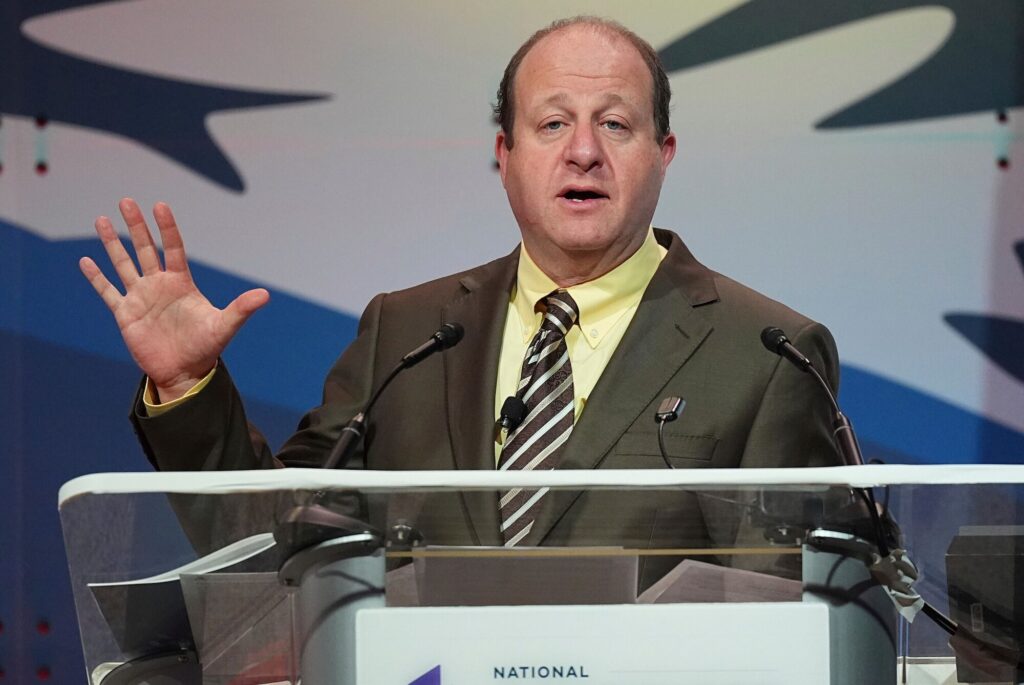
Polis announces ‘Governor for a Day’ contest for Colorado students
Marissa Ventrelli
marissa.ventrelli@coloradopolitics.com
Updated 10 hours ago
Colorado seventh and eighth graders have the chance to experience a day in the life of the governor through a new contest launched by Gov. Jared Polis. The “Governor for a Day” competition will give one student the chance to...
Colorado state House Democratic candidate arrested in Texas for public intoxication
Marianne Goodland
marianne.goodland@coloradopolitics.com
Updated 8 hours ago
A Democrat from Lone Tree who is running for a House seat was arrested in Texas in May on charges of public intoxication and resisting arrest. Christian Schilder, the Democrat, is challenging Rep. Brandi Bradley, the Republican incumbent, in the...
Initiative asks Colorado voters to approve 8th-grade reading standard for ballot measures
Marissa Ventrelli
marissa.ventrelli@coloradopolitics.com
Updated 8 hours ago
A ballot initiative that would require all ballot measures to be written at no higher than an eighth-grade reading level has qualified for the November ballot, according to the Colorado Secretary of State’s Office. The measure, backed by the group...

A course correction Canada would concur with | Miller Hudson
Miller Hudson
miller-hudson@coloradopolitics.com
Updated 3 days ago
I’ve always harbored a soft spot for Canada. My father was stationed there twice, once in the 1960s as the Atomic Energy Commission’s American liaison with the Canadian nuclear reactor program in Chalk River, Ontario and again in the 1970s...

Private property rights challenge rural Colorado communities | Rachel Gabel
Rachel Gabel
rachel-gabel@coloradopolitics.com
Updated 3 days ago
If there were ever a topic I believe deeply in, it’s private property rights. If there were ever a topic that leaves me in a moral conundrum more often than not, it’s private property rights. The northern portion of Weld...

Gaylord — you never check in, but still pay | Jon Caldara
Jon Caldara
jon-caldara@coloradopolitics.com
Updated 4 days ago
I go to a lot of conferences, often in beautiful cities I never actually see. Friends hear where I’ve been and ask depressing questions like, “Did you visit the famous museum?” No. I saw Ballroom C, the lobby bar and...
Reflections on Weiser-Lopez, Crank-Killian debates | Tom Cronin
Tom Cronin
tom-cronin@coloradopolitics.com
Updated 3 days ago
Thursday night, The Gazette and KOAA TV hosted two important candidate debates. The first featured incumbent Republican U.S. Rep. Jeff Crank, who is just completing his first term representing El Paso County in Congress, and Jessica Killian, a Democrat who has...

What courageous citizenship really looks like | Vince Bzdek
Vince Bzdek
vince.bzdek@gazette.com
Updated 2 days ago
By Vince Bzdek What exactly is courage? Ernest Hemingway famously called it grace under pressure. Mark Twain wrote that “courage is resistance to fear, mastery of fear — not absence of fear.” C.S. Lewis refined that even more: “Courage is...
Colorado measure adding ID checks to mail-in voting qualifies for ballot
Marissa Ventrelli
marissa.ventrelli@coloradopolitics.com
Updated 3 days ago
A ballot initiative that would require voters to include additional information on mail-in ballots has qualified for the November election, according to the Secretary of State’s Office. Backed by El Paso County Treasurer Chuck Broerman and former Deputy Secretary of...