A course correction Canada would concur with | Miller Hudson
I’ve always harbored a soft spot for Canada. My father was stationed there twice, once in the 1960s as the Atomic Energy Commission’s American liaison with the Canadian nuclear reactor program in Chalk River, Ontario and again in the 1970s as the State Department’s scientific attache at the U.S. Embassy in Ottawa. I had the good fortune to attend the University of Maryland in College Park, just 10 miles from our home, when my parents departed for Canada, allowing me to live on a familiar campus while dispatching my parents. I would visit them over Christmas break and for a few weeks each summer.
My Maryland driver’s license served as my passport when purchasing a ticket in Montreal on the Trans-Canadian passenger trains that served the 5,000 miles of track connecting Nova Scotia with British Columbia. During my Canadian summers, I had a chance to fight a forest fire and witness a total solar eclipse south of Petawawa, where Canadians operated a German-Italian prisoner-of war camp during the Second World War. I was told, although I never checked its accuracy, there are more insects in the Canadian tundra than are found in the Amazon. It’s easy to believe — mosquitoes and black flies, together with other thirsty bloodsuckers, fly in dense clouds morning and evening.
Now that I reside in Littleton, driving north and south along Santa Fe, I get regular glimpses of the heavy freight traffic moving along the Burlington Northern-Santa Fe mainline rail corridor. Coal-fired electric generation may be in decline, but I can attest to frequent unit trains transporting Wyoming anthracite. The week before last I noted dozens of flatbeds stacked three deep with pallets of Canadian two-by-four framing timbers traveling south. It occurred to me a Texas developer or lumberyard must be trying to beat the threat of promised American tariff hikes. I’d pursued similar savings last year, purchasing a hybrid Ford Maverick assembled in Mexico to escape getting clobbered by a tariff bill.
You see a lot of odd shipments on Colorado rail lines, not only oil-tank cars carrying Utah crude on its way to Gulf refineries. Occasionally, paired railcar-length windmill blades manufactured in Pueblo are seen on their way to wind farms north and east. You even see dedicated trains for double-decked Amazon Prime containers. A few weeks ago, a pair of unit trains (110 cars each) were loaded with desert camouflage military vehicles headed toward either Fort Carson or the Piñon Canyon tank training grounds near La Junta. Since Fort Carson already has ample vehicles of its own, one is left to ponder where all this equipment originated and, perhaps more enlightening, where it might be eventually destined? I can think of one dusty Middle East country which might soon be visited by testosterone-jazzed American troops.
Before Mark Carney replaced Justin Trudeau, who was beginning to exhaust his welcome with Canadian voters, as the Liberal Party’s prime minister, he served as governor of both the Bank of Canada and then the Bank of England. We are forced to conclude he is an economist and politician of unusual intellectual heft. While enjoying a 66% approval rating among Canadians, with just 32% disapproval, a near reversal of Trump’s current poll numbers, Carney is proving a heavyweight in his new role. His center-left Liberals, who previously appeared doomed to defeat in this year’s election, are now running 30 points ahead of the Progressive Conservatives. Facing a “life raft” challenge from their longtime neighbor, Canadians know who they want captaining the nation’s ship of state across the choppy seas ahead.
Carney first came to the world’s attention during the Davos economic meetings last winter. Trump was already pounding his tariff drum, having scuttled an existing agreement with Mexico and Canada he reached during his first term. It was the otherwise diffident Canadian banker who stepped forward to state the obvious: the Trump administration was threatening to place the global economic system “in the midst of a rupture.” He called for a coalition of “middle powers” to join Canada in opposing the American desire for a “world of fortresses,” controlled by major powers seeking proprietary “spheres of influence.”
The following day Trump retorted with, “Canada gets a lot of freebies from us. By the way, they should be grateful … Canada lives because of the United States. Remember that, Mark, the next time you make your statements.” How charming — his remarks make me embarrassed to be represented by an idiot. As the Canadian writer Stephen Marche wrote in the New York Times this week, once the tariff talks collapsed, “For Canada, the choice came down to either accepting severe but temporary economic instability or binding itself to a pseudo-democratic fiscal basket case of a nation, whose only apparent foreign policy objective has become domination for the gratification of its president’s slapdash vanity. Mr. Carney has chosen suffering, but he did what Canadians elected him to do: stand up for Canada.”
When the American West experienced runaway wildfires several years ago, it was Canada and Mexico that dispatched firefighters to help quell them. Following Sept. 11, 2001, Canada joined us in our war to rout al-Qaida from Afghanistan, losing soldiers in that struggle. Even The Wall Street Journal’s editorial page, which has vainly attempted to prop up the legitimacy of MAGA’s foreign policy, declared, “Trump’s decision to escalate a tariff brawl with Canada makes no economic or political sense.” In his Substack column, former Clinton Labor Secretary Robert Reich observes, “The very idea of a trade war with Canada — our neighbor, our ally, our closest friend, a nation that’s peaceful and whose people have a reputation for kindness — is absurd! … The question I ask myself is how much worse will his (Trump’s) behavior have to get before Republicans and the suck-ups around him take some action to stop him?”
When flights were grounded following Sept. 11, 2001 and hundreds of Americans were stranded in Newfoundland for days, they were fed, housed and welcomed by generous Canadians. This abiding decency was memorialized in the hit Broadway musical, “Come From Away.” A few weeks ago, as smoke from Canadian forest fires blanketed the northeast, our president demanded Canadians pay the U.S. reparations for this inconvenience — another instance of humiliating indecency. Presumably, Canadians should have been sweeping their forests. Fortunately, Nov. 3 isn’t that far off. We, the people, can demand a badly needed course correction. We’ve done it before. We can do it again. But we must do it.
Miller Hudson is a public affairs consultant and a former Colorado legislator.


Private property rights challenge rural Colorado communities | Rachel Gabel
Rachel Gabel
rachel-gabel@coloradopolitics.com
Updated 2 days ago
If there were ever a topic I believe deeply in, it’s private property rights. If there were ever a topic that leaves me in a moral conundrum more often than not, it’s private property rights. The northern portion of Weld...

Gaylord — you never check in, but still pay | Jon Caldara
Jon Caldara
jon-caldara@coloradopolitics.com
Updated 3 days ago
I go to a lot of conferences, often in beautiful cities I never actually see. Friends hear where I’ve been and ask depressing questions like, “Did you visit the famous museum?” No. I saw Ballroom C, the lobby bar and...
Reflections on Weiser-Lopez, Crank-Killian debates | Tom Cronin
Tom Cronin
tom-cronin@coloradopolitics.com
Updated 2 days ago
Thursday night, The Gazette and KOAA TV hosted two important candidate debates. The first featured incumbent Republican U.S. Rep. Jeff Crank, who is just completing his first term representing El Paso County in Congress, and Jessica Killian, a Democrat who has...
What courageous citizenship really looks like | Vince Bzdek
Vince Bzdek
vince.bzdek@gazette.com
Updated 1 day ago
By Vince Bzdek What exactly is courage? Ernest Hemingway famously called it grace under pressure. Mark Twain wrote that “courage is resistance to fear, mastery of fear — not absence of fear.” C.S. Lewis refined that even more: “Courage is...
Colorado measure adding ID checks to mail-in voting qualifies for ballot
Marissa Ventrelli
marissa.ventrelli@coloradopolitics.com
Updated 2 days ago
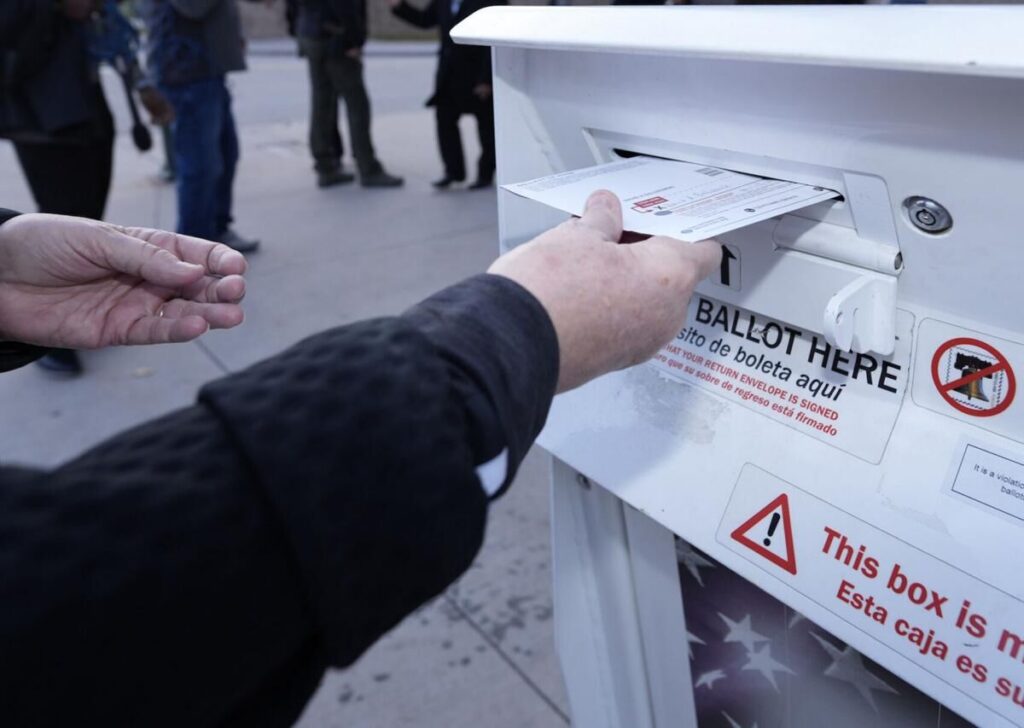
A ballot initiative that would require voters to include additional information on mail-in ballots has qualified for the November election, according to the Secretary of State’s Office. Backed by El Paso County Treasurer Chuck Broerman and former Deputy Secretary of...
Colorado election website error exposes personal data of confidential voters
Marissa Ventrelli
marissa.ventrelli@coloradopolitics.com
Updated 2 days ago
A system update accidentally lifted protections on confidential records in Colorado, exposing dozens of voters’ personal information, according to the Secretary of State’s Office. The limit that normally blocks access to confidential voter profiles was inadvertently disabled during an update...
Colorado’s hunting and fishing traditions rest on science, conservation and a proven heritage | IN RESPONSE
Colorado Politics
colorado-politics@coloradopolitics.com
Updated 3 days ago
By John Howard Eric Washburn’s recent column warns Coloradans the right to hunt and fish amendment is a Trojan horse designed to resurrect “cruel” practices voters have already banned and to elevate killing above every other form of wildlife management....
Why does Colorado limit who can safeguard taxpayer dollars? | GUEST COLUMN
Colorado Politics
colorado-politics@coloradopolitics.com
Updated 3 days ago
By Devin Camacho Recently, PNC Bank announced its purchase of FirstBank Colorado. Not only did Colorado lose a local banking option, but nearly 1,000 people lost jobs, with more job losses coming as the big bank now closes branches too....
Gubernatorial candidates Phil Weiser, Greg Lopez spar, as Marx skips debate
Deborah Grigsby
deborah.smith@denvergazette.com
Updated 3 days ago
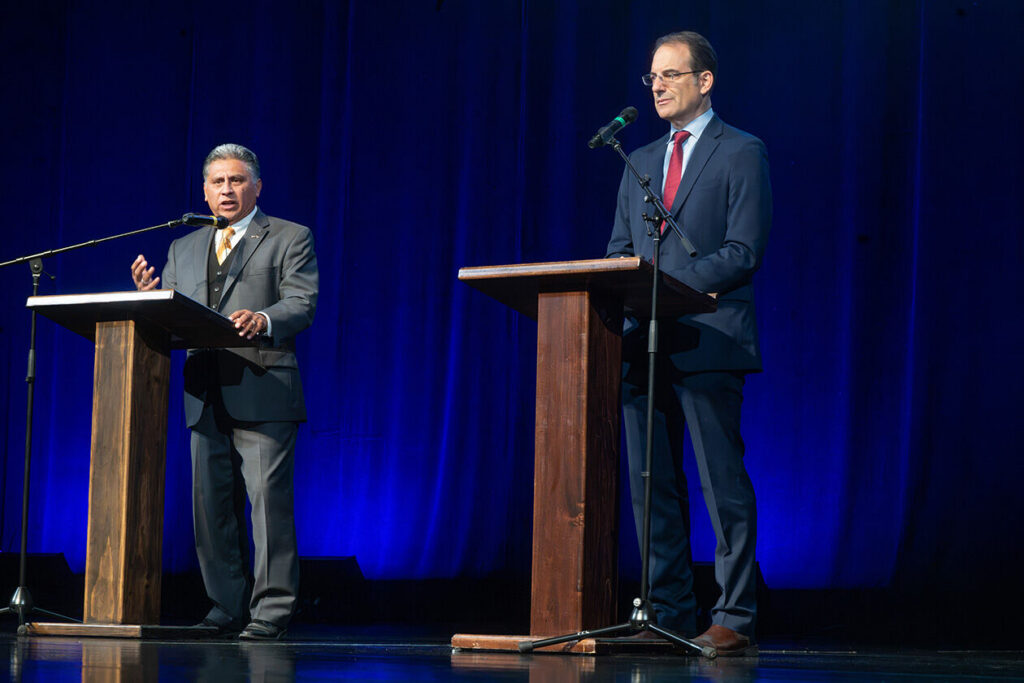
Two of the candidates for Colorado governor squared off in a televised debate on Thursday night, when Attorney General Phil Weiser, the Democratic nominee, and former U.S. Rep. Greg Lopez, an unaffiliated candidate, delved into issues of affordability, data center...
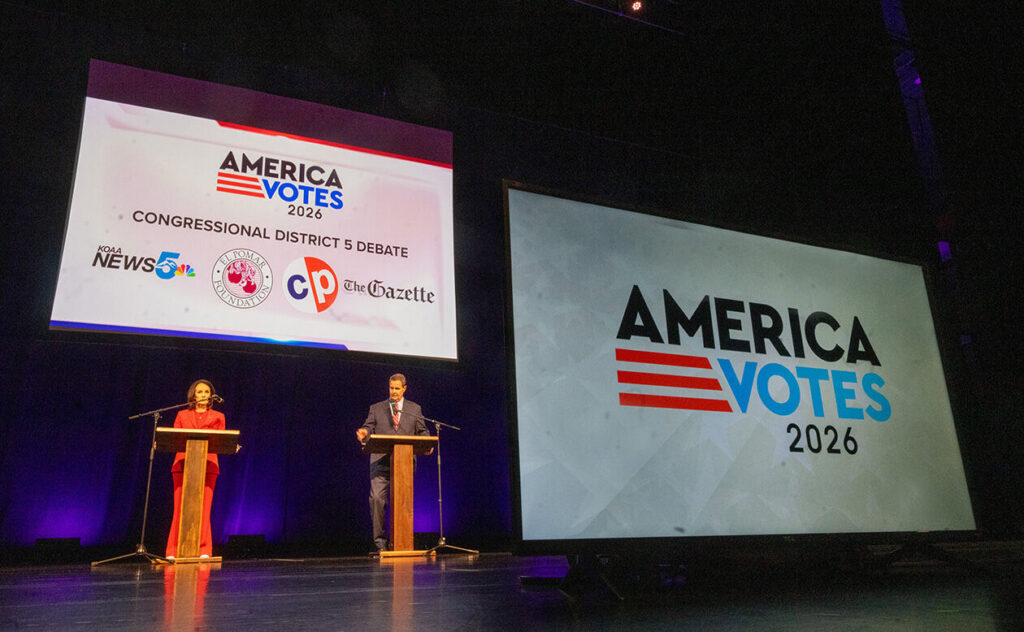
Troops, taxes, war dominate Colorado’s 5th CD debate between Jeff Crank, Jessica Killin
Deborah Grigsby
deborah.smith@denvergazette.com
Updated 3 days ago
Republican U.S. Rep. Jeff Crank and Democratic challenger Jessica Killin on Thursday night clashed over the war in Iran, the federal budget and healthcare when they took the stage in Colorado Springs for a sold-out debate in the race to...