

GEO tells judge state law requiring health inspections is ‘unconstitutional’

GEO Group, the company that operates the U.S. Immigration and Customs Enforcement detention center in Aurora, argued in a court hearing Friday that a state law requiring health inspections is unconstitutional.
Judge Daniel Domenico said a decision on whether the requirement should be halted immediately, as requested by GEO Friday, will come at a later date.
The hearing took place amid tension between the Adams County Health Department and GEO. County officials said the prison continues to block an investigation into a tuberculosis case.
GEO filed the lawsuit in early June to block the enforcement of House Bill 26-1276, which expanded the state health department’s authority to conduct more frequent health and safety inspections at immigration detention facilities in the state and impose fines or even revoke licenses for refusing inspections.
The new law says that a facility refusing to allow the inspections is subject to a civil penalty.
In court Friday, GEO attorney Frederick Yarger argued that the bill burdens federal operations, discriminates against the federal government since it only applies to the ICE facility in Aurora and causes harm to GEO financially and contractually.
The bill forces GEO to break its contract with the federal government by following state law, Yarger said. Since the law could not apply directly to the federal government, it cannot apply to the government’s contractor, he said.
“They know they can’t sue ICE, so they’re trying to sue us instead,” Yarger said. “They’re trying to pry apart the relationship between the GEO Group and ICE.”
Attorneys for the state said the GEO facility has allowed health inspections in previous years. GEO is a private for-profit corporation, and it can’t exempt itself from state and local health inspections, they said. The attorneys also argued that GEO is not facing discrimination as a federal facility because the health inspection laws also apply to other state detention centers.
Gabe Podesta, one of the state’s attorneys, added that the state has a responsibility to keep its residents safe.
The Adams County Health Department has been denied access to the facility since the tuberculosis case was confirmed. County officials said they requested necessary information and GEO did not provide it. The county then issued a public health order in late June requiring compliance.
As of Friday, GEO had not given the health department access or adequate information to conduct an investigation into the case and the possibility of other cases, county officials said.
Colorado law states that local public health agencies are required to investigate every confirmed tuberculosis case, a process that includes a patient interview, medical record review, contact identification and notification, testing, treatment and follow-up.
GEO’s lawsuit listed Colorado Attorney General Phil Weiser as the plaintiff, along with Colorado Department of Public Health and Environment Executive Director Jill Hunsaker Ryan, the department’s environmental health and sustainability director, Jeff Lawrence, and Adams County Health Department Executive Director Kelly Weidenbach.


Former Parker police sergeant pleads guilty to unlawful sexual conduct, misconduct charge
Nicholas Fogleman
nicholas.fogleman@denvergazette.com
Updated 3 hours ago
Former Parker Police Department Sgt. Troy Brienzo pleaded guilty Monday to a felony charge of unlawful sexual conduct by a police officer and first-degree official misconduct in Douglas County District Court. Brienzo entered the guilty pleas before Judge Ryan Stuart,...

U.S. News names Saint Joseph best hospital in Colorado, ending University of Colorado Hospital’s 13-year streak
Nico Brambila
nico.brambila@denvergazette.com
Updated 4 hours ago
University of Colorado Hospital is no longer Colorado’s top-ranked hospital for the first time in more than a decade, with Intermountain Health Saint Joseph Hospital taking the No. 1 spot in U.S. News & World Report’s latest rankings. Located on...

Appeals filed to send Project Taurus decision to the Colorado Springs City Council
Brennen Kauffman
brennen-kauffman@coloradopolitics.com
Updated 3 hours ago
At least one appeal has been filed over the proposed large-scale data center in Colorado Springs, sending the final decision to the Colorado Springs City Council. The filing seeks to overturn the Planning Commission’s decision on July 23 to deny...

Denver City Council keeps 2 a.m. nightlife cutoff, approves $18 million for George Floyd protest claims
Deborah Grigsby
deborah.smith@denvergazette.com
Updated 4 hours ago
Nightlife establishments will not get a two-hour operating extension after the Denver City Council passed an amended version of a bill that keeps the current 2 a.m. closing time. As originally proposed, venues would have been able to keep music,...

Castle Rock launches Link On Demand rideshare service
Nicholas Fogleman
nicholas.fogleman@denvergazette.com
Updated 3 hours ago
Residents in Castle Rock now have access to Douglas County’s app-based rideshare service Link On Demand. Link On Demand officially began serving Castle Rock Friday, expanding the transportation program which already operates in Highlands Ranch, Lone Tree and select areas...

Aurora police officer charged in Belt-Stubblefield shooting
Kyla Pearce
kyla.pearce@gazette.com
Updated 4 hours ago
The Aurora police officer who shot and killed Rajon Belt-Stubblefield was charged with murder, the 18th Judicial District Attorney’s Office announced Monday morning. A grand jury returned an indictment charging APD Officer Matthew Neely with one count of second-degree murder,...

Tunnel to Towers brings 9/11 steel to Denver
Nicholas Fogleman
nicholas.fogleman@denvergazette.com
Updated 1 day ago
A nationwide tour commemorating the 25th anniversary of 9/11 brought a piece of the World Trade Center to Denver on Saturday as the Tunnel to Towers Foundation hosted a ceremony at the Wings Over the Rockies Air & Space Museum....
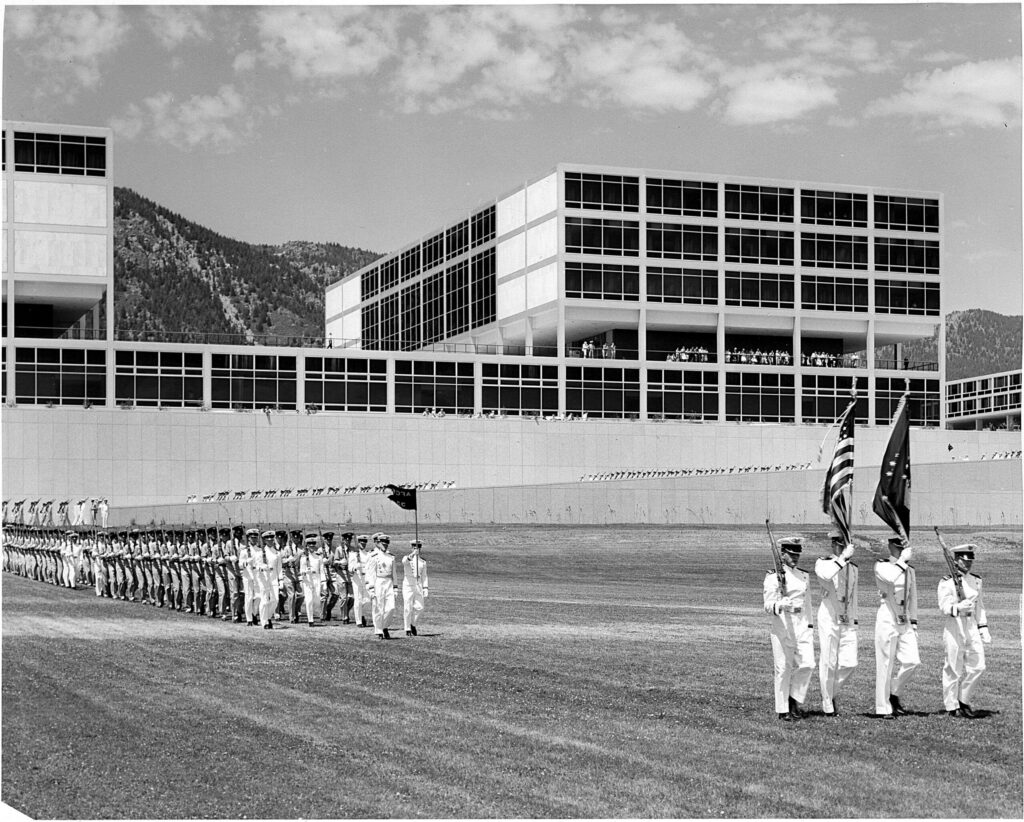
First Air Force Academy class of just 306 cadets started out in WWII barracks, faced high standards
Mary Shinn
mary-shinn@coloradopolitics.com
Updated 1 day ago
When the first class of the Air Force Academy arrived at Lowry Air Force in Denver, they were welcomed with an air show featuring bombers and fighter jets. “Most of us were overwhelmed,” recalled retired Col. Max Miller, the president...

At conservative summit, Colorado Republican leaders concede Democrats’ election edge
Marissa Ventrelli
marissa.ventrelli@coloradopolitics.com
Updated 3 days ago
Four Republican state lawmakers told attendees at a gathering of conservative leaders on Friday they doubt their party can win statewide races, noting that Colorado’s electorate has been shifting toward Democrats but adding they see an opening in several pockets....

Colorado farmers, ranchers wrestle with hurdles amid extreme drought conditions
Shen Wu Tan (Special to The Denver Gazette)
shen-wu-tan@gazette.com
Updated 1 day ago
Some producers take drastic steps to adapt to dry climate, record-low snowpack This is the first time that Jim Magnuson, who operates a family farm in the rural town of Eaton, can ever recall planting only 75% of his acreage. ...
PREV
PREVIOUS

Judge denies Calderon injunction case against Denver, Johnston
A U.S. District Court judge has denied a preliminary injunction in the case of Jessica Calderon, the Denver city employee who won a temporary restraining order preventing the City and County of Denver from terminating her amid the 2025 citywide layoffs. In a court order dated Wednesday, Judge Nina Y. Wang denied Calderon’s injunction and […]

The primary political reform and precondition for all others | SONDERMANN
In its current state, the American political system has no end of ailments. Far too many factors accelerate polarization and work against moderation and narrowing the differences. Media, and the way so many citizens limit themselves to agreeable, reinforcing sources, only dials up the division. Congress has become performative and is essentially crippled in carrying […]