

The primary political reform and precondition for all others | SONDERMANN
In its current state, the American political system has no end of ailments. Far too many factors accelerate polarization and work against moderation and narrowing the differences.
Media, and the way so many citizens limit themselves to agreeable, reinforcing sources, only dials up the division.
Congress has become performative and is essentially crippled in carrying out its legislative, budgetary and oversight roles as laid out in Article I of the Constitution.
The political money machine is cancerous and increasingly oligarchical. Moreover, the incentives are all wrong, sending larger and larger sums around through the backdoor with inadequate disclosure requirements and depriving candidates of both control and accountability for their own message.
I could go on. There is virtually no end of elements of the process that require repair and redress.
But for our purposes today, let me focus on what I regard as the foremost weakness of our system and the single biggest contributor to the tribal dysfunction.
In far too many cases, the summertime primary election has become all-important and the November general election is an afterthought.
Examples abound and are to be found in every part of the country. Here at home, the Democratic gubernatorial primary between Phil Weiser and Michael Bennet meant everything, while the general election this fall will be a noncompetitive, disengaged, perfunctory exercise.
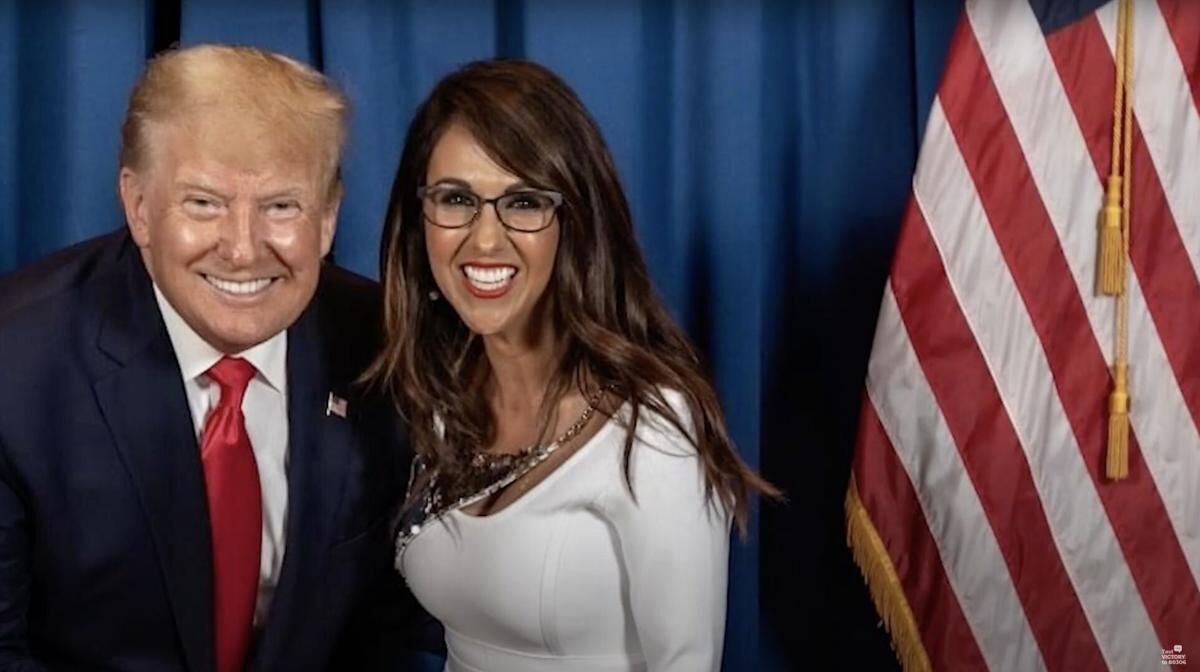
The same was true two years ago on the other side of the aisle when U.S. Rep. Lauren Boebert, Colorado’s 4th Congressional District, running in her adopted new district, won her party’s primary with just 43% of the vote before coasting to an easy victory in what was just a November formality.
Without question, part of the problem rests in a redistricting process that is nakedly partisan in too many jurisdictions. Shame on those here and elsewhere who have attempted to light a mid-decade match to the gerrymandering fire.
But redistricting reform, including that overwhelmingly mandated by Colorado voters in years past, can only do so much. The reality is that we have increasingly sorted ourselves into red neighborhoods and blue neighborhoods.
The sort not only involves the media we consume, our social circle – both real and online, the schools our children attend, if and where we worship and whom we date or marry, but also where we live and put down roots. The technical term used by experts is geographical self-sorting.
No matter the merits of competitive districts, in too many instances, they are impossible to draw. How do you create a legislative district within Denver in which a Republican would stand a chance? Or a district on the eastern plains of Colorado in which a Democrat is anything but a token candidate.
On a national scale, we are not about to see a competitive district in Queens or Brooklyn any sooner than in southern Missouri or west Texas.
According to one study, out of 435 seats in Congress, only 69 can be considered remotely competitive. Add in the factor of entrenched incumbency and the number at play in any given election is far fewer.
Of Colorado’s 100 State Senate and State House districts, the number that are truly competitive is a single digit that you could count even if missing a few fingers.
The fact that the primary election is everything and November is rather inconsequential in the vast majority of legislative districts, both nationally and here at home, means that lawmakers’ overriding concern is keeping their own partisans happy.
It is the reason why politicians on both sides are so ultra-focused these days on the so-called base. Our president leads the way in this preoccupation. Unaffiliated voters, much less voters of the other party, are of limited relevance.
The effect of this is as utterly predictable as it is abundantly evident. Democratic politics skew ever further to the left while Republican politics bend ever more to the right. It is all about keeping the base happy and energized.
When U.S. Rep. Diana DeGette’s 30-year tenure was brought to an end in Colorado’s 1st Congressional District, it was not at the hands of someone to the center or right of her, but to someone who outflanked her on the left. Politicians have a keen instinct for survival and that lesson will not be lost on others.
Given the limits of what can be accomplished through redistricting reform, my attention is more and more drawn to broader reforms of the election process to reduce the premium on partisan primaries. States such as Alaska, Washington and California have led the way in this pursuit.
A “Top Two” system may hold the most promise. Under such a plan, all candidates run in a single, unified primary with the top two finishers advancing to the general election.
Over the long haul, this cannot help but moderate the influence of the mass of unaffiliated voters and those aligned with the minority party in that locale, allowing them to select the less extreme candidate come November.
Critics and defenders of the status quo will squeal that such a system has potential flaws and downsides. Of course, they are correct. But then, I did not realize that perfection was a hallmark of our current arrangement.
Eric Sondermann is a Colorado-based independent political commentator. He writes regularly for Colorado Politics and The Gazette. Reach him at EWS@EricSondermann.com; follow him at @EricSondermann

Pueblo mayor, council concoct Trumpian Texas Two-Step | Dennis Maes
Dennis Maes
dennis-maes@coloradopolitics.com
Updated 1 day ago
Several weeks ago, an article was published positing Pueblo Mayor Heather Graham is a disciple of the calamitous Donald Trump school of governance — specifically as it related to questionable ethical practices and the misuse of public funds. Recently, Graham...
As education conflicts abound across Colorado, who puts the kids first? | Paula Noonan
Paula Noonan
paula-noonan@coloradopolitics.com
Updated 2 days ago
Elected school boards and the Colorado Department of Education (CDE) have hit the headlines with fired superintendents, superintendent resignations, failures of oversight, and misdirected dollars. Cherry Creek School District’s superintendent was fired. Jefferson County Schools’ superintendent found a less stressful...
The outrages mount | Hal Bidlack
Hal Bidlack
hal-bidlack@coloradopolitics.com
Updated 4 days ago
My kindly and forgiving editors understand that, from time to time, I can’t help myself from leaping atop my rickety soapbox to vent. And, like many other political commentators have already done, I could easily fill this entire missive with...

Weiser’s leadership crucial for rural win-win | Rachel Gabel
Rachel Gabel
rachel-gabel@coloradopolitics.com
Updated 1 week ago
Attorney General Phil Weiser is going to win the gubernatorial election. That said, Colorado agriculture and rural communities have a 30-year track record of finding the win-win be it for species or industries or habitat. Former Governor Roy Romer possessed...
A Colorado history lesson for Victor Marx | Dick Wadhams
Dick Wadhams
dick-wadhams@coloradopolitics.com
Updated 1 week ago
Victor Marx, who narrowly won the Republican nomination for governor by one half 1% after boasting of a massive 44-point lead, is just as misguided on Colorado political history. During the primary, Marx made a clumsy attempt to denigrate his...
‘Be prepared to march in the streets’ | Miller Hudson
Miller Hudson
miller-hudson@coloradopolitics.com
Updated 2 days ago
It was early in 1974 when I first met Tim Wirth as he announced his candidacy for Congress, challenging Republican incumbent Don Brotzman. Although I had only resided in Colorado two years, I was drafted to serve as a Democratic...

‘CoCo’ would take taxpayers for a ride | Jon Caldara
Jon Caldara
jon-caldara@coloradopolitics.com
Updated 5 days ago
Colorado wants taxpayers to spend another $4.73 billion on passenger rail. Don’t worry. They have a plan. Which is a little like your brother-in-law announcing he’s launching another exciting restaurant venture after his last three restaurants ended in bankruptcy. Please....
The through line from Donald Trump to Victor Marx | SONDERMANN
By Eric Sondermann
by-eric-sondermann@coloradopolitics.com
Updated 1 week ago
Over 10 years ago, before Donald Trump could ever defeat Hillary Rodham Clinton, he had to first engineer a hostile takeover of the Republican Party. Prior to his descent of that golden escalator, the previous seven Republican presidential nominees had...
Primary voters rejected big money in politics | Paula Noonan
Paula Noonan
paula-noonan@coloradopolitics.com
Updated 1 week ago
While we’re in an election campaign lull between now and Labor Day, we have time to consider the impact of $102 million in campaign contributions in the primary. In the general election, more money will fill candidate campaign coffers, and...
Colorado’s primary proved in this political climate money doesn’t buy electoral happiness | Paula Noonan
Paula Noonan
paula-noonan@coloradopolitics.com
Updated 1 week ago
To catch you up, campaign committees from this 2026 election cycle already collected and shoveled out a lot of cash: $102.64 million. That’s contributions in all forms — dollars, in kind, loans, etc. — from December 2024 to now. Total...
PREV
PREVIOUS

10th Circuit partially revives lawsuit over 2020 Denver protest injuries
The Colorado-based federal appeals court revived a man’s claims against Denver on Friday after concluding a trial judge resolved the case in the city’s favor without analyzing two of the three instances of alleged excessive force and other constitutional violations. For the past six years, plaintiffs have litigated several lawsuits arising from the demonstrations that […]
Susemihl wins surprise victory to replace Steve Durham as Colorado Springs state senator | A LOOK BACK
Forty-five years ago this week: In a closed session, the vacancy committee for Colorado’s Senate District 12 selected attorney Peter Susemihl to complete Sen. Steve Durham’s, R-Colorado Springs, term. Durham resigned his seat to become Region 8 Director of the Environmental Protection Agency. Ed Bland, El Paso County Republican Party chairman and member of the […]