

The through line from Donald Trump to Victor Marx | SONDERMANN
Over 10 years ago, before Donald Trump could ever defeat Hillary Rodham Clinton, he had to first engineer a hostile takeover of the Republican Party. Prior to his descent of that golden escalator, the previous seven Republican presidential nominees had been named Bush, Bush, Dole, Bush, Bush, McCain and Romney.
Those names constituted something of a country club roster of the party’s mainstream establishment. The fact that four of those seven (all named Bush) prevailed and took the presidential oath did not mask the transition that was taking hold in party ranks.
A party of America’s “haves” was fast shedding many among the economic elite in favor of the dispossessed and left-behind. The party’s epicenter moved from the penthouse suite to the abandoned strip mall and down-on-its-luck Main Street.
If there was a precursor to Trump, and a warning sign, it came four years earlier in John McCain’s Hail Mary selection of Sarah Palin as his running mate. Her emergence signaled that celebrity, outrage and resentment were fast replacing old-fashioned credentialing as GOP markers.
This was a cultural vibe shift as much as it was any kind of strategic calculation or change in economic policy. Manners, refinement and conciliation were all suddenly out. In their place came grievance, division and isolation, all with a venomous, pugilistic edge and an acceptance of “alternative facts” when the real ones proved inconvenient.
Trump has now occupied center stage for a full decade, six of those years in the Oval Office and the other four in aggrieved exile. The Republican Party has been fully remade in his image. To be a Republican of any standing these days is to have fully bought into Trumpism or to have quietly, often shamelessly, acquiesced to it.
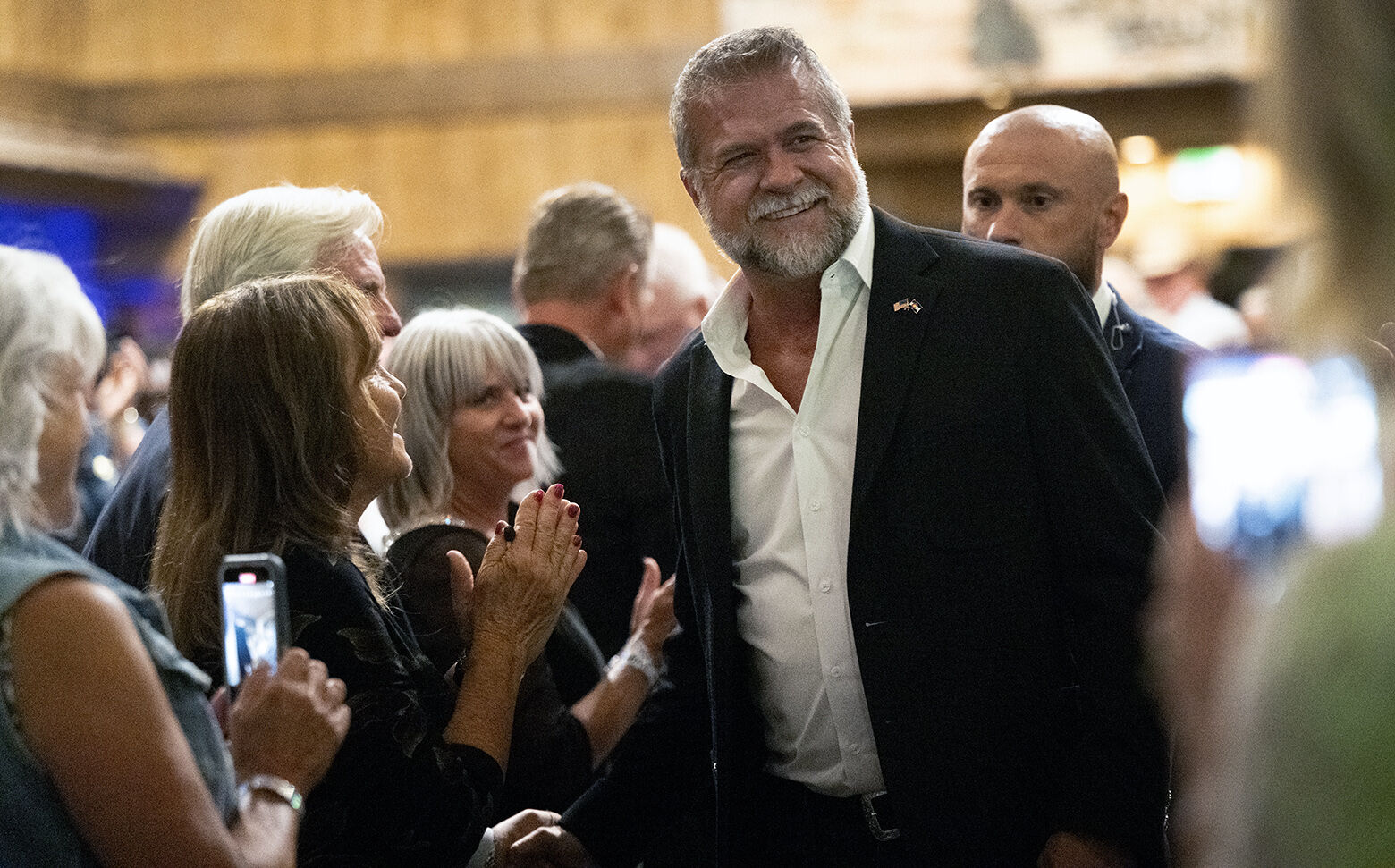
All of which brings us home to Colorado and the spectacle of Victor Marx, now the GOP nominee for governor. Absent Trump, it is impossible to conjure up a vision of Marx as a serious political player, much less his party’s choice for the state’s highest office.
While Democrats in Colorado began their ascendancy in 2004, their complete dominion over the state closely tracks Trump’s rise. There can be little doubt as to cause and effect.
Think back to a generation of Republicans who repeatedly won some of the state’s top posts — Hank Brown, Bill Owens, Wayne Allard, Cory Gardner, Gail Norton, John Suthers, even the late Ben Nighthorse Campbell.
All were plenty conservative in their time. But all understood that winning coalitions must be broad and that governing was seldom an all-or-nothing proposition.
Now try to imagine any of these individuals navigating the current GOP nominating process — part gauntlet of litmus tests, part cultish initiation ritual.
What have Colorado Republicans wrought in their place? For openers, there is no Republican in major statewide office. There hasn’t been for some time; nor is there a realistic prospect of that happening any time soon.
The most prominent Republican in Colorado, their poster child if you will, is Congresswoman Lauren Boebert. Though she opted two years ago to move from a plus-seven GOP district to an ultimately safe, plus-22 district to avoid a likely defeat.
While Boebert identifies as full-MAGA, props to her for having the backbone and gumption to resist full-court Trump pressure on the Epstein files among other issues.
As to the second highest-profile Republican around here, it might well be the disgraced felon, Tina Peters. Some brand there.
Boebert’s predecessor in her new district, Ken Buck, was a Tea Party favorite and founding member of the House Freedom Caucus. Despite those roots, his independence was too much for local Republicans and he became persona non grata in advance of his 2024 retirement.
While the party’s most recent gubernatorial nominee, Heidi Ganahl, lost by nearly 20 points and thought it wise to spend the final day of her quest talking “stolen elections” with the likes of Steve Bannon and Joe Oltmann.
If the party has willfully reduced itself to a clown car, then it makes perfect sense to designate a jester to lead the parade. Enter Victor Marx.
In a half-century of observing our state’s politics, I have not seen a candidate so utterly unprepared and plainly bizarre. An elementary-level media training class would instruct that if asked in a televised interview, “How many people have you killed,” the appropriate response is not to take an awkwardly long pause while doing the mental math and sorting through the possible answers.
Yet, candidate Marx is completely a product of this era. Stardom trumps qualification; lack of governing experience is an attribute; controversy is embraced; no offense merits disqualification. His appeal within party ranks lies in his outsider status and the contempt of those not fully on the team.
While Trump rode this formula to two presidential victories (not a third, no matter his never-ending assertions), the appeal in Colorado has been wholly absent. In the order of the last three elections, Trump lost this state by 5, 14 and 11 points.
Add those three numbers together and the sum will barely exceed Marx’s coming margin of defeat. Though we can then look forward to the inevitable squawks that the whole thing was rigged. It has become MAGA’s go-to excuse for this litany of electoral failure.
Eric Sondermann is a Colorado-based independent political commentator. He writes regularly for ColoradoPolitics and the Gazette newspapers. Reach him at EWS@EricSondermann.com; follow him at @EricSondermann

Colorado ed department must up its competence to prevent waste, fraud, abuse | Paula Noonan
Paula Noonan
paula-noonan@coloradopolitics.com
Updated 11 hours ago
The Colorado Department of Education let $24 million fly from its checking accounts from January 2017 through June 2026 to CHE, aka Colorado Homeschool Enrichment. The details show how easily CHE and Education Re-Envisioned BOCES re-envisioned how to convert public...

Trumpicans thumb their nose at the Constitution | Hal Bidlack
Hal Bidlack
hal-bidlack@coloradopolitics.com
Updated 3 days ago
As is all too often the case, there are again too many interesting things appearing in Colorado Politics for me to comment on all of them. So let me tell you what I won’t be talking about before I get...

CoComandering? | Miller Hudson
Miller Hudson
miller-hudson@coloradopolitics.com
Updated 11 hours ago
At 8 a.m., Friday morning, Aug. 28, 70 or 80 mostly bleary-eyed visitors to the Transportation Technology Center outside Pueblo packed a conference room to attend the Front Range Passenger Rail District’s (FRPRD) Board meeting. With the exception of those...

Even Dem court couldn’t abide theft of GOP seats | Dick Wadhams
Dick Wadhams
dick-wadhams@coloradopolitics.com
Updated 3 hours ago
Thanks to the Colorado Supreme Court, Colorado voters will be able to reaffirm their support for the Independent Congressional Redistricting Commission after the court struck down the Democratic scheme to steal three Republican congressional seats. Billionaire-funded national Democratic groups from...

Chaotic meeting began with attempt to squelch public comment | Rachel Gabel
Rachel Gabel
rachel-gabel@coloradopolitics.com
Updated 4 days ago
When Attorney General Phil Weiser takes the governor’s office in January, he must immediately address the chaos of the latest round of appointees to the Colorado Parks and Wildlife Commission to assure stakeholders he’s willing to put pressure on the...

Graduated income tax proposal is a flat tax in disguise | Jon Caldara
Jon Caldara
jon-caldara@coloradopolitics.com
Updated 1 week ago
“Youth is wasted on all the wrong people.” That’s one of my favorite lines from “It’s a Wonderful Life.” The older I get, the less it sounds like a joke. Every generation inherits victories it did not win. Young Americans...
AI optimism vs. anxiety — podcasters debate this every night | Tom Cronin
Tom Cronin
tom-cronin@coloradopolitics.com
Updated 5 days ago
President Donald Trump, CNBC’s “Mad Money” host Jim Cramer and entrepreneurial “accelerationists” celebrate the AI revolution and the infrastructure data-center build-out. Cramer recently gushed, “I like data centers so much that I wish I lived in one.” Trump criticized any community...

The dissonance of an American Jew thinking about Israel | SONDERMANN
Eric Sondermann
eric-sondermann@coloradopolitics.com
Updated 1 week ago
The Jewish High Holidays will soon be upon us. The third anniversary of Oct. 7 will then quickly follow. Three weeks later, Israeli voters will head to the polls to elect all 120 members of its parliament, the Knesset and...
Gong-Show Griswold’s latest data dump a disaster | George Brauchler
George Brauchler
george-brauchler@gazette.com
Updated 1 week ago
Last week, Colorado Secretary of State Jena Griswold’s office discovered they exposed for weeks the addresses of more than 130,000 “confidential voters” — including victims of sexual assault, domestic violence — and her political opponent in the attorney general’s race,...
Colorado’s education paradigm déja-vu | Paula Noonan
Paula Noonan
paula-noonan@coloradopolitics.com
Updated 1 week ago
Déja-vu for 10 years. In 2015-2016, state standardized testing was fully integrated into teacher performance evaluation. The tests comprised 50% of teacher “performance.” The idea was to follow the General Electric “rank-and-yank” human resources model. At GE, the model went...
PREV
PREVIOUS

Aurora City Council to discuss accountability for homeless navigation campus
The Aurora City Council will discuss performance metrics and accountability for the homeless navigation campus, vote on election timing and hear updates on chamber accessibility in Monday night’s meetings. In Monday night’s study session, Councilmember Gianina Horton will propose a resolution to establish performance metrics and accountability standards for the Aurora Regional Navigation Campus. If […]

Armstrong staffer considers congressional bid, DeGette angers rural communities with wilderness act | A LOOK BACK
Forty-five years ago this week: If the lines were drawn just right, Republican Sen. Bill Armstrong stood the chance of losing his office manager, Ruth Fountain. Fountain admitted she was seriously thinking about running for Colorado’s new congressional seat in the next year. Fountain had worked on Armstrong’s Colorado House campaign, served as deputy campaign […]