

Primary voters rejected big money in politics | Paula Noonan
While we’re in an election campaign lull between now and Labor Day, we have time to consider the impact of $102 million in campaign contributions in the primary. In the general election, more money will fill candidate campaign coffers, and from the looks of things, ballot initiatives will get plenty of attention as well. The primary provides clues.
Up to now, about 110,000 individuals and entities have given somewhere between $10 and $2 million in contributions, with a grand total of about 300,000 donations when duplicates are added.
It’s easy to see who has donated in the $0 to $2500 range, about 115,000 individuals and entities, because these dollars typically go straight from individuals to candidates under strict campaign finance rules. Those dollars add up to about $32.6 million spread across statewide candidates (governor, attorney general, etc), legislator candidates, and local office seekers as well as prospective ballot initiatives and propositions. Of the $102 million, these dollars represent 33 percent of the total but the vast majority of donors.
The number of individuals or unique contributions above $2500 drops dramatically down to 650 between the amounts $2501 to $10,000. The total in this range is $7.1 million. Voters may begin to wonder at what point, or if, these amounts influence candidates’ positions or political actions. Often, these amounts are collected by various types of campaign committees representing interest groups to maximize their impact.
It’s illustrative to compare the independent expenditure committees (IECs) of the two Democratic candidates for governor. These committees gather up money without limits on amounts. They support candidates but they cannot “coordinate” with them. Contributions to IECs are reported at the Secretary of State, but some entities don’t disclose their donors so it’s unclear who is contributing or why a candidate is receiving a boost.
The independent expenditure committee supporting Phil Weiser’s campaign, Fighting for Colorado, had 252 total contributions with three at $100,000, seven at $50,000, and nine between $20,000 and $35,000. Only four contributions came from entities not identified as individuals. Most of the money collected by Fighting for Colorado is “visible” from a donation perspective. The top donors are apparent and no doubt influential in the campaign.
The IEC supporting US Sen. Michael Bennet, Rocky Mountain Way (RMW), has a much different donation profile. Former NY City mayor Michael Bloomberg is definitely in the influential category at a total of $5.1 million out of $11.5, or almost 50 percent of proceeds. The good news for voters is that there’s nothing opaque about his money. People know what Bloomberg represents. Why he and other generous New Yorkers were so interested in the Colorado governor’s race is a curious question.
Unlike Weiser’s campaign, a lot of RMW’s money came from entities not easily revealed from their committee names. Brighter Future for Colorado contributed eight times to RMW for $1.25 million total. In the past, it contributed to candidates running on the Democratic side and against Republicans, according to SOS contribution reports. It’s registered as a 501c4 according to the SOS, but there’s no information about why its contributors supported Bennet. Voters cannot determine what brighter future for Colorado this money is buying.
American Opportunity Action gave $70,000 to RMW, similarly dark. 50Can Action Fund is out of Washington, DC. It gave $20,000 to RMW. Colorado election reporting doesn’t disclose its orientation, but the entities in Colorado that have received its donations in the past support charter schools. Its website indicates it’s a charter school, grassroots advocacy organization. Campaign for Great Public Schools gave $100,000 to RMW. Who are they? The money is connected to a 501c4 associated with The City Fund. City Fund supports charter schools and “portfolio” style school reforms.
Add these dark dollars to $200,000 from the Colorado League of Charter Schools. Denver Families Action pitched in $85,000. Denver Families for Public Schools dished out $40,000. These entities were prominent participants in the Denver Public School board election in 2025 supporting charter candidates. Bit by bit, the meaning of influencers in the Bennet campaign can be inferred, but is that right? These donations enter campaign coffers like dim sunset light slipping through window shutters on a late summer day.
Some Democrats might be surprised that Prosperity through Property Rights contributed to RMW at $50,000. Covering its bases, the entity also gave $50,000 to the Colorado Conservative Leadership Fund. Nothing ties this entity to Phil Weiser, so it didn’t cover that base, but Prosperity did pass another $50,000 to support Jena Griswold’s campaign for attorney general.
Griswold is our Secretary of State who is running for Attorney General. Under her eight-year SOS watch, these gaping gaps in campaign finance transparency have continued. A 2025 bill to improve transparency by forbidding lobbyist donations, speeding disclosures, and disclosing top donors was ignominiously ditched.
With so much money pouring into candidate and ballot initiative campaigns, the public must know the stakes are high. In this primary, the stakes pit Dem on Dem, R on R. Voters mostly rejected the monied candidates. There’s a message in that.
Paula Noonan owns CapitolCommons.ai, the state’s premier legislature tracking platform.


Weiser joins lawsuit challenging changes to Endangered Species Act
Marissa Ventrelli
marissa.ventrelli@coloradopolitics.com
Updated 32 minutes ago
Colorado Attorney General Phil Weiser has joined a coalition of state attorneys general challenging the Trump administration’s proposed changes to the Endangered Species Act, his office announced Wednesday. The pair of lawsuits challenge new rules made under Interior Secretary Doug...

Boebert challenger Eileen Laubacher says she’ll ‘break through the noise’ in Democrat’s 1st TV ad
Ernest Luning
ernest.luning@coloradopolitics.com
Updated 13 minutes ago
Democratic congressional candidate Eileen Laubacher says she’ll take a different approach than her opponent in a campaign ad released by Wednesday that opens with a cacophonous series of videos featuring Republican U.S. Rep. Lauren Boebert. “Eileen’s had enough of the...

Lori Gimelshteyn on 3 ballot measures to ‘let kids be kids’ | The OpEdge Podcast
Tony Olivero
tony.olivero@gazette.com
Updated 4 hours ago
Lori Gimelshteyn — board member of Protect Kids Colorado and executive director of the Colorado Parent Advocacy Network — joins The OpEdge to discuss three measures headed to Colorado voters this November. Gimelshteyn tells host and investigative columnist Jimmy Sengenberger...
A path toward justice and public safety | PODIUM
Anthony Hartsook
ahartsockop@gmail.com
Updated 18 hours ago
Strangulation can be one of the most dangerous forms of assault; despite the lack of visible ailments it is accompanied by. Though strangulation leaves no broken bones, bruises or visible wounds, it is one of the strongest predictors of future...
From moving people to managing them | GUEST COLUMN
Michael Hancock
michael-hancock@coloradopolitics.com
Updated 18 hours ago
Transportation policy used to have a fairly uncomplicated purpose: move people safely, efficiently and reliably. Build roads where people drive. Maintain bridges before they fail. Add capacity where growth overwhelms the system. Provide transit where it makes sense. Infrastructure was...
Disgraced ex-CBI analyst Missy Woods sentenced to prison in DNA scandal
Jenny Deam
jenny.deam@gazette.com
Updated 24 hours ago
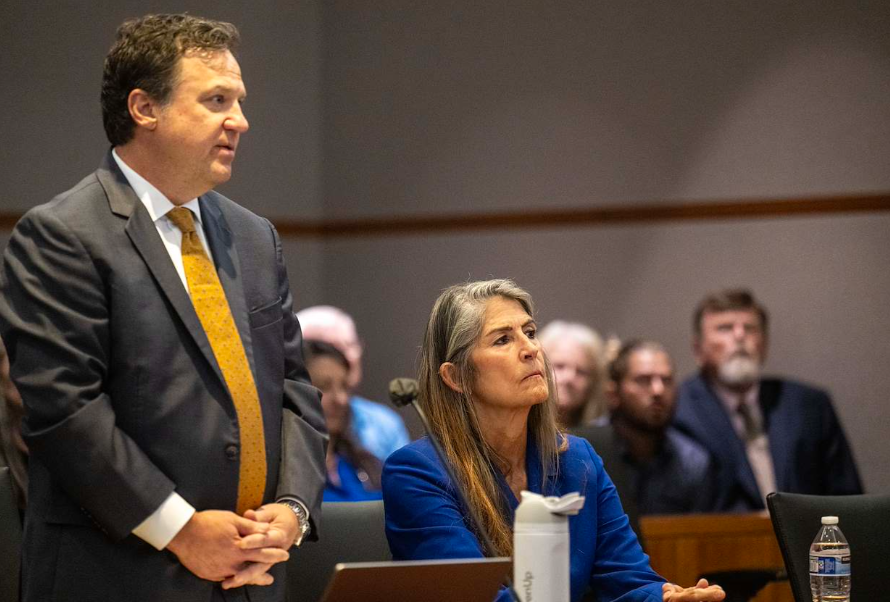
A Jefferson County district court judge on Tuesday sentenced a disgraced former Colorado Bureau of Investigation DNA analyst to a decade in prison for altering and deleting data in scores of criminal cases over several years. Jefferson County District Judge...

Jason Crow endorses Democrats up and down Colorado’s ballot, chips in $100K for campaign efforts
Ernest Luning
ernest.luning@coloradopolitics.com
Updated 23 hours ago
Democratic U.S. Rep. Jason Crow on Tuesday formally endorsed more than 60 Democrats running up and down Colorado’s ballot and said he’s putting $100,000 into statewide and county campaigns and organizing programs to drive turnout in the fall election. Crow,...
Trumpicans thumb their nose at the Constitution | Hal Bidlack
Hal Bidlack
hal-bidlack@coloradopolitics.com
Updated 2 days ago
As is all too often the case, there are again too many interesting things appearing in Colorado Politics for me to comment on all of them. So let me tell you what I won’t be talking about before I get...
CoComandering? | Miller Hudson
Miller Hudson
miller-hudson@coloradopolitics.com
Updated 3 days ago
At 8 a.m., Friday morning, Aug. 28, 70 or 80 mostly bleary-eyed visitors to the Transportation Technology Center outside Pueblo packed a conference room to attend the Front Range Passenger Rail District’s (FRPRD) Board meeting. With the exception of those...

Even Dem court couldn’t abide theft of GOP seats | Dick Wadhams
Dick Wadhams
dick-wadhams@coloradopolitics.com
Updated 3 days ago
Thanks to the Colorado Supreme Court, Colorado voters will be able to reaffirm their support for the Independent Congressional Redistricting Commission after the court struck down the Democratic scheme to steal three Republican congressional seats. Billionaire-funded national Democratic groups from...
PREV
PREVIOUS

DOJ sues Colorado to overturn in‑state tuition for students living in the country illegally
The U.S. Department of Justice has sued Colorado to dismantle a decade‑old law that grants in‑state tuition to students living illegally in the United States, setting up a high‑stakes clash over immigration policy. In 2013, after more than six tries in a decade, Colorado legislators passed Senate Bill 33, also known as the ASSET Act, […]

Victor Marx, GOP candidate for governor, faces 100-plus campaign finance complaints
Victor Marx’s gubernatorial campaign has been hit with more than 140 campaign finance complaints, although most have been consolidated by the state’s election office because they follow similar alleged violations. Marx faces Attorney General Phil Weiser, who won the Democratic nomination, in the general election. All but one of the complaints filed against the Marx […]