

Planning Commission rejects resident appeals to stop proposed data center

Editor’s note: This story has been updated to reflect comment from District 11 clarifying that it has not conducted a financial review of Project Taurus.
The Colorado Springs Planning Commission rejected appeals Thursday night against a proposed artificial-intelligence data center off Garden of the Gods Road.
The vote of the commission was 6-2, but residents who filed the appeals will have 10 days to challenge that decision.
While allowing Project Taurus to proceed, the commissioners set four conditions on the company, Raeden. These include:
- Requiring Raeden to report utility use data for the first 10 years of operation.
2. Limiting utility use to a specified level of 50 megawatts, with the condition that if Raeden wants to exceed that, it must return to the commission for further approval.
3. Raeden must furnish a corrected “single sheet” to the existing building plan.
4. The company must modify its sound-monitoring plan to include “dB(C) monitoring in the same fashion as dB(A) monitoring and reporting.”
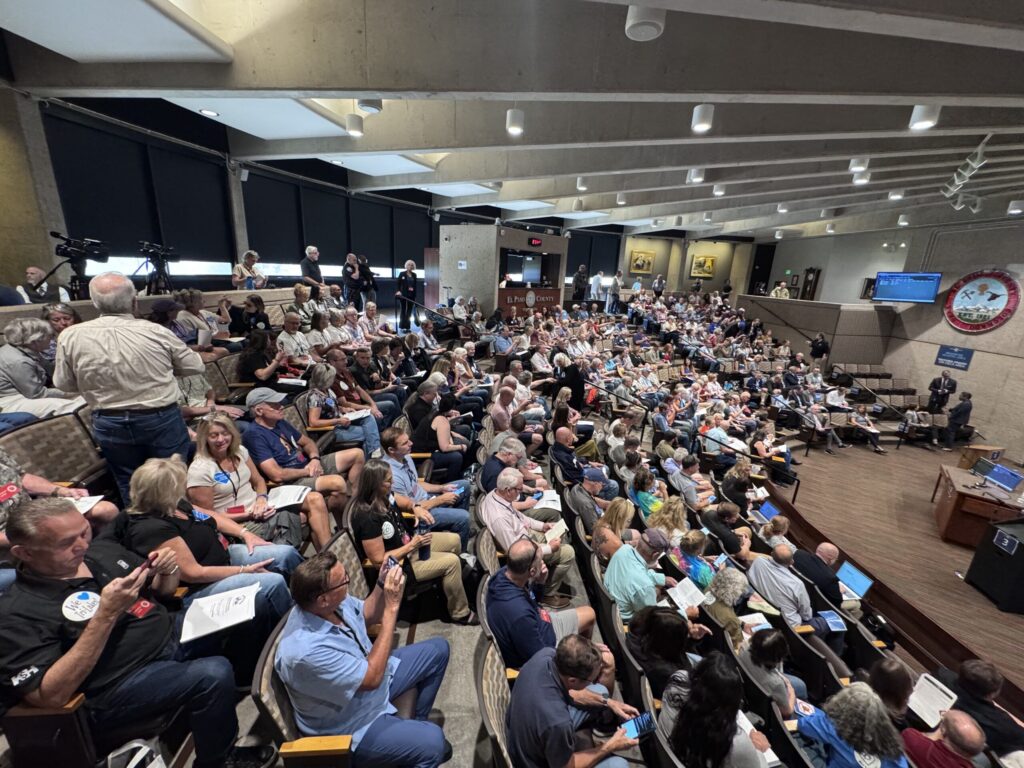
The vote came shortly before midnight after a session that began at 9 a.m. Thursday morning.
Known as Project Taurus, the data center has sparked significant community interest. More than 100 people signed up to speak in opposition to the data center while only 13 signed up to speak in support of it. Much of the opposition centered on environmental and noise concerns and power and water use.
Those speaking in support of the data center highlighted how the project will support the construction industry and make use of an old, abandoned building that does not generate any income for the city.
During the three-hour public comment session, Ean Tafoya, the vice president of state programs for Green Latinos, an environmental nonprofit, raised the issue of chemicals and coolants used within the data center’s closed loop cooling system. In a bid to use less water, Tafoya said the industry at large is using “forever chemicals” like per- and polyfluoroalkyl substances (PFAS), ethylene glycol and hydrofluorocarbons.

Contamination by PFAS are believed to contribute to health conditions, such as cancer, infertility, interference with hormones, among other conditions, The Gazette previously reported.
“These chemicals are made in industrial areas of Houston and other places that also have people living on the fence line. It’s a supply chain of suffering” in the race to use less water, Tafoya said. “You’re repeating the mistakes of the past, like with fracking. Do you know if your wastewater utility can remove these and to what efficacy and what that cost will be?”
PFAS from firefighting foam at Peterson Space Force Base contaminated the groundwater under Fountain, Security and Widefield in 2015 and 2016, prompting all three communities to install water treatment systems.
The Air Force spent $41 million on three water treatment plants meant to remove PFAS from residents’ water that were implemented in 2021.
Raeden, a California-based company, is planning to build the data center and has said it will use a closed-loop cooling system, which is designed to have a one-time water use of 200,000 gallons of water. The company’s CEO, Jason Green, has said beyond that, the company doesn’t want more water and won’t need more water.
The 200,000-gallon figure is roughly one-third the amount that would fill an Olympic-sized swimming pool.
Those speaking in support of building the data center point to the economic benefits of refurbishing the disused building. An economic impact report produced by the Ryan Tax Firm and commissioned by Raeden estimates the project will bring 600 “construction-related positions.”
At an early community meeting, Green said the jobs will be union jobs. While these positions are temporary, members of the International Brotherhood of Electrical Workers said they have built their careers on jobs like this.
“(I am) not either pro-or anti-data center, I’m pro-providing for my family,” said Mike Ham. “Know that those jobs, those short-term jobs, can have a lasting impact.”
The building will need constant maintenance, he added. The jobs to address that will provide good benefits, health care and retirement savings for workers.
Former Colorado Springs City Councilmember Tim Leigh said he’s seen a lot of “civic tomfoolery,” adding that the Raeden plan is “not a real problem.” He argued that filling the building will be a good thing for the city but also for Colorado Springs School District 11.
“For nearly two decades, the old Intel buildings have mostly empty over that time, District 11 classrooms went without roughly $750,000 a year in property tax,” he said. “If we approve the micro data center, District 11 is going get a steady check every year.”
On Friday morning, staff with District 11 said they had not conducted an independent financial review of how Project Taurus may impact its finances. An economic impact study, commissioned by Raeden and conducted by the Ryan Tax Firm, estimates the project will generate $1.2 million in annual property tax revenue.
“The figure cited during the hearing should therefore be understood as the speaker’s estimate, not as a district financial projection,” staff at D-11 said. Determining the actual fiscal impact requires much more analysis based on the final assessed value of the property, applicable mill levies and other considerations.
But residents citywide are still concerned and pressed for a data center moratorium.
“A deliberate pause is needed for the city to understand how a hyperscale data center will cost the people that they’re meant to protect,” said Kate Kent, a resident in the Chelsea Glen neighborhood to the south of the proposed data center. “In close, we ask for a moratorium.”
“The reality is that everyone on the grid will pay the costs,” she said.



Fashion, food and fun combine to make arc Thrift Store’s annual fundraiser a success | NONPROFIT REGISTER
Joanne Davidson Special to Colorado Politics
joanne-davidson-special-to-colorado-politics@coloradopolitics.com
Updated 2 hours ago
arc THRIFT STORES Denver News: “Let’s Celebrate” was the theme for arc Thrift Stores’ annual fundraiser, and it’s not a stretch to say that’s exactly what everyone did at this Sept. 3 gathering held at Denver Botanic Gardens. The crowd that filled the gigantic...

With its water source dry, a southeast Colorado town’s clock is ticking
Savannah Eller
savannah-eller@coloradopolitics.com
Updated 1 day ago
The Cucharas is not a mighty river, but the people of La Veta knew they had a problem brewing when it ran dry at the beginning of June. “We’re getting by,” said La Veta Mayor Doug Brgoch. “It’s not great.”...

Ikon Pass company Alterra to move into former Denver Post building, create downtown ‘outdoor hub’
Bernadette Berdychowski
bernadette.berdychowski@denvergazette.com
Updated 6 days ago
What was once the home of two of Colorado’s longest-running daily newspapers could soon become a central location for the state’s ski resort and outdoor companies, city and state leaders said Thursday. Alterra Mountain Co. is moving its headquarters to...

‘Until Every Woman Thrives’ campaign receives a $10 million investment | NONPROFIT REGISTER
Joanne Davidson Special to Colorado Politics
joanne-davidson-special-to-colorado-politics@coloradopolitics.com
Updated 1 week ago
WOMEN’S FOUNDATION OF COLORADO COLORADO HEALTH FOUNDATION Denver News: A $10 million gift from the Colorado Health Foundation will enhance “Until Every Woman Thrives,” a comprehensive campaign launched by the Women’s Foundation of Colorado in 2024 to transform lives, deepen relationships and amplify the impact of various...

Voices of Our Youth Gala celebrated the impact a mentor can have | NONPROFIT REGISTER
Joanne Davidson Special to Colorado Politics
joanne-davidson-special-to-colorado-politics@coloradopolitics.com
Updated 4 days ago
BIG BROTHERS BIG SISTERS OF COLORADO Denver News: When chief executive officer Elycia Cook extended an invitation to the 2026 Big Little Gala, Voices of Our Youth, it came with a note advising that it would be an evening that was “Very...

Amazon buys 70 acres in Aurora
Bernadette Berdychowski
bernadette.berdychowski@denvergazette.com
Updated 1 week ago
Amazon purchased 70 acres of land in Aurora with plans to build a distribution center, according to city and county records. The e-commerce giant bought a parcel at 825 N. Lisbon St. from a company tied to Northpoint Development for...

Colorado’s EV charging map nearly complete, state says
Scott Weiser
scott.weiser@gazette.com
Updated 3 days ago
Gov. Jared Polis and the Colorado Department of Transportation released a statement calling the state’s public fast-charging network nearly built out. The Aug. 27 news release reports there are now 486 DC fast-charging locations and 83% of the state highway...

PUC adds weekly comment after killing private talks
Scott Weiser
scott.weiser@gazette.com
Updated 2 weeks ago
The Colorado Public Utilities Commission will take public comment at the start of every commissioner’s weekly meeting beginning Sept. 9 as part of its new transparency mandate, the commission announced, expanding a slot previously limited to the second Wednesday of...

Healthcare Freefall: AI arms race hits rural healthcare as hospitals fight to keep up
Thelma Grimes
thelma.grimes@coloradopolitics.com
Updated 2 weeks ago
Editor’s Note: Colorado’s healthcare system is entering a period of accelerating instability — a “tsunami,” as multiple leaders describe it — driven by collapsing hospital finances, shrinking Medicaid reimbursements, disappearing services and a political fight over who is responsible for...
El Paso County upholds Buc-ee’s zoning appeal, clearing way for administrative approval
Savannah Eller
savannah-eller@coloradopolitics.com
Updated 2 weeks ago
A packed, daylong meeting on Thursday resulted in a win for the Texas travel center chain Buc-ee’s, with El Paso County commissioners voting 4-1 to approve the developer’s zoning appeal. “I think the burden of proof has been met here,”...
PREV
PREVIOUS

Victor Marx, GOP candidate for governor, faces 100-plus campaign finance complaints
Victor Marx’s gubernatorial campaign has been hit with more than 140 campaign finance complaints, although most have been consolidated by the state’s election office because they follow similar alleged violations. Marx faces Attorney General Phil Weiser, who won the Democratic nomination, in the general election. All but one of the complaints filed against the Marx […]

Denver City Council to weigh Xcel franchise, $18M move to liability fund
The Denver City Council will hold a combined courtesy hearing during its regular Monday meeting to consider a previously introduced trio of Xcel Energy measures. The first would ask voters to extend the utility company’s franchise license with the city through 2026. The franchise license question would go before voters on the Nov. 3 ballot. […]