

Colorado districts prepare for school year amid mental health cuts. But will less cellphone distractions help?

The signs of a new school year are everywhere — buses in the shop, teachers unpacking boxes, families ticking through supply lists — but behind the familiar rituals, Colorado districts are preparing for a year defined less by routine than by strain.
Mental-health dollars that once paid for therapists, psychologists and individualized support have largely disappeared after the federal government claimed the program was steeped in race-based contortions. Medicaid cuts have tightened budgets further.
The changes are occurring amid a new statewide cellphone-policy mandate that compels districts to rethink how students interact with technology during the day, and already, some schools that ban their use have anecdotally reported more interaction among students and fewer distractions.
For many administrators, the combination of less mental health funding and instituting a technology policy feels less like a transition and more like a reckoning.
To some, Colorado has long struggled to adequately fund its 179 public school districts, though others contend that the problem is an issue of prioritization — one report found that school districts keep growing their administrative staff despite declining student enrollment. Others also argue that higher per capita spending does not necessarily translate to better performance, pointing to states like Utah, which spends less per pupil than most states but yet surpasses many in academic metrics.
Still, advocates in Colorado point to the state ranking below the national average in per-pupil spending, which they say leaves districts dependent on federal programs to fill critical gaps. Now, they’re bracing for the loss of one of those programs: a school‑based mental-health grant Congress created to support services ranging from in-school therapy to individualized education plans and school psychologists.
In April 2025, the U.S. Department of Education notified Colorado grantees that it would discontinue the program, arguing the state had adopted policies that conflict with the Trump administration’s priorities. A department spokesperson said states were using grant dollars for “race-based actions like recruiting quotas in ways that have nothing to do with mental health,” which the agency claimed could “hurt the very students the grants are supposed to help.”
The Colorado Attorney General’s Office has joined a coalition of attorneys general in filing a second lawsuit to block the termination. A previous lawsuit resulted in a permanent injunction preventing the department from canceling the grants, but the Colorado office insisted that the federal agency has sidestepped the order.
Advocates say funding gaps threaten programs, future work pipelines
Colorado Education Association president Kevin Vick said most districts in the state are planning their budgets on the assumption they won’t receive federal mental health funding.
They hire new staff over the summer in preparation for the upcoming school year, Vick said.
“So if you’re not guaranteed a funding source for that whole year, that makes it so you can’t really engage in hiring for that school year, because if you don’t get the money you are counting on, district budgets are so tight these days that there really is nowhere to pull from,” he said. “Districts can’t just absorb that cost.”
The lament that K-12 education has been fiscally starved and school districts are struggling is a common narrative. Against that backdrop, a coalition that includes the teachers’ union has launched a campaign for a ballot proposal that would reduce more than $1 billion in taxpayer refunds and spend the money on education. Referred to the ballot by the state legislature, the average Colorado taxpayer would lose about $7,300 in Taxpayer’s Bill of Rights refunds between the 2026-27 and 2036-37 fiscal years if the proposal is approved at the ballot box, according to a nonpartisan analysis.
About 80% of Colorado schools say they expect to reduce staff due to uncertainty about federal education funding, said Vincent Atchity, president and CEO of Mental Health Colorado.
Medicaid cuts approved in last summer’s federal budget bill have added another strain on districts. The program is the largest payer of school-based health services, and as many as 40% of Colorado children rely on it, according to the Kaiser Family Foundation.
Students are six times more likely to receive mental-health care at school than anywhere else, Atchity said. When those services are reduced or disappear, many kids simply have no alternative, he added.
Dr. Lauren Henry, a child psychologist at Children’s Hospital Colorado, pointed to the pandemic as a sign of what can happen when school-based services become unavailable.
“With the onset of COVID restrictions, when kids did not have access to this primary level of mental health support, our kids fell into crisis … our community systems to support these families became overwhelmed,” she said. “Our prevention approach really turned into a triage when (kids) weren’t able to access these supports in school.”
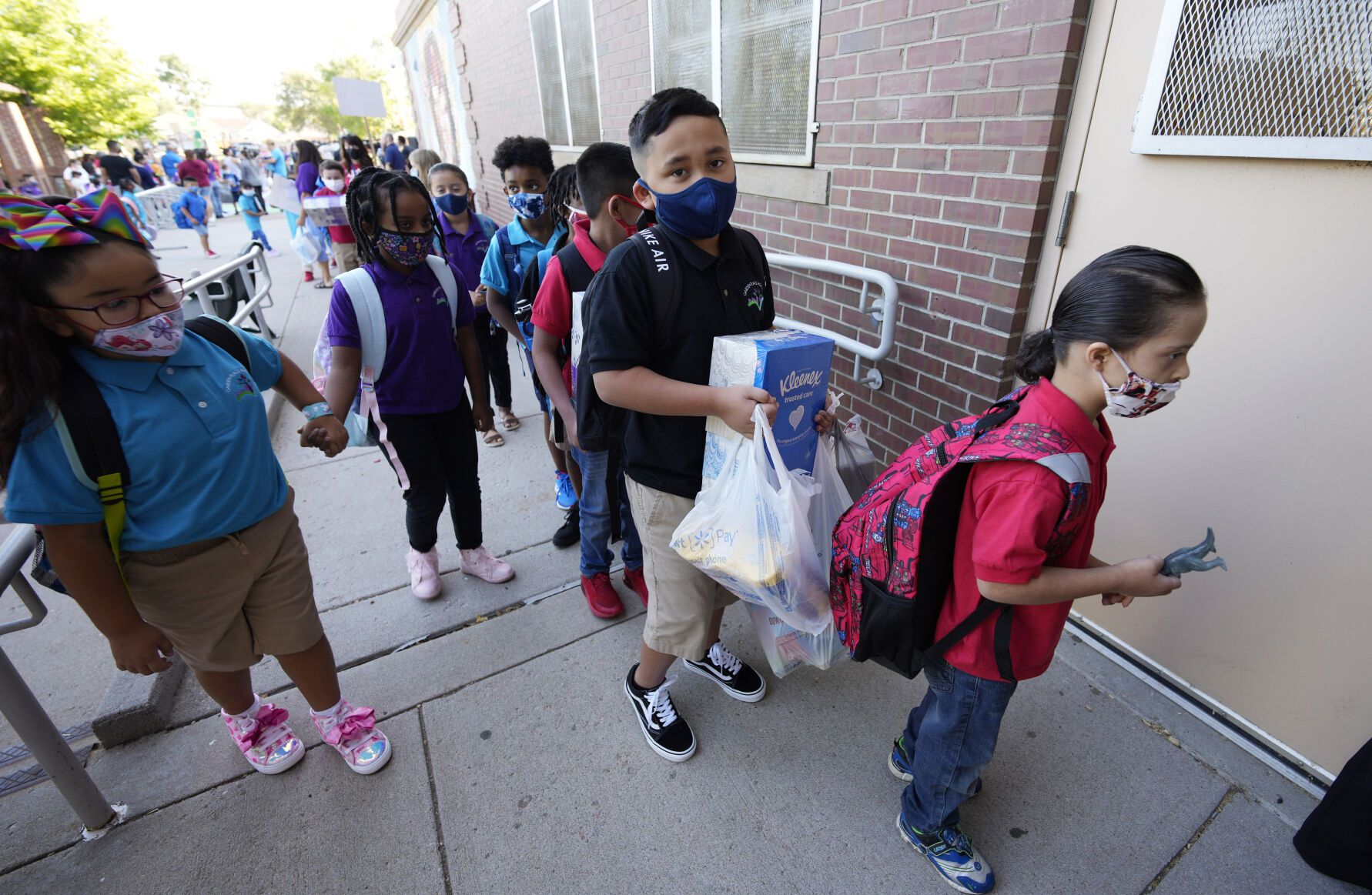
During the pandemic, officials had shut down schools and forced students and teachers into remote learning, a decision that led to learning losses that schools are still digging themselves out of today.
Colorado schools are facing what Henry called a “perfect storm” of funding pressures. With inadequate support from local, state and federal sources, districts are eliminating positions — and mental-health specialists are often among the first to go when budgets tighten.
The cuts reach beyond current staffing, she said, wiping out training programs for future professionals at a time when Colorado is already short more than 4,400 mental health workers.
Henry said the state’s preventive model depends on having trained staff in schools, but those training programs are no longer being funded — a shift she warned will undermine efforts to support kids’ mental health.
Colorado sees some progress
In December 2021, then-U. S. Surgeon General Dr. Vivek Murthy formally declared a national youth mental health crisis. America’s youth — stuck at home and isolated from their peers following governments’ decisions to shut down schools and curb gatherings — reported record-high rates of depression, anxiety and suicidal ideation.
That same year, Colorado lawmakers passed House Bill 1258, a measure establishing the I Matter program, which provides kids and teens with up to six free therapy sessions. The following year, the national suicide and crisis lifeline, 988, launched.
Youth mental health has shown signs of improvement since the pandemic. A recent Colorado Children’s Campaign report found a 14% drop in high school students reporting sadness or hopelessness between 2021 and 2023. Access has improved as well. In 2025, only 8% of parents said their child needed mental‑health services but didn’t receive them, down from 16% two years earlier.
However, mental health and education advocates are concerned that funding cuts could derail that progress.
Henry said school teams have made real progress in supporting students’ mental health, much of it tied to the federal grants that helped districts recover from the pandemic. But she warned that, without those dollars, schools don’t know how they’ll sustain the programs that have strengthened prevention and early intervention.
State-funded school programs are also being trimmed after lawmakers confronted more than $1 billion in budget shortfalls in both 2025 and 2026.
That crisis was primarily driven by dramatic increases in Medicaid spending, which some in the health industry have blamed on mismanagement on the part of Colorado officials, alongside expansions in services, which some critics have called “Cadillac” coverage.
That’s not to mention allegations of fraud and abuse at a cost of tens of millions of dollar.
An analysis by the Common Sense Institute suggested another culprit — the legislature, where Democrats have solidified their majority control following the 2018 elections. The authors argued much of the Medicaid spending growth in Colorado stems from expansive policy choices, rather than enrollment or medical inflation. They attribute about $858 million in annual costs to more than 180 healthcare bills enacted since 2019.
Cellphone policies take effect
Despite the doom, some find optimism in a new law that compels districts to confront their students’ use — or overuse — of phone screens.
Amid growing concerns about how cellphones affect students’ mental health and learning, Colorado lawmakers approved House Bill 1135 in 2024. The bipartisan measure, which takes effect this school year, requires every public school district to adopt a policy governing phone use during the school day.
“It is clear this matter can no longer be ignored,” said Rep. Mary Bradfield, R-Colorado Springs, who sponsored the bill. “Our children cannot afford to wait until we know for certain the impact daily cellphone use in the classroom has on their psychological health. We have a duty to take immediate action to ensure the situation is addressed appropriately. Therefore, it is critical that we see this legislation go into effect.”

Many of the state’s largest districts already have phone rules in place. Denver Public Schools recently adopted a “bell-to-bell” policy that bars smartphones, smartwatches and non‑school‑issued devices during the entire school day.
Vick said cellphones have become a major classroom distraction, noting that while they have occasional educational uses, “the overall reliance by students on cellphones has become generally problematic” for attendance, attention and staying focused on classwork.
Henry, a psychologist, cited a recent report in the Journal of American Pediatrics that found students spend an average of 90 minutes on their phones during the school day and up to seven hours a day in total.
Studies have shown that spending more than three hours a day on social media platforms can double a child’s risk of negative mental health outcomes.
Vick said he has mostly received positive feedback from educators and staff at schools that have already implemented cellphone policies.
Vick added, “From a classroom management and from an overall school health perspective, things that are consistently reported to us are more social behavior in the cafeteria, more social behavior in hallways, less distraction during class time and just generally better class discussion.”
A recent Denver Public Schools survey found strong support for tighter rules: more than 80% of parents, students and staff favored banning cellphones in class and 64% supported a ban for the entire school day.
Atchity said he supports the bill’s flexible approach, which requires districts to have a cellphone policy but doesn’t dictate what that policy must be. It’s a structure he described as “agnostic about the nature of the policy,” allowing districts to maintain “local independence,” while still meeting the statewide requirement.
The law also requires districts to acknowledge the significant impact cellphones are having on students. Henry noted that research shows phones can support kids’ social and emotional health in some cases, but that excessive use can be highly detrimental.
Henry added that the research shows both sides of the issue: there’s clear evidence that phone and social-media use can harm kids’ mental health, but there’s also work highlighting the value of healthy digital connection — supporting social interaction and helping kids build online communities.
“So, there are pros and cons to cellphone use and social media,” she said.
For Atchity, ensuring educators, parents and students are having these important discussions is crucial, regardless of what research might say.
Atchity said every district will need to take a hard look at how phones are affecting students’ learning and well‑being and craft a policy, even if it isn’t perfect.
“Even if the policy varies widely in its restrictiveness from one school to another,” he said, the key is ensuring “the conversation is happening” and the issue isn’t simply ignored.
Some say they have begun to record positive results.
Regis Jesuit High School in Aurora implemented its bell-to-bell ban two years ago.
In the first few weeks of implementation, Tricco said, officials at Regis Jesuit confiscated fewer than two dozen cellphones.
He had imagined it would be more.
“The kids learned pretty quickly that this is something we’re serious about,” Tricco said.
Violators face escalating consequences — up to expulsion, Tricco said.
While Regis Jesuit does not store student cellphones, the devices must remain out of sight during the school day. If necessary, students may use their phone in the main office in the presence of school administrators.
Students were reluctant to give up their devices — as a DPS survey shows in Denver. But once put away, Tricco said, students now acknowledge the benefits.
By all accounts, the ban accomplished what Tricco had hoped: greater interaction among students.
“I wish I had bought stock in hacky sacks,” Tricco said.
Now when he crosses the courtyard, students are playing on the lawn. They’re talking to each other and looking one another in the eye — instead of fixing their gaze on a glowing screen.
And teachers are reporting fewer distractions.
Reporter Nico Brambila contributed to this article.

Surprise candidate Shimon Blau cleared to face off against Melat Kiros in November
Ernest Luning
ernest.luning@coloradopolitics.com
Updated 11 hours ago
Unaffiliated congressional candidate Shimon Blau, a Denver doctor, has qualified by petition for the general election in Colorado’s 1st District, where Democrat Melat Kiros defeated 15-term U.S. Rep. Diana DeGette in last month’s primary, the Colorado Secretary of State’s Office...

UNC opens College of Osteopathic Medicine
Marissa Ventrelli
marissa.ventrelli@coloradopolitics.com
Updated 12 hours ago
The University of Northern Colorado held a grand opening for its new College of Osteopathic Medicine on Friday, with Gov. Jared Polis in attendance to celebrate the culmination of a two-year, $127.5 million project. The project was funded through legislation...

Victor Marx, GOP candidate for governor, faces 100-plus campaign finance complaints
Marianne Goodland
marianne.goodland@coloradopolitics.com
Updated 11 hours ago
Victor Marx’s gubernatorial campaign has been hit with more than 140 campaign finance complaints, although most have been consolidated by the state’s election office because they follow similar alleged violations. Marx faces Attorney General Phil Weiser, who won the Democratic...
Primary voters rejected big money in politics | Paula Noonan
Paula Noonan
paula-noonan@coloradopolitics.com
Updated 6 hours ago
While we’re in an election campaign lull between now and Labor Day, we have time to consider the impact of $102 million in campaign contributions in the primary. In the general election, more money will fill candidate campaign coffers, and...
DOJ sues Colorado to overturn in‑state tuition for students living in the country illegally
Marianne Goodland
marianne.goodland@coloradopolitics.com
Updated 13 hours ago
The U.S. Department of Justice has sued Colorado to dismantle a decade‑old law that grants in‑state tuition to students living illegally in the United States, setting up a high‑stakes clash over immigration policy. In 2013, after more than six tries...

Jefferson County to fill commissioner vacancy after Dahlkemper tapped for lieutenant governor
Matt Kyle
matt.kyle@denvergazette.com
Updated 1 day ago
Democratic gubernatorial nominee Phil Weiser on Wednesday announced that Jefferson County Commissioner Lesley Dahlkemper would be his lieutenant governor, meaning she would be leaving her commissioner seat open should he win the race in November. However, Dahlkemper’s term was already...

New wolf pack confirmed in Eagle County, marking 4th Colorado pack with pups this year
Marissa Ventrelli
marissa.ventrelli@coloradopolitics.com
Updated 2 days ago
A new gray wolf pack has formed in Eagle County, Colorado Parks and Wildlife announced on Wednesday. Known as the Piney Ridge Pack, it is the fourth pack of gray wolves in the state to have produced pups this year....
Colorado’s primary proved in this political climate money doesn’t buy electoral happiness | Paula Noonan
Paula Noonan
paula-noonan@coloradopolitics.com
Updated 2 days ago
To catch you up, campaign committees from this 2026 election cycle already collected and shoveled out a lot of cash: $102.64 million. That’s contributions in all forms — dollars, in kind, loans, etc. — from December 2024 to now. Total...
Colorado housing laws take effect, expanding tools for affordable and workforce housing
Marissa Ventrelli
marissa.ventrelli@coloradopolitics.com
Updated 3 days ago
New housing laws taking effect on Aug. 12 in Colorado aim to boost affordability, improve homelessness response and ensure safer water systems for mobile‑home communities. The first bill, Senate Bill 001, allows municipalities to sell county- or town-owned property to...
Democrat Phil Weiser names Jeffco Commissioner Lesley Dahlkemper as his gubernatorial running mate
Ernest Luning
ernest.luning@coloradopolitics.com
Updated 2 days ago
Colorado Attorney General Phil Weiser, the Democratic nominee for governor, on Wednesday named Jefferson County Commissioner Lesley Dahlkemper to be his lieutenant governor running mate in the general election. Calling her “someone who can be a governing partner,” Weiser said...
PREV
PREVIOUS

The through line from Donald Trump to Victor Marx | SONDERMANN
Over 10 years ago, before Donald Trump could ever defeat Hillary Rodham Clinton, he had to first engineer a hostile takeover of the Republican Party. Prior to his descent of that golden escalator, the previous seven Republican presidential nominees had been named Bush, Bush, Dole, Bush, Bush, McCain and Romney. Those names constituted something of […]

Armstrong staffer considers congressional bid, DeGette angers rural communities with wilderness act | A LOOK BACK
Forty-five years ago this week: If the lines were drawn just right, Republican Sen. Bill Armstrong stood the chance of losing his office manager, Ruth Fountain. Fountain admitted she was seriously thinking about running for Colorado’s new congressional seat in the next year. Fountain had worked on Armstrong’s Colorado House campaign, served as deputy campaign […]