

Unsustainable: How Colorado’s Medicaid spending exploded

The state’s Medicaid program — which covers about one in four Coloradans — is poised for its largest single-year jump in at least two decades, with officials proposing a $2.3 billion increase, even as lawmakers face a $1.5 billion budget shortfall.
The data shows Medicaid enrollment has grown steadily, while spending has increased far more rapidly — more than fivefold since 2007.
As lawmakers work on next year’s budget, they will have to grapple with Medicaid spending, which has overtaken K-12 education as the largest line item in the state budget.
“What’s even more alarming, over the past five years, Medicaid expenses have averaged 19%,” said state Rep. Rick Taggart, a Grand Junction Republican.
“This is not sustainable under any stretch of the imagination.”
For some Coloradans, the program provides services that can be difficult to replace — from in-home care to therapies that help people with disabilities maintain their independence.
Jointly funded by the state and federal government, Medicaid provides health coverage to low-income residents, including children, pregnant women, seniors and people with disabilities. The program is overseen in Colorado by the Department of Health Care Policy and Financing or HCPF.
Twenty years ago, the program covered about 560,900 Coloradans — or roughly 12% of the state’s population, according to a federal report. Today, Colorado Medicaid covers about 1.3 million people.
Over that time, the agency’s staffing more than tripled — from about 257 full-time employees to roughly 841 — far outpacing enrollment growth.
Spending for the program shows no signs of slowing.
Today, Medicaid is the state’s single-largest expense, far exceeding any other agency.
Before 2011, the Colorado Department of Education received a larger share of state funding, but Medicaid spending has since overtaken it. The shift accelerated after Colorado expanded Medicaid eligibility in 2014 under the Affordable Care Act.
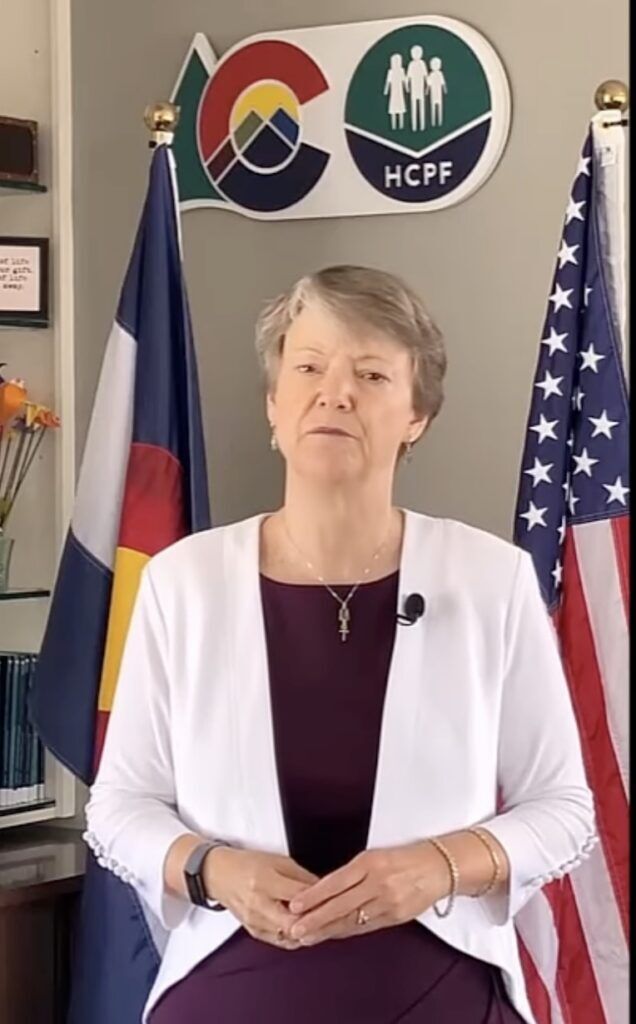
Kim Bimestefer, the executive director of HCPF, refused an interview request. A spokesperson said her calendar was packed with budget discussions, as well as with internal and legislative meetings. (On March 30, she stepped down from her position, facing pressure from critics and legislators who prepared to press for resignation.)
In fact, Bimestefer had not been directly interviewed by a local media organization regarding the state’s Medicaid-driven budget woes or reports of fraud and abuse plaguing the program.
Instead, her department has provided statements or, in the case of The Denver Gazette’s request for an interview, pointed to a recorded webinar — controlled environments, in which officials don’t face tough questions.
In that webinar, Bimestefer said rising health care costs — along with new federal requirements that could increase administrative demands — are driving Medicaid spending higher.
“In the last four years, no commercial or Medicaid health plan has consistently controlled its trends at or below inflation,” Bimestefer told stakeholders last summer.
Medical inflation in 2026, she said, is projected at 8%.
‘An unsustainable path’
An analysis by The Denver Gazette shows Medicaid spending in the state has grown every year over the past two decades, except fiscal year 2016-17, when HCPF’s budget decreased by $34.7 million.
State officials said rising Medicaid costs — particularly for autism services — reflect both an increasing diagnoses and industry dynamics, including the growth of private equity-backed providers and billing practices that have driven up the volume of care.
Autism diagnoses have quadrupled nationally over the two decades. While there is no single cause, health officials cite expanded diagnostic criteria and increased screening, particularly at earlier ages.
Today, roughly one in 31 — or 3% — of children are autistic, according to the Centers for Disease Control and Prevention.
Generally speaking, health care costs have grown faster than overall consumer prices, according to an analysis by KFF and the Peterson Center on Healthcare. Even so, recent federal data shows only modest differences — with medical prices rising 3.3% compared with 3.0% overall inflation last year.
For the upcoming budget, HCPF has proposed a $20.6 billion budget — 96% of which is paid to providers, according to HCPF’s fiscal year 2026–27 summary request.
The proposal includes about $537 million in reductions meant to slow growth — but even with those cuts, spending is still expected to rise by more than 12%.
That request alone is roughly twice the roughly $1.5 billion budget shortfall lawmakers will need to close this year.
“At some point we have to acknowledge the fact that we’re on an unsustainable path,” said Taggart, who serves on the Joint Budget Committee (JBC), the six-member bipartisan panel of lawmakers that drafts the state’s annual budget.
State Sen. Barbara Kirkmeyer, R-Brighton, has said most of the cuts proposed for the upcoming budget target Medicaid, a major contributor to overspending.
“From the decisions we’ve been making, we have not cut enough and we’re still overspending,” Kirkmeyer told Colorado Politics.
‘That’s mismanagement’
By law, states must cover Medicaid costs.
Roughly $1 out of every $3 in the state budget is spent on Medicaid. Rising pharmacy, behavioral health and long-term care costs are among the drivers — despite enrollment dropping after the “unwind,” when pandemic-era coverage protections ended.
While Medicaid costs are rising nationwide, Colorado stands out for how much of its budget is devoted to the program.
Nationwide, Medicaid accounts for about 19% of state expenditures, according to KFF, formerly the Kaiser Family Foundation, a source for health policy research.
Only New Hampshire’s share is higher than Colorado.
The state’s Medicaid program has nabbed headlines in recent weeks with allegations of a fraudulent billing ring, improper payments for autism therapy and exploding cost in a relatively new program meant to provide health care to pregnant women and children illegally staying in the U.S.
Last month, federal prosecutors charged two Medicaid transportation providers with fraud and bilking taxpayers of more than $500,000 in proceeds used for luxury vehicles, jewelry and cosmetic surgery.
State officials also said they detected $25 million in abnormal billing — a surge that prompted a new state law and the suspension of dozens of providers.
Medicaid’s non-emergent medical transportation program covers rides for beneficiaries who lack other means of transportation to medically necessary, non-emergency services. Providers are typically reimbursed based on mileage and level of service.
And a federal audit also found Colorado made $77.8 million in improper Medicaid payments for autism therapy after program spending for Applied Behavior Analysis (ABA) surged. ABA is a therapeutic approach that centers on managing symptoms by improving social and communication skills.
“Colorado and the nation are battling unacceptable cost increases due to outrageous behaviors and practices by a subset of disruptive and revenue maximizing ABA providers,” Marc Williams, a HCPF spokesperson, has said.
State payments for the program nearly tripled in four years rising from $60.1 million in 2019 to $163.5 million in 2023, according to the audit.
A state-commissioned review found spending on pediatric behavioral therapy has grown dramatically — rising 650% since 2018 to about $287 million — while the number of patients increased far more slowly. The report attributed much of the growth to higher reimbursement rates and a sharp increase in the number of therapy hours patients receive each week.
Speakers at a recent policy panel hosted by Colorado Politics and the Common Sense Institute (CSI) sharply criticized the agency’s leadership, questioning how officials have remained in their roles amid what they described as mismanagement.
Maureen Tarrant, an HCA HealthONE vice president and a former hospital CEO, said the lack of oversight points to deeper failures.
“(T)his is the largest line item in the state budget and you have that kind of mismanagement,” Tarrant said during the forum. “That’s not fraud, waste and abuse. That’s mismanagement.”
Alec Garnett, a former House speaker and chief of staff to Gov. Jared Polis who is now with UCHealth, accused the HCPF leadership of focusing on “punishing” hospitals and missing the “core responsibility” of running the state Medicaid efficiently.
Later in the forum, Garnett said the next governor must pick an “operator” for HCPF chief — one who can ensure costs and enrollments don’t explode, “instead of trying to roll out all these humongous ideas to change health care.”
A congressional committee is now probing allegations of waste, fraud and abuse in the state’s Medicaid program.
‘Cut everywhere’
Some of the cost pressures stem from relatively new programs that have expanded eligibility and benefits in recent years.
Take Cover All Coloradans.
The program launched in 2024 when Denver was in the throes of a crisis with waves of immigrants, who had crossed the southern border illegally, seeking shelter in Colorado.

The bill’s fiscal note assumed about 3,600 people would participate in the program, which provides health care to pregnant women and children living in the country without authorization.
It was expected to cost of $27 million.
Lawmakers had assumed modest growth, projecting a roughly $34.9 million cost in 2025-2026.
Spending blew past that.
The program is expected to cost $112 million in the next fiscal year’s budget.
Today, Cover All Coloradans enrolls nearly 30,000 women and children, Williams said.
“The previous forecast included an assumption that this population would be relatively healthier than the traditional Medicaid children population, based on early data from a similar program in Oregon and empirical evidence from academic research that immigrants are a generally healthier population than non-immigrants,” Williams said in an email.
“However, this has not been true in the first calendar year of Colorado’s program.”
Forecasts project a $3,888 per capita cost for Cover All Coloradan children with a corresponding estimate of $3,697 for traditional Medicaid kids.
Republicans pointed to Cover All Coloradans as emblematic of Democrats overspending the past eight years.
JBC staff has recommended eliminating dental, long-term services and behavioral health benefits for unauthorized immigrants to save the state about $17 million.
While those cuts, Kirkmeyer has said, will not make a dent in the deficit, it comes at a time that the JBC is considering Medicaid reductions to U.S. children with intellectual and developmental disabilities.
“We’re going to have to cut everywhere,” Kirkmeyer told Colorado Politics.
These decisions are not abstract. For some Coloradans, what lawmakers choose to cut could shape what care remains available.
‘An enormous regulatory burden’
In the crosshairs are Medicaid recipients like Tegan Motschall.
Cerebral palsy isn’t the 28-year-old’s only lifelong challenge. Epilepsy and chronic headaches also make getting out of bed difficult somedays.
The equine therapy Motschall receives at Hearts & Horses Therapeutic Riding Center doesn’t just help with her posture on top of BaeBae, a 7-year-old Fjord.
“I think Tegan can feel really small in the world,” said Christine Motschall, her mother.

Christine Motschall added: “The big change would be the self-confidence. She stands a little bit taller.”
Hearts & Horses is a nonprofit in Loveland that provides therapeutic horseback riding for individuals with disabilities.
Liz Ampe, a licensed occupational therapist who works with Tegan Motschall, worries what budget constraints could mean for Medicaid.
“I think it would be too bad if the state decided what form of therapy is appropriate in their eyes,” Ampe said.
Others have argued that rising costs are fueled less by individual services and more by broader policy decisions.
An analysis by the Common Sense Institute (CSI) last month suggested another culprit — the legislature, where Democrats have solidified their majority control following the 2018 elections.
The authors argued much of the Medicaid spending growth in Colorado stems from expansive policy choices, rather than enrollment or medical inflation. They attribute about $858 million in annual costs to more than 180 health care bills enacted since 2019.
“It’s an enormous regulatory burden,” said Greg D’Argonne, who authored the report.
The CSI report recommended rolling back these recent legislative actions.
One example is equine therapy.
In 2022, lawmakers passed a bill allowing Medicaid reimbursement for therapy using equine movement, when provided by a physical, occupational or speech therapist.
A fiscal note showed a general fund impact of about $62,000.
The law went into effect in 2024.
Adam Daurio, director of the Temple Grandin Equine Center in Fort Collins, was among those who pushed for the legislative change.
What Colorado’s law did, Daurio said, was recognize that equine therapy is not a standalone therapy but, rather, a treatment tool in much the same way bands or balls or other equipment is used in clinical settings.
“At the core of this, it was never an additional therapy. It just removed an exclusion,” Daurio said.
Garnett, who is now the vice president of government and regulatory affairs at UCHealth after serving as House speaker in 2021 and 2022 and the governor’s chief of staff from 2023 to late 2024, said the legislature, by passing one bill at a time, “turned the Medicaid benefit program into everything for everyone.”
“So all of a sudden, Medicaid has become the one of the richest benefits in the entire marketplace. So, if we were all on Medicaid, you probably would have a better benefit than you would on commercial insurance,” he said at the CSI forum in February.
He noted that Medicaid today covers equine, music and physical therapy.
“These are areas that are nice to have, and if we had all the money in the world and you didn’t have to constitutionally balance the budget on an annual basis, may make sense. But that is not the world that we live in,” he said.
To Garnett, the HCPF leadership failed in intervening and telling legislators “we cannot afford that here in Colorado,” adding the state Medicaid program should have focused on the “most important things,” notably primary care, while covering as many people as possible.

As lawmakers weigh the program’s growing costs, decisions about what to cover — and how — are likely to draw increased scrutiny.
With Medicaid consuming a third of the state budget, lawmakers face a narrow set of options — cutting costs, reducing services or finding new revenue — each carrying tradeoffs for the more than one million Coloradans who rely on the program.
JBC Chair Emily Sirota, D-Denver, said she expects “tough decisions” ahead.
“If we do nothing and Medicaid continues to balloon, that means Colorado will have less money to spend under the TABOR cap on other priorities and programs, such as K-12 and higher education,” Sirota said in an email to The Denver Gazette.


At conservative summit, Colorado Republican leaders concede Democrats’ election edge
Marissa Ventrelli
marissa.ventrelli@coloradopolitics.com
Updated 1 day ago
Four Republican state lawmakers told attendees at a gathering of conservative leaders on Friday they doubt their party can win statewide races, noting that Colorado’s electorate has been shifting toward Democrats but adding they see an opening in several pockets....

Colorado lawmakers start crafting strategy to manage $200 million in federal rural health funds
Marissa Ventrelli
marissa.ventrelli@coloradopolitics.com
Updated 16 minutes ago
Members of the Colorado legislature’s new Commission on Medicaid raised concerns Wednesday about the federal Rural Health Transformation Program created under H.R. 1. The bipartisan, bicameral commission, created in the last legislative session to guide implementation of Medicaid changes under...

Colorado’s 72-hour social media warrant law takes effect Aug. 12
Marissa Ventrelli
marissa.ventrelli@coloradopolitics.com
Updated 3 days ago
A law requiring social media platforms to respond to search warrants within 72 hours goes into effect on Aug. 12. Senate Bill 011 also requires platforms to create a staffed hotline for Colorado law enforcement agencies to contact regarding pending...

Gov. Polis celebrates Colorado’s first-place education ranking by U.S. News
Marianne Goodland
marianne.goodland@coloradopolitics.com
Updated 4 days ago
Colorado officials said they have something to celebrate this week, in addition to the state’s sesquicentennial birthday on Saturday. U.S. News & World Report on Tuesday gave Colorado its top ranking for education efforts from pre-K to postsecondary, though it...

Colorado districts prepare for school year amid mental health worries — will fewer cellphone distractions help?
Marissa Ventrelli
marissa.ventrelli@coloradopolitics.com
Updated 1 day ago
The signs of a new school year are everywhere — buses in the shop, teachers unpacking boxes, families ticking through supply lists — and behind the familiar rituals, Colorado districts are preparing for a year defined less by routine than...

DOJ sues Colorado to overturn in‑state tuition for students living in the country illegally
Marianne Goodland
marianne.goodland@coloradopolitics.com
Updated 1 week ago
The U.S. Department of Justice has sued Colorado to dismantle a decade‑old law that grants in‑state tuition to students living illegally in the United States, setting up a high‑stakes clash over immigration policy. In 2013, after more than six tries...
Details emerge after teen motorcycle parental consent bill is set to become law in Colorado
Marianne Goodland
marianne.goodland@coloradopolitics.com
Updated 1 week ago
Gov. Jared Polis this year signed a bill that requires minors to obtain parental consent for a motorcycle instruction permit — legislation inspired by a young man who almost died in a crash last year. The measure, House Bill 26-1079,...

What to know before Colorado’s new law on semiautomatic firearms goes into effect
Marissa Ventrelli
marissa.ventrelli@coloradopolitics.com
Updated 2 weeks ago
A Colorado law passed in 2025 established new requirements for individuals planning to purchase semiautomatic weapons. Here’s what residents should know before Senate Bill 003 goes into effect on Aug. 1. From a ban to a training course For decades,...
Will Colorado Gov. Jared Polis’ independent streak define his legacy?
Marissa Ventrelli
marissa.ventrelli@coloradopolitics.com
Updated 2 weeks ago
Sometimes aligned with his party and at other times apart from it, Colorado Gov. Jared Polis has spent much of his tenure charting his own course. That independent streak carried through fights over labor policy, rural anger over wolf reintroduction...

Campaign launched to redirect $1 billion in TABOR refunds to education
Marissa Ventrelli
marissa.ventrelli@coloradopolitics.com
Updated 2 weeks ago
A coalition that includes the state teachers’ union on Tuesday launched a campaign for a ballot proposal that would reduce more than $1 billion in taxpayer refunds and spend the money on education. The measure is among several campaigns taking...
PREV
PREVIOUS

Phil Weiser wins top spot in Colorado’s Democratic gubernatorial primary at party’s state assembly
Attorney General Phil Weiser’s name will appear first on Colorado’s Democratic gubernatorial primary ballot after his overwhelming win Saturday at the party’s state assembly in Pueblo. Weiser joins U.S. Sen. Michael Bennet in the June 30 primary for the office held by term-limited Gov. Jared Polis. Bennet, who successfully petitioned onto the ballot, didn’t participate […]
Oklahoma’s governor picks energy executive Alan Armstrong to fill US Senate seat | OUT WEST ROUNDUP
OKLAHOMA Governor makes US Senate pick OKLAHOMA CITY — Oklahoma’s governor on March 24 appointed energy executive Alan Armstrong to serve in the U.S. Senate through the end of the year and finish the term of Republican Markwayne Mullin, the new homeland security secretary. The choice by Republican Gov. Kevin Stitt, who had pledged to […]