

Colorado Republicans will have to live with the consequences of their candidate of choice | Miller Hudson

Two surprising election results this year in Colorado and Maine’s 2026 primaries compel us to examine the role of voters. It’s usually regarded as impolite, if not insulting, to question the judgment of voters. Democratic theory often implies the collective conclusions they reach capture some ephemeral element of shared wisdom. This may be true when guessing how many marbles are in a jar at a carnival, but it seems a dubious proposition when considering political choices. Although the Federalist Papers are replete with the need for a truly informed electorate, this advice has been infrequently heeded since the nation’s birth.
After my election to the legislature in 1978, I continued to purchase our groceries at the 44th-and-Lowell Safeway in northwest Denver. It was here I conducted my informal, anecdotal Safeway polls just a few blocks from my home. Meeting friends and neighbors, I would quiz them regarding pending legislative disputes. More often than not, I may as well have been speaking Greek. I would be asked how I was enjoying Washington. Correcting this misapprehension by clarifying I worked out of the state Capitol, I would be asked what I could do to get a pothole fixed or remedy a dangerous traffic intersection. I would refer them to their city council member or offer to have the council staff contact them. It was evident our civics education was profoundly deficient.
An understanding of who does what, where and why among our elected officials is shaky at best for most voters. Their ignorance does not sustain a healthy democracy. Voters are reaching ballot-box decisions on the basis of the most superficial impressions. There is little doubt Graham Platner is what pundits call “a good talker.” The same can be said for Colorado’s own Elmer Gantry con man, Victor Marx. Democrats in Maine and Republicans in Colorado fell for these candidates’ smooth pitches despite ample warnings each had personal histories of substantial concern. In a previous political era, characterized by strong party organizations and even stronger party bosses, they would have vetted both out of their races months ago. Their judgments would have been transmitted to precinct leaders who informed the rank and file.
In Colorado, Marx beamed himself into the governor’s race from a parallel universe. Allegedly an evangelical pastor to a devoted congregation which swallows his tales of rescuing child trafficking victims at gunpoint, his reach may extend no further. Having spoken with several Marx supporters, it’s evident they knew little about this alleged ministry or its bizarre claims but loved Marx’s saturation television campaign. They were indeed persuasive. In a culture that values the power of money, one voter asked, “How could he raise that kind of money, if he wasn’t a legitimate candidate?” His claims of Rambo-style exploits are impressive, even if the truth appears to be he has only distributed plush toys to orphans. Nonetheless, together with an intense on-lie presence, he vaulted past state Sen. Barb Kirkmeyer.
Numerous Colorado Republicans are refusing to support his campaign, while others are dodging requests for an endorsement. In a few months, comedians challenging his claims of having been a 7-year-old assassin will have badly embarrassed Colorado Republicans. It is seemingly impossible his campaign will slow the juggernaut of the Weiser campaign. This year there is no Tom Tancredo standing by to jump in as an independent candidate. He successfully torpedoed the ill-fated Republican Dan Maes nominee in 2010. Tom actually outpolled Maes in November, re-electing John Hickenlooper and nearly squeezing the Republicans into minority party status by limiting it to 11% of the vote. Perhaps former Senate Minority leader Paul Lundeen could be persuaded to play a similar role this year. The painful truth is both red and blue camps often don’t regard elections as a serious matter. Sassy and ignorant has worked well for Lauren Boebert, while masculine and down-to-earth elevated Ben Nighthorse Campbell both as a Democrat and later as a Republican.
Yet, elections have consequences — just look at Donald Trump. It makes a difference whom we elect. Kirkmeyer would make a competent governor — someone who most voters wouldn’t lose any sleep if she was residing in the governor’s mansion. She’s regarded as perhaps the most effective senator in either party, although serving in the minority. She would have passed any serious vetting process, but there is no longer any such hurdle in either party. Perhaps some voters presume there is such a mechanism. Candidacy has become a free-lance business. Bosses had their uses. Whether it was the Democrat Tweed in New York or the Republican Mark Hanna in Ohio, they frequently influenced presidential nominations. In 1960, it was Denver’s Mike Pomponio who delivered Colorado’s delegates to John Kennedy rather than Lyndon Johnson.

When both parties actually had elite and powerful leaders, 2026 Democrats would have asked U.S. Sen. Michael Bennet to sit down and keep his chair warm in Washington. If he had won, many Democrats presumed he would appoint Joe Neguse to fill his chair in the Senate. This would not have been in the interest of Coloradans either, Neguse is likely to be the third or fourth most powerful House leader in a Democratic Congress come January — a potential future house speaker. Gov. Weiser will continue to file lawsuits against MAGA lunacy in Washington while Neguse calls investigation shots in the House and, possibly, Bennet is chairing the Agriculture Committee in the Senate, maximizing Colorado’s political muscle. Democratic voters seem to have figured this out — doing the right thing without instructions.
Maine Democrats will get a “redo” on their primary, while Colorado Republicans will have to live with the consequences of their choice. Voters in both parties, independents as well, need to better educate themselves on both the issues and the candidates. It isn’t sufficient to rely on streaming news channels, social-media screeds and targeted advertising. Most of that’s propaganda — which candidates are smarter than a box of rocks and what the hell is wrong with Colorado’s tax system and how can it be fairly restructured? When I spoke with government classes at North High School 40 years ago, a majority would raise their hand when I asked whether they expected social security to be available when they reached retirement. It’s still there, but on life support and in need of rescue.
I would tell them, don’t wait for another fiscal collapse and then run into the street yelling, “What’s happening here? We left you in charge!” You’ll be wrong. The people are in charge both then and now. Our current affordability crisis is a case of leaders serving their donors and not their constituents. Running elections as auctions, we shouldn’t be surprised when the passengers riding in the first-class seats dine on caviar while the rest of us are offered canned spam. The success of democracy requires a well-informed citizenry — that’s part of the program. Civics education should be restored to our public curriculum, beginning in elementary schools. Voters must pay attention — there is no alternative truth, facts are facts. The climate is warming. While the rich are getting richer, fewer and fewer of the rest of us can afford health care, or housing. That sounds like our democracy is failing.
Miller Hudson is a public affairs consultant and a former Colorado legislator.

Trumpicans thumb their nose at the Constitution | Hal Bidlack
Hal Bidlack
hal-bidlack@coloradopolitics.com
Updated 16 hours ago
As is all too often the case, there are again too many interesting things appearing in Colorado Politics for me to comment on all of them. So let me tell you what I won’t be talking about before I get...

CoComandering? | Miller Hudson
Miller Hudson
miller-hudson@coloradopolitics.com
Updated 2 days ago
At 8 a.m., Friday morning, Aug. 28, 70 or 80 mostly bleary-eyed visitors to the Transportation Technology Center outside Pueblo packed a conference room to attend the Front Range Passenger Rail District’s (FRPRD) Board meeting. With the exception of those...

Even Dem court couldn’t abide theft of GOP seats | Dick Wadhams
Dick Wadhams
dick-wadhams@coloradopolitics.com
Updated 2 days ago
Thanks to the Colorado Supreme Court, Colorado voters will be able to reaffirm their support for the Independent Congressional Redistricting Commission after the court struck down the Democratic scheme to steal three Republican congressional seats. Billionaire-funded national Democratic groups from...

Chaotic meeting began with attempt to squelch public comment | Rachel Gabel
Rachel Gabel
rachel-gabel@coloradopolitics.com
Updated 2 days ago
When Attorney General Phil Weiser takes the governor’s office in January, he must immediately address the chaos of the latest round of appointees to the Colorado Parks and Wildlife Commission to assure stakeholders he’s willing to put pressure on the...

Graduated income tax proposal is a flat tax in disguise | Jon Caldara
Jon Caldara
jon-caldara@coloradopolitics.com
Updated 4 days ago
“Youth is wasted on all the wrong people.” That’s one of my favorite lines from “It’s a Wonderful Life.” The older I get, the less it sounds like a joke. Every generation inherits victories it did not win. Young Americans...

AI optimism vs. anxiety — podcasters debate this every night | Tom Cronin
Tom Cronin
tom-cronin@coloradopolitics.com
Updated 3 days ago
President Donald Trump, CNBC’s “Mad Money” host Jim Cramer and entrepreneurial “accelerationists” celebrate the AI revolution and the infrastructure data-center build-out. Cramer recently gushed, “I like data centers so much that I wish I lived in one.” Trump criticized any community...

Colorado House ethics committee issues ‘stern letter’ to Democrat over caucus funds mismanagement
Marianne Goodland
marianne.goodland@coloradopolitics.com
Updated 2 days ago
The Colorado House ethics committee on Friday voted unanimously to issue a “stern letter” to Rep. Mandy Lindsay, D-Aurora, regarding her mismanagement of House Democratic caucus funds. The committee further voted to request that Lindsay resign as Democratic Caucus co-chair...
Manny Rutinel resigns from Colorado legislature to focus on congressional race
Marissa Ventrelli
marissa.ventrelli@coloradopolitics.com
Updated 3 days ago
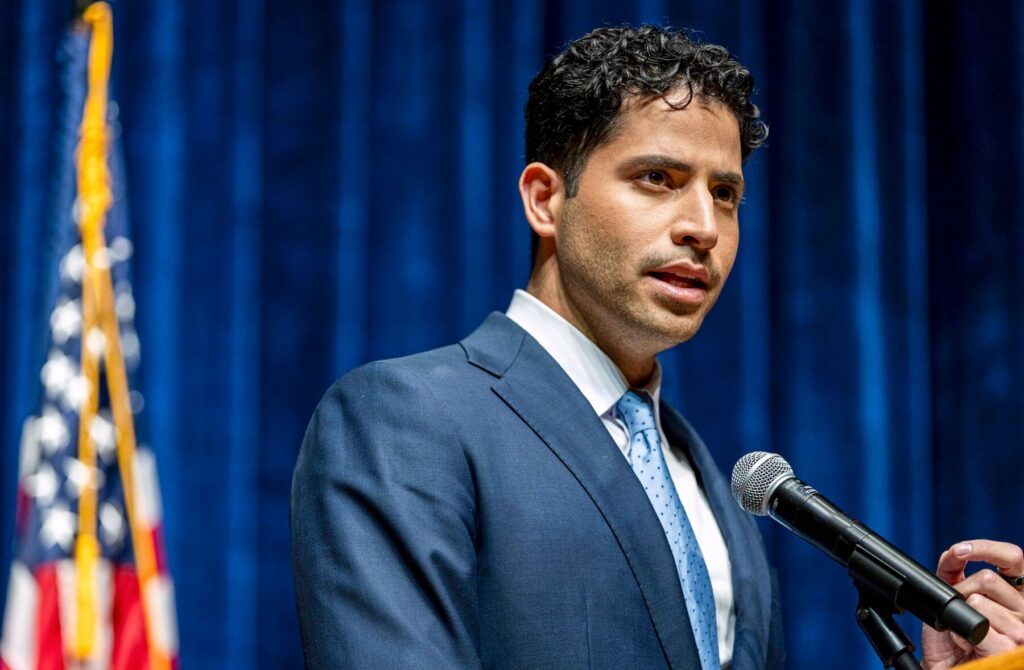
The Democrat running for a key congressional race — whose outcome could decide the balance of power in the U.S. House — on Friday resigned from the Colorado legislature. State Rep. Manny Rutinel is turning his attention to his campaign...

Colorado secures FEMA support for wildfire, flooding and mudslide recovery
Marissa Ventrelli
marissa.ventrelli@coloradopolitics.com
Updated 3 days ago
Federal authorities on Friday approved Colorado’s request for federal public assistance to help communities devastated by the Aspen Acres and Gold Mountain Fires. The Federal Emergency Management Agency did not announce how much the state would receive but confirmed that...

State seeks $50K penalty against GOP candidate Victor Marx over alleged campaign finance violations
Deborah Grigsby
deborah.smith@denvergazette.com
Updated 3 days ago
Republican gubernatorial candidate Victor Marx is looking at more than $50,000 in fines in what the Elections Division of the Office of the Secretary of State calls “unprecedented” campaign finance violations. The state has not imposed that fine yet, and...
PREV
PREVIOUS

Colorado Commission prioritizes feelings over science | Rachel Gabel
The Colorado Parks and Wildlife Commission voted Thursday and prioritized feelings over science-based management. Meanwhile, Rancher X is the beneficiary of those feelings-driven decisions. Well played, Governor. The newest appointees to the CPW Commission are just the parting gift you had in mind for rural Colorado. The Commission voted Thursday 6-5 to reject CPW staff […]

Survey: Voters in Colorado's 8th Congressional District back federal AI regulations
A majority of both Democrats and Republicans in one of Colorado’s most competitive congressional districts say they support federal regulations on artificial intelligence, according to a recent survey. Members of both major parties residing in the state’s 8th Congressional District were asked their opinions on AI regulation as part of a nationwide survey of 20,000 […]