

Federal judge rejects DOJ bid to force Colorado to hand over voter information
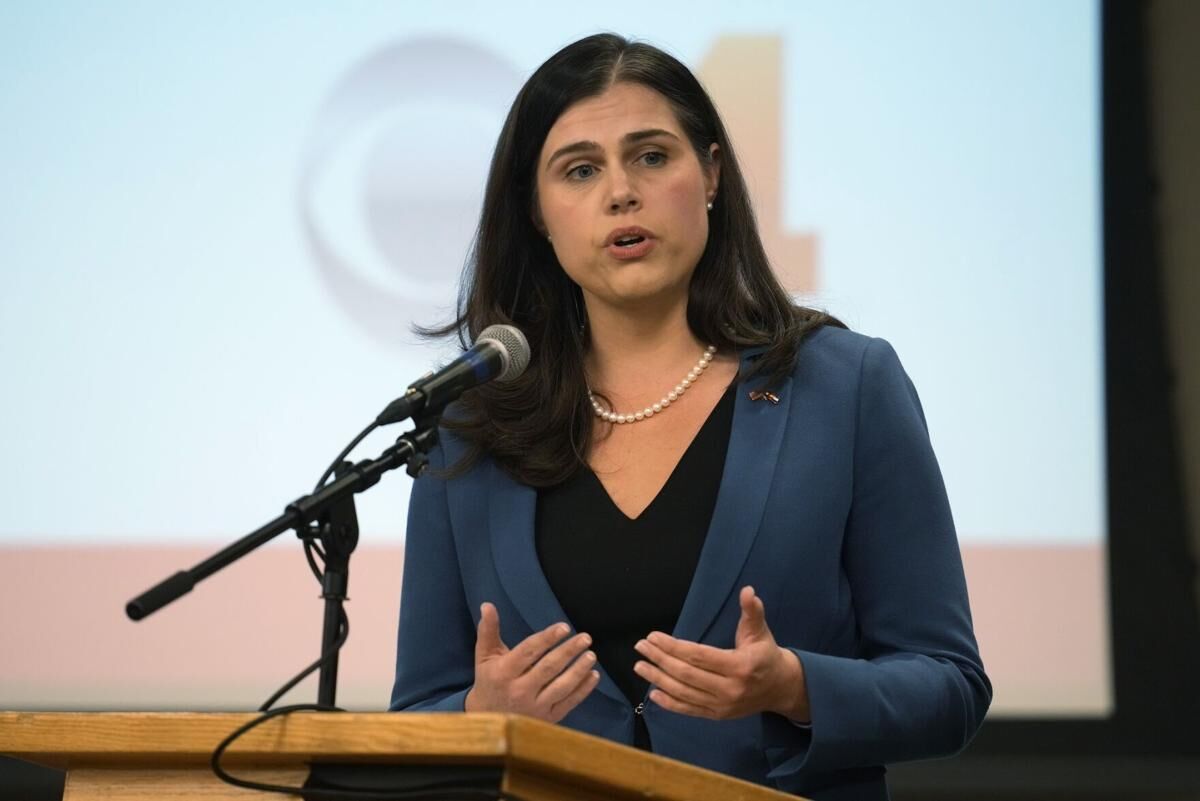
A U.S. District Court Judge has dismissed a lawsuit filed by the Department of Justice against Colorado Secretary of State Jena Griswold for refusing to provide the agency with personal voter information.
Last December, the DOJ’s Civil Rights Division asked Griswold’s office to provide unredacted voter data, including full names, dates of birth, residential addresses and driver’s license numbers. Federal authorities have sought voter data from nearly every state, saying it’s part of a project to ensure election security.
In late July, New Jersey Gov. Mikie Sherrill disclosed that a “software error” at the state’s Motor Vehicles Commission had led to about 6,600 noncitizens being added to the state’s voter registration. According to Sherrill, about 400 of them voted in the most recent election. Colorado has a similar “motor voter” law to New Jersey, which automatically registers eligible individuals to vote when they interact with the Division of Motor Vehicles.
Griswold and other Secretaries of State refused, instead sending unredacted and publicly available files, citing privacy and security concerns. About a week later, the DOJ filed a lawsuit alleging that Griswold violated the federal Civil Rights Act by failing to provide the requested information.
“We will not hand over Coloradans’ sensitive voting information to Donald Trump,” Griswold said in a statement following news of the lawsuit against her. “He does not have a legal right to the information. I will continue to protect our elections and democracy, and look forward to winning this case.”
On Monday, U.S. District Court Judge Philip Brimmer dismissed the lawsuit, arguing that because Colorado’s registration list is not a record or paper that must be produced under Sections 20701 and 20703 of Title 52 of the Civil Rights Act, the DOJ cannot file a claim alleging violation of the act.
Intervenor Colorado Common Cause argued that the DOJ’s request exceeds its statutory authority granted under the Civil Rights Act and that any records disclosed under the act should be redacted.
Another intervenor, Colorado Alliance for Retired Americans, argued that the DOJ did not assert a proper basis and purpose for its demand and failed to comply with the Privacy Act of 1974.
“Trump and his DOJ are attacking elections and democracy,” said Griswold. “We will not let them win. Today’s victory affirms that Trump’s DOJ has no right to Coloradans’ sensitive voter information,” said Griswold. “I will always defend our elections from unlawful federal interference.”
The lawsuit against Griswold is one of 31 suits filed against states that have refused to share voter data and other election information. To date, 20 of those suits have also been dismissed.


Cedric Pride’s blueprint for opportunity through the trades | The OpEdge Podcast
Tony Olivero
tony.olivero@gazette.com
Updated 3 hours ago
Cedric Pride, CEO of the nonprofit Pride Initiative in Denver, joins The OpEdge with a blueprint for workforce development, skilled trades, and economic opportunity. Pride tells host and investigative columnist Jimmy Sengenberger why he believes the trades offer a path...

Colorado’s No. 1 education ranking should raise our ambition | GUEST COLUMN
Colorado Politics
colorado-politics@coloradopolitics.com
Updated 5 hours ago
By Scott Laband Colorado has earned the right to celebrate its new No. 1 ranking in education from U.S. News & World Report. Gov. Jared Polis called it “one of the proudest moments” of his time in office and shared the...

Colorado’s No. 1 education ranking reflects the power of school choice | GUEST COLUMN
Colorado Politics
colorado-politics@coloradopolitics.com
Updated 16 hours ago
By Peter Mason Colorado is now the No. 1 state in the nation for education, according to the 2026 U.S. News & World Report Best States rankings. That is a distinction worth celebrating. It is also a distinction worth understanding....

Group submits signatures for proposed Colorado graduated income tax
Marianne Goodland
marianne.goodland@coloradopolitics.com
Updated 3 hours ago
The measure, which eliminates Colorado’s flat tax, is expected to raise $2 billion in new revenue The proposal to amend the Colorado constitution to change the state’s flat rate into a graduated income tax came in under the wire Monday,...

Democratic group maps out path to Colorado House and Senate supermajorities
Marissa Ventrelli
marissa.ventrelli@coloradopolitics.com
Updated 23 hours ago
A national organization that works to elect Democrats to state legislatures has its sights on Colorado, unveiling a road map to establish a supermajority in both the House and Senate. Democrats have held a majority in the House since 2013...

Courageous Colorado bucks Trump’s federal stupidity | Miller Hudson
Miller Hudson
miller-hudson@coloradopolitics.com
Updated 1 day ago
There are several theories regarding the rhythm of American politics. The most frequently cited is the pendulum hypothesis — positing that episodes of liberal dominance are then interrupted by spans of conservative control. Since Ronald Reagan’s presidential election in 1980,...

A historic moment during another major drought | Rachel Gabel
Rachel Gabel
rachel-gabel@coloradopolitics.com
Updated 4 days ago
Gustav Sumnick emigrated from Germany, traveled to Oklahoma and decided rather than be a Sooner, he wanted to be a farmer. He moved north to Nebraska and married an Irish immigrant farmer’s daughter. They farmed near Fremont, Nebraska, where the...

Colorado can’t forget the lessons of COVID | Jon Caldara
Jon Caldara
jon-caldara@coloradopolitics.com
Updated 1 day ago
We are finally getting a clearer picture of what happened during COVID. Not because the people who locked us up, masked our faces and forced unproven chemicals into our bodies have suddenly become transparent, but because Anthony Fauci’s COVID-era diary...

Historic preservation supporters organize to oppose Trump changes | Bob Loevy
Tom Cronin
tom-cronin@coloradopolitics.com
Updated 4 days ago
Historic preservation organizations in Colorado Springs, the remainder of Colorado and across the nation are organizing to resist a recent effort to relax and weaken historic preservation laws in the United States. In Washington, D.C., the Advisory Council on Historic...

At conservative summit, Colorado Republican leaders concede Democrats’ election edge
Marissa Ventrelli
marissa.ventrelli@coloradopolitics.com
Updated 3 days ago
Four Republican state lawmakers told attendees at a gathering of conservative leaders on Friday they doubt their party can win statewide races, noting that Colorado’s electorate has been shifting toward Democrats but adding they see an opening in several pockets....
PREV
PREVIOUS
3 Colorado judges receive unfavorable retention recommendation as one performance commission violates rules
Of the 123 Colorado judges standing for retention on the November ballot, citizen-led performance commissions found that three did not meet the required performance standards. However, in an unprecedented move, the commission charged with evaluating Supreme Court and Court of Appeals members stepped in to issue its own narrative after it concluded the local performance […]

Parole, appeals deadlines and restitution: Colorado justices accept cases
The Colorado Supreme Court announced on Monday that it will determine how a defendant’s parole-eligibility date should be calculated in instances where a new trial results in a sentence being imposed retroactively to the date of the original, since-overturned sentence. At least three of the court’s seven members must agree to hear a case on […]