Parole, appeals deadlines and restitution: Colorado justices accept cases
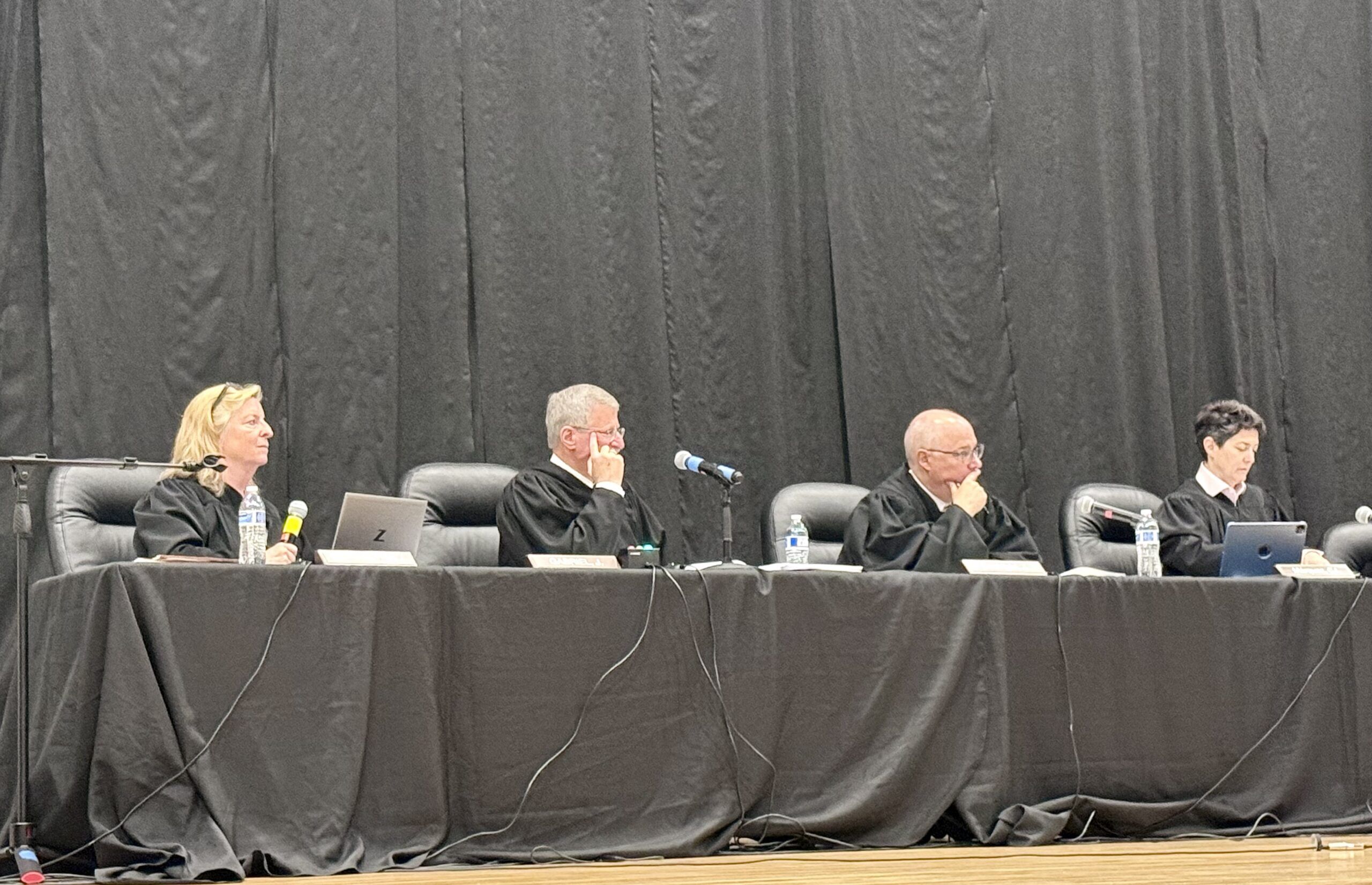
The Colorado Supreme Court announced on Monday that it will determine how a defendant’s parole-eligibility date should be calculated in instances where a new trial results in a sentence being imposed retroactively to the date of the original, since-overturned sentence.
At least three of the court’s seven members must agree to hear a case on appeal.
The justices will also address the approach the Court of Appeals uses to decide when to overlook a lawyer’s careless mistake in filing a late appeal.
However, the court fell one vote short in a pair of cases where the Court of Appeals overturned the defendants’ obligations to pay tens of thousands of dollars in crime victim restitution.
Finally, the Supreme Court dismissed a case it previously agreed to hear, in which Netflix challenged the Court of Appeals’ finding that its streaming subscriptions were subject to the tax on “tangible personal property.” Netflix and the state informed the justices on July 8 that they were no longer pursuing the appeal.
Parole calculation
In 2013, Mark Lewis began serving prison sentences for convictions out of Arapahoe County. Then, in 2016, an Adams County jury convicted him of first-degree murder and related offenses, for which he received life without parole. The Court of Appeals ultimately reversed the murder conviction and ordered a new trial.
At that point, the corrections department released Lewis from prison on parole, based on accumulated earned time from all of his other sentences. Lewis remained incarcerated pending his retrial for murder, and a jury convicted him of a lesser murder charge in 2021.
In sentencing Lewis anew, his trial judge imposed a 28-year sentence “nunc pro tunc” — literally meaning “now for then,” but practically meaning the sentence was backdated to 2016, when Lewis received his initial murder sentence.
However, the various developments gave rise to a mathematical dilemma: What is Lewis’ new parole-eligibility date?
Representing himself, Lewis filed suit against the corrections department in February 2024, alleging what the proper calculation looks like:
- His earliest sentences began in 2013, and state law required the department to treat his various prison terms as one continuous sentence from that date
- The second murder sentence, imposed “nunc pro tunc” to 2016, should be a continuation of the other sentences in effect at that time
- After applying the percentages and pretrial confinement credits applicable to the 2013 sentences and the retroactive 2016 sentence, Lewis’ parole eligibility date would be in February 2035
- Although Lewis was not eligible for earned time on his former lifetime murder sentence, he should now receive those credits for his one continuous sentence as it exists following retrial
By 2-1, a three-judge Court of Appeals panel disagreed with him.
Judge Lino S. Lipinsky de Orlov, writing for himself and Judge Michael H. Berger, believed the imposition of a sentence retroactive to 2016 did not change the fact that Lewis was no longer serving his other prison sentences at the time of his second trial.
“No legal authority supports Lewis’s contention that the one continuous sentence rule applies to sentences that were discharged before he was sentenced in his most recent case — even if the trial court entered the latter sentence nunc pro tunc,” wrote Lipinsky.
Judge Daniel M. Taubman argued in dissent that the majority failed to apply a key principle behind “nunc pro tunc” orders: They affect a person’s rights as of the retroactive date.
“That means treating the sentence ‘as if’ it were entered concurrently with the prior sentences when they were active,” Taubman wrote. “Precluding him from having the opportunity to pursue such relief essentially amounts to penalizing him for successfully appealing his first degree murder conviction.”
Now with legal representation, Lewis asked the Supreme Court to weigh in.
“This issue has statewide constitutional significance. Any inmate who succeeds in setting aside their first-degree murder conviction on appeal and is convicted of a lesser crime, for which they are resentenced nunc pro tunc, faces the same unfair loss of freedom faced by Mr. Lewis,” wrote attorney William Bacharach.
The justices will review the issue.
The case is Lewis v. Stancil.
Deadline to appeal
In October 2025, a Denver judge dismissed Alison Springer Taylor’s constitutional rights lawsuit against a sheriff’s sergeant in the Denver jail. She had 49 days to initiate an appeal and her lawyer’s office filed a notice at the end of that window.
However, her lawyer’s assistant mistakenly initiated the appeal in Denver District Court instead of the Court of Appeals. Seven days later, the attorney caught the mistake and asked the Court of Appeals to accept the belated filing.
In December, a three-judge panel consisting of Judges Matthew D. Grove, David H. Yun, and W. Eric Kuhn rejected the appeal without elaboration.
Taylor’s attorney, Peter R. Bornstein, asked the Supreme Court to step in. He noted that the justices previously accepted a case under highly similar circumstances, where the Court of Appeals refused to hear an appeal that a legal assistant initially filed in the trial court and the lawyer had not realized the mistake until shortly after the deadline.
“Rather than take responsibility for his failure to check the submission receipt, counsel blames his assistant for her deviation from his instructions,” wrote Lipinsky in that case. “Accordingly, we hold that counsel’s failure to timely read the district court’s submission receipt showing that his assistant filed the notice of appeal in the wrong court does not constitute excusable neglect.”
The parties settled the case after the Supreme Court had agreed to hear it, so Bornstein asked the justices to pick up where they left off and decide whether the Court of Appeals’ “hard line” approach to deadline extensions was proper.
“Failure to catch and remedy a staff person’s mistake within a narrow window of time is not careless lawyering,” Bornstein wrote. “In contrast to other courts’ flexible approaches, the Court of Appeals holds that an inconsequential mistake by an otherwise diligent lawyer is never excusable.”
The Supreme Court will examine the “hard line” approach.
The case is Taylor v. Cole.
Restitution
Last year, the Court of Appeals overturned two crime victim restitution orders that failed to comply with the law. As part of sentencing, Colorado judges must consider whether defendants owe financial restitution to their victims. The Supreme Court concluded in 2021 that trial judges and prosecutors were treating the deadlines and procedural requirements too loosely, and reiterated the need to follow the process as lawmakers had written it.
The Colorado Attorney General’s Office pushed back hard on the court’s ruling. While the justices wound up creating several caveats last spring, they declined to reverse course.
In November, the Court of Appeals reversed a Mesa County judge’s order for the defendant to pay $66,589 in crime victim restitution. The appellate panel agreed that the judge’s decision to leave restitution “open” at sentencing was not one of the options available to her.
The following month, another panel overturned a Morgan County judge’s order for $36,809.12 in restitution. The trial judge acknowledged he used the same faulty process the Supreme Court originally called out, and the appellate panel agreed by 2-1 that he had not entered a proper restitution order.
Justices William W. Hood III and Susan Blanco indicated that they would have reviewed both appellate decisions, but the court fell one vote short of taking the cases.
The cases are People v. Cramer and People v. Xiong.

Federal judge rejects DOJ bid to force Colorado to hand over voter information
Marissa Ventrelli
marissa.ventrelli@coloradopolitics.com
Updated 3 hours ago
A U.S. district court judge has dismissed a lawsuit filed by the U.S. Department of Justice against Colorado Secretary of State Jena Griswold for refusing to provide the agency with personal voter information. Last December, the DOJ’s Civil Rights Division asked...
3 Colorado judges receive unfavorable retention recommendation as one performance commission violates rules
Michael Karlik
michael.karlik@coloradopolitics.com
Updated 7 hours ago
Of the 123 Colorado judges standing for retention on the November ballot, citizen-led performance commissions found that three did not meet the required performance standards. However, in an unprecedented move, the commission charged with evaluating Supreme Court and Court of...

10th Circuit weighs Gross Reservoir expansion, judge’s ‘punishment’ of Denver Water
Michael Karlik
michael.karlik@coloradopolitics.com
Updated 23 hours ago
Members of the Denver-based federal appeals court considered on Friday whether they could intervene in an ongoing infrastructure project to enlarge a Boulder County dam after a trial judge deemed the underlying permit unlawful nearly two years ago. Denver Water...

10th Circuit upholds federal prohibition on juvenile handgun possession
Michael Karlik
michael.karlik@coloradopolitics.com
Updated 2 hours ago
The Denver-based federal appeals court concluded on Monday that Congress acted within its constitutional powers to make it a crime for juveniles to possess handguns in most instances. The decision from the U.S. Court of Appeals for the 10th Circuit...

Senate advances judicial nominee, Montezuma County judge agrees to discipline | COURT CRAWL
Michael Karlik
michael.karlik@coloradopolitics.com
Updated 1 day ago
Welcome to Court Crawl, Colorado Politics’ roundup of news from the third branch of government. A U.S. Senate committee advanced a judicial nominee from Colorado, plus a Montezuma County judge agreed to receive discipline for his misconduct that stops short...
Judge denies Calderon injunction case against Denver, Johnston
Deborah Grigsby
deborah.smith@denvergazette.com
Updated 1 day ago
A U.S. District Court judge has denied a preliminary injunction in the case of Jessica Calderon, the Denver city employee who won a temporary restraining order preventing the City and County of Denver from terminating her amid the 2025 citywide...
10th Circuit partially revives lawsuit over 2020 Denver protest injuries
Michael Karlik
michael.karlik@coloradopolitics.com
Updated 2 days ago
The Colorado-based federal appeals court revived a man’s claims against Denver on Friday after concluding a trial judge resolved the case in the city’s favor without analyzing two of the three instances of alleged excessive force and other constitutional violations....
Federal judges find Colorado immigration judge violated several orders
Michael Karlik
michael.karlik@coloradopolitics.com
Updated 3 days ago
Multiple federal judges in Colorado have freed people from immigration custody after determining that one immigration judge violated their directives for properly conducting bond hearings. For nearly a year, Colorado’s U.S. District Court has faced a flood of habeas corpus petitions...
Misconduct complaints from ex-Colorado judicial discipline director dismissed against federal judges
Michael Karlik
michael.karlik@coloradopolitics.com
Updated 5 days ago
The administrative body for the Denver-based federal appeals court upheld a finding last week that misconduct complaints against Colorado’s chief federal trial judge and the chief appeals judge warranted dismissal and appeared to be a “litigation tactic” by the complaining...

First-ever Red Rocks naturalization ceremony draws most diverse group of new citizens
Michael Karlik
michael.karlik@coloradopolitics.com
Updated 3 days ago
Colorado’s federal trial court held its first-ever naturalization ceremony for nearly 300 new citizens on Thursday at Red Rocks Park and Amphitheatre. “We’re doing it to commemorate the 250th anniversary of the Declaration of Independence and the United States. Red...