

10th Circuit weighs Gross Reservoir expansion, judge’s ‘punishment’ of Denver Water
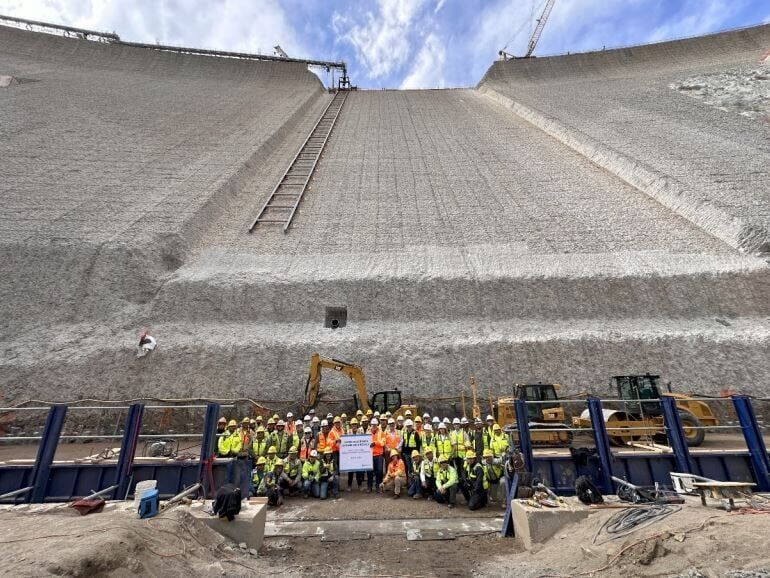
Members of the Denver-based federal appeals court considered on Friday whether they could intervene in ongoing infrastructure project to enlarge a Boulder County dam after a trial judge deemed the underlying permit unlawful nearly two years ago.
Denver Water has completed construction on the now-471-foot Gross Dam. However, an injunction still prevents the utility from filling the reservoir with additional water, after then-U.S. District Court Senior Judge Christine M. Arguello concluded the U.S. Army Corps of Engineers violated the law when it approved a permit for discharging material into wetlands during construction.
Specifically, she believed the Corps eliminated alternatives that avoided disturbing wetlands and improperly combined two distinct goals, thereby steering the project toward reservoir expansion. Arguello allowed construction of the dam to conclude for safety reasons, but she blamed Denver Water for forging ahead with the massive project in the face of a legal challenge.
“Although some courts have found that the public interest in continuing a project that has already begun is stronger than the public interest in complying with (the law),” she wrote, “this Court will not reward Denver Water for starting construction on the Project despite being aware of the seriousness of the environmental law challenges.”

However, during oral arguments on July 31, a three-judge panel of the U.S. Court of Appeals for the 10th Circuit wondered whether Arguello was wrong to fault Denver Water for acting on a seemingly valid federal permit after more than a decade of planning.
“The district court, it seemed, punished the other side for continuing their construction,” said Chief Judge Jerome A. Holmes.
“We don’t view this as some sort of punitive or vindictive matter,” said attorney William S. Eubanks II, representing the project’s challengers. “The fact is, there was nothing requiring them to move forward.”
“Why wouldn’t they? There was nothing stopping them,” interjected Judge Nancy L. Moritz. “Nobody’s asking for them to be stopped. They’re perfectly entitled to move forward. And yet, the court seemed to be punishing them for that. That seems to be the reason for this injunction.”
In the underlying case, six environmental groups challenged Denver Water’s plan to store more water for the 1.5 million people it serves, equating to 25% of the state’s population. The selected alternative was to raise Gross Dam by 131 feet.
Under the Clean Water Act, Denver Water needed a permit from the Corps to discharge fill material into wetlands during construction at the site near Boulder. The Corps issued its decision in 2017 and concluded the enlargement project was the “environmentally preferable alternative.”
In an October 2024 decision, Arguello concluded the Corps wrongfully eliminated alternatives that avoided disturbing wetlands. Further, the Corps improperly combined two distinct project goals. She found actions had violated the Clean Water Act and the National Environmental Policy Act.
After adjusting her injunction to account for dam safety, Arguello permitted Denver Water to finish the dam construction but not to enlarge the reservoir, which would require tree removal and water diversion.
Denver Water called her decision “irrational,” as the permitting process addressed the utility’s dual needs: injecting more water into its system to meet its estimated demand and correcting an imbalance in its north and south transmission systems.
It also argued to the 10th Circuit that the case was now moot given the completion of the dam.
“It’s not fair. Denver Water did everything it was supposed to do. It got every single permit it needed for this very important and substantial project,” said lawyer Amanda Shafer Berman. “Alternatives cannot realistically be considered at this point.”
Eubanks countered that the controversy was far from moot.
“There’s at least two, possibly three, years of tree cutting. Half a million trees that are left to be cut,” he said. “There’s additional work to be done before the water can come in and fill the reservoir. So, this project is not a done deal.”
“Did you ever ask that the dam not be filled as part of the relief sought in this case?” asked Judge Timothy M. Tymkovich.
Eubanks said his clients asked for “the broadest relief possible,” but he said it would have been unusual to request a specific outcome or to seek an injunction at the outset.
“You sued the Corps and there’s nothing that the Corps can do at this time,” said Tymkovich. “The three acres of fill have been commenced. There’s a 400-foot, 600-foot dam on top of it. The Corps’ job is done. There’s nothing on remand they can do. I just don’t see what’s left.”
Numerous outside entities weighed in to the 10th Circuit. Twenty-six former U.S. Environmental Protection Agency employees argued that Arguello was correct to recognize that Denver Water and the Corps improperly defined the project’s purpose to facilitate dam expansion.
“The Colorado River is facing a crisis. Annual flows have been diminishing, and the water in the river is already over-appropriated,” added 10 professors of natural resources law. “The steady decline of the river’s health has been well known for the past couple decades; yet the Corps approved a plan to divert even more water from this troubled river.”
Multiple municipalities and water authorities in Colorado argued that they depended on the project to meet their own needs and warned that Arguello’s treatment of Denver Water would throw future public works projects into chaos.
“The district court’s decision suggests that a project proponent should halt work immediately upon the filing of any legal challenge (meritorious or not), regardless of whether the challenger has sought injunctive relief,” wrote attorneys for Aurora, the South Metro Water Supply Authority, and Pueblo Water. “It would require a project proponent to second-guess the decision-making of the federal permitting agency entitled to deference lest the project proponent proceed with construction under a ‘questionably valid permit.’”
The 10th Circuit panel appeared sympathetic to those concerns, and Moritz wondered what it would look like for the Corps to redo its analysis now.
“How would they possibly evaluate reasonable alternatives at this point?” she asked. “There’s only one.”
The case is Save the Colorado et al. v. Graham et al.


10th Circuit upholds federal prohibition on juvenile handgun possession
Michael Karlik
michael.karlik@coloradopolitics.com
Updated 3 hours ago
The Denver-based federal appeals court concluded on Monday that Congress acted within its constitutional powers to make it a crime for juveniles to possess handguns in most instances. The decision from the U.S. Court of Appeals for the 10th Circuit...

Senate advances judicial nominee, Montezuma County judge agrees to discipline | COURT CRAWL
Michael Karlik
michael.karlik@coloradopolitics.com
Updated 7 hours ago
Welcome to Court Crawl, Colorado Politics’ roundup of news from the third branch of government. A U.S. Senate committee advanced a judicial nominee from Colorado, plus a Montezuma County judge agreed to receive discipline for his misconduct that stops short...
Judge denies Calderon injunction case against Denver, Johnston
Deborah Grigsby
deborah.smith@denvergazette.com
Updated 10 hours ago
A U.S. District Court judge has denied a preliminary injunction in the case of Jessica Calderon, the Denver city employee who won a temporary restraining order preventing the City and County of Denver from terminating her amid the 2025 citywide...

10th Circuit partially revives lawsuit over 2020 Denver protest injuries
Michael Karlik
michael.karlik@coloradopolitics.com
Updated 1 day ago
The Colorado-based federal appeals court revived a man’s claims against Denver on Friday after concluding a trial judge resolved the case in the city’s favor without analyzing two of the three instances of alleged excessive force and other constitutional violations....
Federal judges find Colorado immigration judge violated several orders
Michael Karlik
michael.karlik@coloradopolitics.com
Updated 2 days ago
Multiple federal judges in Colorado have freed people from immigration custody after determining that one immigration judge violated their directives for properly conducting bond hearings. For nearly a year, Colorado’s U.S. District Court has faced a flood of habeas corpus petitions...
Misconduct complaints from ex-Colorado judicial discipline director dismissed against federal judges
Michael Karlik
michael.karlik@coloradopolitics.com
Updated 4 days ago
The administrative body for the Denver-based federal appeals court upheld a finding last week that misconduct complaints against Colorado’s chief federal trial judge and the chief appeals judge warranted dismissal and appeared to be a “litigation tactic” by the complaining...

First-ever Red Rocks naturalization ceremony draws most diverse group of new citizens
Michael Karlik
michael.karlik@coloradopolitics.com
Updated 2 days ago
Colorado’s federal trial court held its first-ever naturalization ceremony for nearly 300 new citizens on Thursday at Red Rocks Park and Amphitheatre. “We’re doing it to commemorate the 250th anniversary of the Declaration of Independence and the United States. Red...
Jeffco taxpayers could be on the hook for a possible child sex assault settlement
Matt Kyle
matt.kyle@denvergazette.com
Updated 3 days ago
Taxpayers may end up on the hook for a child sexual assault settlement, possibly worth up to $15 million, after Jeffco Public Schools failed to notify its insurance company in a timely manner about the case. The incident stems from...
10th Circuit finds no fair housing violation by Littleton landlord for worker’s alleged rape of tenant
Michael Karlik
michael.karlik@coloradopolitics.com
Updated 7 hours ago
The Denver-based federal appeals court concluded on Monday that Littleton’s housing authority could not be held liable for a maintenance worker’s alleged rape of a tenant, as the worker’s employment did not provide any special access to the victim. A...

Jeffco Public Schools sues Trump administration to protect funding after alleged transgender policies violation
Matt Kyle
matt.kyle@denvergazette.com
Updated 4 days ago
In the wake of several threats by the Trump administration to revoke federal funding, Jeffco Public Schools filed a lawsuit against the Department of Education seeking to protect that badly needed money. Jeffco has been under investigation by the DOE’s...
PREV
PREVIOUS

Democratic group maps out path to Colorado House and Senate supermajorities
A national organization that works to elect Democrats to state legislatures has its sights on Colorado, unveiling a road map to establish a supermajority in both the House and Senate. Democrats have held a majority in the House since 2013 and the Senate since the 2019 session. There are currently 43 Democrats in the House […]

Group submits signatures for proposed Colorado graduated income tax
The measure, which eliminates Colorado’s flat tax, is expected to raise $2 billion in new revenue The proposal to amend the Colorado constitution to change the state’s flat rate into a graduated income tax came in under the wire Monday, the deadline for groups to turn in petition signatures for November’s ballot, setting up a […]