

Colorado business leaders, Gov. Jared Polis send warning as companies pack their bags

Is Colorado scaring away corporate expansions and entrepreneurs that had once made the state a magnet for high-tech business growth?
That’s the assertion of a letter signed by more than 200 business and technology leaders, addressed to Gov. Jared Polis, Denver Mayor Mike Johnston, Democratic senatorial candidates and other political leaders.
Notably, one of the signers is Polis himself.
Boulder entrepreneur Dan Caruso told The Denver Gazette that after he drove an effort to draft the missive, warning that political messaging is damaging the state’s business competitiveness, Polis had reached out.
The governor offered to join in signing the letter and presenting it.
“It wasn’t hard to get huge support,” Caruso said of the effort to find the 233 cosigners. “We need to give our politicians a wakeup call.”
But was it surprising that Polis, a Democrat, had joined in a message that was largely addressed to members of his own party?
“They are the people in power, right?” Caruso replied.
He noted that in addition to Polis, the two leading candidates for governor, along with both of Colorado’s U.S. senators and the mayor of the state’s biggest city, are also all Democrats. Polis’ term is set to end next January.
Caruso, who is listed as having been among the cofounders of Level 3 Communications, said that the letter had been addressed to members of both parties, and that it is bipartisan in tone.
Eric Maruyama, the governor’s press secretary, told The Denver Gazette that Polis’ outreach represented a commitment to improving the state’s future business climate.
“Many businesses are moving and expanding in Colorado, seeking our highly educated workforce and high quality of life,” Maruyama said on behalf of the governor. “This is an important part of attracting businesses to our state, but he knows there is more work to do.”
He said that Polis is proud of his record in working to attract business, as well as lowering housing costs, expanding lower-cost clean energy technology, and cutting income and property taxes.
Business leaders express surprise
Other business leaders privately expressed surprise that the governor would join in a messaging effort that appeared largely directed against his own party.
The letter, titled “Ensuring Colorado’s Innovation Future,” followed an April 6 report by the Colorado Chamber Foundation that showed Colorado had suffered a net loss of 34 public company headquarters since 2022.
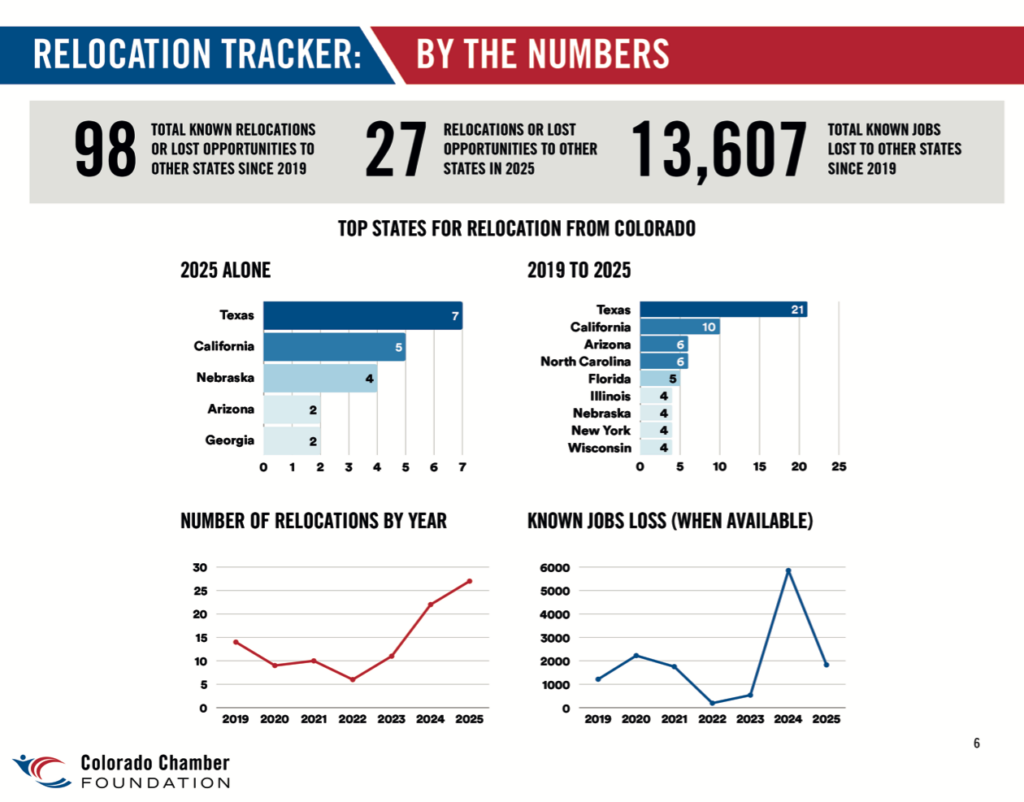
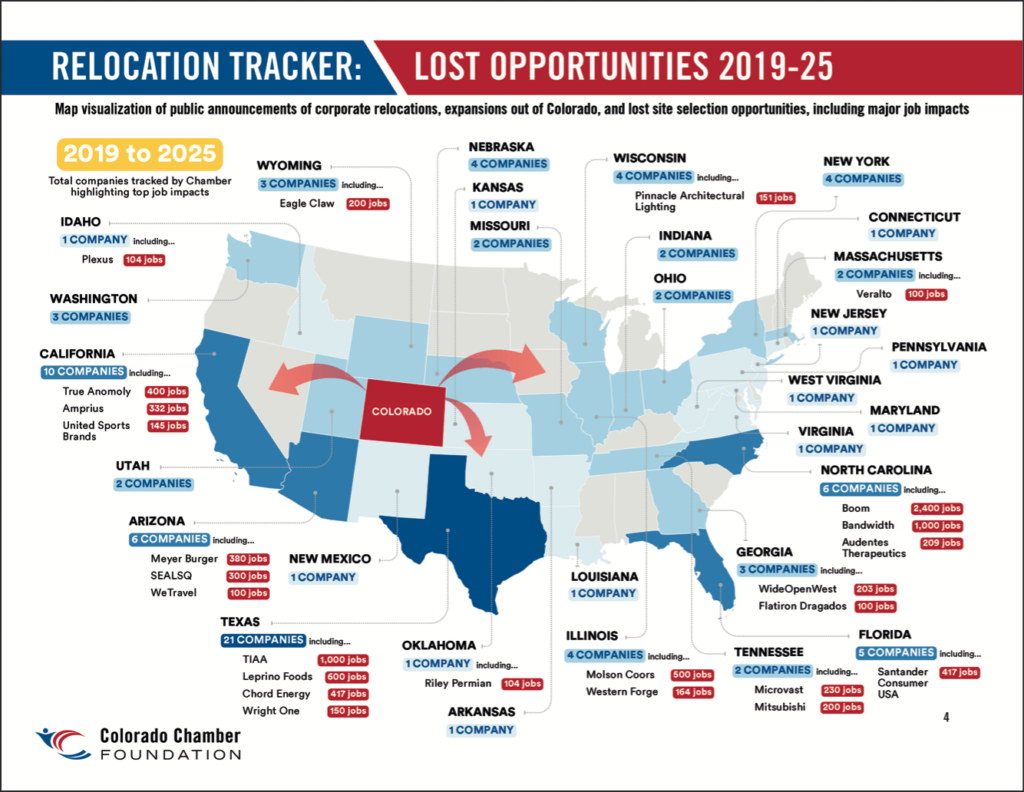
That report cited 98 companies that had opted for other destinations since 2019, either choosing to move away or picking someplace else after weighing Colorado.
According to that report, such decisions had cost at least 13,600 jobs, resulting from moves where a jobs impact could be measured.
The new letter from business leaders specifically pointed to the state’s recent loss of Palantir Technologies, the defense-related software firm estimated to be valued at more than $300 billion. The company announced it was pulling out of Colorado in February, headed for Florida.
That move had been widely attributed to passage of an “algorithmic discrimination” law by the Colorado legislature in 2024, which seeks to hold employers liable for discrimination resulting from use of AI tools.
Caruso told The Denver Gazette that the bill stood out as “the most glaring” example of recent policy decisions that sent the wrong message to companies and investors considering where to expand.
Noting that he has extensive contacts among policymakers, Caruso said that he had tried to get the bill changed.
“They chose not to repeal it and start over, which is what I advocated,” he said.
He added that he hopes that the letter’s release would serve as an opportunity to repeal the bill.
“It’s silly to single ourselves out,” Caruso said.
He speculated that if similar effort had been made in Colorado to curb the expansion of the internet, the state would never have spawned the tech growth that followed.
‘Lack of predictability’
Polis, who had signed the AI legislation into law with reservations, told a television interviewer Friday that the issue is not about one bill.
“The lack of predictability is absolutely a problem, not knowing what comes next,” Polis said as he sat with Caruso during a presentation of the letter.
“It speaks to more than just the legislature,” the governor said. “It goes to the fact that people can put things on the ballot and that sometimes they can pass.”
Colorado Chamber President and CEO Loren Furman, who had added her own signature to the new letter, told The Denver Gazette that she hopes the governor would be working together with the chamber on issues that the organization has long flagged as harmful to continued growth.
“We’ve aligned with Gov. Polis on many of our regulatory reform, housing and affordability priorities in the past, and we believe there are still opportunities to partner during the remainder of his term to continue this work,” Furman said.
The Chamber Foundation’s report last week had warned about a similar list of issues that could be damaging the state’s competitiveness, including the tax and regulatory climate, and the approval process for construction.
Furman said that she welcomes the support of business voices that aligned with the chamber’s own warnings on the issues.
In addition to Polis, the bipartisan letter was addressed to U.S. Sens. Michael Bennet and John Hickenlooper, Attorney General Phil Weiser, Johnston, and other Colorado political leaders. The letter noted that both Bennet and Weiser are running for governor.
Colorado ‘structural disadvantages’
The letter said that Colorado stood at an inflection point for its technology economy and business climate, adding that signers “are deeply concerned that the direction we are heading threatens the long-term prosperity of the people who call Colorado home.”
The letter noted that Colorado had experienced a two-decade run in creating an “innovation ecosystem” that spanned aerospace and defense, digital infrastructure, cybersecurity,” and a host of other tech-oriented fields.
“This ecosystem was built by entrepreneurs, risk-takers, research institutions, capital providers, and forward-looking public leadership,” it continued.
“Despite the extraordinary progress of the past two decades — and despite these enduring structural advantages — the foundation of Colorado’s technology and business leadership is deteriorating,” the letter said, adding, “When business leaders evaluate where to launch their next startup, relocate headquarters, expand manufacturing, or deploy significant capital, Colorado is categorized as carrying structural disadvantages that introduce unnecessary risk.”
If changes aren’t made in the perceptions being created, Caruso told The Denver Gazette, “turning the ship around will be very difficult.”
‘Looking like Chicago‘
What is the worst that could follow if warnings are ignored and the state’s direction stays its present course?
“Boulder starts looking like Chicago,” Caruso said, adding similar parallels about business perceptions of New York, Boston and California. The latter, Caruso suggested, evinces a “you’re welcome to move elsewhere” takeaway.
In addition to having cofounded Level 3, Caruso is listed as CEO and chairman of Zayo Group, a communications infrastructure firm providing fiber and network connectivity. Among other involvements, he noted that his companies are involved with the Boulder Roots Music Fest.
Among the 233 signers of the online letter, the site breaks out 11, in addition to himself, that Caruso listed as “billion dollar company builders.”
Those included Anatoly Yakovenko and Greg Fitzgerald (Solana), Sureel Choksi (Vantage Data Centers), Kevin Ness (Inscripta), Cully Cavness (Crusoe Energy), John Street (Pax8), Steve Lucas (Boomi), Greg Keller (JumpCloud), Kent Thiry (former chairman and CEO of DaVita), Kevin O’Hara (Congruex, Level 3) and Jay Monroe (The Thermo Companies).
Caruso, meeting with his team during a retreat in Cabo, said that his newly coalesced effort is now in the process of assessing the state’s messaging problem and that a draft is underway, currently at 50 pages. Prospective solutions to the problem, he said, would follow the assessment.
Polis, in introducing the letter, suggested he would be part of that process.
“This is about a vision, diagnostics, and solutions that speak to the entire issue of making Colorado the most competitive state and the best state,” Polis said during the joint interview.
“I’ve started businesses here and maybe I will in the future,” the governor added.


Federal biotech commission examines Colorado’s role in critical minerals production
Scott Weiser
scott.weiser@gazette.com
Updated 2 days ago
China’s dominance over critical mineral supplies has left U.S. manufacturers vulnerable. Colorado’s biotech and research community is working to ease that dependence. Leaders from the National Security Commission on Emerging Biotechnology met last week at the Colorado School of Mines...

Douglas County schools to consolidate administrative offices into $29M headquarters to cut costs
Nicholas Fogleman
nicholas.fogleman@denvergazette.com
Updated 2 days ago
The Douglas County School Board is moving forward with a $29 million plan to consolidate district administrative operations into a new headquarters. It’s part of an effort to reduce annual costs as the district faces ongoing budget pressures. In June,...

Veo scooter clutter, sidewalk riders frustrate Denverites
Deborah Grigsby
deborah.smith@denvergazette.com
Updated 2 days ago
Denver resident Mike Miller was on a downtown sidewalk recently when a Veo scooter rider traveling at full speed passed him as the scooter blasted a “do not ride on sidewalks” warning. In a letter to Veo Policy and Partnerships...

Colorado’s 72-hour social media warrant law takes effect Aug. 12
Marissa Ventrelli
marissa.ventrelli@coloradopolitics.com
Updated 3 days ago
A law requiring social media platforms to respond to search warrants within 72 hours goes into effect on Aug. 12. Senate Bill 011 also requires platforms to create a staffed hotline for Colorado law enforcement agencies to contact regarding pending...

El Paso County rejects multi-family zoning request near Monument Academy
Savannah Eller
savannah-eller@coloradopolitics.com
Updated 4 days ago
The El Paso County Board of Commissioners narrowly rejected a developer’s bid to convert land from low- to high-density residential zoning. The request, made by MA Infrastructure, LLC, would have allowed 12 units per acre on half of a 14-acre...

Denver City Council sends Xcel franchise deal to voters
Deborah Grigsby
deborah.smith@denvergazette.com
Updated 5 days ago
This November, Denver voters will decide whether to renew the city’s longstanding franchise agreement with Xcel Energy. Members of the Denver City Council approved on Monday sending a proposed 20-year franchise agreement with Xcel that would deliver more than $180...

Chamber names its Top 25 Most Powerful Women in Business | NONPROFIT REGISTER
Joanne Davidson Special to Colorado Politics
joanne-davidson-special-to-colorado-politics@coloradopolitics.com
Updated 1 day ago
COLORADO WOMEN’S CHAMBER OF COMMERCE Denver News: Marielena DeSanctis, chancellor of the Colorado Community College System; Terri Jackson, executive director and co-founder of the African American Trade Association and Emily Trujillo, chief operating officer at HCA HealthONE Centennial, are among the 2026 Top 25 Most Powerful Women...

Colorado produce not tied to nationwide cyclospora outbreak, agriculture officials say
Marissa Ventrelli
marissa.ventrelli@coloradopolitics.com
Updated 1 week ago
There is no indication that the recent outbreak of cyclospora, a fecal parasite that has contaminated food and water across nearly every state, can be linked to produce grown in Colorado, according to the state’s Department of Agriculture. “Colorado growers...

Planning Commission rejects resident appeals to stop proposed data center
alex-edwards
alex.edwards@gazette.com
Updated 6 days ago
Editor’s note: This story has been updated to reflect comment from District 11 clarifying that it has not conducted a financial review of Project Taurus. The Colorado Springs Planning Commission rejected appeals Thursday night against a proposed artificial-intelligence data center...

Inspiration for film ‘Safety’ is tourney’s special guest | NONPROFIT REGISTER
Joanne Davidson Special to Colorado Politics
joanne-davidson-special-to-colorado-politics@coloradopolitics.com
Updated 1 week ago
VOLUNTEERS OF AMERICA COLORADO Denver News: Ray McElrathbey, a former Clemson University football player whose story of fighting to keep his brother out of foster care inspired the Disney+ movie “Safety,” will be the special guest when Volunteers of America Colorado hosts...
PREV
PREVIOUS

Colorado justices weigh constitutionality of unique disclosure requirement for ballot measures
Members of the Colorado Supreme Court considered on Tuesday whether a unique feature of the state’s campaign finance system categorically violates the First Amendment by requiring the disclosure of a ballot measure committee’s legal representative on advertisements. No on EE — A Bad Deal for Colorado was an issue committee in 2020 that opposed Proposition EE, […]

Congress presses Colorado court about rule tied to immigration enforcement
The U.S. House Judiciary Committee is seeking information from Colorado’s court administrator regarding a new requirement that attorneys certify they will not use court data for immigration enforcement, arguing it unlawfully obstructs federal law and compels political speech tied to the state’s “sanctuary” policies. Colorado, a blue state that has passed “sanctuary” laws, has been […]