

Second appeals judge voices concerns about new ‘reasonable doubt’ instruction
Another member of Colorado’s second-highest court registered his concern on Thursday that a portion of the recently revised “reasonable doubt” definition improperly lowers the prosecution’s burden to prove a defendant guilty.
Judge Daniel M. Taubman wrote that the current instruction advising jurors to acquit whenever there is “a real possibility the defendant is not guilty” is ambiguous and problematic. He is now the second appellate judge to reject that language, even as others have found it to be an accurate statement of the law.
Before 2023, Colorado’s template jury instructions for criminal cases contained a longstanding explanation of reasonable doubt: A doubt based upon reason and common sense, which was not vague or speculative, that would “cause reasonable people to hesitate to act in matters of importance to themselves.”
Then, in January 2023, the judicial branch announced a small group of judges had voted to change the language of the model instruction. The revision advised jurors to vote to convict if they were “firmly convinced of the defendant’s guilt.”
“But if you think there is a real possibility that the defendant is not guilty,” the instruction continued, “then the prosecution has failed to prove the crime charged beyond a reasonable doubt.”
The 2023 update resembled the reasonable doubt instruction used in Colorado’s federal trial court, and the language was endorsed by U.S. Supreme Court Justice Ruth Bader Ginsburg in 1994 as a “clear, straightforward, and accurate” definition of reasonable doubt for jurors. Last year, the state’s Court of Appeals issued a pair of precedent-setting decisions upholding the new wording as constitutional.
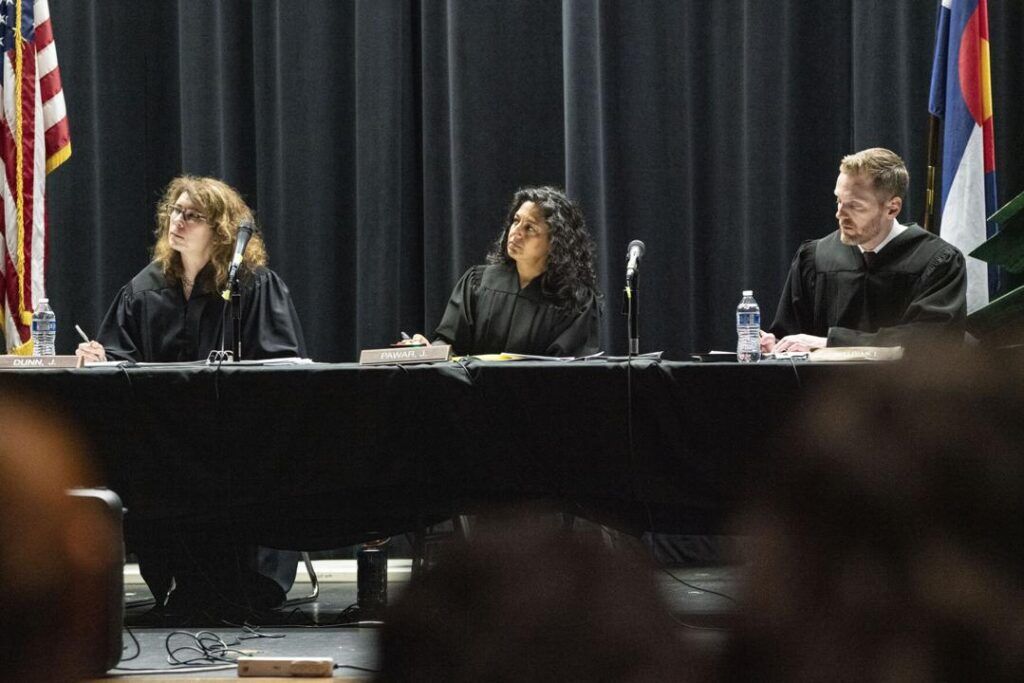
Then, in December, Judge Michael H. Berger became the first appellate judge to argue that the “real possibility” language unconstitutionally lowered the prosecution’s burden of proof. Among other things, he worried that the phrasing appeared to assume the defendant’s guilt.
“It suggests that the defendant is guilty unless there is a real possibility that he is not guilty. However, a defendant has no obligation to prove that he is not guilty or even that there is a real possibility that he is not guilty,” Berger wrote.
On Feb. 12, a different appellate panel addressed Michael Lyne Green’s challenge to his convictions, partly based on the revised reasonable doubt instruction. The majority acknowledged Berger’s “legitimate concerns” about the language, but declined to find it so problematic as to warrant a new trial.
“And we echo Judge Berger’s observation that, should they share his concerns about the revised model instruction, trial courts retain discretion to use the well-tested (prior) model instruction,” wrote Judge Elizabeth L. Harris for herself and Judge Karl L. Schock.
Case: People v. Green
Decided: February 12, 2026
Jurisdiction: Douglas County
Ruling: 2-1
Judges: Elizabeth L. Harris (author)
Karl L. Schock
Daniel M. Taubman (dissent)
Taubman, writing in dissent, would have ordered a new trial for Green.
“I believe that the (2023) model instruction was motivated by the Supreme Court’s rejection of a hypothetical used by a trial judge,” wrote Taubman, referring to a 2022 state Supreme Court decision to reverse a defendant’s convictions over a trial judge’s botched attempt to explain reasonable doubt under the old definition.
Taubman, who, like Berger, is a retired judge who hears cases part-time, argued that removing the “real possibility” language from the revised instruction “would simplify and clarify for jurors the meaning of ‘proof beyond a reasonable doubt.'”
The Colorado Supreme Court announced in September that it would review the constitutionality of the revised definition in another case.
Otherwise, the appellate panel agreed that one of Green’s Douglas County convictions could not stand for reasons unrelated to the reasonable doubt instruction. Then-District Court Judge Patricia Herron, without explanation, allowed jurors to hear evidence of Green’s alleged shoplifting, even though prosecutors had not charged him with shoplifting.
The testimony “suggested Green had bad character and a propensity to steal,” which cannot be the basis for admitting evidence of other misconduct, wrote Harris.
The decision is the third in three months to find that Herron made a substantial error in a criminal case. She retired from the bench at the end of 2023, but the chief justice subsequently hired her as a part-time senior judge despite the Court of Appeals having reversed numerous convictions and sentences due to her errors. A different appellate panel overturned a defendant’s convictions in January because Herron allowed a biased juror to serve, and reversed another defendant’s sentence in December because of Herron’s actions.
The case is People v. Green.


10th Circuit partially revives lawsuit over 2020 Denver protest injuries
Michael Karlik
michael.karlik@coloradopolitics.com
Updated 12 hours ago
The Colorado-based federal appeals court revived a man’s claims against Denver on Friday after concluding a trial judge resolved the case in the city’s favor without analyzing two of the three instances of alleged excessive force and other constitutional violations....

Federal judges find Colorado immigration judge violated several orders
Michael Karlik
michael.karlik@coloradopolitics.com
Updated 1 day ago
Multiple federal judges in Colorado have freed people from immigration custody after determining that one immigration judge violated their directives for properly conducting bond hearings. For nearly a year, Colorado’s U.S. District Court has faced a flood of habeas corpus petitions...

Misconduct complaints from ex-Colorado judicial discipline director dismissed against federal judges
Michael Karlik
michael.karlik@coloradopolitics.com
Updated 3 days ago
The administrative body for the Denver-based federal appeals court upheld a finding last week that misconduct complaints against Colorado’s chief federal trial judge and the chief appeals judge warranted dismissal and appeared to be a “litigation tactic” by the complaining...

First-ever Red Rocks naturalization ceremony draws most diverse group of new citizens
Michael Karlik
michael.karlik@coloradopolitics.com
Updated 1 day ago
Colorado’s federal trial court held its first-ever naturalization ceremony for nearly 300 new citizens on Thursday at Red Rocks Park and Amphitheatre. “We’re doing it to commemorate the 250th anniversary of the Declaration of Independence and the United States. Red...
Jeffco taxpayers could be on the hook for a possible child sex assault settlement
Matt Kyle
matt.kyle@denvergazette.com
Updated 3 days ago
Taxpayers may end up on the hook for a child sexual assault settlement, possibly worth up to $15 million, after Jeffco Public Schools failed to notify its insurance company in a timely manner about the case. The incident stems from...
10th Circuit finds no fair housing violation by Littleton landlord for worker’s alleged rape of tenant
Michael Karlik
michael.karlik@coloradopolitics.com
Updated 1 day ago
The Denver-based federal appeals court concluded on Monday that Littleton’s housing authority could not be held liable for a maintenance worker’s alleged rape of a tenant, as the worker’s employment did not provide any special access to the victim. A...

Jeffco Public Schools sues Trump administration to protect funding after alleged transgender policies violation
Matt Kyle
matt.kyle@denvergazette.com
Updated 4 days ago
In the wake of several threats by the Trump administration to revoke federal funding, Jeffco Public Schools filed a lawsuit against the Department of Education seeking to protect that badly needed money. Jeffco has been under investigation by the DOE’s...
Denver detox center did not violate man’s rights with 10-hour hold, 10th Circuit says
Michael Karlik
michael.karlik@coloradopolitics.com
Updated 5 days ago
The Colorado-based federal appeals court concluded on Tuesday that Denver’s detoxification facility did not violate a man’s rights by holding him against his will for 10 hours until his blood alcohol content was projected to reach zero. Unusually, Brian Garrett’s...

Federal judge clarifies ex-GOP treasurer candidate’s burden to prove defamation claims
Michael Karlik
michael.karlik@coloradopolitics.com
Updated 5 days ago
A federal judge clarified last week that businessman and former Republican statewide candidate Brian Watson will need to surmount a higher hurdle in proving his claim that a party guest’s alleged description of him as a “criminal” amounted to defamation....
Colorado board permits state to appeal injunction against arthritis drug price cap
Marissa Ventrelli
marissa.ventrelli@coloradopolitics.com
Updated 6 days ago
A Colorado board voted Friday to allow the Attorney General’s Office to fight an injunction against a price cap on a drug that treats arthritis. A U.S. district court judge had granted the company Amgen a preliminary injunction, temporarily blocking...
PREV
PREVIOUS

Colorado lawmakers target 'ghost networks' to expand access to mental health care
A few years ago, the U.S. Senate Committee on Finance conducted a “secret shopper” survey on health insurance plans across six states, including Colorado. Of the 120 providers called, one-third were either inaccurately listed in the carrier database, out of service, or did not return the call. Only half of all calls to providers in […]

Colorado justices skeptical that intimate messages relevant to assault case
Members of the Colorado Supreme Court seemed to agree on Tuesday that a Douglas County judge acted reasonably by blocking evidence of a defendant’s BDSM-related conversations with the victim in his trial for assault and false imprisonment. Jurors found Donald Louis Gerle guilty in 2022. In the prosecution’s telling, Gerle began beating his alleged victim following […]