

Error-prone judge returns to bench after chief justice authorizes part-time service
A retired Douglas County judge is now back on the bench, despite the state’s appellate court overturning convictions and sentences in numerous criminal cases she handled due to her errors.
District Court Judge Patricia Herron stepped down from active service in December 2023. But in October, Chief Justice Monica M. Márquez signed a contract permitting Herron to continue handling cases as a part-time senior judge.
The contract allowed Herron to resume work even after the Court of Appeals found she:
• Allowed prosecutors to give a false impression to jurors about the DNA evidence in a sex assault case
• Permitted multiple defendants to represent themselves without ensuring they had validly given up their right to counsel
• Blocked a defendant from telling the jury his alibi
• Allowed a defendant’s lawyer to withdraw without informing the defendant of her rights
• Subjected a defendant to lifetime sex offender registration without explaining why
• Allowed a biased juror to serve in a drunk driving trial
• Declined to correct a prosecutor who misstated the law to jurors
• Barred crucial testimony from a vehicular homicide case, which enabled prosecutors to misrepresent the facts to the jury
In two instances, Herron also ordered criminal defendants to pay financial restitution to their victims far beyond the 91-day deadline in state law. She issued her decisions even after the Supreme Court warned trial judges in 2021 that they lose authority to order restitution if they do not comply with the law.

District Court Judge Patricia Herron

District Court Judge Patricia Herron
In one of those cases, a Court of Appeals judge was troubled that Herron “recharacterized history” by asserting she issued a restitution order within the legal deadline, when the appellate court found no evidence that she did.
Through the judicial branch, Colorado Politics asked Márquez why she believed Herron was fit to continue service as a judge. The chief justice declined to comment.
Under the state constitution, the chief justice may temporarily assign judges and retired judges to perform specific duties. The senior judge program allows retired judges to handle cases in which an active judge has a conflict, is occupied with a lengthy trial, has an emergency or vacation, is at training, or in which there is a vacancy on the court. The judicial branch pays for travel, lodging and associated costs for a senior judge providing coverage.
A judge may apply to join the program within five years of their retirement, but there is no guarantee they will be accepted. For judges who do end up serving, they receive an increase in their retirement benefits.
Although active judges are evaluated by citizen-led performance commissions and retained by voters, senior judge contracts are renewed after court personnel, other judges, and attorneys who appeared before the senior judge provide their input on the judge’s performance. Attorney regulators and judicial discipline authorities also alert the judicial branch about any complaints filed against senior judges.
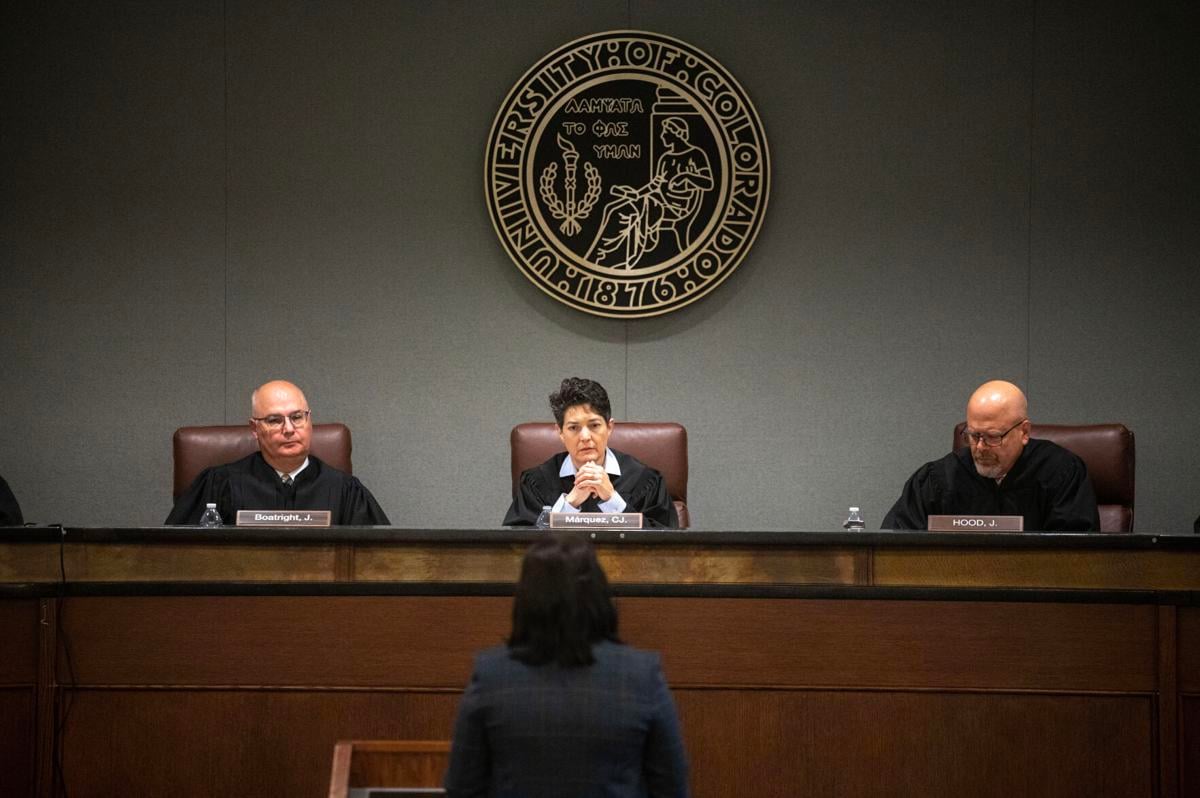
(From left) Colorado Supreme Court Justice Brian D. Boatright, Chief Justice Monica M. M á rquez and Justice William W. Hood III listen to arguments from Assistant Attorney General Caitlin E. Grant during the People v. Rodriguez-Morelos case as part of Courts in the Community at the Wolf Law building at University of Colorado Boulder on Thursday, Oct. 24, 2024. The semi-annual event entails the Colorado Supreme Court hearing arguments before an audience of students throughout the state. (Stephen Swofford, Denver Gazette)
Stephen Swofford Denver Gazette

(From left) Colorado Supreme Court Justice Brian D. Boatright, Chief Justice Monica M. Márquez and Justice William W. Hood III listen to arguments from Assistant Attorney General Caitlin E. Grant during the People v. Rodriguez-Morelos case as part of Courts in the Community at the Wolf Law building at University of Colorado Boulder on Thursday, Oct. 24, 2024. The semi-annual event entails the Colorado Supreme Court hearing arguments before an audience of students throughout the state. (Stephen Swofford, Denver Gazette)
As of Jan. 1, the senior judge program had 46 participants, including six retired Court of Appeals judges, one retired Supreme Court justice, and the remainder being retired county court or district court judges.
Herron’s contract, signed by the chief justice on Oct. 15, lasts until Sept. 30, 2025. Herron agreed to perform 60 days of work in a one-year period.
The Colorado Attorney General’s Office, which argues for convictions and sentences to be upheld on appeal, had no comment about Herron’s continued service. The public defender’s office did not respond to an email seeking comment.

10th Circuit overturns framework for sentencing probation violators by 11-1
Michael Karlik
michael.karlik@coloradopolitics.com
Updated 2 days ago
In a rare decision by all 12 of its full-time judges, the Denver-based federal appeals court ruled in a lopsided vote on Friday that one of its members created a sentencing process for probation violators that was out of step...

Federal judge dismisses excessive force lawsuit against Colorado Springs, officer
Michael Karlik
michael.karlik@coloradopolitics.com
Updated 2 days ago
A federal judge concluded last week that a Colorado Springs police officer could not be held liable for shooting a suspect three times after the man menaced two victims with a gun and fled the scene. Al’morion Germany was involved...

Weld County man sentenced to 236 years for sexually assaulting 9-year-old girl
Kyla Pearce
kyla.pearce@gazette.com
Updated 3 days ago
A Weld County man was sentenced to 236 years in prison for repeatedly sexually assaulting a 9-year-old girl. Joshua Andrews, 41, was charged in June with 12 counts of sexual assault on a child by a person in a position...
Wrongfully deported man to be returned to U.S., Colorado federal judge orders
Michael Karlik
michael.karlik@coloradopolitics.com
Updated 4 days ago
Colorado’s chief federal judge took the extraordinary step of directing the government on Tuesday to do everything it can to return a man it deported in violation of his order. At the same time, Colorado’s chief magistrate judge has set...
Denver murder, assault convictions reversed due to faulty jury instructions
Michael Karlik
michael.karlik@coloradopolitics.com
Updated 3 days ago
Colorado’s second-highest court reversed a defendant’s convictions for murder and assault last week after concluding a Denver judge incorrectly omitted key jury instructions that could have affected the verdict and sentencing. Stephen C. Swainson fatally stabbed Israel Casillas in downtown...
‘Understand people for who they are’: 2 federal judges talk about compassion in courtroom
Michael Karlik
michael.karlik@coloradopolitics.com
Updated 2 days ago
Before taking the bench in 2022, U.S. District Court Judge Charlotte N. Sweeney was an employment discrimination attorney. While the cases could be emotionally charged, they were different from the criminal proceedings she is now handling. “It wasn’t necessarily affecting...
Denver murder conviction reversed for incomplete self-defense instruction
Michael Karlik
michael.karlik@coloradopolitics.com
Updated 13 hours ago
Colorado’s second-highest court reversed a defendant’s murder conviction last week because a Denver judge gave an incomplete instruction to the jury about the man’s right to self-defense. Donald R. Gonzales and Gary McLaughlin met up in a Capitol Hill parking...
Colorado lawmaker, House leaders named in workplace-retaliation lawsuit
Marianne Goodland
marianne.goodland@coloradopolitics.com
Updated 6 days ago
A former legislative aide has filed a lawsuit alleging she was mistreated, illegally directed to perform campaign work and harmed by a House leadership structure she charged was fragmented, politicized and ineffective at protecting employees. The lawsuit, filed by Jennifer...
Federal judge hears arguments about Colorado’s 3-day gun purchase waiting period
Michael Karlik
michael.karlik@coloradopolitics.com
Updated 6 days ago
A federal judge heard arguments on Monday about the constitutionality of a 2023 Colorado law that generally imposes a three-day waiting period on firearm purchases after the initiation of a background check. The test that the U.S. Supreme Court created...
Colorado Supreme Court intervenes in Weld County prosecution dismissed due to Missy Woods misconduct
Michael Karlik
michael.karlik@coloradopolitics.com
Updated 6 days ago
The Colorado Supreme Court ordered a Weld County trial judge last week to respond to the district attorney’s claim that he improperly dismissed a criminal case because of “outrageous” conduct by the Colorado Bureau of Investigation. Daniel Lee Eatinger stood...