

Ex-Lochbuie officer’s rights not violated with disclosure of misconduct finding, appeals court rules
Colorado’s second-highest court concluded last month that a former law enforcement officer cannot sue his employer under one police accountability law for reporting its misconduct finding to another agency, as required under a different police accountability law.
Officer Michael Oliveira sued leaders of the Lochbuie Police Department under Senate Bill 217, also known as the Enhance Law Enforcement Integrity Act (ELEIA). Enacted in 2020, the law permits lawsuits against police officers for violations of rights under the state constitution. Oliveira alleged Lochbuie police leadership reported a faulty finding of misconduct to the Peace Officer Standards and Training (POST) Board, violating his right to due process.
But a three-judge Court of Appeals panel declined to recognize Oliveira’s claim that one government agency transmitting false statements to another agency and affecting a person’s reputation amounts to a constitutional violation. In a May 15 opinion, Judge Timothy J. Schutz noted Colorado mandates that law enforcement agencies report an officer’s dishonesty to POST.
“POST and ELEIA serve a common purpose: to facilitate the employment of quality law enforcement officers across Colorado who are truthful and respect the constitutional rights of the public,” he wrote. Allowing legal claims under one law for the reports made mandatory by another law “would incentivize law enforcement agencies and their employees not to robustly comply with POST reporting requirements. This was not the General Assembly’s intent when enacting ELEIA.”
Following an investigation by multiple Lochbuie police employees, the town’s chief terminated Oliveira. He had misused his work phone for personal communications with a woman, and the investigation found he dishonestly portrayed the nature and extent of the interaction. The police department also reported the details to POST, whose database lists Oliveira as “terminated for cause” and as having a policy violation involving dishonesty.
Oliveira sued, alleging the department’s finding was incorrect and based on faulty information. If he had received a hearing, Oliveira contended, he never would have been terminated.
Pursuant to the 2020 ELEIA law, he claimed the defendants violated his right to due process by reporting the misconduct to POST, causing “embarrassment.” He also alleged the report amounted to defamation.
In May 2024, Weld County District Court Judge Todd Taylor dismissed the lawsuit. Taylor determined the lack of a hearing did not violate Oliveira’s rights, and the report to POST did not amount to a violation because “intra-governmental dissemination of information related to a public employee’s discharge” cannot sustain a claim of reputational damage.
Taylor added that because Oliveira failed to allege Lochbuie acted “willfully and wantonly,” the defendants were entitled to immunity on his defamation claim.
Oliveira then turned to the Court of Appeals.
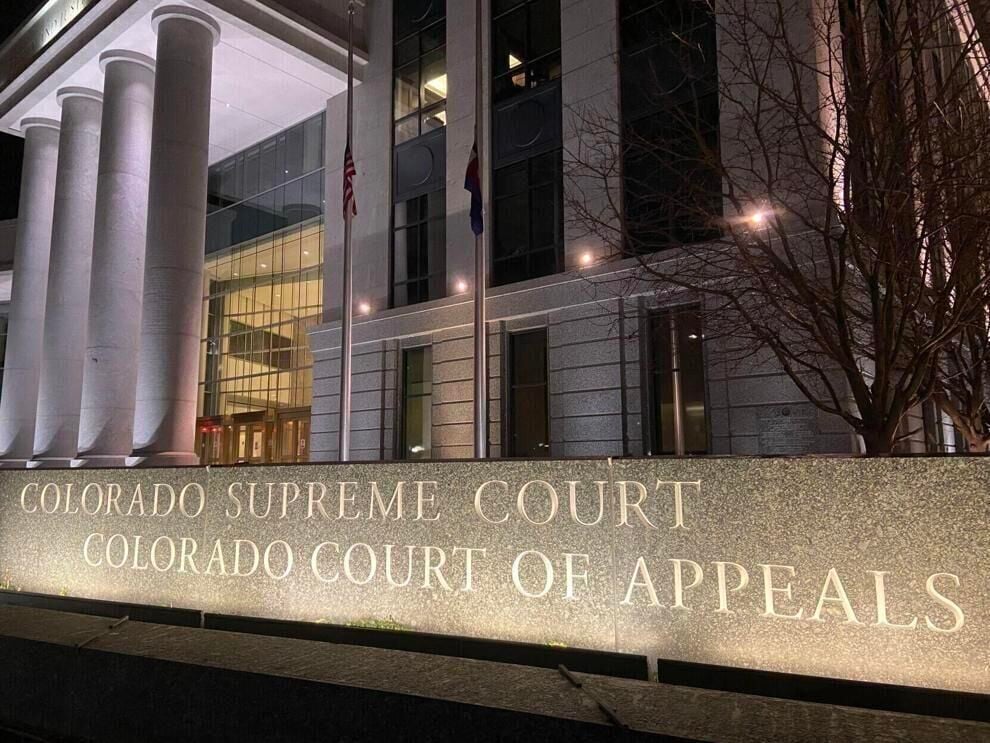
FILE PHOTO: The Ralph L. Carr Colorado Judicial Center in downtown Denver houses the Colorado Supreme Court and Court of Appeals.
Michael Karlik / Colorado Politics

“Plaintiff has a liberty interest in protecting his reputation for purposes of obtaining employment,” wrote attorney Robert M. Liechty about Oliveira’s due process claim. “Defendants should not be able to avoid liability from this claim simply because their defamatory statement was made to a governmental agency.”
In the appellate panel’s opinion, Schutz noted no court has found Colorado’s constitution recognizes a due process claim where government employers spread false information about an employee’s termination and negatively affect their reputation. However, federal courts have permitted such claims, so long as the communication is not “intra-governmental” from one agency to another.
Schutz wrote that even if the Colorado Constitution recognized a parallel circumstance, the misconduct report from a local police department to POST fell within the intra-governmental exception.
Public employers “are often tasked with making reports for the public’s benefit that may impact a former employee’s future employability. The recognition and importance of these reporting obligations provides the foundation of the intra-governmental exception,” he elaborated.
As for whether the Lochbuie defendants acted in a “willful and wanton” manner by reporting Oliveira to POST and defaming him, Schutz concluded the evidence of Oliveira’s actions supported the department’s response to the cell phone investigation.
The case is Oliveira v. Ohlinger et al.
Colorado Politics Must-Reads:

10th Circuit finds no fair housing violation by Littleton landlord for worker’s alleged rape of tenant
Michael Karlik
michael.karlik@coloradopolitics.com
Updated 6 hours ago
The Denver-based federal appeals court concluded on Monday that Littleton’s housing authority could not be held liable for a maintenance worker’s alleged rape of a tenant, as the worker’s employment did not provide any special access to the victim. A...
Denver detox center did not violate man’s rights with 10-hour hold, 10th Circuit says
Michael Karlik
michael.karlik@coloradopolitics.com
Updated 1 day ago
The Colorado-based federal appeals court concluded on Tuesday that Denver’s detoxification facility did not violate a man’s rights by holding him against his will for 10 hours until his blood alcohol content was projected to reach zero. Unusually, Brian Garrett’s...

Federal judge clarifies ex-GOP treasurer candidate’s burden to prove defamation claims
Michael Karlik
michael.karlik@coloradopolitics.com
Updated 1 day ago
A federal judge clarified last week that businessman and former Republican statewide candidate Brian Watson will need to surmount a higher hurdle in proving his claim that a party guest’s alleged description of him as a “criminal” amounted to defamation....
Colorado board permits state to appeal injunction against arthritis drug price cap
Marissa Ventrelli
marissa.ventrelli@coloradopolitics.com
Updated 1 day ago
A Colorado board voted Friday to allow the Attorney General’s Office to fight an injunction against a price cap on a drug that treats arthritis. A U.S. district court judge had granted the company Amgen a preliminary injunction, temporarily blocking...

Federal judge rejects constitutional claims, ‘expressions of hatred’ by Club Q defendant
Michael Karlik
michael.karlik@coloradopolitics.com
Updated 2 days ago
A federal judge rejected a defendant’s claims that he received constitutionally ineffective assistance of counsel while facing federal hate crime and firearms charges for murdering five people at a Colorado Springs LGBTQ nightclub in 2022. Anderson Lee Aldrich is serving...

Divided 10th Circuit upholds Colorado congestion fee on car rentals
Michael Karlik
michael.karlik@coloradopolitics.com
Updated 2 days ago
The Denver-based federal appeals court concluded on Monday that a 2024 “congestion impact fee” that lawmakers imposed on short-term vehicle rentals did not conflict with a federal prohibition on certain airport-related charges. Beginning in the 1970s, Congress began limiting the...
10th Circuit dismisses woman’s lawsuit following 10-year attempt to undo restraining order
Michael Karlik
michael.karlik@coloradopolitics.com
Updated 5 days ago
The Denver-based federal appeals court rejected a woman’s challenge on Friday to a restraining order imposed on her more than a decade ago, finding that she cannot credibly claim she will be prosecuted for violating the restraining order through her...
10th Circuit dismisses woman’s lawsuit following 10-year attempt to undo restraining order
Michael Karlik
michael.karlik@coloradopolitics.com
Updated 5 days ago
The Denver-based federal appeals court rejected a woman’s challenge on Friday to a restraining order imposed on her more than a decade ago, finding that she cannot credibly claim she will be prosecuted for violating the restraining order through her...
Colorado equal pay law does not require plaintiffs to allege gender-based retaliation, appeals court finds
Michael Karlik
michael.karlik@coloradopolitics.com
Updated 4 days ago
The 2019 Colorado law aimed at rooting out pay discrimination on the basis of sex does not require a plaintiff to allege their employer retaliated against them for sex- or gender-related reasons, the state’s second-highest court decided on Thursday. Lawmakers...
Hudson faces lawsuit over ICE detention facility
Nicole C. Brambila
nicole-c-brambila@coloradopolitics.com
Updated 5 days ago
A nonprofit organization filed a lawsuit against the Town of Hudson Wednesday, challenging plans to reopen a former federal prison in the town as a U.S. Immigration and Customs Enforcement detention facility. Together Colorado, along with Janet E. Carlson, filed...