

Federal judge allows Aurora protest leader to sue city, detective over prosecution
A federal judge last week declined to dismiss a malicious prosecution lawsuit against the city of Aurora and one of its detectives, brought by a 2020 protest leader who alleged there was no probable cause to arrest her.
Eliza Lucero was involved in a protest outside an Aurora Police Department station in July 2020. She had been active in the push for an investigation into the killing of Elijah McClain the prior year, and for the firings of the Aurora officers whose actions led to his death.
Detective Andrew Silberman applied for an arrest warrant for Lucero, on the grounds that she committed kidnapping, incited a riot and obstructed government operations through her protest at the police station. But a judge later found no probable cause existed for kidnapping and prosecutors dismissed the remaining charges.
In a Feb. 28 order, U.S. District Court Judge S. Kato Crews ruled that Lucero plausibly alleged Silberman violated her rights by pursuing the prosecution without probable cause. Moreover, because Lucero alleged the effort to arrest her had the blessing of the then-police chief, Crews found the city could be held liable, as well.
“Silberman testified under oath that APD established a task force to investigate protest leaders, including Plaintiff, who had brought public focus to APD’s alleged misdeeds,” he wrote. “Plaintiff has pleaded sufficient facts to plausibly allege Aurora had a policy of targeting the Elijah McClain protest leaders for arrest and prosecution, including utilizing illegal and unconstitutional means.”
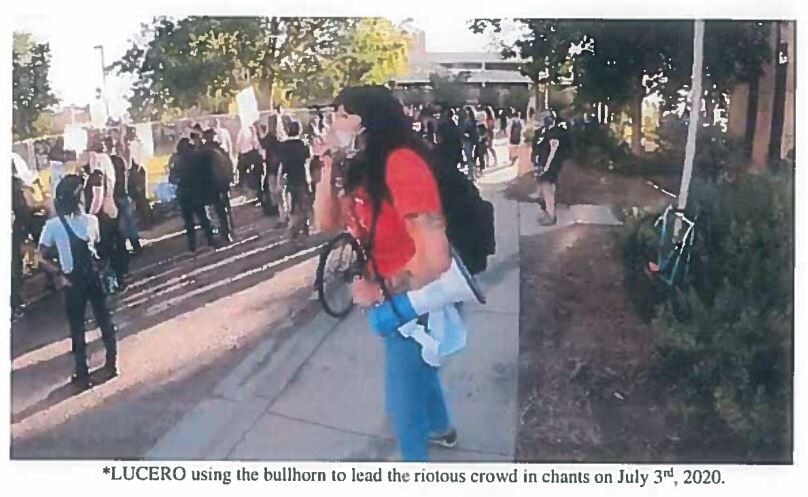
Source: Lucero v. City of Aurora, affidavit of Detective Andrew Silberman

Source: Lucero v. City of Aurora, affidavit of Detective Andrew Silberman
The demonstration outside the Aurora District 1 police station at 13347 E. Montview Blvd. took place on July 3, 2020. Protesters in Colorado sought accountability for McClain’s death following his deadly encounter with Aurora police officers and paramedics — which later culminated in criminal prosecutions by the Colorado Attorney General’s Office.
Lucero alleged that she led the crowd in calling on Aurora to fire the officers, but she discouraged people from building barricades around the police station. She further alleged that one door was always unobstructed and that then-Chief Vanessa Wilson and her commanders had instructed officers to stay inside the building.
Afterward, Silberman volunteered to lead a police effort to investigate the protest.
“Under his direction, task force officers spent hundreds if not thousands of hours scouring surveillance video, body worn camera video, and social media to try to generate criminal cases against Ms. Lucero and others,” Lucero’s attorneys wrote.
However, Lucero’s criminal case ultimately resulted in the dismissal of charges, prompting her to sue for malicious prosecution. Silberman’s application for an arrest warrant alleged 18 officers were “imprisoned inside the station,” but Lucero argued he left out key facts that would undermine any probable cause: Wilson’s directive for the officers to stay inside and the one unobstructed door.
Silberman attached his 33-page statement in support of a warrant and argued bad behavior from certain attendees could be tied to Lucero’s “admitted leadership role in the incident.”
“Neither Chief Wilson’s order nor the fact that at least one exit door may have remained unobstructed contravenes the elements of these offenses,” wrote Silberman’s attorneys.
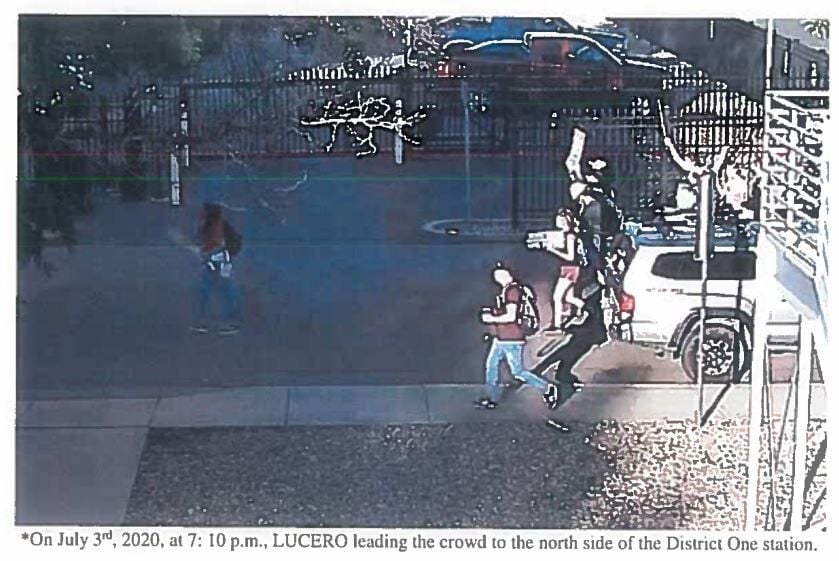
Source: Lucero v. City of Aurora, affidavit of Detective Andrew Silberman

Source: Lucero v. City of Aurora, affidavit of Detective Andrew Silberman
The city, meanwhile, contended Lucero had failed to show its policies or customs were responsible for her allegedly wrongful prosecution. Her lawyers responded that Silberman, as alleged, was acting “pursuant to Aurora’s unconstitutional policy and/or practice of targeting the protest leaders for arrest and prosecution,” with Wilson’s blessing.
In evaluating the motions to dismiss, Crews noted he could not rely on Silberman’s 33-page statement because Lucero disputed its authenticity. Based on Lucero’s allegations about the contents, Crews found the warrant was obviously deficient in its rationale for why Lucero had committed kidnapping and other crimes.
“Silberman’s affidavit recounted only that she had walked and spoken with protesters, provided them pizza, changed her clothes, stood briefly outside one of the police station doors, and led protest chants,” he wrote. “None of these allegations suggest she incited or participated in a riot, obstructed a government function, or attempted first degree kidnapping.”
Further, the exclusion of Wilson’s alleged directive to officers to remain inside suggested Silberman acted “with malice” in pursuing charges.
As for the city, Crews noted Silberman had testified in Lucero’s criminal case about the efforts Aurora undertook to investigate Lucero and other protest leaders. The city’s actions could show a policy of targeting protest leaders unconstitutionally, if proven.
Although Crews denied both motions to dismiss, he noted that to the extent Lucero was seeking to hold Silberman liable for allegedly perjuring himself in state court, she could not do so.
The case is Lucero v. City of Aurora et al.

Local party leaders, incoming judge among members of judicial performance commission that violated law
Michael Karlik
michael.karlik@coloradopolitics.com
Updated 12 hours ago
A local Democratic leader and 2024 presidential elector. A legislative aide and leader in the Young Republicans. An incoming county court judge freshly appointed by the governor. They are among the eight members of the northeastern Colorado judicial performance commission...
Judge dismisses lawsuit seeking records from Colorado Democratic group
Marianne Goodland
marianne.goodland@coloradopolitics.com
Updated 1 day ago
A lawsuit seeking to obtain records from Democratic lawmakers affiliated with a caucus has been thrown out by a Denver District Court judge. On July 17, Judge Ericka Englert dismissed the April lawsuit filed by progressive activist Derrick Blanton, who...
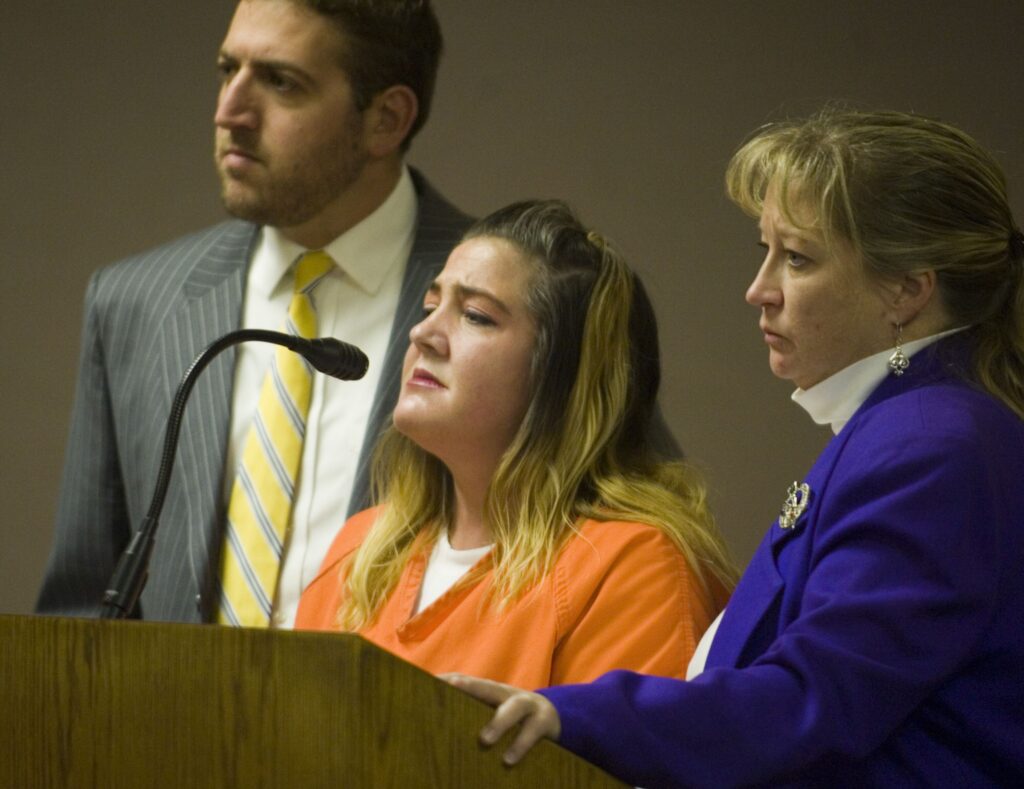
Colorado Springs mother Deborah Nicholls’ murder conviction overturned
Nick Smith
nick-smith@coloradopolitics.com
Updated 2 days ago
A Colorado Springs mother convicted in 2008 of murdering her three children in a house fire might get a new trial after a judge ruled that prosecutors withheld key evidence that could have impacted the jury’s verdict. Deborah Nicholls, whose...
Colorado court overturns illegal $7,000 restitution order
Michael Karlik
michael.karlik@coloradopolitics.com
Updated 1 day ago
Colorado’s second-highest court overturned a Weld County defendant’s obligation to pay more than $7,000 in crime victim restitution on Thursday because a trial judge failed to issue a legally compliant restitution order at the time of sentencing. In Colorado, as...

Appeals court rejects former DougCo commissioner’s legal fee claim
Nicholas Fogleman
nicholas.fogleman@denvergazette.com
Updated 2 days ago
The Colorado Court of Appeals rejected a former Douglas County commissioner’s bid for reimbursement of attorney fees she incurred while responding to multiple investigations into her conduct. The dispute stemmed from a 2019 anonymous letter sent to county officials alleging...
Appeals court orders second look at Denver Water’s immunity for cyclist’s injury
Michael Karlik
michael.karlik@coloradopolitics.com
Updated 2 days ago
Colorado’s second-highest court ordered another look at a bicyclist’s negligence lawsuit against Denver Water on Thursday, concluding that a trial judge needed to evaluate the utility’s potential immunity using the state Supreme Court’s new guidance. Joseph A. “Joey” Scott alleged...
Labels, duration not definitive proof of ‘intimate relationship,’ Colorado court rules in domestic violence case
Michael Karlik
michael.karlik@coloradopolitics.com
Updated 1 day ago
Colorado’s second-highest court clarified on Thursday that the length of a couple’s relationship and the labels they attach to it are not conclusive evidence of whether it is an “intimate relationship” that can give rise to a domestic violence prosecution....

Colorado AG urges Supreme Court to let Boulder climate lawsuit proceed
Marissa Ventrelli
marissa.ventrelli@coloradopolitics.com
Updated 2 days ago
Colorado Attorney General Phil Weiser has filed a court brief with the U.S. Supreme Court in a lawsuit brought by Boulder city officials seeking to hold oil companies liable for their environmental impact. The case began in 2018, when the...
10th Circuit says landowner cannot sue ex-Routt County judge for statements in decision
Michael Karlik
michael.karlik@coloradopolitics.com
Updated 3 days ago
A Routt County landowner cannot sue a former judge for his allegedly inaccurate statements in a case where the landowner was not a party, the Denver-based federal appeals court decided on Wednesday. Anne Fitzsimmons, who lives in Germany, owns a...
Defendant’s competency in question in El Paso County case involving slain Army police officer
Nick Smith
nick-smith@coloradopolitics.com
Updated 3 days ago
It will be another 60 days before a 4th Judicial District court determines if a man charged in the shooting death of an Army police officer is competent to proceed in his case. Judge Erin Sokol granted a request Wednesday...