

Colorado justices hear pleas to fix accommodations process for disabled bar applicants
Members of the Colorado Supreme Court heard from law students with disabilities last week that the process for pursuing accommodations on the bar exam is expensive, time-consuming and unfriendly — and a proposed rule change is only the first step to fixing the problem.
“If this court chooses not to address these inequities, it effectively endorses a status quo seen as inherently unfair,” said Omar Ochoa, president of the Disability Law Student Association at the University of Denver. “Inaction suggests that Colorado’s highest legal authority is comfortable with some bearing disproportionate burdens, paying prohibitive costs or silently enduring a two-day examination without proper supports.”
Pending before the Supreme Court is a multi-step plan for applicants with disabilities to request accommodations when seeking admission to the practice of law in Colorado, including the bar exam for attorneys and the LLP exam for licensed legal paraprofessionals.
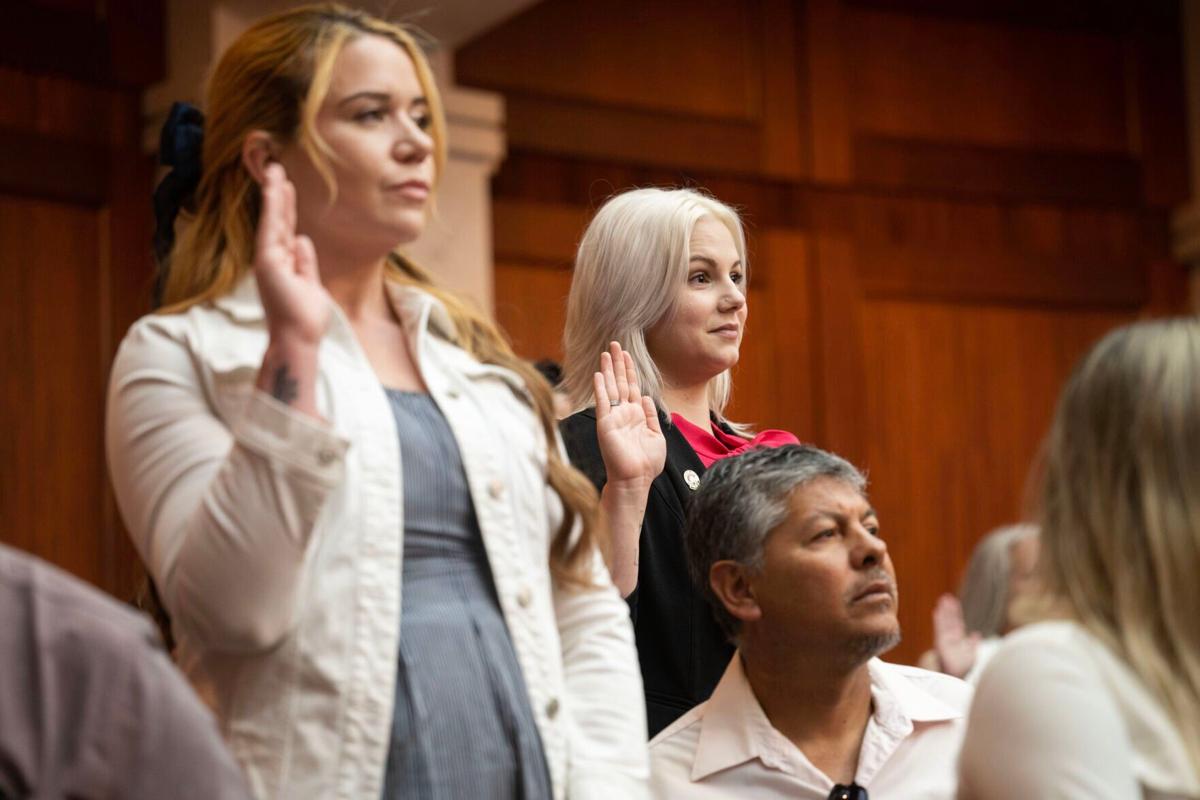
Grace Cunningham, left, and Hannah Schoeninger, right, get sworn in as the first class of licensed legal paraprofessionals, a newly authorized occupation allowed to practice law to a limited extent, in the Colorado Supreme Court's courtroom on Thursday, June 20, 2024. (Stephen Swofford, Denver Gazette)
Stephen Swofford The Gazette

Grace Cunningham, left, and Hannah Schoeninger, right, get sworn in as the first class of licensed legal paraprofessionals, a newly authorized occupation allowed to practice law to a limited extent, in the Colorado Supreme Court’s courtroom on Thursday, June 20, 2024. (Stephen Swofford, Denver Gazette)
The draft rule change lays out two ways to obtain testing accommodations: provide documentation of accommodations received on prior standardized tests, like the SAT, or obtain materials from a medical professional explaining in detail why a given accommodation is necessary to ensure an applicant has equal access compared to non-disabled test-takers.
Earlier this year, the General Assembly enacted a law to address concerns that professional licensing examinations were failing to accommodate disabled test-takers in a straightforward fashion. Although the legislation similarly requires a medical professional to weigh in on the accommodation request, the Supreme Court received multiple written comments observing its rule change imposes far higher burdens on applicants to justify the accommodation.
The rule “suggests a focus will remain on proving whether a person has a disability, not whether their disability requires a testing-related accommodation,” wrote disability rights attorney Sara Pielsticker. “This rule appears to be set up to deny individuals accommodations at (the Office of Attorney Admissions’) discretion rather than following the requirements laid out” in the law.
‘Hundreds of hours and thousands of dollars’
Spencer Kontnik, a lawyer who is deaf in one ear and has severe hearing loss in the other, told the Supreme Court at its Dec. 11 public hearing that he has had to sue Colorado’s attorney regulation office on behalf of two applicants. The cases were expensive — costing $40,000 and $80,000, respectively — with one applicant’s accommodation being rejected because it “lacked real-world application.”
“That is a very difficult standard to address and try to mitigate or figure out,” said Kontnik.

The Ralph L. Carr Colorado Judicial Center in downtown Denver houses the Colorado Supreme Court and Court of Appeals. (Michael Karlik/Colorado Politics)
Michael Karlik/Colorado Politics

The Ralph L. Carr Colorado Judicial Center in downtown Denver houses the Colorado Supreme Court and Court of Appeals. (Michael Karlik/Colorado Politics)
On the other hand, the head of Colorado’s attorney regulation office, Jessica Yates, contended there was a “misunderstanding” about the process of granting disability accommodations. She argued the commenters were “learning from other students or from recent graduates” about what the process used to be, not how it operates now.
“It really shouldn’t be a process that takes hundreds of hours and thousands of dollars,” Yates said.
This year, the Centers for Disease Control and Prevention noted more than 25% of American adults reported having a disability, including long COVID. At the same time, an estimated 1.4% of attorneys working in law firms have disabilities.
Yates said Colorado administers a uniform bar exam, with scores that can be used for admission in more than 40 states. Therefore, it is crucial for test-takers to labor under the same conditions as others.
“If many people are all of a sudden getting non-portable bar exam scores, it actually affects the entire applicant pool here in Colorado,” she said.
Suggestions for improvement
However, multiple students who testified to the Supreme Court worried they would ultimately be unable to practice law in Colorado because the accommodations they received in law school for their documented disabilities would be frowned upon by bar examiners.
“It seems that Colorado, my home state, has proven skeptical and inconsiderate to the legitimacy of my needs and the disabled community’s needs,” said fourth-year law student Marisa Olivas. “We want to be heard and believed when we share our stories. Not put under a microscope or to have to jump through hoops.”
Ange Ferrantelli, a fourth-year law student with ADHD and autism, said the rule change does not go far enough, nor does it contemplate what documentation is reasonable for those who are not diagnosed with a disability until their final years in law school.
“How are you supposed to get accommodations when you’re undiagnosed and told by everyone that it’s your fault that you’re struggling?” Ferrantelli asked. “Plenty of people think that accommodations are just a way for disabled students to gain an advantage. To that I say: You don’t understand what accommodations are. We’re not asking for a separate, easier test.”


The student speakers referenced their own existing accommodations, including extra time on tests and low-distraction environments. Further, DU’s Disability Law Student Association suggested changes to the rule to ease the burden on test-takers:
• Allowing applicants to receive the same accommodations on the licensing exam that they currently receive in school, absent a compelling reason
• Eliminating additional verification of long-term or permanent disabilities
• Requiring attorney regulators to provide detailed reasons for denying an accommodation
At the end of the hearing, the justices questioned Yates, the head of attorney regulation, on the complaints they heard about the treatment of disabled applicants.
“When someone is turned down, what information is provided to them as to why?” asked Justice Brian D. Boatright.
Yates said her office is “revisiting those letters,” as they have historically been “not particularly friendly.”
“One of the things that we have heard feedback on is that our letters, at times, sounded like, ‘We don’t believe you.’ And we do want to get away from that language and that tone,” Yates said.
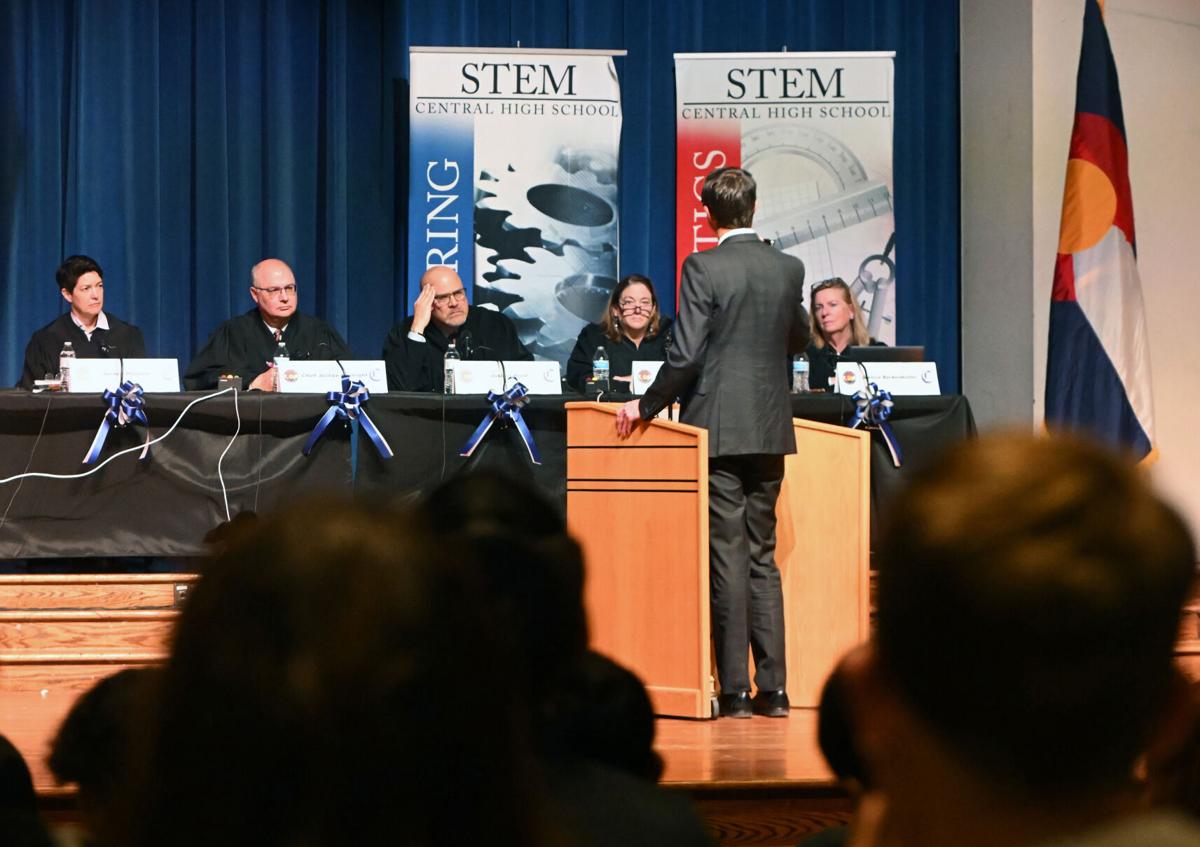
FILE PHOTO: Members of the Colorado Supreme Court listen to arguments from attorney Julian R. Ellis, Jr. during "Courts in the Community" at Pueblo's Central High School on Thursday, May 9, 2024. (Photo by Jerilee Bennett, The Gazette)
Jerilee Bennett/The Gazette

FILE PHOTO: Members of the Colorado Supreme Court listen to arguments from attorney Julian R. Ellis, Jr. during “Courts in the Community” at Pueblo’s Central High School on Thursday, May 9, 2024. (Photo by Jerilee Bennett, The Gazette)
Other members were curious about alleviating burdens for applicants to adequately document their disability. Justice William W. Hood III wondered if someone who has “significant documentation” of a permanent disability needs anything more.
“It seems like a student who obtained accommodations on the LSAT or the SAT or has sort of a known track record, that’s an easier process,” added Chief Justice Monica M. Márquez. “It’s the students who don’t have that for whatever reason — either they were diagnosed late or didn’t have resources — but started receiving accommodations during law school and are unable to obtain the same accommodations for the bar exam.”
Yates responded that the latest protocols for granting accommodations have likely addressed those concerns.
“I think the paradigm of, ‘Oh, I’m always gonna have to go out and get another $3,000 test,’ that is not part of our current guidance,” she said.


10th Circuit partially revives lawsuit over 2020 Denver protest injuries
Michael Karlik
michael.karlik@coloradopolitics.com
Updated 1 day ago
The Colorado-based federal appeals court revived a man’s claims against Denver on Friday after concluding a trial judge resolved the case in the city’s favor without analyzing two of the three instances of alleged excessive force and other constitutional violations....
Federal judges find Colorado immigration judge violated several orders
Michael Karlik
michael.karlik@coloradopolitics.com
Updated 2 hours ago
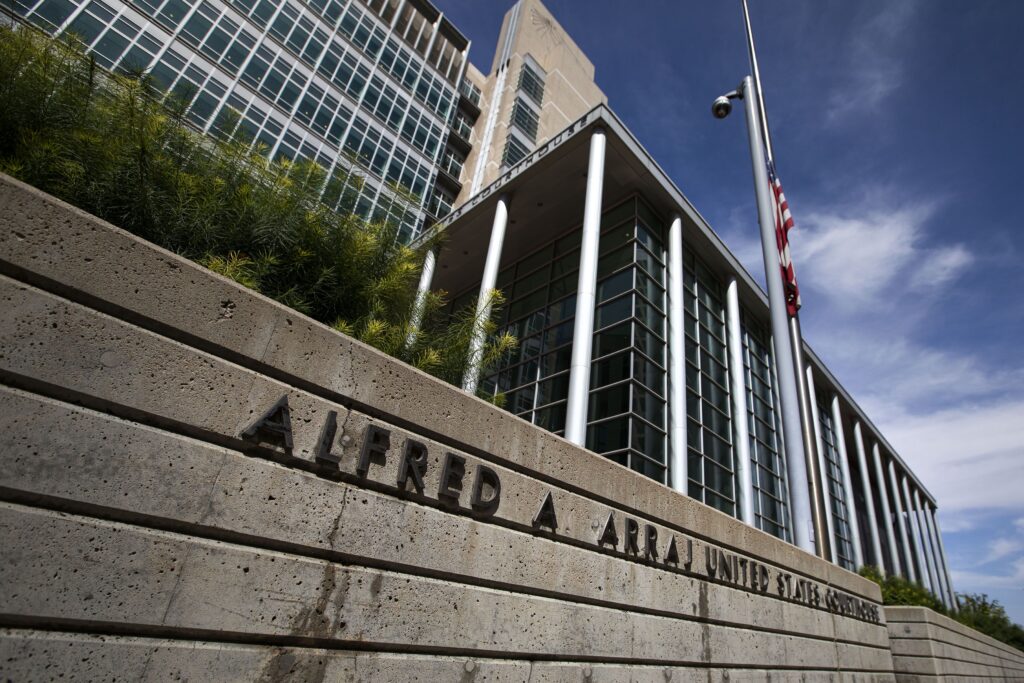
Multiple federal judges in Colorado have freed people from immigration custody after determining that one immigration judge violated their directives for properly conducting bond hearings. For nearly a year, Colorado’s U.S. District Court has faced a flood of habeas corpus petitions...
Misconduct complaints from ex-Colorado judicial discipline director dismissed against federal judges
Michael Karlik
michael.karlik@coloradopolitics.com
Updated 2 days ago
The administrative body for the Denver-based federal appeals court upheld a finding last week that misconduct complaints against Colorado’s chief federal trial judge and the chief appeals judge warranted dismissal and appeared to be a “litigation tactic” by the complaining...

First-ever Red Rocks naturalization ceremony draws most diverse group of new citizens
Michael Karlik
michael.karlik@coloradopolitics.com
Updated 1 day ago
Colorado’s federal trial court held its first-ever naturalization ceremony for nearly 300 new citizens on Thursday at Red Rocks Park and Amphitheatre. “We’re doing it to commemorate the 250th anniversary of the Declaration of Independence and the United States. Red...
Jeffco taxpayers could be on the hook for a possible child sex assault settlement
Matt Kyle
matt.kyle@denvergazette.com
Updated 1 day ago
Taxpayers may end up on the hook for a child sexual assault settlement, possibly worth up to $15 million, after Jeffco Public Schools failed to notify its insurance company in a timely manner about the case. The incident stems from...
10th Circuit finds no fair housing violation by Littleton landlord for worker’s alleged rape of tenant
Michael Karlik
michael.karlik@coloradopolitics.com
Updated 2 hours ago
The Denver-based federal appeals court concluded on Monday that Littleton’s housing authority could not be held liable for a maintenance worker’s alleged rape of a tenant, as the worker’s employment did not provide any special access to the victim. A...

Jeffco Public Schools sues Trump administration to protect funding after alleged transgender policies violation
Matt Kyle
matt.kyle@denvergazette.com
Updated 2 days ago
In the wake of several threats by the Trump administration to revoke federal funding, Jeffco Public Schools filed a lawsuit against the Department of Education seeking to protect that badly needed money. Jeffco has been under investigation by the DOE’s...
Denver detox center did not violate man’s rights with 10-hour hold, 10th Circuit says
Michael Karlik
michael.karlik@coloradopolitics.com
Updated 4 days ago
The Colorado-based federal appeals court concluded on Tuesday that Denver’s detoxification facility did not violate a man’s rights by holding him against his will for 10 hours until his blood alcohol content was projected to reach zero. Unusually, Brian Garrett’s...
Federal judge clarifies ex-GOP treasurer candidate’s burden to prove defamation claims
Michael Karlik
michael.karlik@coloradopolitics.com
Updated 4 days ago
A federal judge clarified last week that businessman and former Republican statewide candidate Brian Watson will need to surmount a higher hurdle in proving his claim that a party guest’s alleged description of him as a “criminal” amounted to defamation....
Colorado board permits state to appeal injunction against arthritis drug price cap
Marissa Ventrelli
marissa.ventrelli@coloradopolitics.com
Updated 4 days ago
A Colorado board voted Friday to allow the Attorney General’s Office to fight an injunction against a price cap on a drug that treats arthritis. A U.S. district court judge had granted the company Amgen a preliminary injunction, temporarily blocking...