

Colorado Supreme Court wary of requiring child welfare workers to give Miranda warnings prior to interrogations
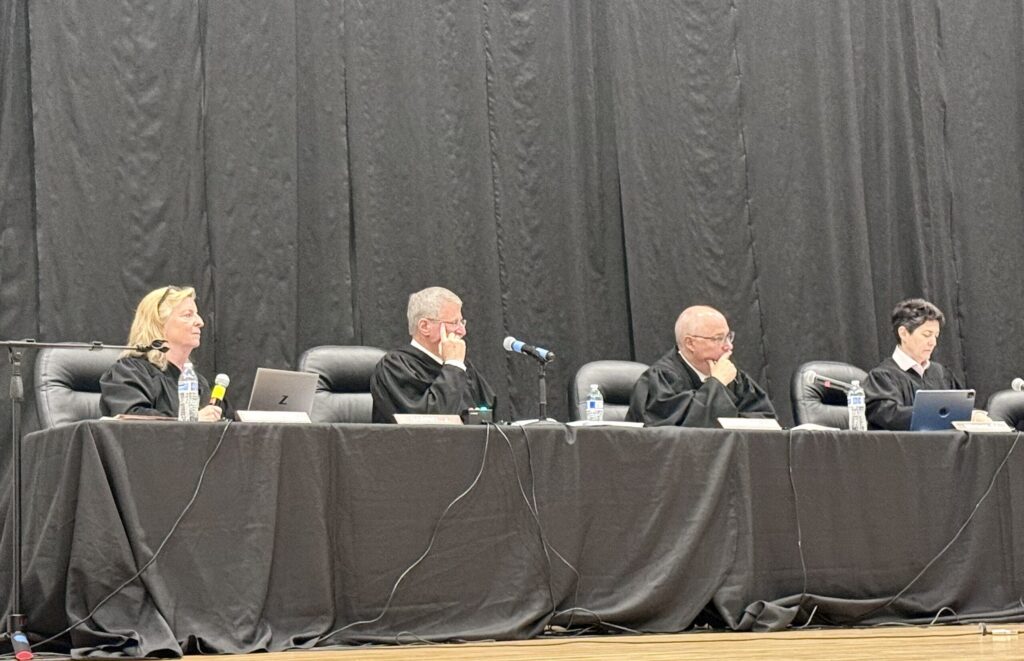
Members of the Colorado Supreme Court seemed hesitant on Wednesday to endorse the idea that child welfare workers must provide a Miranda warning before interrogating a parent in custody, even if the conversation will later be used in a criminal prosecution.
The state’s Court of Appeals previously upheld the murder convictions of two men, both of whom spoke to a caseworker while under arrest. In each instance, they were not informed of their constitutional rights to remain silent and to consult with an attorney first. Both defendants had their statements used at trial.
Although such advisements, named after the landmark U.S. Supreme Court case Miranda v. Arizona, are required when law enforcement interrogates a person in custody, a Miranda warning is also necessary when a third party acts as an agent of law enforcement.
If a child welfare worker questions a parent in custody about matters that could be incriminating, “we’re always gonna have the coercive environment the court was concerned about in Miranda. There’s always going to be a likelihood or a possibility that the information is going to lead to or end up in a prosecution,” said public defender Chelsea E. Mowrer during oral arguments.
But some justices worried a Miranda warning would be required in virtually all scenarios and would interfere with the main objective of the caseworker: figuring out who will care for the child with one parent in custody.
“This strikes me as a pretty good argument that a caseworker is just doing their job,” said Justice Richard L. Gabriel. “The police didn’t tell them what to ask. The police didn’t send them to the interview. They’re just figuring out where to put the child.”
Two interviews, no Miranda warning
The Supreme Court considered two appeals, each of which featured a similar sequence of events. In the first case, a Boulder County jury convicted Adam Douglas Densmore of killing and dismembering Ashley Mead, dumping her remains as he traveled from Colorado to Louisiana and back.
At the time police arrested him in Oklahoma, Densmore was with his and Mead’s toddler. Jessica Punches, a welfare worker, took custody of the child and learned the mother’s whereabouts were unknown.
Although police gave Densmore his Miranda warning and he invoked his right to counsel, Punches began questioning him in the jail about “where the mother was,” among other topics. The meeting was recorded and a federal agent was present. Punches had a follow-up call as part of her work to create a plan for the child, and continued to ask about Mead.
During the conversations, Densmore admitted to hitting Mead. Punches later shared the interviews with law enforcement in Colorado after getting clearance from her supervisor.
In the second case out of Teller County, a jury convicted Patrick Frazee of murdering Kelsey Berreth, who was also his child’s mother. Key testimony came from Frazee’s mistress, who Frazee enlisted to clean the crime scene and help dispose of Berreth’s body.
As with Densmore, child welfare worker Mary Longmire interrogated Frazee days after he was jailed about the “timeline of events” surrounding Berreth’s killing. She talked with the Woodland Park police chief beforehand about the case and sent a 16-page summary to the prosecution afterward.
When police interrogate a suspect in custody without providing a Miranda warning, the normal protocol is to bar the prosecution from using any of the defendant’s statements at trial. However, both defendants’ trial judges declined to bar the evidence. Two panels of the Court of Appeals subsequently upheld each man’s convictions.
For Densmore, Judge Stephanie Dunn acknowledged law enforcement is not permitted to circumvent a Miranda warning by enlisting third parties to interrogate suspects.
“To be sure, Punches was a government employee,” she wrote. However, “there’s no evidence that law enforcement directed, controlled, or participated in Punches’ child welfare investigation. More specifically, Punches never consulted — or coordinated — with law enforcement about questions to ask Densmore.”

Colorado Court of Appeals Judge Stephanie Dunn listens during the case of People v. Dooley at Fort Lupton High School on Tuesday, April 2, 2024 in Fort Lupton, Colorado. The Colorado Court of Appeals and Supreme Court hold "Courts in the Community" events for students to learn about the justice system and hear real cases. (Rebecca Slezak For The Denver Gazette)
Rebecca Slezak

Colorado Court of Appeals Judge Stephanie Dunn listens during the case of People v. Dooley at Fort Lupton High School on Tuesday, April 2, 2024 in Fort Lupton, Colorado. The Colorado Court of Appeals and Supreme Court hold “Courts in the Community” events for students to learn about the justice system and hear real cases. (Rebecca Slezak For The Denver Gazette)
Frazee’s panel similarly concluded his caseworker was not acting as an agent of police, but added that a person already in physical custody must be placed under “additional restrictions” to trigger a Miranda warning. For Frazee, who was not handcuffed and who was told he could decline to answer Longmire’s questions, such a restriction did not exist.
An appropriate balance?
Multiple outside groups weighed in to the Supreme Court.
The Colorado Department of Human Services argued caseworkers are focused on the welfare of the child, with no goal of gathering evidence for prosecutors.
“Ultimately, the proposed rule would endanger children who are victims of child abuse or neglect by placing their right to be protected from abuse below that of their abuser when caseworkers are acting to assess the safety of the child,” wrote Assistant Attorney General Nicole Cheney.
The ACLU of Colorado and Office of Respondent Parents’ Counsel countered that some states already require Miranda warnings by caseworkers. Moreover, there are other ways to elicit necessary information from parents in custody, including by excluding such statements from trial.
Otherwise, police could “avoid Miranda‘s requirements by having (caseworkers) conduct interrogations and then turn over the information to law enforcement,” the organizations wrote.
“We seem to sort of frame this as a binary. Either the caseworker gets to ask the full panoply of questions, including questions that involve substance abuse and domestic violence and things that could clearly be incriminating, or nothing at all,” observed Justice William W. Hood III. “Why is it so harmful to children to say, ‘If you’re going to ask about things that are incriminating, then you need to Mirandize?'”
Justice Maria E. Berkenkotter added that the prosecution’s preferred method of looking holistically at whether a child welfare worker is acting at the behest of police has its flaws.
“What might fall through the cracks is sort of the wink-wink, nod-nod, ‘We’re a small jurisdiction, we’ve worked together over the years. … We don’t have to actually, explicitly ask you to ask particular questions because it’s obvious,'” she said.
Chief Justice Monica M. Márquez latched onto a suggestion from Frazee’s attorney that police can use incriminating statements given to caseworkers to pursue leads, but the statements themselves cannot be evidence.
“Why isn’t that an appropriate balance?” she asked.
“There are some situations where the statements are the strongest evidence,” replied Assistant Solicitor General Brittany Limes Zehner.
The cases are Densmore v. People and Frazee v. People.

10th Circuit tosses GEO Group’s pretrial appeal in human trafficking lawsuit
Michael Karlik
michael.karlik@coloradopolitics.com
Updated 42 minutes ago
The Denver-based federal appeals court dismissed an attempt by The GEO Group on Wednesday to appeal a trial judge’s non-existent decision two months before the company is scheduled to face a civil trial over alleged trafficking violations at the Aurora...
Denver sues Trump to block armed ICE agents from polling sites
Deborah Grigsby
deborah.smith@denvergazette.com
Updated 4 hours ago
The city of Denver, along with several groups, sued the Trump administration Thursday, seeking to block U.S. Immigration and Customs Enforcement officers who are armed from polling sites during the upcoming midterm elections. In fact, there are no official orders...
Federal judge takes no action against ICE in Colorado after hearing about mistakes, not ‘blatant violations’
Michael Karlik
michael.karlik@coloradopolitics.com
Updated 2 hours ago
A federal judge declined to take action against U.S. Immigration and Customs Enforcement on Thursday after hearing that a pattern of alleged lawbreaking amounted to mistakes and a misunderstanding of the government’s position in court. For nearly a year, Colorado’s...
Colorado doctors, dentists challenge state law on gender‑transition services in new federal lawsuit
Marissa Ventrelli
marissa.ventrelli@coloradopolitics.com
Updated 6 hours ago
A group of Christian doctors and dentists has filed a federal lawsuit challenging a Colorado law they say requires them to provide gender‑transition services that conflict with their religious and ethical beliefs. The lawsuit, filed by the Christian Medical and...
Federal judge directs plaintiff to revise complaint alleging Denver officers’ constitutional violations
Michael Karlik
michael.karlik@coloradopolitics.com
Updated 1 day ago
A federal judge directed a plaintiff to revise his allegations on Wednesday to more precisely state what two Denver officers and the city itself allegedly did to violate his constitutional rights by facilitating his prosecution for murder until prosecutors dropped...
Lawsuit challenges Douglas County commissioners’ ballot actions
Nicholas Fogleman
nicholas.fogleman@denvergazette.com
Updated 10 hours ago
A new lawsuit against Douglas County commissioners seeks to invalidate the board’s intervention in efforts to expand the commission from three members to five and restore the original ballot language approved by more than 20,000 petition signers. The suit marks...
Federal judge explores new sanctions against ex-Colorado judicial discipline director
Michael Karlik
michael.karlik@coloradopolitics.com
Updated 4 hours ago
A federal judge on Wednesday directed Colorado’s former judicial discipline director, for the third time this year, to explain why she should not sanction him for his latest conduct in his litigation against the state’s judiciary. Christopher S.P. Gregory, who served...
Colorado joins lawsuit challenging changes to Endangered Species Act
Marissa Ventrelli
marissa.ventrelli@coloradopolitics.com
Updated 1 day ago
Colorado once more joined a coalition of states challenging the Trump administration — this time on proposed rules regarding the Endangered Species Act. The pair of lawsuits challenge new rules made under Interior Secretary Doug Burgum, who earlier said the...
10th Circuit orders second look at immunity for Kiowa County deputy over fatal vehicle crash
Michael Karlik
michael.karlik@coloradopolitics.com
Updated 1 day ago
The Denver-based federal appeals court directed a trial judge on Tuesday to further analyze whether a Kiowa County deputy and the sheriff’s office may be sued for a fatal vehicle collision. The Colorado Governmental Immunity Act generally shields government entities and public...
Colorado justices to hear appeal in Kendrick Castillo death lawsuit, ‘fugitive’ rule
Michael Karlik
michael.karlik@coloradopolitics.com
Updated 7 hours ago
The Colorado Supreme Court announced on Tuesday that it will decide whether it was proper to dismiss a lawsuit over the 2019 shooting death of Kendrick Castillo after the defendants paid the maximum amount of damages available to Castillo’s parents,...