

Appeals court rejects notion that coroners’ conclusions preempt other evidence of murder
Colorado’s second-highest court ruled last week that an “undetermined” cause of death from a county coroner does not preclude prosecutors from presenting their own evidence that the death was actually a homicide.
In the case before the Court of Appeals, Denver jurors convicted Robert W. Feldman in 2022 of murdering his wife, Stacy Feldman. He is serving a life sentence in prison.
According to the evidence, Robert Feldman found Stacy Feldman unconscious in the bathtub with the shower running, and he unsuccessfully attempted to resuscitate her before first responders arrived. Two forensic pathologists with the Denver medical examiner’s office, in consultation with the chief medical examiner, ultimately certified the cause and manner of death as “undetermined.”
After discovering Robert Feldman may have had a motive to kill his wife because she just learned he was having an affair, law enforcement consulted with an expert. Although he was not a forensic pathologist, the doctor had autopsy experience and strangulation expertise. He testified that he believed Stacy Feldman died “from a combination of strangulation and suffocation.”
On appeal, Feldman argued the state’s constitution and laws give coroners the “exclusive discretion” to determine a person’s cause and manner of death. Denver’s medical examiner, therefore, could not “delegate” that power to the district attorney’s office for its own expert to make such a determination.
“Is it your argument,” asked Judge Lino S. Lipinsky de Orlov during arguments to a three-judge appellate panel, “that once the coroner makes that determination, no expert on behalf of a prosecutor could contradict that at a later date, based on that expert’s further review of the evidence?”
That is correct, responded defense attorney Jeffrey S. Pagliuca, but “I will go further than that.”
“You can’t bring a prosecution for murder where there is no cause of death determination by the coroner,” he said. “Under Colorado law, that has to be decided by the office of the coroner.”
“Is it correct, then, that the implication of what you’re saying is that when a coroner determines a cause of death is undetermined, nobody can ever be prosecuted?” pressed Judge Daniel M. Taubman.
Not unless law enforcement can provide new facts or evidence that would persuade the coroner to change his or her mind, Pagliuca replied.
The Court of Appeals panel rejected the invititation to recognize a broad authority for coroners to block criminal charges. It noted Feldman’s theory — that one executive branch agency cannot delegate a function to another agency — has not been endorsed by Colorado’s courts. Moreover, the Denver medical examiner’s office did not delegate to anyone its responsibility to determine the cause and manner of death.
“The coroner and forensic pathologist performed their duties to conduct a forensic autopsy, determine the cause and manner of death, and issue a death certificate,” wrote Taubman, a retired judge who sat on the panel at the chief justice’s assignment, in the Nov. 7 opinion.
“The performance of those duties in no way precluded the prosecution from presenting other evidence regarding the cause and manner of the victim’s death in a subsequent criminal proceeding, even if it conflicted with the coroner’s determination,” he continued.
The case is People v. Feldman.

Colorado appeals judge’s delays in releasing opinions noted by performance commission
Michael Karlik
michael.karlik@coloradopolitics.com
Updated 1 hour ago
The citizen-led performance commission that provides guidance to voters about whether to retain members of Colorado’s second-highest court raised concerns by judges and attorneys that Judge Elizabeth L. Harris sometimes struggles with releasing opinions promptly. Harris, who joined the Court...
Colorado judge explores sanctions against DOJ, ICE for rearresting man 4 days after release on bond
Michael Karlik
michael.karlik@coloradopolitics.com
Updated 14 hours ago
A federal judge in Colorado is considering sanctions against the government after immigration agents rearrested a man four days after an immigration judge found him suitable for release on bond. On July 28, U.S. Magistrate Judge N. Reid Neureiter ordered...
Divided disciplinary panel censures Montezuma County judge after agreement reached
Michael Karlik
michael.karlik@coloradopolitics.com
Updated 21 hours ago
A disciplinary panel formally imposed a public censure, suspension, and further training on Montezuma County Court Judge Ian J. MacLaren on Tuesday by a 2-1 vote. Under constitutional Amendment H, which voters adopted in November 2024, MacLaren was set to...
Colorado’s Western Slope magistrate judges describe unique role in federal judiciary
Michael Karlik
michael.karlik@coloradopolitics.com
Updated 1 day ago
Two of Colorado’s federal judges stationed on the Western Slope spoke to lawyers on Wednesday about their unique roles, the ways their workloads differ, and the need for more criminal defense lawyers to take cases outside the Front Range. “Here...

Denver sues Philip Morris, other tobacco companies over cigarette butt litter
Deborah Grigsby
deborah.smith@denvergazette.com
Updated 11 hours ago
Denver is demanding that some of the biggest tobacco companies in the world pay for the cleanup of discarded cigarette butts on its streets, following a similar campaign that cities in other states have pursued. Denver’s lawsuit, filed this week...
Federal judge rules that request for bond hearing not necessary to challenge immigration detention
Michael Karlik
michael.karlik@coloradopolitics.com
Updated 1 day ago
A federal judge in Colorado ruled last week that it is not mandatory for a person to seek a bond hearing with an immigration judge before they challenge the lawfulness of their detention in federal court. For the past year,...

Boulder Valley School District introduces new policies following antisemitism lawsuit
Marissa Ventrelli
marissa.ventrelli@coloradopolitics.com
Updated 15 hours ago
The chief of Boulder Valley School unveiled new policies for the 2026-2027 school year following a lawsuit filed on behalf of a student alleging antisemitic harassment. In June, the Anti-Defamation League filed a federal civil rights complaint against the school...

Colorado NRA chapter seeks injunction against new gun‑training requirement
Marissa Ventrelli
marissa.ventrelli@coloradopolitics.com
Updated 19 hours ago
The Colorado chapter of the National Rifle Association is seeking an injunction to stop the state from enforcing a new law that took effect earlier this month. The new law requires anyone buying or selling certain firearms to first complete...
Denver moves to dismiss Trump challenge to ‘assault-style’ weapons ban
Deborah Grigsby
deborah.smith@denvergazette.com
Updated 13 hours ago
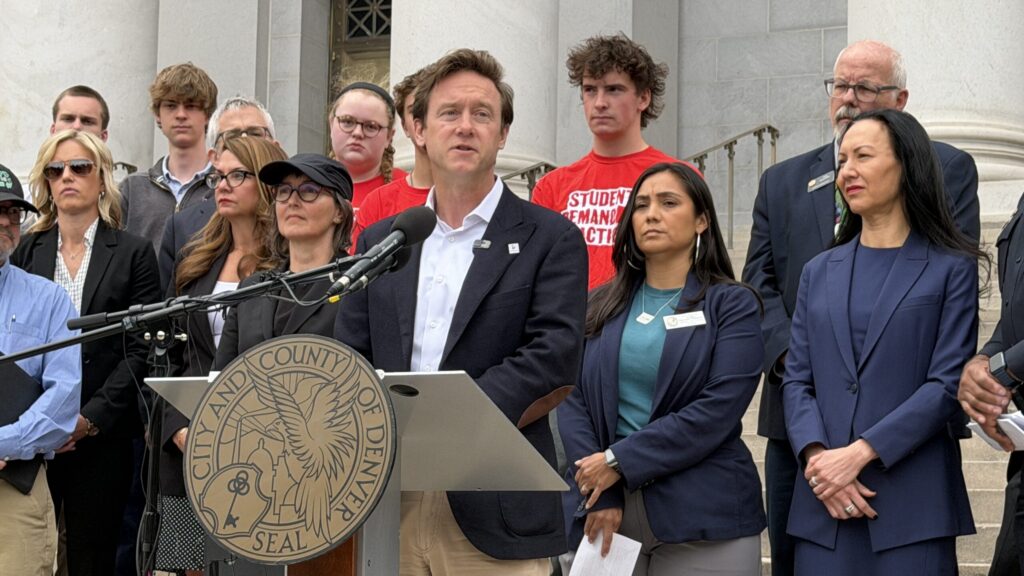
Denver has filed a motion to dismiss a lawsuit brought by the Trump administration challenging the city’s ban on “assault-style” weapons and magazines exceeding a 15-round capacity. The U.S. Department of Justice filed a suit in federal court in May,...
Federal judge dismisses ex-Colorado judicial discipline director’s conspiracy lawsuit
Michael Karlik
michael.karlik@coloradopolitics.com
Updated 3 days ago
A federal judge dismissed a lawsuit from Colorado’s former judicial discipline director on Tuesday, finding that he failed to adequately state claims for conspiracy or constitutional violations. Christopher S.P. Gregory, who served as the executive director of the Colorado Commission on Judicial...