

Colorado Supreme Court concerned about police overreach in interrogations
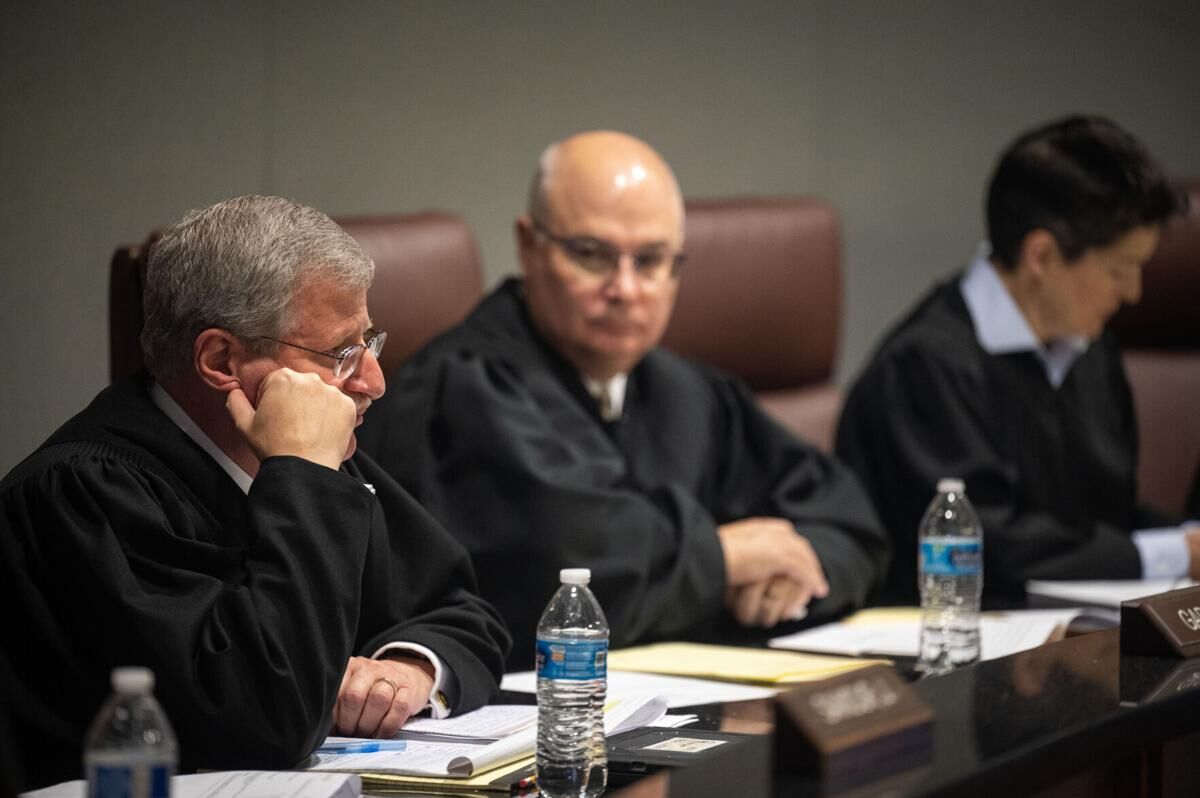
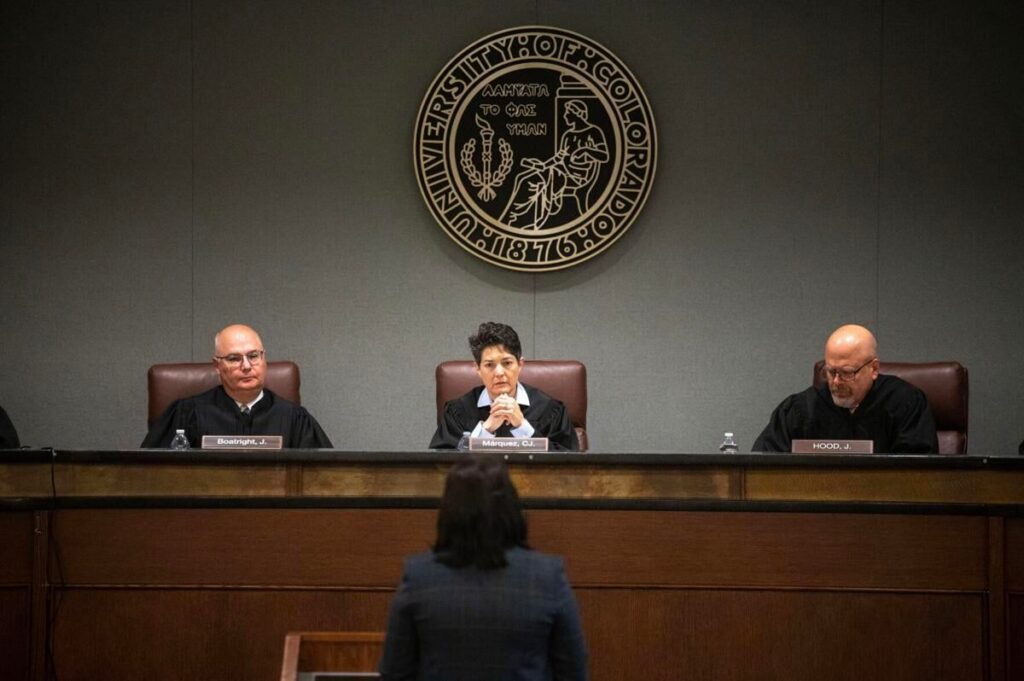
Some members of the Colorado Supreme Court appeared hesitant on Tuesday to endorse the ability of police to interrogate a suspect after they have obtained a court order authorizing only the collection of physical evidence.
Under Colorado’s criminal rules, law enforcement may obtain an order for “nontestimonial identification,” allowing them to pursue a person’s fingerprints, blood specimen, handwriting sample, picture, or other evidence that does not stem from an interrogation.
Notably, police only need to demonstrate “reasonable grounds,” not probable cause, that their target committed an offense.
During oral arguments, the justices grappled with the actions of two Boulder detectives who came to a suspect’s house to collect his DNA pursuant to a “41.1 order,” as it is known. But rather than take him to the police station right away, they interrogated him for almost 45 minutes before turning to the 41.1 order.
The state’s Court of Appeals initially found the detectives had improperly detained and questioned the defendant, rejecting the prosecution’s argument that he was not in custody until it was time for the DNA swab.
“If he had voluntarily showed up at the police station, under your view of this,” Chief Justice Monica M. Márquez told the government, “they could put him in an interrogation room, conduct a full-blown back-and-forth before actually conducting the buccal swab. Because it’s not until they conduct the buccal swab that the 41.1 order’s being executed. I guess I’m a little troubled by that.”
Justice William W. Hood III added that he was concerned about police interrogating a suspect in an arrest-like atmosphere, based upon a court order that does not authorize such tactics.
“I’m just saying in the grand scheme of things, I could see the potential for creating some perverse incentives,” he said.
Upon securing a 41.1 order to collect the DNA of Angel Adrian Castro-Velasquez, who was suspected of an attempted sexual assault, Detectives Kevin Marples and Kara Wills arrived at Castro-Velasquez’s house one morning. Marples originally told Castro-Velasquez about the 41.1 order over the phone the day before, but Marples realized it would not work for Castro-Velasquez to come to the police station after-hours as they had planned.
Instead of moving to collect the evidence authorized by the order, the detectives interrogated Castro-Velasquez at length. He eventually confessed, after which they executed the order. Marples later testified he lacked probable cause to arrest Castro-Velasquez for the attempted attack at the time he and Wills showed up at the house.
On appeal, Castro-Velasquez argued the detectives manipulated the order to detain and interrogate him without probable cause. Such conduct allegedly violated the Fourth Amendment’s prohibition on unreasonable seizures.
A three-judge Court of Appeals panel concluded Castro-Velasquez was seized during the encounter, meaning he would not have felt able to leave or disregard the detectives’ questioning. Although police were not prohibited from investigating Castro-Velasquez further, wrote then-Judge Anthony J. Navarro, they could not interrogate him under the narrow authorization of the 41.1 order.
“Overall, the record reveals that the detectives intentionally elicited Castro’s statements about the alleged offenses while he was detained on less than probable cause,” Navarro wrote. “We cannot condone it.”
To the Supreme Court, the government argued the appellate panel was wrong to ask whether Castro-Velasquez was “free to leave” during the encounter at his home. Instead, the government maintained that Castro-Velasquez was not in custody until the interrogation concluded, and the detectives took him for a DNA swab.
Justice Richard L. Gabriel countered that if police had shown up to a suspect’s home, asked to talk, and he invited them in, that would be a permissible consensual encounter or, at most, a brief investigatory stop.
“But the 41.1 order seems to make some sort of difference here,” he said. “He’s not free to leave. At that point, we have an order. And I think the world is different than just the consensual stop or an investigatory stop.”

Further, Gabriel continued, once a suspect is being interrogated in custody, they have the protection of their Miranda rights. Therefore, the guardrails for executing 41.1 orders would be redundant.
“Forget the rule 41.1 for a moment,” said Justice Carlos A. Samour Jr. “Say they had just shown up at his house one morning, knocked on his door, and said, ‘Hey, we are investigating a case. Can we talk to you?’ And he invites them in and they have the same conversation they had here. You would agree that it’s either consensual or, at most, an investigatory stop, right?”
Defense attorney Todd Narum agreed. He added that police “execute” a 41.1 order once the suspect is aware of it and there is a police presence in connection with it. Both of those conditions were met at the time of Castro-Velasquez’s interrogation.
“So, as soon as there’s a 41.1 signed, and as soon as the defendant is made aware of that,” said Justice Susan Blanco, “there is no circumstance where law enforcement can have a consensual interaction with the defendant?”
“Correct, because they’ve already done something that they’re not allowed to do in the typical situation,” said Narum.
The case is People v. Castro-Velasquez.

Federal judge green-lights civil trial against ex-Fort Collins DUI officer
Michael Karlik
michael.karlik@coloradopolitics.com
Updated 2 days ago
A federal judge ruled on Thursday that Fort Collins’ former “DUI officer” will face a civil trial for allegedly investigating a motorist for impaired driving without any reasonable suspicion to do so. In recent years, several people arrested by Officer...

Colorado Supreme Court suspends Mesa County judge pending misconduct investigation
Michael Karlik
michael.karlik@coloradopolitics.com
Updated 19 hours ago
The Colorado Supreme Court suspended Mesa County Court Judge Michael J. Grattan on Thursday amid a misconduct investigation. The court’s Sept. 10 order gave Grattan 21 days to explain why his paid suspension should not continue through the end of...
Colorado Supreme Court changes course, dismisses case about special district bonds
Michael Karlik
michael.karlik@coloradopolitics.com
Updated 19 hours ago
The Colorado Supreme Court declined on Friday to decide a dispute between a large-scale Commerce City development and the various districts financing it, after initially showing interest in the ongoing case. Colorado has roughly 2,800 special districts, which are local...

10th Circuit tosses GEO Group’s pretrial appeal in human trafficking lawsuit
Michael Karlik
michael.karlik@coloradopolitics.com
Updated 2 days ago
The Denver-based federal appeals court dismissed an attempt by The GEO Group on Wednesday to appeal a trial judge’s non-existent decision two months before the company is scheduled to face a civil trial over alleged trafficking violations at the Aurora...
Denver sues Trump to block armed ICE agents from polling sites
Deborah Grigsby
deborah.smith@denvergazette.com
Updated 3 days ago
The city of Denver, along with several groups, sued the Trump administration Thursday, seeking to block U.S. Immigration and Customs Enforcement officers who are armed from polling sites during the upcoming midterm elections. In fact, there are no official orders...
Federal judge takes no action against ICE in Colorado after hearing about mistakes, not ‘blatant violations’
Michael Karlik
michael.karlik@coloradopolitics.com
Updated 17 hours ago
A federal judge declined to take action against U.S. Immigration and Customs Enforcement on Thursday after hearing that a pattern of alleged lawbreaking amounted to mistakes and a misunderstanding of the government’s position in court. For nearly a year, Colorado’s...
Colorado doctors, dentists challenge state law on gender‑transition services in new federal lawsuit
Marissa Ventrelli
marissa.ventrelli@coloradopolitics.com
Updated 14 hours ago
A group of Christian doctors and dentists has filed a federal lawsuit challenging a Colorado law they say requires them to provide gender‑transition services that conflict with their religious and ethical beliefs. The lawsuit, filed by the Christian Medical and...
Federal judge directs plaintiff to revise complaint alleging Denver officers’ constitutional violations
Michael Karlik
michael.karlik@coloradopolitics.com
Updated 17 hours ago
A federal judge directed a plaintiff to revise his allegations on Wednesday to more precisely state what two Denver officers and the city itself allegedly did to violate his constitutional rights by facilitating his prosecution for murder until prosecutors dropped...

Lawsuit challenges Douglas County commissioners’ ballot actions
Nicholas Fogleman
nicholas.fogleman@denvergazette.com
Updated 3 days ago
A new lawsuit against Douglas County commissioners seeks to invalidate the board’s intervention in efforts to expand the commission from three members to five and restore the original ballot language approved by more than 20,000 petition signers. The suit marks...
Federal judge explores new sanctions against ex-Colorado judicial discipline director
Michael Karlik
michael.karlik@coloradopolitics.com
Updated 19 hours ago
A federal judge on Wednesday directed Colorado’s former judicial discipline director, for the third time this year, to explain why she should not sanction him for his latest conduct in his litigation against the state’s judiciary. Christopher S.P. Gregory, who served...
PREV
PREVIOUS
Colorado House committee advances Democratic bill to reduce penalties for ‘extreme indifference’ murder
Lawmakers on the Colorado House Judiciary Committee narrowly passed a bill proposing changes to the state’s sentencing guidelines for murders facilitated with “extreme indifference to the value of human life.” Colorado is one of several states with this type of charge, which applies when someone causes another person’s death by doing something they know is […]
RTD lays off two dozen managers in operations ‘realignment’
More than two dozen managers at the Regional Transportation District learned in March that their jobs would be eliminated, with their last day of work set for July 2. That’s according to documents provided to The Denver Gazette by an RTD employee who asked to remain anonymous because they are not authorized to speak to […]