

Colorado House committee advances Democratic bill to reduce penalties for ‘extreme indifference’ murder

Lawmakers on the Colorado House Judiciary Committee narrowly passed a bill proposing changes to the state’s sentencing guidelines for murders facilitated with “extreme indifference to the value of human life.”
Colorado is one of several states with this type of charge, which applies when someone causes another person’s death by doing something they know is very dangerous and could seriously hurt or kill someone.
But Colorado is the only state that classifies extreme‑indifference homicide as first‑degree murder, which carries a mandatory life‑without‑parole sentence.
Democratic Reps. Cecelia Espenoza, of Denver, and Michael Carter, of Aurora, say they are trying to align state statute with the rest of the country through House Bill 1281, which would create a new charge of second-degree murder with extreme indifference.
“The current law is too blunt in some places and incomplete in others,” Carter told the Judiciary Committee on Tuesday. “This bill will give Colorado a clear and more credible structure for some of the most serious cases in our state.”
District attorneys and law enforcement agencies argued that reducing sentences for certain classifications of murder will do nothing to make Colorado safer.
“This bill would lower the penalty for murderers who have taken extreme actions in a cold-blooded nature to cause mass harm to other people,” said Jessica Dotter of the Colorado District Attorneys Council. “It doesn’t take a lot of legal analysis to know that that is not a good move for public safety or the citizens of our state.”
Passing this bill would send a message to Coloradans that crime victims and their families don’t matter, she added.
The proposed legislation would eliminate the mandatory life‑without‑parole requirement and, by reclassifying the offense as second‑degree murder, establish a sentencing range of 24 to 48 years in prison.
Suspects could still be charged with first‑degree murder under an extreme‑indifference theory in certain cases, such as when the incident results in the deaths of two or more people, a child under 12, or a law enforcement officer, EMS provider, or firefighter who is on duty.
According to Espenoza, there have been 50 cases of homicide with extreme indifference in Denver County in the last three years. Of those, 30 were resolved: 20 were plea-bargained to a determinate sentence, and 10 went to trial. In four of those cases, the defendants were between 17 and 20 years old.
One of the most notable cases of extreme indifference murder in recent years is the 2023 death of 20-year-old Alexa Bartell.
Bartell was driving in Jefferson County when a nine-pound rock was thrown at her windshield, killing her. Three young adults were charged with her murder, including 18-year-old Joseph Koening, who was convicted of 19 counts, including murder with extreme indifference.
Koenig had just turned 18 a few weeks before the incident, according to Espenoza.
“The question becomes for me, do we want to use the extreme indifference murder tool as it has been used against people who have just left childhood into adulthood?” she asked. “Is he not redeemable? Should he have no hope for all of his time in prison because he made that horrible mistake?”
Padraic Emerine of the Colorado Association of Chiefs of Police said the bill would give “a significant break” to some of the most violent offenders in the state.
Murders committed with extreme indifference should be considered among the worst kinds of murders, Emerine said. Regardless of whether or not there was premeditation, he argued, murders committed with premeditation and with extreme indifference both end the same way — in the loss of a life — and should be treated with equal severity.
“This bill is more than just soft on crime; it is extreme,” Emerine said. “It gives unwarranted and undeserved benefits to mass shooters, school shooters, and those offenders who want to cause as much harm as possible without a care or a worry for who they hurt or how many.”
A vote for HB 1281 “is a vote to support mass shooters,” Emerine said.
Dan Meyer of the Spero Justice Center said Colorado is the only state that requires a mandatory life‑without‑parole sentence for every extreme‑indifference murder conviction.
“Meyer said the current law in Colorado is unusually broad and confusing, covering many different types of behavior but punishing all of it with the harshest possible sentence,” Meyer said.
He added that there is no evidence this approach improves public safety, noting research showing that people are more influenced by the likelihood of being caught than by the length of a potential sentence — especially since most people don’t know their state’s sentencing laws.
Meyer also said the current statute imposes one blanket penalty and prevents judges from tailoring sentences based on the specific facts of each case.
“Our constitutional system is designed to balance power to punish between the jury, the judge, and the prosecutor, but Colorado’s approach concentrates power in the hands of prosecutors only, taking away checks and balances,” he said. “Forty-eight other states give judges the ability to consider the facts of a particular case when choosing an appropriate sentence.”
Criminal defense attorney Jennifer Jones, who has represented children and young adults charged with serious crimes, said she’s seen young adults charged with extreme indifference homicide for merely being with the perpetrator at the time of a shooting.
Extreme indifference, by definition, involves creating risk, and it is well known that young people have a reduced ability to assess risk, she said.
“Young people are especially vulnerable to reckless, risky behavior that results in these extreme indifference charges that carry extreme sentences,” Jones said. “Creating a risk of death is different than intentionally and deliberately killing someone; that should be reflected in sentencing.”
Jones called the bill “a moderate step that addresses how these charges are used to leverage really high plea agreements when the conduct and the outcome don’t warrant having no hope for ever being released from prison as a teenager.”
The proposed legislation passed the Judiciary Committee on a 6-5 vote, with all Republicans and Democratic Rep. Chad Clifford of Greenwood Village voting against it.


Colorado joins lawsuit challenging changes to Endangered Species Act
Marissa Ventrelli
marissa.ventrelli@coloradopolitics.com
Updated 5 hours ago
Colorado once more joined a coalition of states challenging the Trump administration — this time on proposed rules regarding the Endangered Species Act. The pair of lawsuits challenge new rules made under Interior Secretary Doug Burgum, who earlier said the...

Boebert challenger Eileen Laubacher says she’ll ‘break through the noise’ in Democrat’s 1st TV ad
Ernest Luning
ernest.luning@coloradopolitics.com
Updated 2 hours ago
Democratic congressional candidate Eileen Laubacher says she’ll take a different approach than her opponent in a campaign ad released Wednesday that opens with a cacophonous series of videos featuring Republican U.S. Rep. Lauren Boebert. “Eileen’s had enough of the noise...

Lori Gimelshteyn on 3 ballot measures to ‘let kids be kids’ | The OpEdge Podcast
Tony Olivero
tony.olivero@gazette.com
Updated 9 hours ago
Lori Gimelshteyn — board member of Protect Kids Colorado and executive director of the Colorado Parent Advocacy Network — joins The OpEdge to discuss three measures headed to Colorado voters this November. Gimelshteyn tells host and investigative columnist Jimmy Sengenberger...

A path toward justice and public safety | PODIUM
Anthony Hartsook
ahartsockop@gmail.com
Updated 23 hours ago
Strangulation can be one of the most dangerous forms of assault; despite the lack of visible ailments it is accompanied by. Though strangulation leaves no broken bones, bruises or visible wounds, it is one of the strongest predictors of future...

From moving people to managing them | GUEST COLUMN
Michael Hancock
michael-hancock@coloradopolitics.com
Updated 24 hours ago
Transportation policy used to have a fairly uncomplicated purpose: move people safely, efficiently and reliably. Build roads where people drive. Maintain bridges before they fail. Add capacity where growth overwhelms the system. Provide transit where it makes sense. Infrastructure was...
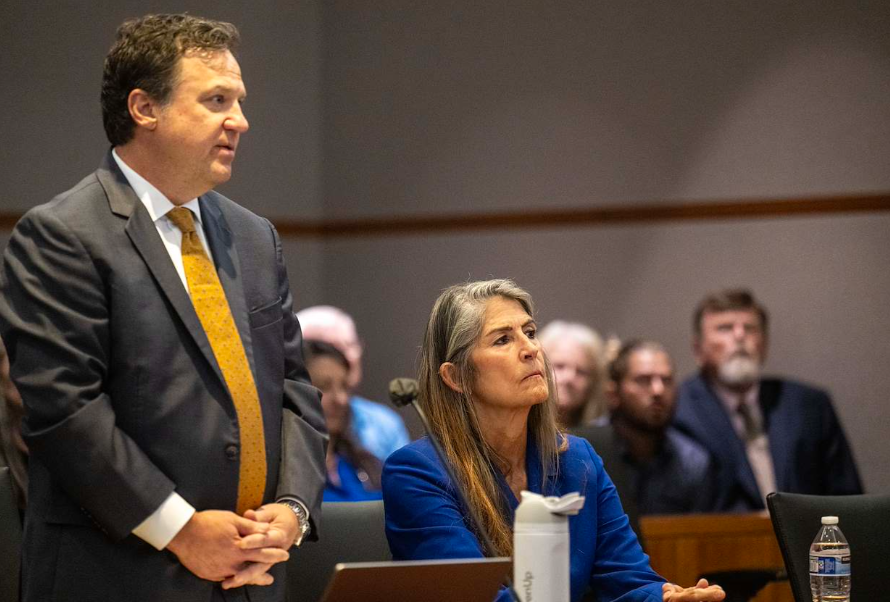
Disgraced ex-CBI analyst Missy Woods sentenced to prison in DNA scandal
Jenny Deam
jenny.deam@gazette.com
Updated 1 day ago
A Jefferson County district court judge on Tuesday sentenced a disgraced former Colorado Bureau of Investigation DNA analyst to a decade in prison for altering and deleting data in scores of criminal cases over several years. Jefferson County District Judge...

Jason Crow endorses Democrats up and down Colorado’s ballot, chips in $100K for campaign efforts
Ernest Luning
ernest.luning@coloradopolitics.com
Updated 1 day ago
Democratic U.S. Rep. Jason Crow on Tuesday formally endorsed more than 60 Democrats running up and down Colorado’s ballot and said he’s putting $100,000 into statewide and county campaigns and organizing programs to drive turnout in the fall election. Crow,...

Trumpicans thumb their nose at the Constitution | Hal Bidlack
Hal Bidlack
hal-bidlack@coloradopolitics.com
Updated 2 days ago
As is all too often the case, there are again too many interesting things appearing in Colorado Politics for me to comment on all of them. So let me tell you what I won’t be talking about before I get...

CoComandering? | Miller Hudson
Miller Hudson
miller-hudson@coloradopolitics.com
Updated 4 days ago
At 8 a.m., Friday morning, Aug. 28, 70 or 80 mostly bleary-eyed visitors to the Transportation Technology Center outside Pueblo packed a conference room to attend the Front Range Passenger Rail District’s (FRPRD) Board meeting. With the exception of those...

Even Dem court couldn’t abide theft of GOP seats | Dick Wadhams
Dick Wadhams
dick-wadhams@coloradopolitics.com
Updated 3 days ago
Thanks to the Colorado Supreme Court, Colorado voters will be able to reaffirm their support for the Independent Congressional Redistricting Commission after the court struck down the Democratic scheme to steal three Republican congressional seats. Billionaire-funded national Democratic groups from...
PREV
PREVIOUS

Boebert working on bill to strip Swalwell of $22,000 annual taxpayer-funded pension
EXCLUSIVE — Rep. Lauren Boebert (R-CO) is working on legislation to strip disgraced former Rep. Eric Swalwell of his $22,000 annual taxpayer-funded congressional pension. Swalwell resigned from the House on Tuesday after allegations of sexual assault by multiple women, including a former congressional staffer. Despite his exit under an ethical cloud, the California Democrat is […]

Colorado Supreme Court concerned about police overreach in interrogations
Some members of the Colorado Supreme Court appeared hesitant on Tuesday to endorse the ability of police to interrogate a suspect after they have obtained a court order authorizing only the collection of physical evidence. Under Colorado’s criminal rules, law enforcement may obtain an order for “nontestimonial identification,” allowing them to pursue a person’s fingerprints, blood specimen, […]