

Q&A with Eric Hogue | CCU president on protests, education and putting the phone the down
In the latest episode of Colorado Conversations, Eric Hogue, president of Colorado Christian University, talked about why there have been no pro-Palestinian protests on the CCU campus, how the institution encourages robust debate within the confines of the classroom and the risks of what he called the “decay” and “deconstruction” of the family poses to American society.
Hogue, who took office as CCU president last year, previously served as the chief development officer of William Jessup University.
This interview, which took place at the height of the pro-Palestinian protests in Colorado, has been edited for brevity.
In the latest episode of Colorado Conversations, Eric Hogue, president of Colorado Christian University, talks about why there are no pro-Palestinian protests on the CCU campus, how the institution encourages robust debate – but within the confines of the classroom – and the risks that the “decay” and “deconstruction” of the family poses to American society.
Denver Gazette Staff
Colorado Politics: I’ll start by asking you about the protests that have erupted across many universities in the United States, and which we’ve seen some in Colorado. As far as I can tell, and do correct me if I’m wrong, none has erupted at CCU.
Eric Hogue: There are conversations at Colorado Christian University about what’s going on with Israel since Oct. 7, even historically previous to that in reference to Hamas, but we don’t have any protests at CCU. One event we did have shortly after Oct. 7 was to invite the Jewish community to campus and to raise a million dollars in support of the victims that were targeted on that date and thereafter because of the terroristic acts of Hamas in that part of the world.
CP: Why do you think that is?
Hogue: I think No. 1, there is a Judeo-Christian understanding at Christ-centered higher education universities across the country. … There’s also an understanding of what Western civilization is and what it has done for civilization around the world. And there’s also a steep understanding of what it means — holistically and I think an intentionality — to be an antisemite in reference to Jewish brothers and sisters.
CP: And that messaging comes from the highest levels of leadership, and, of course, you’re disseminating that message to a mostly Christian student population?
Hogue: Yes, most definitely. I mean, you have faculty that would take that position. You’d have administration and our board of trustees. You would have the pedagogical structure of our curriculum, both public policy, the Centennial Institute, where we stand in our strategic priorities — all of those aspects would simply say that there is a strict and complete understanding of the alliance we have with Israel as Americans and as Christian believers.
CP: How would you handle if there are protests on campus or in the university? And it may not be an encampment, just protests.
Hogue: Well, No. 1, it’s private property. There are laws against encampments on private property. You can’t obstruct somebody else’s right to go to class nor to graduate. So, we would take measures immediately to look at the behavior, the actions, the inappropriate actions — I might even label it sophomoric actions — of these encampments and these protests and refuse them. … And then if there was a desire for free expression of ideas, differing opinions or ideologies, we have a great hall to do that in with a lecture. We can do that openly in our classrooms, like adults handle issues and not children.
CP: I think it’s correct to presume there is an orthodoxy (at CCU) and if a student has a different persuasion, if you will, that would be welcome in the classroom, that would be welcome in an instructional setting, (that) wouldn’t be welcome as a protest, correct?
Hogue: Correct. I mean there’s numerous things that I want to run to on university campus protests going all the way back to the Vietnam era. I mean there’s a lot of future political leaders that come from these tempest-in-a-teapot episodes that lead us in progressive ideology. I’ll just leave that comment there. It is a breeding ground of a progressive regressing in our country versus embracing honest, open debate and critical thinking and dialogue of differing opinions. To your point, yes, our faculty would allow discussion, encourage discussion. I mean we have open discussion every day on soteriology in the school of theology. How is one saved? How does one come to a saving faith in Jesus Christ? Where does the origin start? Are you Armenian or are you a Calvinist? And there’s differing views and we welcome differing views. We have open discussion on the origin of creation. Was it a strict six day or seven day? Was it gap theory? You can hold differing views. We have geopolitical discussions, we have bio-ethic discussions in our science and school of nursing, but it’s handled like everybody’s an adult in the room versus everybody acting like they just came out of the basement after 35 years of age and they’re a sophomore and they want to get out of class and they want to disrupt something and they want to check a box and call that successful. It’s not successful.
CP: I talked to Scott Wasserman, who is a political observer … He’s suspicious of what he called the Christian Right. And he feels the Christian Right wants to create what’s called a theological majority or theological majorities, and he’s worried about that.
Hogue: I firmly do not believe there’s an effort on behalf of the Christian Right to create a theocracy. I think there may be a misunderstanding of how we represent our faith in the public arena. Let me detail that. The Founding Fathers had a religious intent of understanding faith, family, freedom and liberty. The Puritans had a benchmark, a plumb line, as to how to build the construct of government in this country. And even Thomas Jefferson, some may say a deist, his musing with his (Danbury Baptist Association) letter of separation of church and state, although not a part of the constitution, would tell you what the conversations were in the room. And the conversations in the room is — we start with origin — would be we’re going to create a country that offers the pursuit of happiness, life, liberty, and (offers) that pursuit for everybody, and then defend it — that they have a right of religious expression and religious practice and religious speech that can be a part of the arena. But it cannot be a theocracy of the arena.
CP: When a student graduates from CCU, what kind of a worldview does that student have?
Hogue: That student has an eternal worldview that we were created by a sovereign God; there was a disconnect in that creation and that sovereign God sent his son, our savior Jesus Christ, as an evangelical; and, that there was a price paid for our reattachment of relationship with a sovereign God so that we can live a life from a perspective of a Christ-like, Christian worldview, which plays into a conservative ideological worldview, which plays into an eternal worldview. So our graduates are concerned and attached to truth. They also understand grace in the midst of life. They are winsome in delivering that message and they are committed — should be — to excellence in everything they do, so that they can be a light in a dark place, in a dark world, to help those who need help in the moment, in the future, and in a season of time.
CP: You mentioned history and the importance of looking at history. I often think of navigating the world in terms of looking at the rearview mirror because you don’t really see what’s in front of you, but you can kind of see and perceive what’s happened behind you. And universities have a long history of protest. We’ve seen that happened during the Vietnam War. You mentioned that in the run up to the Iraq war, the universities were immensely involved in the protest. It’s very difficult to judge whether a protest is correct or not right at the moment because we don’t have the hindsight of history. But when is it, in your mind, a right time — the right time — to protest at a university setting?
Hogue: I think you protest in the midst of order. Protests of chaos never produce an outcome because they don’t know what outcome they want to produce. Martin Luther King Jr. talked about peaceful protests versus violent protests. I wish we could go back to peaceful protests. It’d be nice. But there’s no order in the protest. I mean, if you go to Columbia today or another (Ivy League school) tomorrow, or you go to pick a state school, there’s an encampment. There’s dancing, there’s delivery of pizza. I mean, what are you protesting (when you say) ‘from the river to the sea’? Give me some geography. What does that mean? Are you lumping in Hamas and the Palestinian people or are you talking about just Hamas or are you disregarding the statehood of Israel? What is your message?
CP: The feeling by many is that we’ve lost the art of dialogue and we can’t communicate with our foes. And there’s a sentiment that we view those who don’t hold the same views as we are — we’re venturing into theological space here — but I’ll use the word “evil.” … How do we solve that? How do we bridge that? What are your solutions?
Hogue: We need to model it. We have lost it. I agree. We need to stop doing this so much social media posts, inflaming people and offering two sentences of a retort and the threads are a thousand long. We need to get face-to-face and sit down and have a discussion. I think now I’m going to get into probably a theological position, and this is my opinion, but I think the deconstructing of the family unit and the decay of the family — I mean my dad and I used to sit at the dinner table. The TV was off. Nobody answered the phone. We ate dinner, all of us as a family, and we discussed issues and we disagreed. I remember some disagreements. He was 35 or 40, and I’m the young pup coming up and I have all these young, ambitious ideas, and my dad would sit there even after the table was cleared until 8:30 at night and we learned how to disagree with respect and love for each other. And that was modeled for me. And I carried that into my workplace, into society and into my family.
CP: So, your advise is put down your phone, have a real dinner, talk about all kinds of things, and yeah, argue, disagree. But, ultimately, to the extent that you can, and you probably should, you ought to listen to your parents because they’ve gone through what you’re going through and they’re paying for the mortgage and your education, and back in the day, that’s how you pass wisdom to your children. That’s what you’re saying.
Hogue: A hundred percent. Find a mentor. I manage people here at Colorado Christian University because I had a senior VP executive out of New York when I was 32, and there was a change of leadership and I was put in position to manage about 35 people. I’ll keep it thin. Joe flew in from New York and for three months he mentored me on how to be a young leader — this is what you should do, this is what you cannot do. You need to learn this and figure it out. Let’s stay in communication. I disagreed on a couple of things and he told me, “You can disagree all you want. I’ll let you make that decision and you’re going to suffer the consequences of it. And I’ll be there when you suffer the consequences so you don’t do it again.”


What courageous citizenship really looks like | Vince Bzdek
Vince Bzdek
vince.bzdek@gazette.com
Updated 11 hours ago
By Vince Bzdek What exactly is courage? Ernest Hemingway famously called it grace under pressure. Mark Twain wrote that “courage is resistance to fear, mastery of fear — not absence of fear.” C.S. Lewis refined that even more: “Courage is...
The coming election and mischief in the making | SONDERMANN
Eric Sondermann
eric-sondermann@coloradopolitics.com
Updated 3 days ago
America’s tribalism is such these days that we struggle to even agree on the basic rules. Elections have always been hotly contested. As the saying goes, “Politics ain’t beanbag.” The process has long involved elements of nastiness and underhanded conduct....
Colorado Politics Calendar Aug. 31-Sept. 6
Rachael Wright, Special to Colorado Politics
rachael.wright@coloradopolitics.com
Updated 4 days ago
CoPo’s weekly political calendar will help you find political and public-policy events throughout Colorado. It includes candidate and issue campaign events, public policy meetings, court hearings, state and local party conventions, assemblies, debates, rallies, parades, speaking engagements, traveling dignitary appearances,...
Tancredo in Running for Dept. of Ed. Position | A LOOK BACK
Rachael Wright, Special to Colorado Politics
rachael.wright@coloradopolitics.com
Updated 4 days ago
Forty-five years ago this week: “I know that my name has been placed before the Secretary of Education, and I know that I’m one of three or four being considered for the Department of Education’s Region 8,” said state Rep....
Colorado measure adding ID checks to mail-in voting qualifies for ballot
Marissa Ventrelli
marissa.ventrelli@coloradopolitics.com
Updated 1 day ago
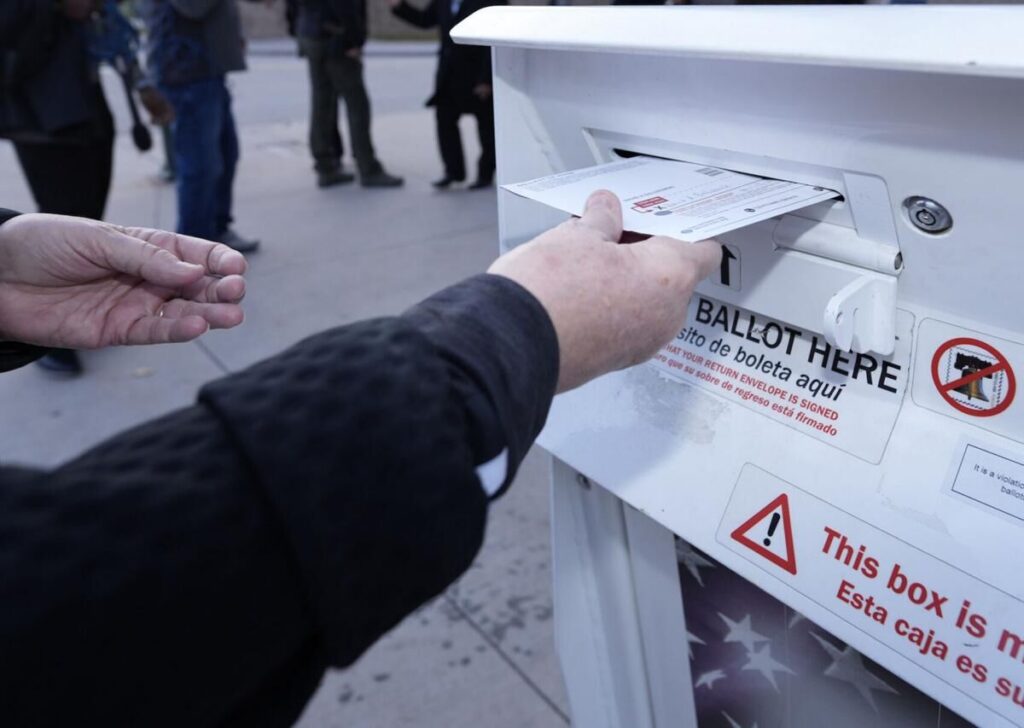
A ballot initiative that would require voters to include additional information on mail-in ballots has qualified for the November election, according to the Secretary of State’s Office. Backed by El Paso County Treasurer Chuck Broerman and former Deputy Secretary of...
Colorado election website error exposes personal data of confidential voters
Marissa Ventrelli
marissa.ventrelli@coloradopolitics.com
Updated 1 day ago
A system update accidentally lifted protections on confidential records in Colorado, exposing dozens of voters’ personal information, according to the Secretary of State’s Office. The limit that normally blocks access to confidential voter profiles was inadvertently disabled during an update...

PUC adds weekly comment after killing private talks
Scott Weiser
scott.weiser@gazette.com
Updated 1 day ago
The Colorado Public Utilities Commission will take public comment at the start of every commissioner’s weekly meeting beginning Sept. 9 as part of its new transparency mandate, the commission announced, expanding a slot previously limited to the second Wednesday of...

10th Circuit overturns framework for sentencing probation violators by 11-1
Michael Karlik
michael.karlik@coloradopolitics.com
Updated 10 hours ago
In a rare decision by all 12 of its full-time judges, the Denver-based federal appeals court ruled in a lopsided vote on Friday that one of its members created a sentencing process for probation violators that was out of step...
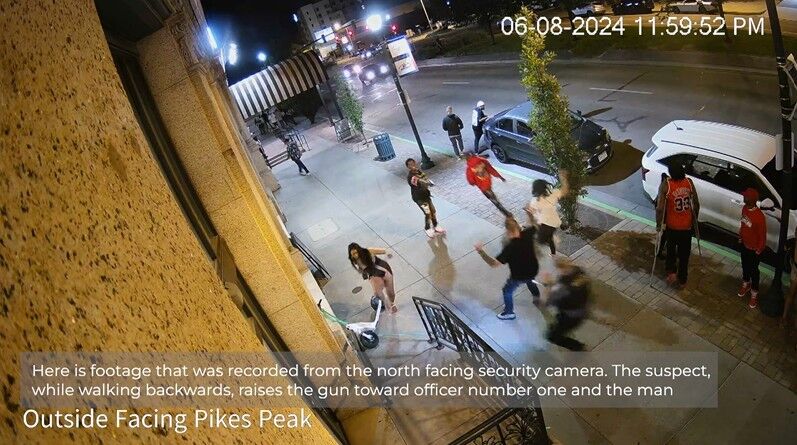
Federal judge dismisses excessive force lawsuit against Colorado Springs, officer
Michael Karlik
michael.karlik@coloradopolitics.com
Updated 15 hours ago
A federal judge concluded last week that a Colorado Springs police officer could not be held liable for shooting a suspect three times after the man menaced two victims with a gun and fled the scene. Al’morion Germany was involved...

DeFlock started from one man’s curiosity — now Flock cameras are a midterm issue
Claire Carter
claire.carter@washingtonexaminer.com
Updated 1 day ago
Will Freeman wasn’t looking to start a national movement when he launched DeFlock after noticing Flock Safety’s automatic license plate readers along the side of the road. The software engineer was driving across the country in 2024 when the cameras...